
Why Your AI Implementation Failed: 5 Critical Workforce Mistakes Sabotaging Success
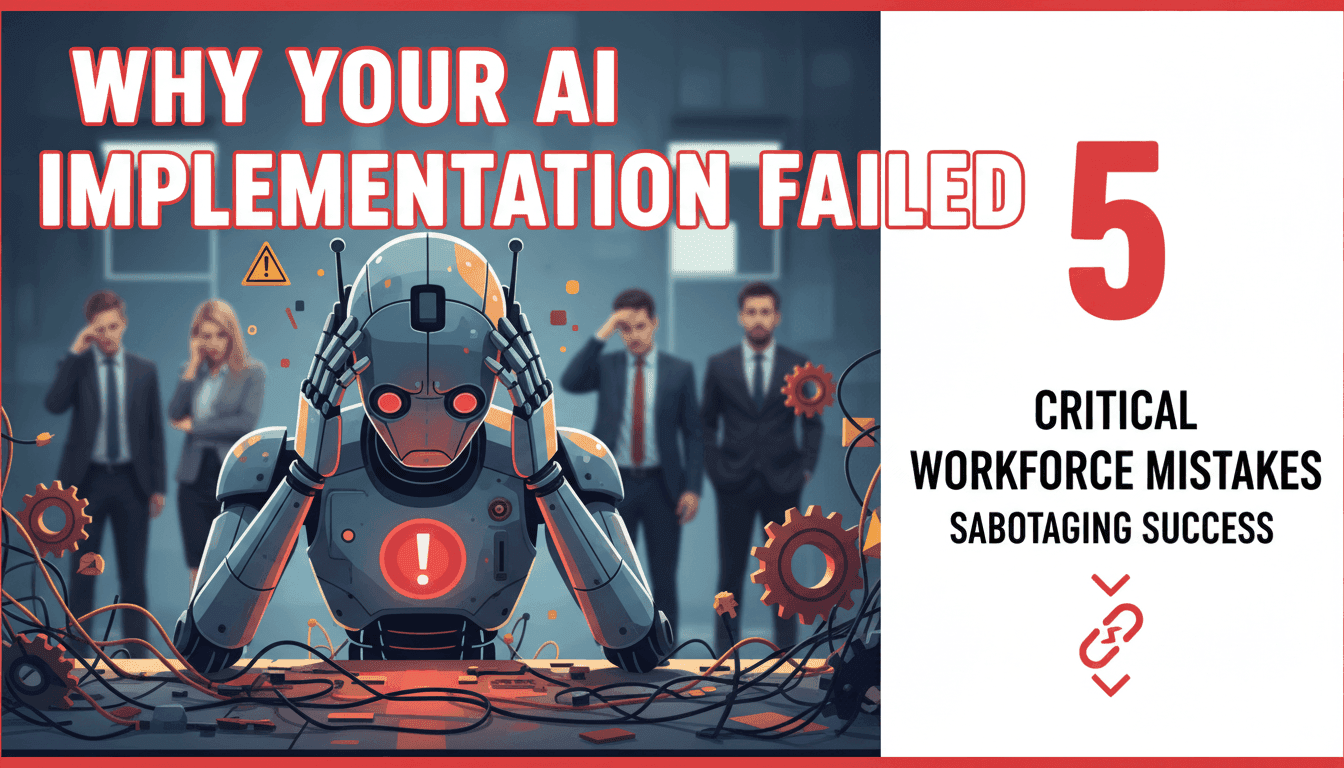
Table Of Contents
- The Hidden Cost of Workforce Misalignment in AI Projects
- Mistake #1: Launching AI Without Adequate Skills Assessment
- Mistake #2: Ignoring the Change Management Imperative
- Mistake #3: Creating AI Silos Instead of Cross-Functional Teams
- Mistake #4: Underinvesting in Continuous Learning and Upskilling
- Mistake #5: Misaligning AI Roles with Business Outcomes
- Building a Workforce Strategy That Delivers AI Success
The statistics are sobering. According to recent industry research, between 70% and 87% of AI projects never make it to production, and among those that do, many fail to deliver their promised business value. While executives often attribute these failures to technology limitations or data quality issues, the real culprit frequently lies much closer to home: workforce mistakes that undermine even the most promising AI initiatives.
Across boardrooms in Singapore and throughout Asia, business leaders are grappling with a uncomfortable truth. The artificial intelligence solutions they've invested millions in aren't failing because of inadequate algorithms or insufficient computing power. They're failing because organizations haven't prepared their people for the profound changes AI demands. From skills gaps and resistance to change, to siloed teams and misaligned incentives, workforce-related challenges represent the most significant barrier between AI experimentation and tangible business gains.
This article examines five critical workforce mistakes that consistently derail AI implementations. More importantly, it provides practical frameworks for avoiding these pitfalls and building teams capable of turning AI investments into measurable business outcomes. Whether you're launching your first AI pilot or scaling existing initiatives, understanding these workforce dynamics is essential for success.
Why 70-87% of AI Projects Fail
It's not the technology—it's your workforce strategy
5 Critical Workforce Mistakes
Launching AI without mapping capabilities to requirements
Treating AI as tech deployment, not organizational transformation
Isolating technical teams from business stakeholders
Treating skills development as an event, not a journey
Measuring technical activity instead of business outcomes
⚠️The Budget Imbalance
This imbalance virtually guarantees implementation struggles. People-related factors account for the majority of AI challenges.
Building AI Success: Key Actions
Conduct Comprehensive Skills Assessment
Map AI ambitions to specific skill requirements across technical, analytical, and business domains before launching initiatives
Prioritize Change Management
Advance organizational readiness in parallel with technical readiness—communicate early, involve stakeholders, position AI as augmentation
Build Cross-Functional Teams
Ensure data scientists and business stakeholders collaborate daily with shared success metrics focused on business outcomes
Invest in Continuous Learning
Dedicate 10-15% of work time to skill development with role-specific, progressive pathways connected to real business challenges
Align Roles with Business Value
Organize AI teams around business outcomes, not technical activities—measure impact, not model counts
Realistic Timeline for AI Workforce Transformation
Leadership commitment will be tested repeatedly—companies that maintain focus position themselves for sustainable AI success
Transform Your AI Workforce Strategy
Building AI-ready teams requires structured approaches, expert guidance, and proven frameworks. Don't let workforce mistakes sabotage your AI investments.
Turn AI talk into tangible business gains
The Hidden Cost of Workforce Misalignment in AI Projects
Before diving into specific mistakes, it's crucial to understand why workforce issues have such an outsized impact on AI success. Unlike traditional software implementations that automate existing processes, AI fundamentally changes how work gets done. It augments human decision-making, reshapes job responsibilities, and requires new forms of collaboration between technical and business teams.
When organizations treat AI as purely a technology project, they systematically underestimate the human dimension. A data scientist might build a brilliant predictive model, but if business users don't understand its outputs, don't trust its recommendations, or lack the authority to act on its insights, the model delivers zero value. The technical success becomes a business failure, not because of algorithmic limitations, but because of workforce readiness gaps.
Research from various consulting firms consistently shows that people-related factors account for the majority of AI implementation challenges. Skills shortages, organizational resistance, and cultural misalignment repeatedly surface as primary obstacles. Yet many organizations continue to allocate 80% of their AI budgets to technology and data infrastructure, leaving workforce development as an afterthought. This imbalance virtually guarantees implementation struggles.
Mistake #1: Launching AI Without Adequate Skills Assessment
The first and perhaps most fundamental mistake organizations make is launching AI initiatives without thoroughly assessing their current workforce capabilities. Executives see competitors deploying machine learning models or announcing AI strategies, and they rush to initiate their own projects without understanding whether their teams possess the necessary skills.
This skills gap manifests at multiple levels. At the technical level, organizations often lack data engineers who can build robust data pipelines, machine learning engineers who understand model deployment, or MLOps specialists who can maintain AI systems in production. But the skills shortage extends beyond technical roles. Business analysts need to translate domain problems into AI opportunities. Product managers must understand AI capabilities and limitations to set realistic expectations. Even senior leaders require sufficient AI literacy to make informed investment decisions and provide appropriate governance.
The consequences of inadequate skills assessment are predictable. Teams struggle with basic implementation tasks, timelines slip repeatedly, and projects get stuck in proof-of-concept purgatory. External consultants might be hired to fill immediate gaps, but without a systematic approach to building internal capabilities, organizations create expensive dependencies that undermine long-term AI success.
Creating an effective skills framework involves several steps:
- Map your AI ambitions to specific skill requirements across technical, analytical, and business domains
- Conduct honest assessments of current capabilities, identifying both individual and organizational gaps
- Prioritize skills based on strategic importance and gap severity
- Develop targeted acquisition and development plans that balance hiring, upskilling, and strategic partnerships
- Establish metrics to track capability building over time
Organizations that invest time in comprehensive skills assessment before launching major AI initiatives consistently achieve better outcomes. They make realistic project selections based on current capabilities, build appropriate support structures for teams, and create development pathways that gradually expand what's possible. Through hands-on workshops and structured learning programs, companies can systematically address skills gaps while maintaining project momentum.
Mistake #2: Ignoring the Change Management Imperative
The second critical mistake involves treating AI implementation as a technical deployment rather than an organizational change initiative. Many project plans focus exclusively on technical milestones like data collection, model training, and system integration, while completely overlooking the human side of adoption.
AI implementations inherently disrupt established workflows, challenge existing expertise, and create uncertainty about roles and responsibilities. When a machine learning model starts making recommendations that previously required human judgment, the affected employees naturally experience concern. Will AI replace their jobs? Diminish their expertise? Change their responsibilities in ways they didn't sign up for? Without proactive change management, these concerns manifest as resistance that can quietly sabotage even technically successful implementations.
This resistance takes many forms. Subject matter experts might question model outputs, emphasizing edge cases where predictions fail while ignoring overall accuracy improvements. Middle managers might create bureaucratic obstacles that slow deployment. Front-line employees might develop workarounds that bypass AI systems entirely. In each case, the resistance stems not from malice but from understandable human reactions to change that wasn't properly managed.
Effective change management for AI initiatives requires acknowledging these concerns and addressing them systematically. Communication must start early, explaining not just what's changing but why it matters and how it benefits both the organization and individual employees. Leaders need to articulate a compelling vision that positions AI as augmentation rather than replacement, emphasizing how automation of routine tasks creates opportunities for higher-value work.
Particularly important is involving affected stakeholders throughout the implementation process rather than presenting them with fait accompli. When employees help shape how AI gets deployed in their domains, they develop ownership and understanding that facilitates adoption. Pilots and phased rollouts provide opportunities to demonstrate value, gather feedback, and refine approaches before full-scale deployment. Organizations that excel at AI implementation recognize that technical readiness and organizational readiness must advance in parallel, with equal attention to both dimensions.
Mistake #3: Creating AI Silos Instead of Cross-Functional Teams
The third mistake involves organizing AI initiatives in ways that isolate technical teams from business stakeholders. Many organizations create centralized AI centers of excellence or data science teams that operate separately from business units. While this structure can make sense for building initial capabilities, it often creates problematic disconnects between those building AI solutions and those who must use them.
When data scientists work in isolation, they tend to optimize for technical metrics like model accuracy rather than business outcomes like revenue growth or cost reduction. They might build sophisticated solutions to problems that aren't actually business priorities, or create models that are technically impressive but practically unusable. Meanwhile, business teams grow frustrated by AI initiatives that don't address their real needs, leading to skepticism about AI's value.
These silos also create communication challenges. Data scientists and business stakeholders often speak different languages, with technical teams focused on algorithms and statistical measures while business teams think in terms of processes, customers, and financial impacts. Without regular interaction and mutual understanding, this language gap leads to misalignment, unrealistic expectations, and ultimately project failure.
Successful AI implementations require fundamentally cross-functional approaches. This doesn't mean eliminating specialized AI teams, but rather ensuring those teams work in close partnership with business stakeholders throughout the project lifecycle. Effective structures often include embedded arrangements where data scientists work directly within business units for specific initiatives, or product team models where technical and business roles collaborate daily.
These cross-functional teams need clearly defined ways of working. Regular standups ensure alignment on priorities and progress. Shared success metrics keep everyone focused on business outcomes rather than technical achievements. Joint problem-framing sessions ensure AI capabilities get applied to genuine business challenges. When technical and business expertise combines effectively, organizations develop AI solutions that are both technically sound and practically valuable.
Businesses can accelerate this cross-functional collaboration through structured environments that bring together diverse perspectives. Business+AI forums provide platforms where executives, technical specialists, and solution vendors collaborate, sharing insights that bridge the gap between AI capabilities and business needs.
Mistake #4: Underinvesting in Continuous Learning and Upskilling
The fourth workforce mistake involves treating AI skills development as a one-time training event rather than an ongoing capability-building journey. Organizations might send employees to a workshop or online course, check the "training completed" box, and wonder why AI adoption remains sluggish months later.
This approach fails to recognize that AI is a rapidly evolving field where best practices, tools, and techniques constantly change. Skills that were cutting-edge two years ago may be obsolete today. More fundamentally, developing genuine AI proficiency requires sustained learning, practice, and application over time. A single training session provides awareness and basic concepts, but real capability emerges through repeated application, experimentation, and learning from both successes and failures.
Underinvestment in continuous learning manifests in several ways. Technical teams struggle to adopt emerging best practices because they lack time and support for skill development. Business teams remain uncomfortable with AI outputs because they never developed deep understanding of how models work and where they can be trusted. Organizations repeatedly hire external expertise for similar problems because they haven't built internal capabilities. The result is persistent dependency on outside support and slow progress toward AI maturity.
Building a culture of continuous AI learning requires systematic approaches across multiple dimensions. Organizations need to allocate dedicated time for learning, not as an afterthought squeezed into already packed schedules, but as a legitimate part of job responsibilities. This might mean dedicating 10-15% of work time to skill development, creating innovation sprints where teams experiment with new techniques, or establishing communities of practice where practitioners share learnings.
Learning pathways should be role-specific and progressive, recognizing that a marketing analyst, supply chain manager, and software developer each need different AI capabilities at different depths. Beginners need foundational concepts and practical applications relevant to their domains. Intermediate practitioners need deeper technical skills and frameworks for tackling complex problems. Advanced practitioners need exposure to cutting-edge research and opportunities to push boundaries.
Importantly, learning must connect to real work. The most effective skill development happens when employees immediately apply new knowledge to actual business challenges, getting hands-on experience with guidance and support. Organizations that provide this application-oriented learning through masterclasses and consulting support see much faster capability development than those relying solely on abstract training.
Mistake #5: Misaligning AI Roles with Business Outcomes
The fifth critical mistake involves defining AI roles and responsibilities in ways that disconnect from business value creation. This misalignment happens when organizations structure AI teams around technical activities rather than business outcomes, creating incentives and success metrics that don't reflect what actually matters.
For example, data science teams might be measured on the number of models built or the accuracy scores achieved, rather than the business impact generated. This leads to optimization for the wrong goals. Teams celebrate deploying five new models when what the business actually needs is one model that drives significant revenue. Engineers focus on incremental accuracy improvements that make no practical difference to business decisions. Projects get declared successful based on technical completion despite delivering minimal business value.
This misalignment extends to role definitions themselves. Many organizations hire "AI specialists" or "data scientists" without clearly defining how these roles connect to business priorities. Job descriptions emphasize technical skills like Python programming or deep learning expertise while barely mentioning business acumen or domain knowledge. The result is technically capable teams that struggle to identify high-value opportunities or translate their work into business impact.
Successful organizations take a fundamentally different approach, organizing AI capabilities around business outcomes from the start. Rather than generic data science teams, they create role structures tied to specific value streams. There might be AI roles focused on customer acquisition, others on operational efficiency, and still others on product innovation. Each role has clear accountability for business metrics, not just technical deliverables.
This outcome-oriented approach influences everything from hiring to performance management. Job descriptions emphasize both technical skills and domain expertise. Interview processes assess business judgment alongside coding ability. Performance reviews evaluate business impact as the primary success criterion, with technical excellence as an enabling factor. Career progression requires demonstrated value creation, not just technical sophistication.
Organizations also need to think carefully about the mix of roles required for AI success. Beyond data scientists and machine learning engineers, successful AI programs include AI product managers who translate between technical and business stakeholders, AI ethicists who ensure responsible deployment, and business translators who identify high-value opportunities. This diverse team composition, all aligned around business outcomes, dramatically increases the likelihood of generating tangible results from AI investments.
Building a Workforce Strategy That Delivers AI Success
Avoiding these five mistakes requires a comprehensive workforce strategy that treats people development as central to AI success, not peripheral to it. This strategy must address multiple dimensions simultaneously, creating an integrated approach to building AI-ready organizations.
Start by establishing executive ownership for workforce readiness. AI transformation isn't just the CIO's or Chief Data Officer's responsibility. It requires leadership from the CEO and active involvement from all C-suite members, each taking accountability for building AI capabilities within their domains. This executive commitment signals that AI workforce development is a strategic priority, not a technical training initiative.
Develop a multi-year capability roadmap that sequences skills development alongside technical implementation. In year one, focus might be on building foundational AI literacy across leaders and establishing core technical capabilities. Year two might emphasize scaling skills to broader employee populations and developing specialized expertise in priority domains. Year three could focus on advanced capabilities and innovation. This phased approach ensures workforce readiness keeps pace with technical ambitions.
Create diverse learning pathways that accommodate different roles, learning styles, and starting points. Some employees learn best through formal coursework, others through hands-on experimentation, and still others through peer learning. Effective programs combine multiple modalities including online learning, instructor-led training, mentoring, communities of practice, and learn-by-doing project experiences. The goal is making skill development accessible and relevant for everyone who needs it.
Establish feedback loops that continuously improve your approach. Regularly assess whether skills development is translating into business impact. Gather input from participants about what's working and what isn't. Track leading indicators like engagement in learning programs and lagging indicators like project success rates and business value delivered. Use these insights to refine your workforce strategy over time.
Build partnerships that extend your capabilities. Few organizations can develop all needed AI expertise internally, especially in the early stages. Strategic relationships with consulting partners provide access to specialized expertise, accelerate learning, and help avoid common pitfalls. The key is structuring these partnerships to build internal capabilities over time rather than creating permanent dependencies.
Finally, recognize that workforce transformation takes time and sustained commitment. Organizations that succeed with AI typically invest 18-36 months in building foundational capabilities before seeing significant returns. During this period, leadership commitment is tested repeatedly as competing priorities emerge and quick wins prove elusive. Companies that maintain focus through this capability-building phase position themselves for sustainable AI success, while those that lose patience restart the cycle with different approaches that encounter the same workforce barriers.
The path from AI experimentation to tangible business value runs directly through your people. Technical infrastructure and data assets matter enormously, but they only create value when combined with workforce capabilities that can effectively deploy and utilize them. By avoiding these five critical mistakes and building comprehensive workforce strategies, organizations transform AI from expensive experiments into genuine sources of competitive advantage.
The gap between AI's promise and most organizations' reality stems less from technology limitations than from workforce readiness. The five mistakes outlined in this article—inadequate skills assessment, neglected change management, functional silos, insufficient continuous learning, and misaligned roles—represent the primary barriers between AI investments and business results. Yet these barriers are entirely surmountable with proper attention and systematic approaches.
Organizations that treat workforce development as central to their AI strategies, not peripheral to them, consistently achieve better outcomes. They assess skills honestly and build capabilities systematically. They manage the human side of change with the same rigor they apply to technical implementation. They create cross-functional collaboration that bridges technical and business expertise. They invest in continuous learning that keeps pace with AI's evolution. And they align roles and incentives around business value creation rather than technical activity.
The good news is that you don't need to figure this out alone. The challenges are common across industries and geographies, and proven approaches exist for addressing them. What matters most is recognizing that AI success is fundamentally a people challenge, and committing to building the workforce capabilities your AI ambitions require.
Ready to Transform Your AI Workforce Strategy?
Building AI-ready teams requires more than good intentions. It demands structured approaches, expert guidance, and communities where you can learn from others navigating similar challenges.
Join the Business+AI membership to access the resources, expertise, and network you need to turn your AI workforce challenges into competitive advantages. Connect with executives facing similar obstacles, learn from consultants with proven implementation frameworks, and discover solution vendors who understand the human side of AI transformation.
Don't let workforce mistakes sabotage your AI investments. Take the first step toward building teams that deliver tangible business gains from artificial intelligence.