
The ROI of AI in Manufacturing: What OEE, Downtime, and Yield Numbers Actually Tell You
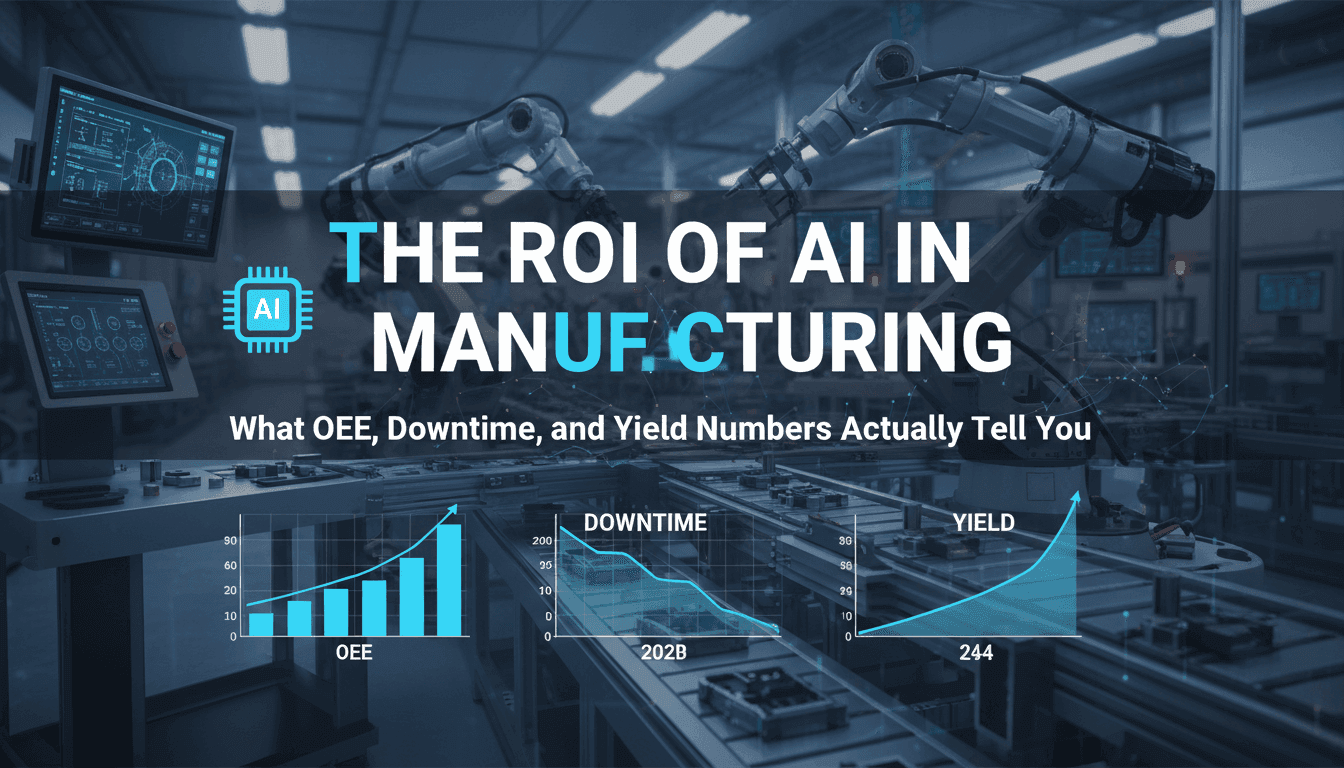
Table Of Contents
- The Hidden Cost Sitting Inside Every Factory
- What OEE Really Measures — And Where AI Changes the Math
- The Downtime Equation: Why Every Idle Hour Is a Boardroom Problem
- Yield Optimization: Where AI Finds Money You Didn't Know You Were Losing
- Real-World ROI Benchmarks Across AI Use Cases
- From Pilot to Scale: Why Most AI Projects Stall Before Delivering Value
- Building a Credible AI Business Case for Manufacturing
- What Strong AI ROI Leaders Do Differently
- Conclusion: Turning AI Talk Into Manufacturing Gains
The ROI of AI in Manufacturing: What OEE, Downtime, and Yield Numbers Actually Tell You
Somewhere on your factory floor right now, money is leaving the building in ways that don't show up as a single line item on any P&L. A machine running slightly below its ideal cycle time. A quality defect caught three stations too late. An unplanned stoppage that consumes 27 minutes of production, triggers overtime, and ripples into your delivery schedule. Individually, each loss looks manageable. Cumulatively, they can represent 20–30% of your production potential — evaporating shift after shift.
This is precisely the problem that artificial intelligence in manufacturing is designed to solve. Not by replacing human judgment, but by giving operations leaders a level of visibility and predictive accuracy that no human team can sustain at scale. The ROI of AI in manufacturing is increasingly measurable, and the numbers tied to three core metrics — Overall Equipment Effectiveness (OEE), unplanned downtime, and yield — are compelling enough to shift these decisions from the IT budget conversation to the COO agenda.
This article breaks down exactly what those numbers look like, where the real gains come from, why so many initiatives stall before delivering meaningful returns, and what the manufacturers capturing genuine value are doing differently.
The ROI of AI in Manufacturing
What OEE, Downtime & Yield Numbers Actually Tell You — and Where the Real Gains Come From
Only 3% of plants reach 85% OEE — the gap represents enormous recoverable value. Moving from 60% to 85% OEE on a $15M line recovers ~$3.75M in capacity.
AI predictive maintenance acts on all three OEE pillars simultaneously — availability, performance, and quality — making the impact multiplicative, not additive. BMW documented a 22% OEE gain at AI-enabled stations.
AI analyzes sensor data to predict failures 2–4 weeks in advance. GE reported a 45% reduction in unplanned downtime and $27M in annual savings across North American facilities.
Reinforcement learning tunes process parameters continuously. A 2% yield gain on 500K units annually saves 10,000 scrapped parts — worth €150K–500K per line, per year.
Scaling multiplier: BCG analysis found manufacturers scaling AI across 5+ use cases achieve 3.2× higher cumulative ROI than single-use-case deployers.
- 1Treat Data as Infrastructure First
Standardize sensors, clean data pipelines, and establish governance before deploying models. Data-ready manufacturers consistently outperform.
- 2Target the Highest-Value Pain Point
Concentrate initial AI deployment on a single, quantifiable loss — unplanned downtime on a critical asset or a high-scrap line. Concentrated ROI funds the next phase.
- 3Build Governance Before Models
Establish AI-specific KPIs, ring-fenced funding, and value-review cadences. Where KPI targets exist, nearly two-thirds of companies meet or exceed them.
- 4Invest in People Alongside Technology
Treat deployment as change management. Operators who trust and interpret AI alerts allow model accuracy to compound — skipping this step kills ROI.
- 5Scale Across Use Cases Deliberately
Design for cross-use-case synergy from day one — predictive maintenance feeding quality optimization, feeding scheduling efficiency — not ad-hoc tool addition.
⚠ Infrastructure Cost Warning: Manufacturers who include all infrastructure costs (sensors, edge computing, data pipelines, change management) in their business case achieve 85% of projected ROI. Those who underestimate infrastructure achieve only 45%. Infrastructure typically represents 30–50% of total brownfield deployment cost.
The Hidden Cost Sitting Inside Every Factory {#hidden-cost}
Before examining what AI can do, it helps to understand the scale of the problem it addresses. Unplanned downtime costs industrial manufacturers an estimated $50 billion per year. For Fortune Global 500 companies, the toll is roughly $1.5 trillion annually — equivalent to 11% of total revenues, according to the Siemens True Cost of Downtime 2024 report. Those figures reflect missed shipments, idle workers, scrapped materials, and frustrated customers. For mid-sized manufacturers already operating on thin margins, even a few hours of disruption can derail a week's production targets.
The per-hour cost of unplanned downtime varies significantly by sector and facility size, but the numbers are consistently eye-opening. The average cost of one hour of unplanned downtime is approximately $25,000 for mid-sized manufacturers and can exceed $500,000 for larger organizations. In high-throughput environments, the exposure is even sharper: in the automotive industry, the per-hour cost reaches $2.3 million, or $600 a second. Meanwhile, quality losses compound the picture further. Industry research consistently places the Cost of Poor Quality (COPQ) at 15–25% of annual revenue for mid-market manufacturers. For a $50 million plant, that means $7.5 million to $12.5 million leaving the building every year through scrap, rework, warranty claims, and customer churn — none of it appearing as a single line item on any P&L.
These are not abstract figures. They are the baseline against which every AI investment in manufacturing must be judged.
What OEE Really Measures — And Where AI Changes the Math {#oee-explained}
Overall Equipment Effectiveness is manufacturing's most comprehensive single metric for production performance. It combines three pillars into one score: Availability (is the machine running when it should be?), Performance (is it running at its ideal speed?), and Quality (are the units produced meeting spec first time?). OEE is calculated as Availability × Performance × Quality — the percentage of planned production time that is truly productive.
The industry baseline is sobering. The average discrete manufacturer scores 66.8% OEE — losing one-third of planned production to downtime, speed losses, and quality defects. Only 3% of plants reach the world-class benchmark of 85%. That gap between 66.8% and 85% represents enormous recoverable value, and it is precisely where AI predictive maintenance and process optimization make their most measurable impact.
What makes AI's effect on OEE particularly powerful is that it acts on all three pillars simultaneously. AI predictive maintenance improves all three OEE pillars simultaneously, which is why its impact is multiplicative, not additive. Traditional improvement programs tend to target one loss category at a time. AI-driven systems identify correlations across downtime events, speed degradation, and quality drift that no human analyst can consistently track across a full shift.
The financial implication of closing this OEE gap is substantial. Moving from 60% to 85% OEE on a $15 million production line recovers approximately $3.75 million in lost capacity — without buying a single new machine. That is a recovery model, not a cost center — and it is why AI ROI in manufacturing tends to justify itself within a single budget cycle when the business case is structured correctly.
Documented results from real deployments reinforce these figures. BMW documented a 22% Overall Equipment Effectiveness improvement alongside a 30–40% reduction in defects at AI-enabled production stations. A major processed food manufacturer facing repeated equipment breakdowns reported a 25% improvement in OEE and a 30% reduction in maintenance costs after implementing AI-based predictive maintenance monitoring mixers, ovens, and conveyor belts. The AI system predicted and scheduled maintenance during off-peak hours, ensuring production continuity.
The Downtime Equation: Why Every Idle Hour Is a Boardroom Problem {#downtime-equation}
Unplanned downtime is the most immediately visible form of OEE loss, and it is where AI delivers some of its fastest, most quantifiable returns. The mechanism is straightforward: AI-powered predictive maintenance analyzes sensor data from motors, bearings, drives, and process equipment to identify the early signatures of impending failure — vibration anomalies, temperature drift, current draw irregularities — and triggers a maintenance intervention before the failure occurs.
Industry benchmarks and recent case studies consistently report reductions in unplanned downtime in the range of 30–50%, with select implementations achieving up to 70% in targeted asset classes, alongside meaningful improvements in OEE and total maintenance expenditure. The difference between planned and unplanned maintenance is not merely scheduling preference. When maintenance teams report downtime costs, they typically count lost production output and repair expenses. Those are the visible costs. The hidden costs often exceed them by two to three times. Emergency parts ordered on short notice carry a 30–40% cost premium. Idle labor during stoppages still draws full wages. And overtime needed to recover lost output runs at 1.5–2x normal labor rates.
For a concrete sense of what this means: General Electric implemented AI-powered predictive maintenance across their power generation equipment manufacturing. The system analyzes data from over 50,000 sensors, predicting failures 2–4 weeks in advance. Results included a 45% reduction in unplanned downtime, a 25% decrease in maintenance costs, and $27 million in annual savings across their North American facilities.
The ROI case for predictive maintenance becomes even clearer when you examine how downtime costs accumulate. The average manufacturing facility loses 30 hours of production per month to downtime — 360 hours per year — with the majority from unplanned stoppages. Applying even a 35% reduction through AI-driven predictive maintenance to a facility experiencing $50,000/hour downtime costs translates to roughly $6.3 million in annual savings from downtime reduction alone.
Predictive maintenance, which uses AI to analyze data on factory machine health including OEE, to forecast equipment failures and schedule maintenance, is called a "must-have" technology by Siemens. That is not marketing language — it reflects a structural shift in how world-class manufacturers think about asset management.
Yield Optimization: Where AI Finds Money You Didn't Know You Were Losing {#yield-optimization}
Downtime is visible. Yield loss is often not. A production line can be running, availability metrics can look healthy, and the plant can still be hemorrhaging value through subtle quality drift, process parameter creep, and first-pass yield failures that only surface at final inspection — or worse, at the customer.
Manufacturers deploying AI yield optimization typically see 25–40% reductions in unplanned downtime, 20–35% improvement in throughput yield — fewer parts scrapped per work order — and 8–12% reductions in materials waste. These gains compound in ways that are easy to model financially. A 2% yield improvement on a production line running 500,000 units annually saves 10,000 units of scrap. At €15–50 per unit in material and processing costs, that is €150K–500K annually from a single line. Multiply across 10 lines or 5 plants, and the numbers become transformative.
The mechanism behind AI yield optimization involves more than simple defect detection. Reinforcement learning models continuously tune process parameters — temperature, pressure, feed rate, cycle time — to maximize first-pass yield without human intervention. Rather than waiting for quality metrics to degrade and then investigating root causes manually, AI models learn the specific combinations of machine state, material condition, and process parameters that precede yield loss — and intervene before defects are produced.
Human inspectors make pass/fail decisions in 200–300 milliseconds under factory lighting. By hour six of a shift, their accuracy has dropped 15–25%. Inter-inspector agreement on defect severity sits at 55–70%, meaning the same part may pass one shift and fail the next. AI vision systems resolve this biological constraint entirely. A modern computer vision system inspects 10,000+ parts per hour at sub-100ms latency, holds 99%+ detection accuracy across every shift with zero drift, and catches sub-millimetre defects down to 50 microns that no human eye can reliably see.
Semiconductor fabs and chemical processors report 8–15% yield improvements within 90 days of deploying AI-driven process optimization — a payback timeline that sits well within most capital project approval thresholds.
Real-World ROI Benchmarks Across AI Use Cases {#roi-benchmarks}
When manufacturers ask what kind of ROI they should expect from AI, the answer depends on which use case they prioritize first. The benchmarks are increasingly well-documented:
- Predictive Maintenance: AI-driven predictive maintenance typically generates 300–500% ROI by minimizing unplanned downtime and optimizing service intervals. Manufacturers commonly achieve a 5–10% reduction in maintenance costs and a 10–20% improvement in asset availability.
- Quality Control and Visual Inspection: Full-fledged AI quality inspection infrastructure provides 200–300% ROI through significant defect reduction and faster inspection cycles. One electronics manufacturer eliminated $1.8 million of annual warranty exposure by cutting its defect escape rate from 2.3% to 0.1%.
- Production Scheduling Optimization: Machine learning schedulers optimize job sequencing, changeover sequencing, and resource allocation across multi-product lines — lifting OEE by 15–25% in documented deployments without adding shift capacity.
- Supply Chain and Inventory Optimization: Advanced AI models yield 150–250% ROI by preventing stockouts and managing all stages of supply chains.
AI ROI in manufacturing averages 200% across deployed use cases — the highest of any sector tracked — because factory operations provide quantifiable baselines, continuous data streams, and direct cost-to-savings mappings that make financial outcomes measurable within months, not years.
Payback periods are notably short by industrial capital investment standards. Most manufacturers evaluate capital investments on 3–5 year payback horizons. AI use cases with 4–12 month payback periods represent a fundamentally different return profile — closer to operational expense with immediate returns than traditional capital projects. Scaling across multiple use cases amplifies returns significantly: a BCG analysis found that manufacturers scaling AI across 5+ use cases achieve 3.2x higher cumulative ROI than single-use-case deployers.
From Pilot to Scale: Why Most AI Projects Stall Before Delivering Value {#pilot-to-scale}
Given the strength of these benchmarks, one question naturally follows: why aren't more manufacturers capturing this value at scale? The answer is consistent across multiple research bodies, and it is rarely about the technology itself.
Despite growing interest and clear ROI potential, many manufacturers still struggle to move AI initiatives from isolated pilots to scalable, factory-wide solutions. These challenges are rarely technical alone: they stem from gaps in data readiness, organizational alignment, and evolving regulatory expectations.
The McKinsey COO100 Survey from mid-2025 — drawing on 101 senior operating executives at organizations with revenues of at least $1 billion — found a stark picture. About two-thirds of respondents indicated that their companies' AI implementation is still at the exploration or targeted-implementation stage. A mere 2% say that AI is now fully embedded across all operations. When asked about the biggest challenges in implementing AI in operations, two of the three top challenges relate to people: fully half of respondents cite the need to shift their culture as a major impediment, and almost as many point to reskilling needs.
On the technical side, most manufacturers still operate with fragmented data ecosystems: legacy MES/SCADA systems, siloed PLC data, and inconsistent sensor quality. Without clean, integrated data feeding AI models, prediction accuracy degrades and the financial case becomes harder to sustain. Manufacturers that spent time cleaning up their data collection, standardizing sensor configurations, and establishing data governance frameworks got dramatically better results.
Governance structure matters too. The majority of survey respondents say their organization lacks AI-specific KPIs. Yet where such targets are in place, nearly two-thirds of companies meet or exceed them — suggesting that robust governance is one of the most powerful differentiators in realizing AI's potential. In other words, the manufacturers capturing real ROI are not necessarily the ones with the most sophisticated technology. They are the ones treating AI as a managed performance program with defined metrics, ownership, and accountability.
Building a Credible AI Business Case for Manufacturing {#business-case}
For manufacturing executives looking to build a convincing ROI case for AI investment, the most effective methodology starts not with technology selection but with operational pain quantification. Start with what you already measure: pull 12 months of data on unplanned downtime hours and cost per hour by production line, scrap and rework rates with material and labor costs, energy consumption per unit of production, quality escape rates and associated warranty/recall costs, and safety incident frequency and severity. Most manufacturers discover €2–10 million in annual losses that AI could partially address.
Phasing investment intelligently also matters. A well-structured AI roadmap typically moves through three phases: begin with one or two foundation use cases that deliver quick, measurable ROI within the first six months; use those returns to fund a broader deployment phase covering additional lines and use cases; then scale into more transformative capabilities as data maturity and organizational readiness improve. A 2025 Deloitte study found that manufacturers who include all infrastructure costs in their business case achieve 85% of projected ROI, while those who underestimate infrastructure costs achieve only 45%. Infrastructure — sensors, edge computing, data pipelines, change management — typically accounts for 30–50% of total investment in brownfield factory deployments and should be fully costed from the outset.
Successful AI adopters started with well-defined problems that had clear metrics — scrap rate, downtime hours, inspection throughput, changeover time. They didn't try to "implement AI" as an abstract initiative. This problem-first framing is what makes ROI cases credible to plant managers and CFOs alike, and it separates the manufacturers generating sustained returns from those cycling through pilots that never reach production.
For manufacturers in Asia-Pacific and Singapore specifically, the strategic imperative is sharpened by regional competitive dynamics, tightening labor markets, and increasing pressure from global supply chain partners to demonstrate manufacturing quality and reliability. The question is no longer whether to invest in AI — it is how to structure that investment to deliver measurable returns, not just proof-of-concepts.
What Strong AI ROI Leaders Do Differently {#roi-leaders}
Across the research and case study data, a clear pattern distinguishes the manufacturers capturing genuine, sustained AI returns from those still stuck in pilot mode:
They treat data as infrastructure, not an afterthought. AI systems are only as accurate as the data feeding them. Organizations that invest in sensor quality, data standardization, and cross-system integration before deploying models consistently outperform those that reverse the sequence.
They start with the highest-value operational pain point. Rather than deploying AI broadly and hoping for diffuse gains, the strongest performers identify the single biggest quantifiable loss — whether that is unplanned downtime on a critical asset, a high-scrap production line, or a quality escape rate eroding customer relationships — and concentrate initial AI deployment there. The concentrated ROI then funds the next phase.
They build governance before they build models. Treating AI not as a series of experiments but as a rewired performance engine — anchored in KPI-tied targets, backed by ring-fenced funding, and tracked through a regular cadence of value reviews is what separates sustained performers from one-hit pilots.
They invest in people alongside technology. Successful adopters treat AI deployment as a change management challenge, not just a technology project. Operators who understand how to interpret AI alerts, trust the recommendations, and provide feedback when the system makes errors are what allows model accuracy to compound over time. Organizations that skip this step consistently underperform on ROI.
They scale across use cases deliberately. The compounding ROI of multi-use-case AI deployment — where predictive maintenance feeds quality optimization, which feeds scheduling efficiency — is where the most significant financial gains accumulate. But this requires architectural thinking from the outset, not ad-hoc tool addition.
Conclusion: Turning AI Talk Into Manufacturing Gains {#conclusion}
The ROI of AI in manufacturing is no longer a theoretical proposition. The benchmarks are established, the case studies are documented, and the financial modeling is straightforward for any manufacturer willing to start with honest measurement of their current operational losses.
OEE improvement of 15–25 points, downtime reduction of 30–50%, and yield gains of 8–15% are achievable outcomes — not optimistic projections — for manufacturers who approach AI deployment with the right combination of data readiness, governance discipline, and change management investment. The payback periods, often 4–12 months, make the financial case compelling relative to virtually any other capital investment a plant manager can put in front of a CFO.
The harder challenge is not the technology. It is building the organizational infrastructure — the data foundations, the governance frameworks, the cross-functional alignment, the workforce readiness — that allows AI to move from promising pilot to embedded performance engine. That is where manufacturers who get the ROI differentiate themselves from those still counting proof-of-concept dashboards.
For executives looking to close that gap, the path forward starts with a structured assessment of your highest-value operational pain points, a realistic business case that accounts for full implementation costs, and a phased roadmap that generates early returns to fund the next stage of deployment.
Ready to Turn Your AI Ambitions Into Measurable Manufacturing Returns?
Business+AI brings together Singapore's leading manufacturing executives, AI consultants, and solution vendors to help you move from AI exploration to factory-floor ROI. Whether you're looking to benchmark your current operations, build a credible business case for leadership, or connect with proven implementation partners, our ecosystem is built for exactly this challenge.
- 🎓 Attend a hands-on Workshop on AI implementation in industrial operations
- 📚 Deepen your leadership team's capabilities through our Masterclass programs
- 🤝 Access expert Consulting support to assess your AI readiness and ROI potential
- 🌐 Join peers tackling the same challenges at the Business+AI Forum
Stop attending AI conferences. Start building AI returns.