
The Psychology of AI Trust: Accepting Digital Teammates in Your Organization
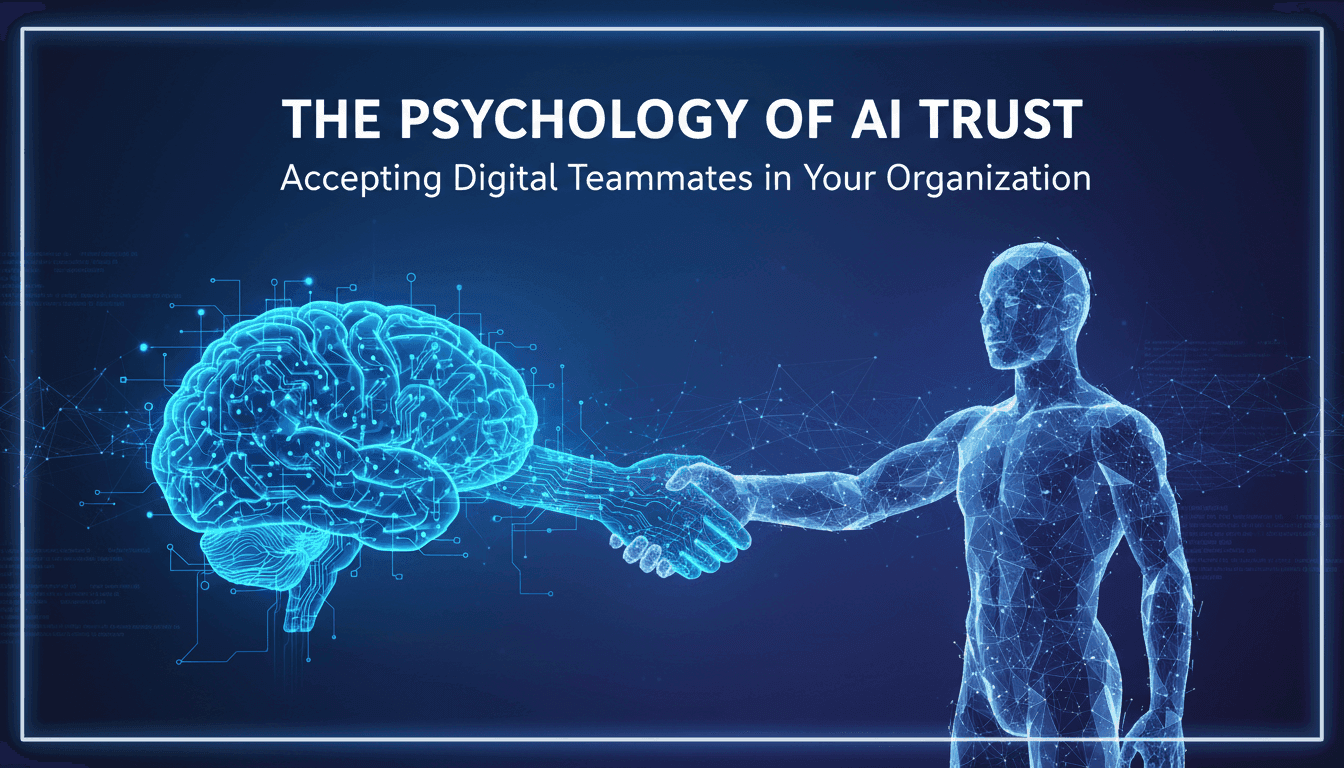
Table Of Contents
- Understanding the Trust Equation with AI Systems
- The Human Resistance Factor: Why We Hesitate
- Building Psychological Safety Around AI Adoption
- The Competence-Warmth Framework for AI Acceptance
- Transparency as a Trust Mechanism
- From Automation Anxiety to Collaborative Confidence
- Practical Strategies for Leaders: The Business+AI Approach
- Measuring Trust Metrics in AI Implementation
When a new team member joins your organization, trust doesn't happen overnight. Your employees observe, evaluate, and gradually build confidence in their colleague's abilities and intentions. Now imagine that new team member isn't human at all, but an AI system designed to augment your workforce. The psychological dynamics become exponentially more complex.
The question of AI trust sits at the intersection of technology adoption and human psychology, creating one of the most significant challenges organizations face today. According to recent research, 67% of employees express concern about AI replacing their roles, while simultaneously acknowledging its potential to enhance productivity. This paradox reveals a fundamental truth: accepting digital teammates isn't primarily a technical challenge but a deeply psychological one.
In this comprehensive exploration, we'll unpack the cognitive mechanisms that govern AI trust, examine why resistance emerges even when benefits are clear, and provide actionable frameworks for leaders navigating this transformation. Whether you're introducing your first AI tool or scaling organization-wide implementation, understanding these psychological principles will determine your success.
The Psychology of AI Trust
From Resistance to Collaboration: Understanding Digital Teammates
Of employees worry about AI replacing their roles, despite recognizing its productivity benefits
The AI trust paradox reveals this isn't a technical challenge—it's a deeply psychological one
The 3 Core Trust Components
Ability
Can it perform competently?
Benevolence
Does it serve our interests?
Integrity
Will it behave consistently?
Why Resistance Emerges
Competence Threat
AI challenges the expertise that defines professional identity and self-worth
Algorithm Aversion
People lose trust in AI faster after a single error than with human colleagues
Accountability Gaps
Unclear responsibility creates psychological discomfort and decision paralysis
6 Strategies for Building AI Trust
Human-Centered Design
Structured Learning Paths
Ethics Councils
Feedback Loops
Measure Progress
Connect to Growth
The Transparency Spectrum
Process Transparency
How the AI was trained, what data it uses, who oversees development
Decision Transparency
Reasoning for specific recommendations in user-friendly language
Performance Transparency
Accuracy metrics, error rates, and improvement trajectories
The Bottom Line
Success with AI isn't about having the best algorithms—it's about building the deepest trust. Organizations that master the human side of AI adoption will separate themselves from those that merely possess sophisticated technology.
Understanding the Trust Equation with AI Systems
Trust in any relationship, human or digital, follows a predictable formula. Researchers have identified three core components: ability (can this entity perform the task competently?), benevolence (does it have my best interests in mind?), and integrity (will it behave consistently and ethically?). When humans evaluate AI teammates, this equation becomes complicated by our tendency to anthropomorphize technology while simultaneously recognizing its fundamental otherness.
The challenge intensifies because AI systems often excel dramatically in the ability dimension while raising profound questions about benevolence and integrity. A machine learning algorithm can process thousands of data points with perfect accuracy, demonstrating superior competence to any human analyst. Yet employees struggle with a critical question: whose interests does this system truly serve? This uncertainty triggers what psychologists call algorithmic anxiety, the discomfort we feel when unable to predict or understand decision-making processes that affect our work and livelihoods.
Organizations that successfully build AI trust recognize that technical performance alone never suffices. Your team needs to understand not just what the AI does, but why it matters, how it was designed, and most importantly, how it enhances rather than threatens their value. The most sophisticated natural language processing system will fail if employees view it as a surveillance tool rather than a collaborative assistant.
This trust-building process mirrors what happens in high-performing human teams. Research from MIT's Human Dynamics Laboratory shows that trust develops through repeated positive interactions, predictable behavior patterns, and perceived shared goals. The same principles apply to digital teammates, requiring deliberate design of interaction patterns that reinforce reliability and mutual benefit.
The Human Resistance Factor: Why We Hesitate
Resistance to AI adoption rarely stems from technophobia alone. Instead, it emerges from a complex web of psychological defense mechanisms protecting our sense of competence, autonomy, and professional identity. When you introduce an AI system that performs tasks your employees have mastered over years, you're not just changing workflows but potentially threatening the expertise that defines their professional self-worth.
The competence threat manifests particularly strongly among mid-career professionals who've built reputations on specific skills. A financial analyst who prides themselves on pattern recognition may experience genuine distress when an AI identifies trends they missed. This isn't irrational resistance but a legitimate grief response to evolving role definitions. The psychological literature on automation anxiety reveals that perceived job insecurity triggers the same stress responses as actual job loss, affecting cognitive performance, decision-making, and team dynamics.
Another critical factor is what researchers call algorithm aversion, the tendency to lose confidence in algorithmic decision-makers more quickly than in human counterparts, even when the AI demonstrates superior accuracy. Studies show that after witnessing a single error from an AI system, people become significantly less likely to trust it again, while they readily forgive repeated mistakes from human colleagues. This asymmetric forgiveness creates an unfair standard where digital teammates must achieve near-perfection to maintain credibility.
The resistance also reflects legitimate concerns about accountability gaps. When an AI system makes a recommendation that proves costly, who bears responsibility? The ambiguity surrounding decision ownership creates psychological discomfort that manifests as reluctance to rely on digital teammates. Employees intuitively understand that deferring to AI advice without understanding its reasoning may protect them from task-level errors while exposing them to career-limiting judgment failures.
Building Psychological Safety Around AI Adoption
Psychological safety, the belief that you can take interpersonal risks without facing punishment or humiliation, proves equally vital when introducing digital teammates. Harvard researcher Amy Edmondson's work on team dynamics reveals that learning behaviors only flourish in environments where people feel secure asking questions, admitting confusion, and acknowledging mistakes. AI adoption requires exactly these vulnerable learning behaviors.
Creating this safety begins with normalizing experimentation and explicitly framing AI tools as collaborative partners rather than evaluative judges. When leaders publicly share their own AI learning journey, including failures and misunderstandings, they signal that exploration carries no penalty. One Singapore-based financial services firm implemented "AI office hours" where employees could ask basic questions without judgment, dramatically accelerating adoption by removing the stigma of ignorance.
The language you use shapes psychological safety profoundly. Terms like "AI transformation" or "digital disruption" trigger threat responses, activating the amygdala and limiting cognitive flexibility. Reframing around "capability enhancement" or "digital collaboration" maintains the same strategic intent while reducing defensive reactions. This isn't semantic manipulation but recognition that our neurological wiring responds differently to opportunity framing versus threat framing.
Equally important is establishing clear boundaries around AI decision-making authority. Psychological safety crumbles when employees feel powerless or unable to challenge digital recommendations. Organizations that excel at AI adoption implement explicit protocols for human override, creating structured opportunities to question, investigate, and refine algorithmic outputs. These protocols serve dual purposes: improving AI performance through human feedback while giving employees agency that protects their sense of professional autonomy.
Participating in hands-on workshops specifically designed to build AI literacy can accelerate this psychological safety by creating peer learning environments where experimentation is encouraged and mistakes become valuable teaching moments rather than career risks.
The Competence-Warmth Framework for AI Acceptance
Social psychologists have long understood that humans evaluate others along two primary dimensions: competence (can they achieve their goals?) and warmth (are their intentions toward me positive?). This framework, developed through decades of research on stereotype formation and interpersonal perception, provides powerful insights into AI acceptance challenges.
AI systems typically score extremely high on perceived competence, given their computational abilities and data processing speed. However, they register as cold and impersonal, lacking the warmth signals that build interpersonal trust. This creates what researchers call the "competent but cold" perception, which historically generates feelings of envy and resentment rather than trust and collaboration. Think of the brilliant but arrogant colleague everyone respects but nobody wants to work with.
Successful AI implementation requires deliberately designing warmth into digital teammate interactions. This doesn't mean adding smiley face emojis to chatbot responses, but rather building systems that demonstrate consideration for human needs, acknowledge limitations, and communicate in ways that feel collaborative rather than directive. When an AI system says "I noticed this pattern that might interest you" rather than "You should do this," it signals partnership rather than authority.
The competence-warmth framework also explains why gradual capability reveals often works better than showcasing full AI functionality immediately. When an AI system demonstrates overwhelming competence from day one, it maximizes the competence-warmth gap, triggering defensive reactions. By revealing capabilities progressively as human teammates build familiarity and comfort, organizations can maintain a more balanced perception that facilitates acceptance.
Some leading organizations implement "AI personality design" processes, deliberately shaping how their digital systems communicate, acknowledge uncertainty, and defer to human judgment. These aren't superficial touches but strategic decisions about building long-term collaborative relationships between human and digital teammates.
Transparency as a Trust Mechanism
The black box problem in AI, where decision-making processes remain opaque even to technical experts, creates profound psychological barriers to trust. Humans possess a fundamental need to understand causality, reflected in our constant "why" questions from childhood forward. When AI systems deliver recommendations without explaining their reasoning, they violate this deep cognitive preference for comprehensible cause-and-effect relationships.
Yet transparency exists on a spectrum, and organizations must calibrate carefully. Complete technical transparency, exposing every parameter and calculation, overwhelms non-technical users and paradoxically decreases trust by highlighting complexity they can't evaluate. Appropriate transparency provides enough visibility to build mental models of AI behavior without requiring data science expertise.
Effective transparency initiatives focus on three levels. Process transparency explains how the AI was trained, what data it uses, and who oversees its development. Decision transparency provides reasoning for specific recommendations in language matched to user expertise. Performance transparency shares accuracy metrics, error rates, and improvement trajectories, helping users calibrate their reliance appropriately.
A manufacturing company in Southeast Asia implemented "AI decision cards" that accompanied every significant algorithmic recommendation, explaining the top three factors influencing the output and indicating confidence levels. This simple transparency mechanism increased adoption rates by 40% within six months, as employees developed appropriate mental models for when to trust versus verify AI guidance.
The transparency conversation connects directly to governance frameworks explored in Business+AI consulting services, where establishing clear guidelines for AI explainability becomes a strategic imperative rather than a technical afterthought.
From Automation Anxiety to Collaborative Confidence
The journey from viewing AI as a threat to embracing it as a teammate requires deliberate psychological reframing. Automation anxiety doesn't disappear through rational argument alone because it stems from primitive threat-detection systems that evolved to protect us from danger. These systems respond to evidence and experience, not logic and reassurance.
Successful reframing strategies begin with acknowledging legitimate concerns rather than dismissing them. When leaders say "your fears are unfounded" or "AI won't replace anyone," they invalidate real emotions and often make promises they can't guarantee. More effective approaches acknowledge that roles will evolve, create transparent processes for supporting that evolution, and demonstrate commitment through resource allocation for reskilling initiatives.
The shift toward collaborative confidence accelerates when employees experience concrete benefits from AI partnership. This requires identifying "quick win" use cases where AI clearly eliminates frustrating work without threatening core competencies. One professional services firm started with an AI tool that automated meeting notes and action item tracking, universally recognized as tedious work nobody valued. Early success with this low-threat application built confidence that facilitated adoption of more sophisticated AI applications.
Creating AI champions within peer groups proves more effective than top-down mandates. Humans trust people similar to themselves, a phenomenon called homophily in social network research. When employees see respected colleagues successfully integrating AI into their workflows and achieving better outcomes, they're far more likely to experiment themselves than when directives come from distant executives or IT departments.
The collaborative confidence framework also requires celebrating human-AI synergies rather than purely algorithmic achievements. When your marketing team uses AI for data analysis but credits a successful campaign to the creative insight humans applied to those insights, you reinforce the partnership model rather than the replacement narrative that fuels anxiety.
Practical Strategies for Leaders: The Business+AI Approach
Translating psychological principles into operational reality requires structured approaches that address both individual and organizational levels. Leaders must recognize that AI trust-building isn't a one-time initiative but an ongoing process requiring consistent attention and resource allocation.
1. Design Human-Centered AI Experiences – Before selecting any AI solution, map the current emotional journey employees have with existing processes. Identify pain points, moments of satisfaction, and tasks that drain versus energize your team. Choose AI applications that address frustrations while enhancing what people value about their work, creating emotional wins alongside productivity gains.
2. Implement Structured Learning Pathways – AI literacy can't develop through occasional lunch-and-learn sessions. Effective organizations create comprehensive learning ecosystems with foundational concepts, role-specific applications, and advanced capabilities. Masterclasses that combine theoretical understanding with hands-on application help employees build both competence and confidence with digital teammates.
3. Establish AI Ethics Councils – Involving diverse employees in governance decisions about AI deployment addresses both practical and psychological needs. These councils surface concerns early, ensure multiple perspectives shape implementation, and give participants ownership that translates into organizational advocacy. The psychological benefit of procedural justice, the perception that decision processes are fair, significantly influences AI acceptance.
4. Create Feedback Loops That Matter – Deploy mechanisms for employees to report AI errors, unexpected behaviors, or improvement suggestions, then visibly act on this input. When teams see their feedback directly influencing AI system refinements, they develop a sense of partnership and control that counteracts helplessness anxiety.
5. Measure and Communicate Progress – Track not just productivity metrics but also trust indicators: usage rates, voluntary adoption beyond mandated tools, peer recommendations, and qualitative feedback about AI experiences. Sharing this data transparently helps employees see organizational commitment to getting AI adoption right, not just getting it done quickly.
6. Connect Individual Growth to AI Capabilities – Help employees envision career trajectories enhanced by AI partnership rather than threatened by it. When a data analyst sees how AI can handle routine reporting while they develop strategic advisory skills, career anxiety transforms into career opportunity. This requires investment in genuine upskilling programs, not just reassuring talking points.
The Business+AI Forum creates valuable opportunities to learn from peers navigating similar trust-building challenges, sharing both successes and setbacks in safe environments that accelerate collective learning.
Measuring Trust Metrics in AI Implementation
What gets measured gets managed, and AI trust requires the same disciplined measurement approach as any strategic initiative. Yet many organizations focus exclusively on utilization metrics like login frequency or task completion rates, missing the psychological dimensions that predict long-term success.
Behavioral trust indicators include voluntary usage beyond required applications, employees recommending AI tools to colleagues, and people expanding their use of AI capabilities over time rather than remaining in a minimal compliance zone. These behaviors signal genuine acceptance rather than grudging compliance, predicting sustainable adoption.
Attitudinal measures captured through regular pulse surveys should assess confidence in AI recommendations, comfort with AI decision-making, perceived fairness of AI systems, and belief that AI enhances rather than threatens career prospects. Tracking these metrics over time reveals whether your trust-building initiatives actually shift perceptions or merely generate temporary enthusiasm.
Interaction quality metrics examine how employees engage with AI systems: Do they blindly accept recommendations or thoughtfully evaluate them? Do they provide feedback to improve AI performance? Do they escalate appropriate edge cases to human judgment? High-quality interaction patterns indicate employees have developed appropriate mental models of AI capabilities and limitations.
Finally, team-level measures capture whether AI integration strengthens or fractures social cohesion. Do teams discuss AI recommendations together, building collective intelligence? Have AI tools created new collaboration patterns? Or has AI introduced tensions, blame-shifting, or decision paralysis? The social fabric of your organization determines whether digital teammates amplify human potential or create organizational dysfunction.
Leading organizations establish baseline measurements before AI implementation, track monthly or quarterly trends, and correlate trust metrics with business outcomes. This data discipline transforms trust from an abstract concept into a manageable organizational asset with clear performance implications.
The psychology of AI trust reveals that accepting digital teammates requires far more than technical capability. It demands attention to human emotional needs, careful design of interaction experiences, transparency that builds understanding without overwhelming, and leadership commitment to genuine partnership models rather than efficiency-driven automation.
Organizations that successfully navigate this transformation recognize that trust isn't built through mandates or reassurances but through consistent, positive experiences that demonstrate AI systems enhancing human capability rather than replacing human value. They invest in psychological safety, create opportunities for gradual learning, measure trust as rigorously as productivity, and maintain patience through the inevitable stumbles that accompany any significant change.
The path from AI skepticism to collaborative confidence isn't linear or quick, but the competitive advantages awaiting organizations that make this journey successfully justify the investment. As artificial intelligence capabilities continue expanding, the companies that master the human side of AI adoption will separate themselves from those that merely possess sophisticated technology.
Your organization's AI future depends less on the algorithms you deploy than on the trust you build. Understanding the psychological principles that govern that trust gives you the foundation to turn artificial intelligence talk into tangible business gains, creating workplaces where human and digital teammates combine their complementary strengths toward shared success.
Ready to Transform AI Skepticism into Collaborative Confidence?
Building trust in digital teammates requires expert guidance, peer learning, and practical frameworks that address both technical and psychological dimensions. Join the Business+AI membership community to access exclusive resources, connect with fellow executives navigating similar challenges, and gain the insights needed to successfully integrate AI into your organization. Transform from AI observer to AI leader with the support of Singapore's premier AI business ecosystem.