
The Human Touch Premium: When Customers Demand a Person Over AI
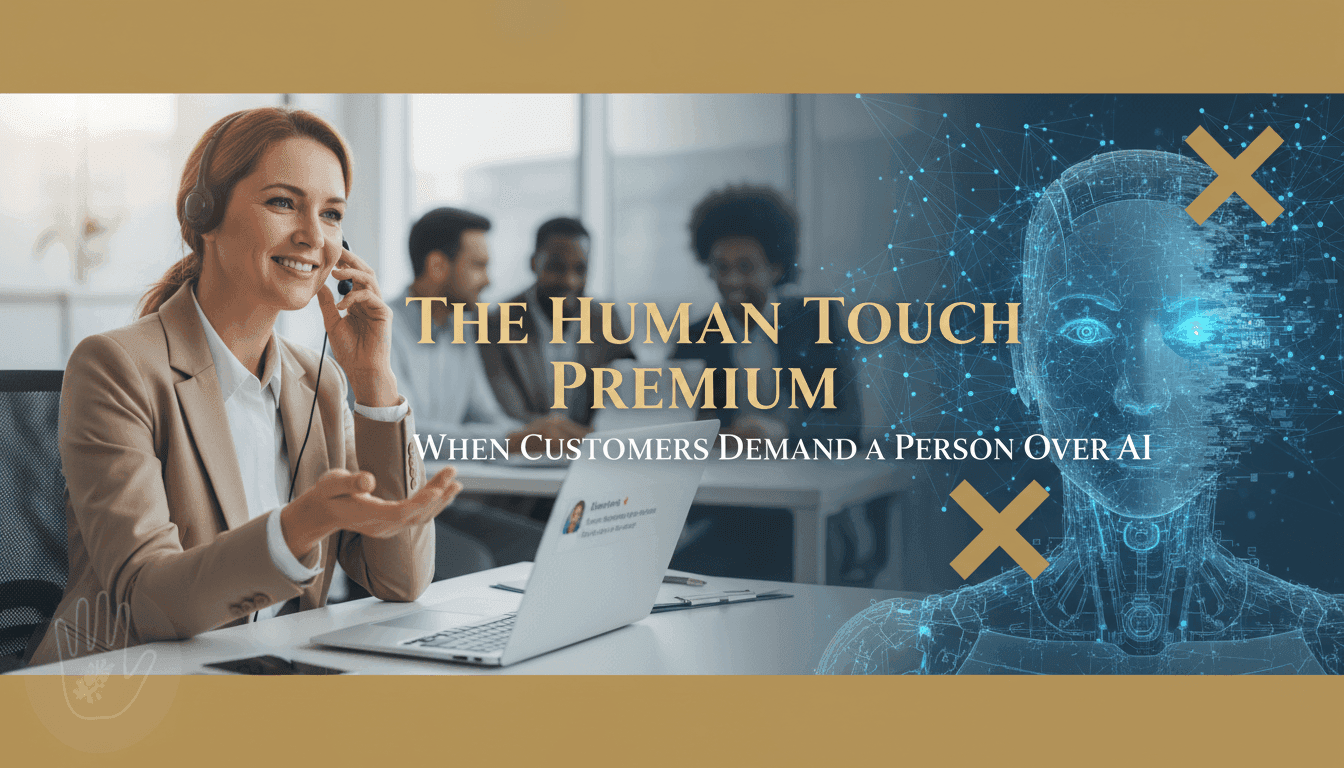
Table Of Contents
- The Rising Paradox: More AI, More Human Demand
- When Customers Refuse the Bot: Five Critical Scenarios
- The Economics of Human Touch: Understanding the Premium
- Building a Hybrid Model That Actually Works
- The Competitive Advantage of Strategic Human Deployment
- Preparing Your Team for the Human Touch Premium Era
A luxury hotel chain recently discovered something unexpected in their customer feedback data. Despite investing millions in AI-powered concierge services, their highest satisfaction scores came from properties that maintained 24/7 human reception desks. The AI was faster and more accurate, but guests were willing to wait longer, and even pay premium rates, for properties that guaranteed human interaction.
This phenomenon extends far beyond hospitality. Across industries, businesses are encountering a surprising truth: the more we automate, the more valuable human interaction becomes. We're entering what researchers call the human touch premium era, where certain customer interactions command not just preference, but premium pricing and fierce brand loyalty.
For business leaders navigating AI transformation, this creates a critical strategic question. It's no longer about whether to implement AI, but rather where to draw the line. Understanding when customers demand a person over a machine isn't just about customer satisfaction anymore. It's become a competitive differentiator that separates market leaders from followers. This article explores the science behind this demand, identifies the critical scenarios where human touch becomes non-negotiable, and provides frameworks for building hybrid models that maximize both efficiency and customer experience.
The Human Touch Premium
Why customers pay more for human interaction in an AI world
📊 The Paradox
of customers want more human interaction as technology advances
cost reduction with 25% better satisfaction via hybrid models
5 Critical Scenarios Where Humans Win
High-Stakes Decisions
Mortgages, investments, major purchases
Emotional Complexity
Complaints, sensitive issues, empathy needs
System Failures
Tech breakdowns, escalations, exceptions
Healthcare & Diagnosis
Treatment decisions, serious news
Luxury Experiences
Premium brands, VIP service, personalization
Building a Hybrid Model That Works
Map Customer Journeys with Decision Stakes
Identify high-stakes, high-emotion touchpoints requiring human interaction
Create Seamless Handoff Architecture
Pass complete context from AI to humans—no customer repetition
Design Human-AI Collaboration
AI augments humans with insights; humans provide empathy and judgment
Implement Continuous Learning Loops
Monitor behavior data to optimize the automation-human boundary
⚡ Key Insight
The goal isn't minimizing human interaction—
it's optimizing its deployment where it drives loyalty and lifetime value
Ready to Build Your AI Strategy?
Join Business+AI to access exclusive workshops, masterclasses, and a community of leaders implementing hybrid AI-human service models.
Explore MembershipThe Rising Paradox: More AI, More Human Demand
The automation paradox presents one of the most fascinating contradictions in modern business. As companies deploy increasingly sophisticated AI systems, customer demand for human interaction hasn't decreased. Instead, it has intensified in specific, high-value scenarios. Research from customer experience consultancies shows that 73% of customers want more human interaction as technology advances, not less. This isn't technophobia or resistance to change. It represents something more nuanced about human psychology and decision-making.
The explanation lies in what behavioral economists call decision significance. When stakes are low and outcomes are predictable, customers happily embrace automation. Checking account balances, tracking shipments, or resetting passwords work brilliantly with AI. However, as financial, emotional, or reputational stakes increase, customers instinctively seek human judgment, empathy, and accountability. The AI can process information faster, but humans provide something algorithms cannot replicate: the assurance that someone understands context, cares about outcomes, and can exercise judgment beyond programmed parameters.
This paradox creates what market researchers identify as the expectation gap. Customers now expect both instant AI-powered service for routine matters and immediate access to skilled humans for complex issues. Companies that fail to deliver both face growing customer frustration. Those that successfully bridge this gap discover a powerful competitive advantage. They're not just meeting expectations; they're demonstrating that they understand when efficiency matters and when empathy matters more.
The financial implications are substantial. Organizations implementing AI solutions through strategic consulting find that properly segmenting automated versus human-touch interactions can reduce overall service costs by 40% while simultaneously improving satisfaction scores by 25%. The key lies not in choosing between AI and humans, but in deploying each where they deliver maximum value.
When Customers Refuse the Bot: Five Critical Scenarios
Identifying exactly when customers demand human interaction requires understanding both psychological triggers and situational factors. Research across industries reveals five consistent scenarios where the human touch premium becomes non-negotiable, regardless of how advanced the AI alternative might be.
High-Stakes Decision Making
Financial services provide the clearest examples of high-stakes scenarios. When customers contemplate mortgage decisions, investment strategies, or insurance coverage for catastrophic events, they overwhelmingly demand human advisors. A multinational bank discovered this when they introduced an AI investment advisor with superior algorithmic performance. Despite consistently better returns, only 12% of high-net-worth clients would use it for portfolio decisions exceeding $100,000. The remaining 88% insisted on human advisors, even when shown the AI's performance data.
The psychology here involves accountability and trust. Customers aren't necessarily doubting the AI's capabilities. They're seeking someone who can be held responsible if things go wrong. A human advisor provides social accountability that algorithms cannot. Additionally, high-stakes decisions involve personal circumstances, risk tolerance, and life goals that customers believe require human understanding. They want advisors who comprehend not just the numbers, but the meaning behind the numbers in their lives.
Healthcare represents another high-stakes domain where human touch remains paramount. Patients accept AI for appointment scheduling, symptom checking, or prescription refills. However, diagnosis discussions, treatment decisions, or serious health news require physician interaction. Telemedicine platforms learned this lesson when patient satisfaction scores dropped significantly when AI triage systems replaced human intake nurses, even though diagnosis accuracy remained unchanged.
Emotional Complexity and Empathy Needs
Customer service escalations frequently involve emotional dimensions that extend beyond the technical problem. A delayed flight isn't just a logistics issue for the passenger missing their daughter's wedding. A damaged product isn't merely a replacement transaction for the customer who purchased it as an anniversary gift. When emotional stakes are high, customers need acknowledgment, validation, and empathy that current AI cannot authentically provide.
Retail companies analyzing complaint resolution data find a striking pattern. Technical resolution speed matters less than emotional acknowledgment for customer retention. Customers whose problems were solved quickly by AI but without emotional acknowledgment showed 40% lower retention rates than those whose issues took longer but included empathetic human interaction. The difference wasn't in the outcome, but in feeling heard and valued.
Luxury brands understand this intuitively. Their customer service models deliberately maintain high human touch ratios, not because they can't afford automation, but because their brand promise includes making customers feel special. A luxury fashion house executive explained: "Our customers aren't buying efficiency. They're buying an experience where someone knows their name, remembers their preferences, and treats them as individuals, not ticket numbers."
Businesses attending Business+AI forums frequently share case studies showing that emotional intelligence remains the clearest differentiator between AI and human service. While sentiment analysis improves, the gap between detecting emotion and appropriately responding to it with genuine empathy remains substantial.
System Failures and Escalations
Ironically, AI's greatest limitation becomes most apparent when technology itself fails. When websites crash, apps malfunction, or automated systems produce errors, customers demand immediate human intervention. The frustration of dealing with a broken automated system compounds exponentially when the only recourse is another automated system.
A telecommunications company learned this expensive lesson during a billing system failure. Their AI chatbot, trained to handle billing questions, continued directing customers through automated troubleshooting even as the underlying system was down. Customer frustration escalated dramatically, not primarily because of the outage, but because they couldn't reach a human who could acknowledge the problem and provide alternatives. The company faced a 300% spike in customer churn during the three-day incident.
The escalation threshold represents a critical design consideration. Companies must determine at what point in any customer journey they provide immediate human access. Best-in-class organizations implement what they call "escape velocity" metrics, measuring how quickly customers can reach a human when automated systems aren't resolving their issues. Leading companies maintain escape velocity under 90 seconds, while lagging competitors often exceed five minutes or more.
Exception handling separates sophisticated AI implementations from basic automation. Truly intelligent systems recognize their own limitations and seamlessly transfer to human agents before customer frustration peaks. This requires not just technical capability, but organizational commitment to maintaining sufficient human capacity for these handoffs.
The Economics of Human Touch: Understanding the Premium
The business case for human interaction in an automated world requires understanding both costs and value creation. Traditional analysis views human service as expensive compared to AI alternatives. A customer service call might cost $5-15 per interaction, while a chatbot interaction costs pennies. However, this cost-per-transaction view misses the larger economic picture.
Customer lifetime value (CLV) analysis reveals a different story. Customers who experience high-quality human interaction at critical journey moments show 30-50% higher lifetime values than those served exclusively through automation. They purchase more frequently, buy higher-margin products, provide more referrals, and demonstrate greater resilience during service failures. A single well-executed human interaction during a high-stakes moment can influence purchasing behavior for years.
The premium pricing opportunity further changes the equation. Across industries, companies successfully charge 10-30% premiums for guaranteed human service access. Airlines offer "premium support" phone lines, software companies sell "white glove" onboarding, and financial institutions charge for "relationship banking." Customers willingly pay these premiums, viewing them not as unnecessary costs but as valuable insurance against automation frustration.
Operational economics also favor strategic human deployment over blanket automation. While automating everything possible seems cost-effective theoretically, it often creates hidden costs. Customers frustrated by inadequate automation abandon purchases, switch providers, or require eventually expensive human intervention anyway. Companies report that failed automation attempts often cost 3-5 times more to resolve than initial human handling would have cost.
Organizations developing AI strategies through specialized workshops discover that optimal economic performance comes from hybrid models. These models automate ruthlessly where it creates genuine customer value and maintain premium human capacity where it drives loyalty and lifetime value. The goal isn't minimizing human interaction, but optimizing its deployment.
Building a Hybrid Model That Actually Works
Creating effective hybrid service models requires more than simply adding a "speak to representative" button to your chatbot. Successful implementations follow four critical principles that distinguish thoughtful integration from mere coexistence of human and AI channels.
1. Customer Journey Mapping with Decision Stakes
Start by mapping your entire customer journey, then overlay decision stakes and emotional intensity at each touchpoint. Low-stakes, low-emotion touchpoints (order tracking, password resets, FAQ answers) are automation candidates. High-stakes or high-emotion touchpoints (complaint resolution, major purchases, technical troubleshooting) require immediate human access. The middle ground benefits from what researchers call "AI-assisted human service," where AI handles information gathering while humans make decisions and provide empathy.
A financial services company implementing this approach created a three-tier model. Tier one (60% of interactions) was fully automated for routine transactions. Tier two (30%) involved AI gathering information and providing initial options, with humans finalizing recommendations. Tier three (10%) provided immediate human access for complex or sensitive matters. This segmentation reduced costs by 35% while improving satisfaction scores across all tiers.
2. Seamless Handoff Architecture
Nothing frustrates customers more than having to repeat information when transitioning from AI to human service. Effective hybrid models require technical architecture that passes complete context from AI to humans. The human agent should see the entire AI conversation, previous interaction history, customer profile, and AI-generated insights before greeting the customer.
Beyond technical handoffs, emotional handoffs matter equally. When AI detects frustration, confusion, or high emotion, the transition should include acknowledgment. Rather than simply transferring, the AI should say something like, "I can see this situation is complex. I'm connecting you with Sarah, who specializes in these issues and already has all your information." This seemingly small detail significantly impacts customer perception of the handoff.
3. Human-AI Collaboration, Not Competition
The most sophisticated models view AI not as a human replacement but as a human augmentation tool. Customer service representatives work with AI systems that provide real-time information, suggest responses, analyze customer sentiment, and flag potential issues. The human retains decision authority and customer connection while AI handles information processing and pattern recognition.
A telecommunications provider implemented this collaborative model with remarkable results. Service representatives received AI assistance that provided customer history summaries, identified likely problem causes based on similar cases, and suggested resolution options ranked by success probability. Human agents retained complete authority to override AI suggestions and personalize responses. Resolution times decreased by 40%, while customer satisfaction increased by 28%. Representatives reported feeling more empowered, not threatened, by AI assistance.
4. Continuous Learning Loops
Hybrid models require ongoing optimization based on customer behavior and preference data. Monitor metrics like automation deflection rates (how often customers bypass AI to reach humans), escalation triggers, resolution effectiveness across channels, and satisfaction scores by interaction type. This data reveals where your automation works well and where customers consistently demand human touch.
Businesses participating in AI masterclasses learn to implement feedback loops where human agents can flag AI failures, contributing to continuous model improvement. Simultaneously, AI analytics identify which human interactions could potentially be automated without satisfaction loss. This bi-directional learning creates increasingly effective boundaries between automated and human service.
The Competitive Advantage of Strategic Human Deployment
While competitors race toward maximum automation, strategic human deployment creates multiple competitive advantages that are difficult to replicate. Companies excelling in this balance don't just satisfy customers better; they create structural advantages that compound over time.
Brand differentiation through service philosophy represents the first advantage. In industries where products and pricing converge, service philosophy becomes a primary differentiator. Companies known for accessible, empowering human service attract customers frustrated by competitors' automation-first approaches. This positioning attracts not just any customers, but typically higher-value customers willing to pay premiums for assured human access.
A mid-sized software company competing against much larger rivals made "humans who care" their core positioning. While competitors pushed customers toward knowledge bases and chatbots, they guaranteed 24/7 human support with maximum 2-minute wait times. This positioning attracted enterprise customers who viewed responsive support as risk mitigation. Despite premium pricing, they achieved 40% annual growth and industry-leading retention rates.
Employee attraction and retention provides another often-overlooked advantage. Customer service roles enhanced by AI rather than replaced by it offer more engaging, meaningful work. Representatives handling only complex, high-value interactions while AI manages routine queries report higher job satisfaction, lower burnout, and greater sense of purpose. This translates to reduced turnover, better service quality, and lower recruitment costs.
The data and insight advantage from human interactions further strengthens competitive position. While AI captures quantitative data, human service representatives gather qualitative insights about customer needs, frustrations, and desires that surveys miss. These insights drive product development, marketing messaging, and strategic decisions. Companies maintaining robust human touchpoints access richer customer understanding than automation-heavy competitors.
Preparing Your Team for the Human Touch Premium Era
Succeeding in the human touch premium era requires different capabilities, both technological and human. Organizations must prepare on multiple fronts to deliver the hybrid service model that modern customers demand.
Skill transformation, not displacement, should guide workforce development. Customer service representatives in hybrid models need enhanced skills in complex problem-solving, emotional intelligence, and judgment-based decision making. Routine, scripted interactions move to AI, while human roles focus on situations requiring creativity, empathy, and expertise. This elevation of the role requires investment in training and development.
Leading organizations implement comprehensive training programs teaching representatives to work effectively alongside AI. This includes understanding AI capabilities and limitations, interpreting AI-generated insights, and knowing when to trust versus override algorithmic recommendations. Representatives also develop advanced de-escalation, emotional intelligence, and complex problem-solving skills that differentiate human value.
Technology infrastructure must support true hybrid operation, not just parallel channels. This means implementing systems where AI and humans share context seamlessly, customer data flows across channels without friction, and representatives access AI-powered tools that enhance rather than constrain their capabilities. The technology should feel like a partnership, not a monitoring system.
Cultural transformation often presents the greatest challenge. Moving from efficiency-first to experience-first metrics requires leadership commitment and patience. Success metrics must expand beyond cost-per-contact to include lifetime value impact, emotional satisfaction scores, and relationship strength indicators. This shift challenges deeply embedded assumptions about service as a cost center rather than a value driver.
Organizations can accelerate these transformations by engaging with communities of practice focused on AI implementation. Business+AI membership programs provide access to case studies, frameworks, and peer networks navigating similar transitions. Learning from others' successes and failures accelerates the journey while avoiding costly mistakes.
The measurement framework must evolve alongside the service model. Traditional metrics like average handle time or first-call resolution remain relevant but insufficient. Add metrics capturing relationship quality, emotional satisfaction, high-stakes decision support effectiveness, and customer willingness to recommend based on service experience. These fuller metrics reveal whether your hybrid model truly delivers on the human touch premium promise.
Finally, maintain flexibility and experimentation. The boundary between optimal automation and essential human touch continues evolving as both AI capabilities and customer expectations shift. Organizations that build learning cultures, test new approaches, and adapt based on data will outperform those that implement once and assume permanence. The human touch premium isn't a destination but an ongoing strategic navigation.
The human touch premium represents far more than a customer service philosophy. It's a fundamental business strategy question with implications for competitive positioning, operational economics, and long-term customer value creation. As AI capabilities expand, the temptation toward maximum automation intensifies. However, market evidence consistently shows that strategic human deployment, not automation maximization, drives superior business outcomes.
The companies winning in this era understand a crucial truth: customers don't oppose AI. They oppose poor experiences. When AI enhances speed, convenience, and accuracy for routine interactions, customers embrace it enthusiastically. When AI creates frustration, depersonalization, or inadequate support for complex needs, customers defect to competitors offering better balance.
Your competitive advantage lies not in choosing between human and AI service, but in deploying each where it creates maximum value. This requires deep understanding of your customers' journeys, honest assessment of AI's current capabilities and limitations, and commitment to hybrid models that feel seamless rather than fragmented.
The investment required extends beyond technology to include workforce development, cultural transformation, and measurement evolution. However, organizations making these investments discover sustainable competitive advantages that pure automation strategies cannot replicate. They build stronger customer relationships, command premium pricing, and attract both customers and employees who value the balance between efficiency and empathy.
As you develop your own approach to the human touch premium, remember that perfection isn't the goal. Start by identifying your highest-stakes customer moments and ensuring robust human support there. Gradually expand automation where it genuinely improves customer experience. Learn continuously from both successes and failures. Most importantly, never lose sight of the reality that behind every data point, transaction, or service interaction is a human being who occasionally needs to connect with another human being.
Ready to Build Your AI Strategy?
Navigating the balance between AI automation and human touch requires expertise, frameworks, and peer learning. Business+AI brings together executives, consultants, and solution vendors to turn AI strategy into tangible business results.
Join Business+AI Membership to access exclusive workshops, masterclasses, case studies, and a community of leaders successfully implementing hybrid AI-human service models. Discover how to maximize efficiency without sacrificing the human connections that drive customer loyalty and premium value.