
The CEO AI Dilemma: Move Fast or Move Responsibly?
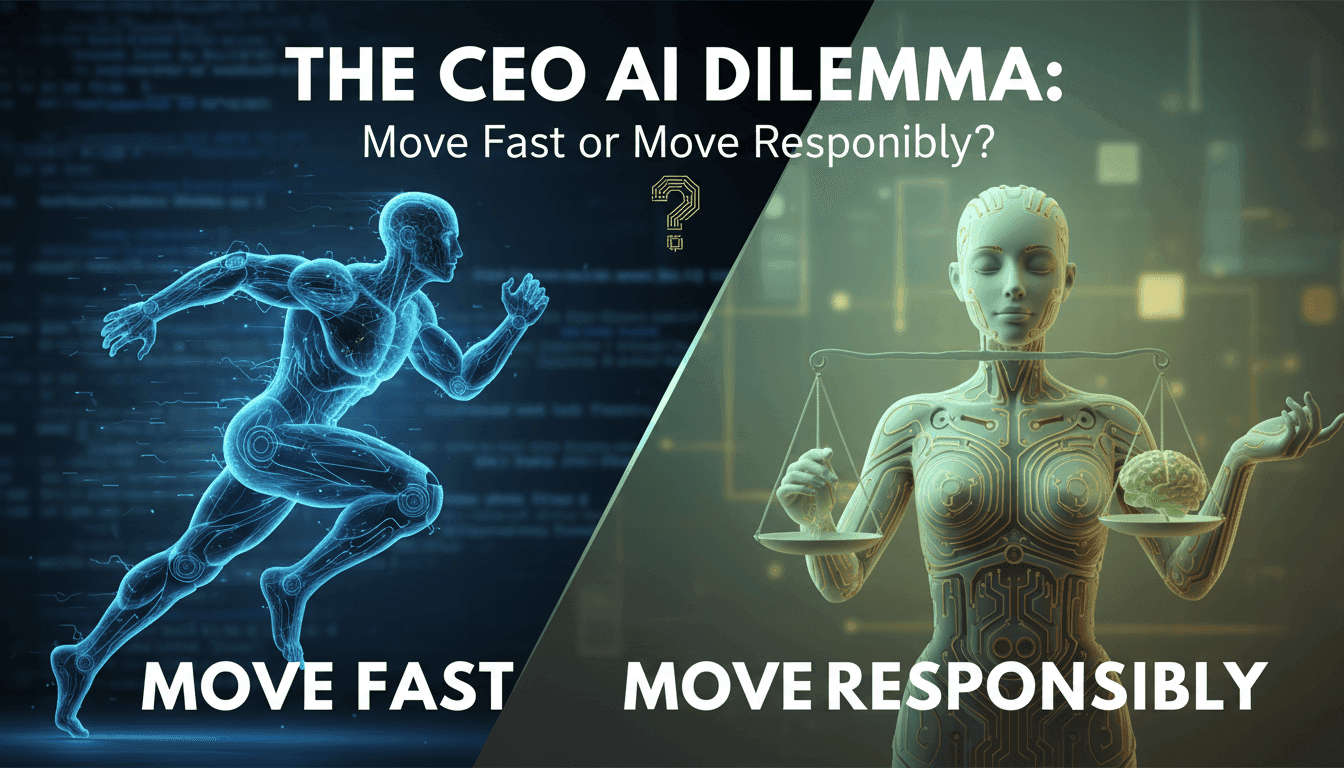
Table Of Contents
- The Pressure Is Real — And So Is the Risk
- Why This Isn't Actually a Binary Choice
- The Hidden Cost of Moving Too Fast
- The Four Pillars of Responsible Speed
- What 'Responsible Speed' Looks Like in Practice
- The CEO's Role Has Changed — Have You?
- Final Thought: The Dilemma Is a Leadership Test
The CEO AI Dilemma: Move Fast or Move Responsibly?
If you've sat in a board meeting recently where AI came up — and it almost certainly did — you know the pressure intimately. Your board wants faster progress. Your investors are watching what competitors are doing. And somewhere in your leadership team, there are people quietly worried that one wrong move with AI could backfire badly enough to make headlines. So you find yourself caught between two forces that feel mutually exclusive: urgency and responsibility.
Here's the thing most executive conversations get wrong. This isn't actually a choice between speed and responsibility. It's a question of whether your organization has the architecture to pursue both at the same time. The CEOs who are winning the AI race right now aren't the ones moving fastest. They're the ones moving smartest — with clear priorities, deliberate governance, and a workforce that's genuinely along for the ride.
This article unpacks that tension head-on. We'll look at why the pressure is legitimate, where unchecked speed creates real risk, and what a practical framework for responsible AI acceleration actually looks like — one you can bring back to your leadership team this week.
The Pressure Is Real — And So Is the Risk {#the-pressure-is-real}
The boardroom anxiety around AI isn't manufactured. The data backs it up at every turn. According to a 2026 BCG global survey of 625 executives, more than 60% of CEOs believe their boards are pushing AI transformation too quickly — yet those same CEOs acknowledge that waiting isn't a safe option either. It's a genuinely uncomfortable position: being pushed from above while managing uncertainty below.
And the competitive stakes have shifted. Unlike earlier technology waves — cloud migration, digital transformation, mobile-first strategy — AI doesn't reward the patient second mover the way those transitions did. The organizations building AI-driven capabilities today are accumulating proprietary data, operational muscle memory, and workflow advantages that compound over time. Sitting out for another 18 months isn't cautious. It's costly.
At the same time, the risks of moving without structure are equally real. A 2026 EY survey found that more than half of department-level AI initiatives operate without formal approval or governance. The result is what researchers are now calling an "AI execution gap" — a widening divide between the number of AI tools deployed and the number delivering measurable business impact. Speed without structure doesn't generate results. It generates technical debt, organizational confusion, and exposure.
Why This Isn't Actually a Binary Choice {#not-a-binary-choice}
The framing of "fast versus responsible" is seductive because it gives leadership teams a simple story to tell. Either we're bold innovators racing ahead, or we're careful stewards protecting the business. The problem is that neither extreme produces good outcomes.
Organizations that prioritize deployment speed over accountability structures are already facing consequences — shadow AI proliferation, unvetted outputs reaching customers, and CIOs being held responsible for systems they never approved. At the same time, organizations that treat every AI initiative as a governance problem to be solved before anything ships end up in perpetual pilot mode, never translating experimentation into enterprise-wide impact.
The better frame is responsible speed — a deliberate approach that moves fast on the right things while building the foundations that allow scale to happen safely. This isn't a compromise position. It's the highest-performance position, and it's what separates the organizations posting double-digit productivity gains from those stuck running disconnected proof-of-concept projects. The differentiator, as the data consistently shows, isn't access to the best AI models. It's how effectively AI is governed, prioritized, and embedded into real workflows.
The Hidden Cost of Moving Too Fast {#hidden-cost}
There's a version of AI speed that looks impressive in a board presentation and falls apart in execution. You've probably seen it: a company rolls out a generative AI tool to every department simultaneously, adoption numbers look great in week one, and then someone in legal quietly asks whether anyone knows what employees are actually putting into the system. That's not a hypothetical. It's a pattern playing out across enterprises right now.
When speed outpaces governance, the costs are rarely immediate and obvious. They accumulate in ways that are harder to see: quality degradation as AI-generated outputs replace careful human judgment, accountability gaps when no one owns what the AI produces, and regulatory exposure that only surfaces when enforcement catches up. Gartner estimates that by the end of 2026, more than 2,000 situations will arise where autonomous AI systems cause harm leading to regulatory investigation — and governance investment before scaling is the primary mitigation.
There's also a people cost that leaders underestimate. When employees feel like AI is being done to them rather than deployed with them, the result isn't just morale damage. It's the quiet undermining of the very transformation you're trying to achieve. Teams work around tools they don't trust, adoption stalls, and the gap between what your AI strategy promises and what it delivers widens.
The Four Pillars of Responsible Speed {#four-pillars}
So what does responsible AI acceleration actually look like in practice? Based on what leading organizations are getting right in 2026, it comes down to four interlocking disciplines.
Start With the Business Problem, Not the Technology {#business-problem}
This is where most AI initiatives go wrong before they even begin. The temptation is to find a powerful AI tool and then identify where to use it. The right sequence is the opposite: identify the two or three business problems that matter most to your enterprise, and then ask what AI can do to solve them.
This distinction is not semantic. When you start with the technology, you end up with scattered pilots that impress technically but don't move business metrics. When you start with the problem — customer churn, claims processing time, supply chain forecasting accuracy — you create the conditions for AI to deliver outcomes that the board actually cares about. The focus also protects your team from the burnout that comes from trying to implement AI everywhere simultaneously, spreading expertise thin and producing weak results across the board.
Leaders who are genuinely winning with AI in 2026 are anchoring every initiative on measurable business outcomes, not AI usage metrics. The question isn't "how many employees are using our AI tools?" It's "what has actually changed in the economics of our business?"
Pick Your Battles Deliberately {#pick-battles}
Once you've identified your priority problems, the next discipline is sequencing. Not all AI use cases carry the same risk profile, and responsible speed means starting in the places where learning is cheap and failure is recoverable.
Begin with processes where being mostly right is genuinely useful, where a human can review outputs before they affect customers or compliance, and where the organization can build familiarity with AI in a low-stakes environment. Customer service draft responses, internal knowledge retrieval, and marketing copy are common starting points precisely because they allow teams to build hands-on experience before moving into higher-stakes territory. Reserve AI for regulatory reporting, financial statements, or clinical decision-making only after your governance infrastructure can support it.
The goal in the early stages isn't perfection. It's building the organizational muscle memory that makes scaling easier and safer over time. Think of it as a crawl-walk-run approach: use early initiatives to strengthen data quality, establish governance norms, and develop the internal skills that more complex use cases will require.
Build Governance Before You Scale {#build-governance}
Governance is the word that makes most executives' eyes glaze over — but frame it differently and it becomes one of the most valuable investments a CEO can make. Good AI governance isn't a bureaucratic overhead. It's the infrastructure that lets you move fast with confidence.
The organizations getting this right aren't creating governance as an afterthought. They're establishing it as a precondition for scale. This means having cross-functional AI councils with real decision-making authority — not advisory committees that meet quarterly, but bodies that can actually approve or block deployments based on risk and readiness. It means assigning specific executives personal accountability for AI outcomes, not just oversight. And it means building escalation paths so that when something goes wrong (and something will), the organization knows exactly how to respond.
IBM's model here is instructive: an AI Ethics Board co-chaired by senior executives reviews high-risk use cases across business units, supported by business-unit focal points who act as first-line reviewers. The result is a governance structure that enables speed rather than constraining it, because teams know the guardrails before they build — not after.
Treat Your People as the Real Variable {#people-variable}
Here's the finding that most technology-focused AI strategies still underweight: in any AI transformation, technology represents a small fraction of the actual work. The larger share — by a significant margin — is the human work of helping employees understand what AI means for their roles, build genuine confidence with new tools, and shift their workflows in ways that stick.
When people say they "aren't ready" for AI, it rarely means they lack the technical aptitude. It usually means they're anxious about what AI signals for the value of their expertise, their career trajectory, and their judgment. That anxiety doesn't go away because you deploy a new tool. It goes away when leaders address it honestly: AI is here to extend what your people can do, not to replace what they know. And then back that message up with practical, low-pressure ways for employees to build real familiarity — summarizing meeting notes, drafting first versions of documents, analyzing customer feedback — before the stakes are high.
Deloitte's 2026 research identifies the AI skills gap as the single biggest barrier to AI integration, and frames workforce reskilling not as an HR initiative but as a revenue protection initiative. The organizations moving fastest with AI are the ones where the largest number of employees know how to use AI tools effectively in their daily work. That's not a coincidence. It's the mechanism.
If you're looking to close that gap in your organization, Business+AI's workshops and masterclasses are designed specifically to build hands-on AI capability across leadership and functional teams — turning awareness into applied skill in real business contexts. For organizations working through the strategic dimensions of AI adoption, Business+AI's consulting services provide structured, expert-led support.
What 'Responsible Speed' Looks Like in Practice {#responsible-speed-practice}
Pull all four pillars together and responsible speed starts to look less like a philosophy and more like a playbook. The CEOs executing it well in 2026 share a common pattern:
- They are specific about priorities. Two or three high-value business problems, not fifty scattered experiments.
- They sequence by risk. Low-stakes, human-supervised processes first. High-stakes, low-oversight processes only after governance is in place.
- They define accountability explicitly. Every AI initiative has a named owner — not a committee, not a department, a person.
- They measure what matters. Adoption metrics tell you how many people clicked. Business outcome metrics tell you whether anything changed.
- They make failure safe, not shameful. Teams that fear being blamed for an AI initiative that doesn't work will never surface the learnings that make the next one better. The culture around AI experimentation needs to treat honest post-mortems as a feature, not a failure.
This isn't a slow approach. Organizations that follow this pattern consistently report faster time-to-value than those chasing breadth over depth, precisely because they're not unwinding poorly governed deployments or rebuilding trust after high-profile failures.
The CEO's Role Has Changed — Have You? {#ceo-role}
There's a version of AI leadership that treats the CEO's job as approving a strategy and stepping back. That version is becoming obsolete fast. IBM's 2026 CEO research shows that executives expect the share of operational decisions made by AI to increase substantially by 2030, while simultaneously emphasizing that human judgment becomes more critical, not less, as AI takes on more routine decision-making.
What that means practically: CEOs need to be close enough to their AI initiatives to ask the right questions, spot the governance gaps, and keep their organizations honest about what's working. It doesn't mean becoming an AI expert. It means refusing to let AI strategy live only in the technology function. The CEOs who are setting the pace aren't the ones who delegated AI to their CIO. They're the ones who made it a cross-functional leadership priority, showed up for the hard conversations with their teams, and stayed honest with their boards about where progress is real and where it isn't.
If you want to build that kind of executive-level clarity, Business+AI's masterclass programs are designed for exactly this — equipping senior leaders with the frameworks and peer insights to lead AI transformation with confidence rather than reaction. And if you want to benchmark your approach against peers and hear from organizations navigating this in real time, the Business+AI Forum brings together the executives, consultants, and solution vendors who are doing this work at the sharp end.
Final Thought: The Dilemma Is a Leadership Test {#final-thought}
The CEO AI dilemma is ultimately not a technology question. It's a leadership test. The organizations that come out ahead won't be the ones that moved fastest or the ones that moved most carefully. They'll be the ones led by executives who could hold two truths at once: the urgency is real, and the foundations matter. Those aren't opposing forces. Handled well, they're the same strategy.
There's No Perfect Answer — But There Is a Better Approach
Every CEO grappling with AI right now is working with imperfect information, evolving technology, and a board that wants clear answers to unclear questions. The goal isn't to have the perfect AI strategy before you move. The goal is to move with intention — focused on the right problems, honest with your team about what's working, and disciplined enough to build the governance that makes real scale possible.
The executives who will look back on 2026 as the year they got AI right are the ones making those calls now. Not waiting for certainty. Not chasing breadth. Moving with purpose, bringing their people with them, and staying close enough to the work to know the difference between progress and noise.
Ready to move from AI conversation to AI results?
Business+AI is a Singapore-based ecosystem built to help executives turn AI ambition into measurable business outcomes. Whether you're looking to build internal capability, sharpen your strategy, or connect with peers navigating the same decisions, we have the resources to accelerate your journey.
- Explore our Workshops for hands-on AI skill-building across your leadership and functional teams
- Access expert-led strategic support through Business+AI Consulting
- Develop executive-level AI leadership through our Masterclass programs
- Join the Business+AI Forum to learn from and connect with executives doing this work in real time