
The AI Advisory Committee: Including Employees in AI Decisions for Better Business Outcomes
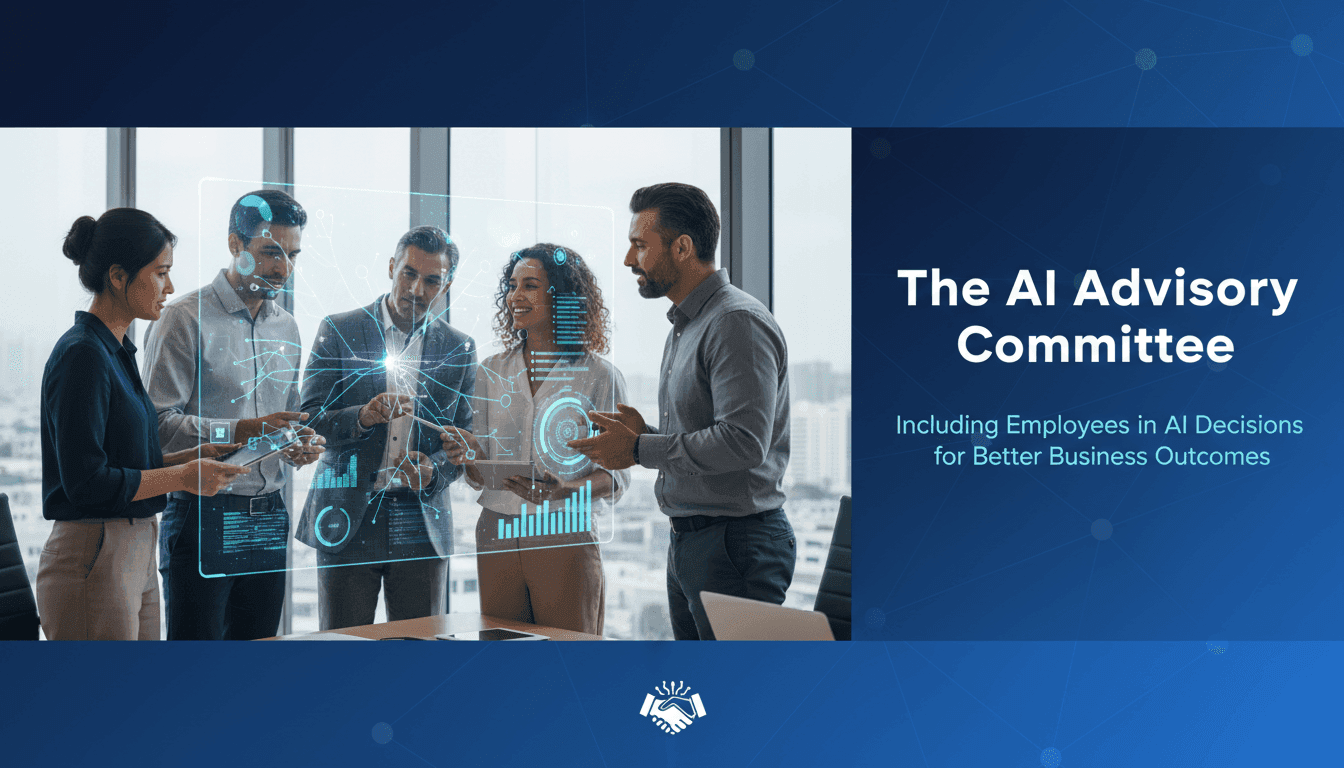
Table Of Contents
- Why Employee Inclusion in AI Decisions Matters
- The Business Case for AI Advisory Committees
- Building Your AI Advisory Committee: Structure and Composition
- Key Roles and Responsibilities Within the Committee
- Establishing Effective Committee Processes
- Overcoming Common Implementation Challenges
- Measuring Success and Impact
- Real-World Examples of Employee-Inclusive AI Governance
As artificial intelligence reshapes business operations across every industry, a critical question emerges: who should decide how AI is implemented in your organization? While many companies default to top-down AI strategies driven solely by C-suite executives and IT departments, forward-thinking organizations are discovering that including employees at all levels in AI decision-making produces significantly better outcomes. The AI advisory committee represents a structured approach to democratizing AI governance, creating a forum where diverse perspectives shape how your organization develops, deploys, and manages AI technologies.
The stakes couldn't be higher. Organizations that fail to include frontline employees in AI decisions often face resistance, poor adoption rates, and missed opportunities to leverage ground-level insights. Meanwhile, companies that establish inclusive AI advisory committees report higher employee engagement, faster AI adoption, and more practical AI applications that solve real business problems. This inclusive approach transforms AI from a threatening unknown into a collaborative tool that employees help shape and champion.
In this comprehensive guide, we'll explore how to build an effective AI advisory committee that includes employees across your organization, establish governance processes that balance innovation with responsibility, and create a culture where AI decisions reflect the collective wisdom of your entire workforce. Whether you're just beginning your AI journey or looking to improve existing AI governance structures, this framework will help you turn employee inclusion into a competitive advantage.
The AI Advisory Committee Framework
Include Employees in AI Decisions for Better Business Outcomes
Why Employee Inclusion Matters
Essential Committee Components
6-Point Proposal Evaluation Framework
Key Takeaway
Organizations with inclusive AI advisory committees achieve faster adoption, reduced implementation risk, and better business outcomes by combining technological capabilities with employee expertise at every level.
Why Employee Inclusion in AI Decisions Matters {#why-employee-inclusion-matters}
The traditional approach to AI implementation follows a familiar pattern: executives identify opportunities, technology teams build solutions, and employees are expected to adopt whatever gets rolled out. This top-down model overlooks a fundamental reality—the people who work directly with processes, customers, and data often possess the deepest understanding of where AI can create genuine value.
Employee inclusion in AI decisions addresses three critical business imperatives. First, it dramatically improves adoption rates by giving employees ownership over changes that affect their work. When people help shape AI implementations, they become advocates rather than resistors. Second, frontline employees identify use cases and potential pitfalls that leadership teams might miss from their distance. A customer service representative understands nuances of customer interactions that no executive dashboard can capture. Third, inclusive AI governance builds trust during a period of significant workplace anxiety about automation and job displacement.
Research consistently shows that organizations with participatory AI governance structures achieve faster time-to-value from AI investments. Employees who contribute to AI decisions develop deeper AI literacy, spot implementation issues earlier, and provide invaluable feedback that prevents costly mistakes. Perhaps most importantly, inclusion ensures that AI solutions address real problems rather than theoretical opportunities that look good in boardroom presentations but fail in practical application.
For organizations serious about transforming AI talk into tangible business gains, employee inclusion isn't optional—it's foundational to sustainable AI success.
The Business Case for AI Advisory Committees {#business-case-for-ai-advisory-committees}
An AI advisory committee formalizes employee participation in AI governance through a structured body that guides AI strategy, evaluates proposed implementations, and monitors ongoing AI initiatives. Unlike ad-hoc feedback sessions or token consultation, a properly constituted committee gives employees genuine influence over AI decisions that affect the organization.
The business benefits extend across multiple dimensions. AI advisory committees reduce implementation risk by subjecting AI proposals to scrutiny from diverse perspectives before significant resources get committed. A proposed AI customer service chatbot might seem brilliant until call center representatives on the committee explain why customers in specific situations need human interaction. This early feedback prevents expensive failures and reputational damage.
Committees also accelerate organizational AI maturity by creating a consistent forum for AI education and knowledge sharing. As committee members learn about AI capabilities and limitations, they become ambassadors who can explain AI initiatives to their peers, reducing misinformation and anxiety. This distributed AI literacy proves invaluable as AI becomes embedded across business operations.
From a talent perspective, AI advisory committees signal that your organization values employee input on transformative technology. In competitive labor markets, this inclusive approach attracts and retains forward-thinking professionals who want to work for organizations that respect their expertise. The committee also identifies emerging AI champions within your workforce who can drive future initiatives.
Finally, advisory committees provide accountability mechanisms that pure top-down structures lack. When cross-functional employees regularly review AI initiatives, projects stay aligned with stated values and business objectives. This transparency builds organizational trust and ensures AI implementations serve the broader good rather than narrow departmental interests.
Building Your AI Advisory Committee: Structure and Composition {#building-your-ai-advisory-committee}
The effectiveness of your AI advisory committee depends heavily on thoughtful composition. The goal is creating a body that represents diverse perspectives while remaining small enough for productive discussion and decision-making.
Cross-Functional Representation
Your committee should include representatives from every major function that AI will impact. This typically includes operations, customer-facing roles, finance, human resources, legal/compliance, IT, and data teams. Each function brings unique insights about how AI can create value and what risks need mitigation. A logistics coordinator understands supply chain optimization opportunities that finance team members might never consider.
Hierarchical Diversity
Perhaps most critically, include employees from various organizational levels. While executive sponsorship remains essential, frontline employees often have the most granular understanding of workflow inefficiencies and customer pain points. A balanced committee might include one C-suite sponsor, several middle managers, and multiple individual contributors. This hierarchical mix ensures decisions aren't skewed by distance from actual operations.
Skills and Expertise Balance
Strike a balance between technical AI expertise and domain knowledge. You need some members who understand machine learning capabilities and limitations, but the committee shouldn't become a purely technical body. Domain experts from various business areas provide equally valuable perspectives on where AI can solve real problems. A marketing professional without technical AI knowledge might identify customer segmentation opportunities that data scientists overlook.
Size Considerations
Most effective AI advisory committees range from 8-15 members. Smaller committees may lack sufficient diversity of perspective, while larger groups become unwieldy for productive discussion. If your organization is large enough to warrant broader participation, consider a tiered structure with a core committee and rotating representatives from different departments.
Term Limits and Rotation
Implement term limits (typically 12-18 months) with staggered rotation to balance continuity with fresh perspectives. This approach prevents committee calcification while ensuring institutional knowledge persists. Rotation also gives more employees the opportunity to participate over time, spreading AI literacy throughout the organization.
For organizations ready to build structured AI capabilities, Business+AI workshops provide hands-on guidance for establishing effective governance structures tailored to your specific context.
Key Roles and Responsibilities Within the Committee {#key-roles-and-responsibilities}
Clearly defined roles prevent confusion and ensure your AI advisory committee operates efficiently. While specific titles may vary, most successful committees include these core roles.
Executive Sponsor
The executive sponsor, typically a C-suite leader, provides strategic direction and ensures the committee's recommendations receive serious consideration in leadership discussions. This person secures resources for committee operations, breaks through bureaucratic obstacles, and champions the committee's work to other executives. The sponsor attends key meetings but shouldn't dominate discussions—their primary role is enabling the committee rather than directing it.
Committee Chair
The chair manages meeting logistics, sets agendas based on member input, and ensures productive discussions. Effective chairs balance structure with flexibility, keeping conversations focused while allowing important tangents. Many organizations select a senior manager rather than an executive for this role, someone respected across functions who can facilitate without intimidating participants.
Domain Representatives
Each functional area should have designated representatives responsible for bringing their team's perspectives to committee discussions. These members research how proposed AI initiatives might impact their departments, solicit feedback from colleagues, and communicate committee decisions back to their teams. Domain representatives serve as bidirectional bridges between the committee and the broader organization.
Technical Advisors
While not every committee member needs deep technical expertise, designated technical advisors explain AI capabilities, assess feasibility of proposals, and flag potential technical risks. These members often come from data science, IT, or engineering teams. Their role is translation—helping non-technical members understand what's possible, practical, and problematic from a technical perspective.
Ethics and Compliance Lead
As AI raises increasingly complex ethical and regulatory questions, designate at least one member to focus specifically on these dimensions. This person ensures AI proposals undergo scrutiny for bias, privacy concerns, regulatory compliance, and alignment with organizational values. They bring ethics and compliance considerations into discussions before they become problems.
Secretary/Coordinator
The often-overlooked coordinator role handles meeting logistics, maintains documentation, tracks action items, and ensures follow-through between meetings. Effective committees treat this as a serious role rather than administrative afterthought, as consistent documentation and follow-up separates productive committees from discussion groups that never drive real change.
Establishing Effective Committee Processes {#establishing-effective-processes}
Structure determines whether your AI advisory committee becomes a powerful governance mechanism or a time-wasting talking shop. Establish clear processes from the outset.
Meeting Cadence and Format
Most effective committees meet monthly for 90-120 minutes, with additional ad-hoc sessions for urgent decisions. Monthly meetings provide enough frequency for meaningful oversight without overwhelming member schedules. Structure meetings with three consistent segments: updates on ongoing AI initiatives, evaluation of new proposals, and strategic discussion of emerging AI trends or challenges.
Decision-Making Authority
Clearly define what the committee can decide versus what it recommends to leadership. Many successful models give committees decision authority over AI pilots and smaller implementations while reserving major strategic decisions for executive teams with strong committee input. Ambiguity about authority undermines committee effectiveness and member engagement.
Proposal Evaluation Framework
Develop a consistent framework for evaluating AI proposals that committees apply to every initiative. Effective frameworks assess proposals across multiple dimensions:
- Business value: What specific problems does this solve and what measurable outcomes should it produce?
- Feasibility: Do we have the data, skills, and resources to implement this successfully?
- Risk assessment: What could go wrong from technical, ethical, legal, and reputational perspectives?
- Employee impact: How will this affect workflows, roles, and job satisfaction?
- Customer impact: How might this change customer experiences positively or negatively?
- Alignment: Does this advance our strategic objectives and reflect our values?
This structured approach prevents decisions driven by enthusiasm for shiny new technology while ensuring thorough consideration of proposals that might seem boring but create significant value.
Communication Protocols
Establish how the committee communicates with the broader organization. Regular updates through town halls, newsletters, or dedicated channels keep employees informed about AI initiatives and demonstrate that the committee drives real decisions. Transparency builds trust and positions the committee as a legitimate governance body rather than theatrical window-dressing.
For executives seeking to develop comprehensive AI strategies that integrate employee perspectives, Business+AI masterclasses offer expert-led guidance on bridging strategic vision with practical implementation.
Overcoming Common Implementation Challenges {#overcoming-implementation-challenges}
Even well-designed AI advisory committees encounter predictable challenges. Anticipating these obstacles allows you to address them proactively.
Token Participation Versus Genuine Influence
The most common failure mode is committees that appear inclusive but lack real authority. Employees quickly recognize when their input gets ignored, leading to cynicism that's worse than never asking for input. Combat this by establishing clear examples where committee recommendations changed or stopped AI initiatives. Publicize these instances to demonstrate that participation matters.
Technical Knowledge Gaps
Non-technical committee members sometimes feel intimidated by AI discussions, leading them to defer to technical experts rather than contributing valuable domain insights. Address this through regular AI literacy sessions tailored to committee members. Focus on conceptual understanding rather than technical details—members need to grasp what AI can and cannot do, not how neural networks function mathematically.
Time Commitment Concerns
Employees already have full-time responsibilities, and committee participation adds to their workload. Ensure that participation is recognized and valued in performance evaluations, and that managers understand committee work is a legitimate use of time. Some organizations provide small stipends or professional development credits to committee members.
Balancing Speed with Inclusion
Rigorous committee evaluation can slow AI implementation when speed matters competitively. Establish expedited processes for time-sensitive decisions while maintaining oversight. Some committees designate a smaller executive subcommittee empowered to make rapid decisions with full committee review afterward.
Managing Conflicting Interests
Different departments often have competing priorities that surface in committee discussions. An AI initiative that improves efficiency in operations might increase workload for customer service. Effective chairs acknowledge these tensions rather than glossing over them, working toward solutions that distribute benefits and costs fairly across the organization.
Preventing Committee Capture
Over time, committees risk becoming dominated by particular perspectives or evolving into rubber stamps for predetermined decisions. Regular member rotation, diverse composition, and explicit attention to inclusive facilitation all help prevent capture. Anonymous feedback surveys allow members to raise concerns about committee dynamics without social risk.
Measuring Success and Impact {#measuring-success-and-impact}
What gets measured gets managed. Establish clear metrics for assessing your AI advisory committee's effectiveness.
Process Metrics
Track basic operational indicators like meeting attendance rates, proposal volume, decision turnaround time, and action item completion. These process metrics reveal whether the committee functions smoothly or encounters operational friction that needs addressing.
Influence Metrics
Measure how often committee recommendations get implemented, how many AI initiatives originated from committee member suggestions, and how frequently leadership solicits committee input on AI strategy. These indicators demonstrate whether the committee exercises real influence or serves purely symbolic purposes.
Outcome Metrics
Ultimately, the committee should improve AI outcomes across the organization. Track AI adoption rates, employee satisfaction with AI implementations, time-to-value for AI projects, and incidence of AI-related problems or failures. Compare these metrics before and after establishing the committee to assess impact.
Perception Metrics
Survey employees regularly about their confidence in organizational AI governance, whether they believe their concerns are heard, and their understanding of AI initiatives. Positive shifts in employee sentiment indicate the committee successfully builds trust and transparency around AI.
Learning and Development Impact
Monitor AI literacy across the organization, using committee members as a benchmark. As members develop expertise and share knowledge with their teams, organizational AI maturity should increase measurably.
Regularly review these metrics with committee members and leadership, using insights to refine committee operations and demonstrate value. Committees that prove their impact through data secure ongoing organizational support and influence.
Real-World Examples of Employee-Inclusive AI Governance {#real-world-examples}
Several organizations have pioneered employee-inclusive approaches to AI governance with impressive results.
A Singapore-based regional logistics company established an AI advisory committee including warehouse workers, delivery drivers, and customer service representatives alongside technology and operations leaders. This diverse committee identified that a proposed AI route optimization system would create problems during peak delivery periods that algorithms couldn't anticipate. Driver input led to a hybrid approach combining AI optimization with human override capabilities, resulting in 15% efficiency improvements without the service failures that pure algorithmic routing would have caused.
A multinational professional services firm created rotating AI advisory committees in each regional office, with members serving six-month terms. These committees surface culturally specific considerations that centralized AI decisions might miss. In their Asia-Pacific offices, committee members identified that AI tools designed for Western work styles needed adaptation for more collaborative regional approaches. This localized input significantly improved adoption rates compared to global AI rollouts.
A healthcare organization facing staff anxiety about AI medical diagnosis tools formed an advisory committee including physicians, nurses, administrative staff, and patient advocates. The committee developed an AI implementation framework prioritizing augmentation over automation, positioning AI as decision support rather than decision replacement. This framing, developed through inclusive discussion, reduced resistance and helped staff view AI as a productivity tool rather than a threat.
These examples share common elements: genuine employee influence, diverse membership, and organizational commitment to incorporating committee insights into actual decisions. They demonstrate that inclusive AI governance produces better outcomes than purely top-down approaches.
For organizations ready to connect with peers who have successfully implemented employee-inclusive AI governance, the Business+AI Forum provides networking opportunities with executives and consultants across industries.
Creating Sustainable AI Governance Through Inclusion
As AI capabilities expand and AI implementations multiply across organizations, the question isn't whether you need governance structures—it's whether those structures include the employees who understand your business most intimately. AI advisory committees that genuinely incorporate employee perspectives deliver measurable advantages: better AI use case identification, faster adoption, reduced implementation risk, and increased organizational trust.
Building an effective committee requires thoughtful composition that balances functions, hierarchies, and expertise. It demands clear processes for evaluation, decision-making, and communication. It necessitates addressing challenges around authority, technical literacy, and time commitment. Most importantly, it requires organizational commitment to valuing employee input and incorporating their insights into actual AI decisions.
The organizations that thrive in an AI-driven future won't be those with the most advanced algorithms or the biggest AI budgets. They'll be the organizations that successfully harness collective intelligence—combining technological capabilities with the distributed wisdom of employees across every level and function. An AI advisory committee transforms that aspiration into structured reality, creating governance mechanisms that ensure your AI journey reflects the insights of those who will ultimately determine whether AI initiatives succeed or fail.
Employee inclusion in AI decisions isn't about slowing innovation or creating bureaucratic obstacles. It's about accelerating sustainable AI adoption through governance structures that build trust, surface critical insights, and ensure AI implementations solve real problems rather than creating new ones. The question facing your organization isn't whether to include employees in AI decisions—it's how quickly you can establish structures that transform employee expertise into competitive advantage.
The path from AI potential to AI performance requires more than technical expertise and executive vision. It requires the insights, trust, and engagement of employees throughout your organization. An AI advisory committee provides the structure to systematically incorporate employee perspectives into AI governance, transforming how your organization identifies opportunities, evaluates proposals, and implements AI solutions.
By establishing a diverse, empowered committee with clear processes and genuine authority, you create governance that improves both AI outcomes and organizational culture. Employees become AI champions rather than resistors. Use cases emerge from ground-level understanding rather than theoretical possibilities. Implementation risks get identified early by those who understand practical realities. And your organization builds the trust necessary for successful AI transformation.
The committee structures, roles, and processes outlined in this guide provide a framework you can adapt to your organizational context. Start with pilot committees focused on specific AI initiatives, learn from early implementations, and scale successful approaches across the organization. Measure impact rigorously, communicate transparently, and continuously refine your approach based on what works.
Most importantly, commit to genuine inclusion. Token participation that ignores employee input produces cynicism that undermines all future AI initiatives. When you give employees real influence over AI decisions and demonstrate that their perspectives shape outcomes, you unlock the collaborative potential that transforms AI from a source of anxiety into a tool for collective advancement.
Ready to Build AI Capabilities That Include Your Entire Organization?
Establishing effective AI governance requires more than good intentions—it demands structured approaches, expert guidance, and connection with organizations navigating similar challenges. Business+AI membership provides the resources, community, and expertise to help your organization turn employee inclusion into AI advantage. Join executives, consultants, and solution vendors who are building AI-powered futures through collaborative approaches that value every perspective. Transform AI talk into tangible business gains—together.