
The 3-Tier AI Upskilling Model: From Literacy to Innovation Excellence
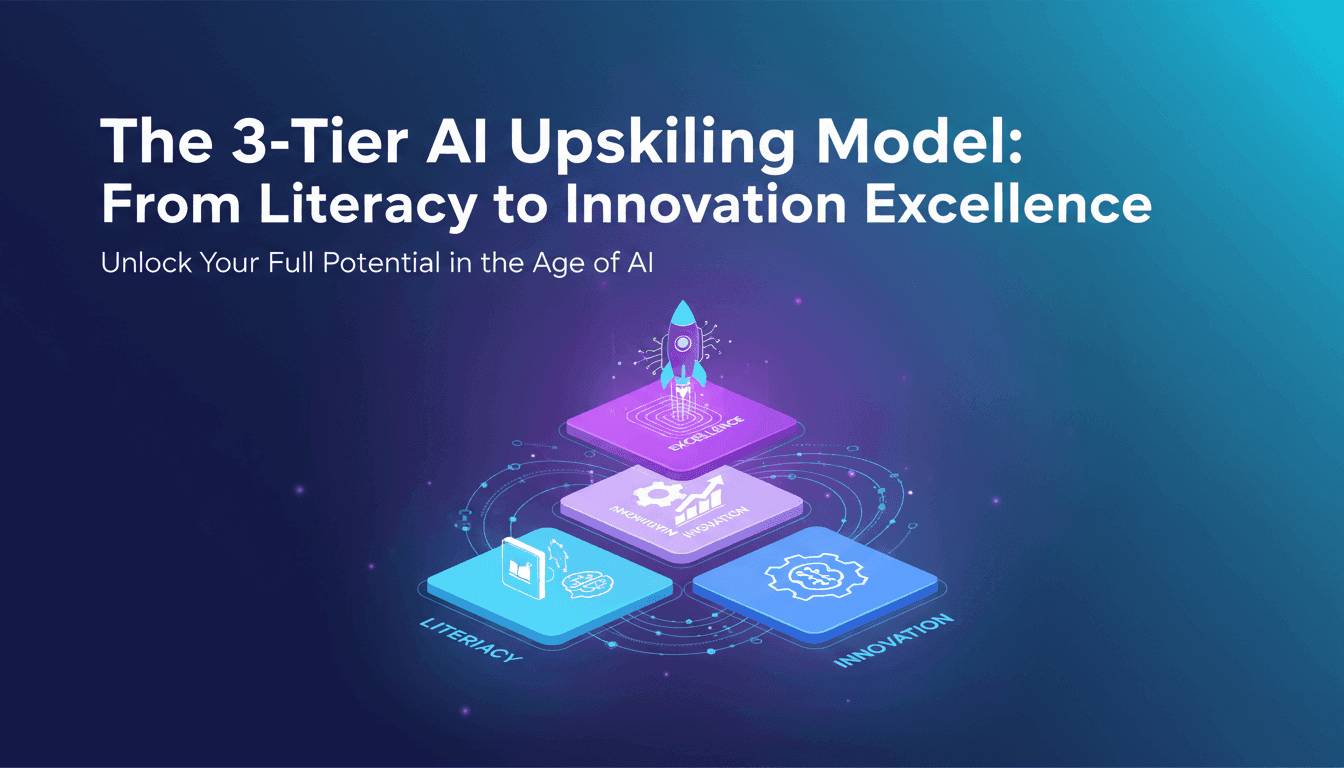
Table Of Contents
- Understanding the AI Upskilling Imperative
- The Three-Tier AI Upskilling Framework
- Tier 1: AI Literacy – Building Your Foundation
- Tier 2: AI Fluency – Developing Working Competence
- Tier 3: AI Innovation – Creating Competitive Advantage
- Implementing the Model in Your Organization
- Measuring Success Across the Three Tiers
- Common Pitfalls to Avoid
The conversation around artificial intelligence has shifted dramatically. No longer confined to technology departments or innovation labs, AI has become a boardroom priority that demands attention from every corner of the organization. Yet most companies struggle with a fundamental question: where do we actually start with AI upskilling?
The answer lies not in a single training program or certification, but in understanding that different roles require different depths of AI knowledge. A marketing manager doesn't need to code machine learning algorithms, but they absolutely need to understand how AI can transform customer segmentation. A product designer doesn't need to architect neural networks, but they must know how to integrate AI capabilities into user experiences.
This is where the 3-tier AI upskilling model provides clarity. By segmenting your workforce into three distinct levels—literacy, fluency, and innovation—you create a structured pathway that meets people where they are while building the comprehensive AI capability your organization needs to compete. The model recognizes that AI transformation isn't about turning everyone into data scientists; it's about ensuring every employee has the right level of AI understanding to excel in their role and contribute to your organization's AI-powered future.
The 3-Tier AI Upskilling Model
Transform your organization from basic literacy to innovation excellence
The Reality: 84% of executives believe AI will give them a competitive advantage, yet fewer than 40% have implemented comprehensive AI training programs.
What Each Tier Delivers
AI Literacy Foundation
Conceptual understanding, opportunity recognition, informed collaboration
AI Fluency Development
Hands-on implementation, autonomous tool usage, practical application
AI Innovation Leadership
Novel AI solutions, technical architecture, competitive differentiation
Key Success Factors
Ready to Transform Your Organization?
Build comprehensive AI capability with structured learning pathways, expert guidance, and ongoing support.
Join Business+AI MembershipAccess workshops • masterclasses • consulting • annual forum
Understanding the AI Upskilling Imperative
Businesses today face an unprecedented skills gap. According to recent research, 84% of executives believe AI will give them a competitive advantage, yet fewer than 40% have implemented comprehensive AI training programs. This disconnect creates a dangerous vulnerability where companies invest millions in AI technology but lack the human capability to leverage it effectively.
The challenge isn't just technical. While data scientists and ML engineers remain in short supply, the more critical gap exists in the broader workforce's ability to think strategically about AI applications, identify high-value use cases, and collaborate effectively with technical teams. Organizations need employees who can bridge the gap between business problems and AI solutions, even if they never write a line of code.
This reality has given rise to a more nuanced approach to AI education. Rather than attempting to train everyone to the same level or focusing exclusively on technical roles, forward-thinking organizations are adopting tiered models that recognize different learning needs across the enterprise. The 3-tier approach provides this structure, creating clear pathways for different employee populations while ensuring everyone develops the AI competencies their role demands.
The Three-Tier AI Upskilling Framework
The 3-tier AI upskilling model divides organizational AI capability into three progressive levels, each building on the foundation of the previous tier. Think of it as a pyramid: a broad base of AI literacy supports a smaller group with AI fluency, which in turn enables a specialized innovation team at the apex.
This structure reflects how AI knowledge should distribute across your organization. Everyone needs literacy—the ability to understand AI concepts and participate in AI-driven transformation. A subset needs fluency—the capability to implement and work hands-on with AI tools and solutions. And a select group needs innovation capability—the expertise to create novel AI applications and drive breakthrough implementations.
The beauty of this model lies in its scalability and adaptability. A 50-person startup and a 10,000-employee enterprise can both apply the framework, adjusting the size of each tier to match their needs, resources, and strategic priorities. More importantly, the model creates clear career pathways, allowing motivated employees to progress from basic literacy through fluency to innovation leadership over time.
Tier 1: AI Literacy – Building Your Foundation
What AI Literacy Means in Practice
AI literacy forms the essential foundation that every employee should possess, regardless of department or seniority. At this level, the goal isn't technical proficiency but conceptual understanding. AI-literate employees can explain what artificial intelligence is and isn't, understand the difference between machine learning and traditional software, and recognize potential AI applications in their daily work.
An AI-literate workforce demonstrates several key capabilities:
- Conceptual understanding: They grasp fundamental AI concepts like machine learning, natural language processing, and computer vision without needing to understand the underlying mathematics
- Opportunity recognition: They can identify processes or challenges in their work that might benefit from AI solutions
- Informed collaboration: They communicate effectively with technical teams about business needs and understand what AI can realistically deliver
- Ethical awareness: They recognize AI bias, privacy concerns, and ethical considerations that should guide AI deployment
- Adaptive mindset: They view AI as a tool that augments human capability rather than a threat to be resisted
Literacy training typically requires 8-16 hours of learning through a combination of online modules, workshops, and practical demonstrations. The content should focus on real-world examples from your industry, avoiding excessive technical detail while building genuine understanding. Workshops designed for broad audiences serve this tier particularly well, creating shared vocabulary and understanding across departments.
Who Needs AI Literacy
The simple answer: everyone. From customer service representatives to senior executives, every employee benefits from AI literacy. This universal baseline ensures that AI transformation doesn't remain siloed in IT or innovation departments but becomes an organization-wide initiative.
For executives and senior leaders, AI literacy means understanding the strategic implications of AI, making informed investment decisions, and leading AI-driven transformation with confidence. For middle managers, it means identifying opportunities within their teams, supporting AI adoption, and helping their reports navigate changing workflows. For frontline employees, it means working effectively alongside AI tools and contributing ideas for improvement based on their ground-level expertise.
Creating this foundation across your entire organization generates compound benefits. Conversations about AI become more productive when everyone speaks the same language. Resistance to AI initiatives decreases when employees understand the technology rather than fearing it. And innovation accelerates when ideas come from every corner of the company rather than just the IT department.
Tier 2: AI Fluency – Developing Working Competence
Defining AI Fluency
AI fluency represents the next level of capability, where understanding transitions into practical application. Fluent employees don't just comprehend AI concepts; they actively work with AI tools, implement solutions, and serve as multipliers for your organization's AI capabilities.
At this tier, individuals develop hands-on skills that vary by role. A marketing analyst might become fluent in using AI-powered analytics platforms to predict customer behavior and optimize campaigns. A product manager might master prompt engineering to leverage large language models for competitive research and feature ideation. An operations manager might learn to configure and deploy AI-driven process automation within their department.
The distinguishing characteristic of fluency is autonomy. Where literate employees can participate in AI discussions and identify opportunities, fluent employees can take action. They configure tools, run experiments, interpret results, and implement improvements without constant technical support. This independence dramatically accelerates AI adoption by distributing implementation capability across the organization rather than bottlenecking it in specialized teams.
Developing fluency typically requires 40-80 hours of structured learning combined with ongoing practice and application. The training becomes more specialized and role-specific at this level, focusing on the AI tools and techniques most relevant to particular job functions. Masterclasses that provide deep-dive, hands-on experience with specific AI applications serve this tier effectively.
Target Audience for Fluency Training
Not every employee needs to reach fluency, but strategically selecting who receives this training determines your organization's AI velocity. The ideal candidates typically fall into several categories:
- Functional leaders and managers: Those responsible for departmental outcomes who can integrate AI solutions directly into their teams' workflows
- Business analysts and data professionals: Individuals who already work with data and can extend their capabilities with AI-powered analysis and prediction
- Product and project managers: Those guiding development efforts who need to incorporate AI features and capabilities into their deliverables
- Domain experts: Deep specialists in areas like finance, supply chain, or customer experience who can apply AI to their specific expertise
- Early adopters and champions: Enthusiastic employees who will model successful AI adoption and mentor others
The size of your fluency tier typically ranges from 10-25% of your workforce, depending on your industry and AI ambitions. Technology companies might push toward the higher end, while organizations in less AI-intensive sectors might start smaller and expand over time.
Selecting fluency candidates should balance current capability with future potential. Look for individuals who combine domain expertise, analytical thinking, and demonstrated learning agility. Previous technical experience helps but shouldn't be a requirement; the best AI practitioners often come from business backgrounds that give them the context to apply AI meaningfully.
Tier 3: AI Innovation – Creating Competitive Advantage
What AI Innovation Requires
At the pyramid's apex sits the innovation tier, where individuals create novel AI solutions, push technical boundaries, and generate competitive differentiation. These are your AI builders—the people who don't just use existing AI tools but develop new capabilities tailored to your unique business challenges.
Innovation-tier competency demands substantially deeper technical knowledge. These individuals understand the mathematics behind machine learning algorithms, can select and fine-tune models for specific use cases, and architect end-to-end AI systems. They stay current with the latest AI research, experiment with emerging techniques, and translate cutting-edge capabilities into business value.
Beyond technical expertise, innovation requires a unique combination of skills. The most effective AI innovators blend deep technical knowledge with business acumen, understanding not just how to build AI systems but which systems create the most value. They combine creativity with rigor, imagining novel applications while maintaining the discipline to validate assumptions and measure results. And they excel at collaboration, working across technical and business teams to transform ideas into production systems.
Developing innovation-tier capability typically requires 200+ hours of intensive, technical training, often supplemented with formal education in computer science, statistics, or related fields. However, training alone doesn't create innovators; they need resources, time for experimentation, and organizational support to explore ideas and learn from failures. Organizations serious about AI innovation should consider consulting partnerships that can accelerate capability development and provide access to specialized expertise.
Building Your Innovation Team
The innovation tier typically represents 2-5% of your workforce, though this varies dramatically based on your AI strategy. A company pursuing AI as a core differentiator might invest in a larger innovation team, while one focused on adopting proven AI applications might maintain a smaller group.
Building this team involves both developing internal talent and strategic hiring. The most sustainable approach combines both. Identify high-potential employees from your fluency tier who demonstrate exceptional aptitude and invest in their advanced development. Simultaneously, recruit experienced AI practitioners who can hit the ground running and mentor developing talent.
Your innovation team should reflect diverse backgrounds and perspectives. Data scientists bring algorithmic expertise, but don't overlook ML engineers who excel at productionizing models, research scientists who can explore novel techniques, and AI product managers who can translate capabilities into roadmaps. The most effective teams combine these specializations rather than trying to find unicorns who excel at everything.
Providing the right environment matters as much as assembling the right people. Innovation teams need access to quality data, appropriate compute resources, and tools that enable experimentation. They need protection from excessive bureaucracy that stifles creativity while maintaining enough governance to ensure responsible AI development. And they need clear connections to business priorities so their innovations solve real problems rather than chasing technology for its own sake.
Implementing the Model in Your Organization
Successfully implementing the 3-tier model requires more than designing training programs; it demands a systematic approach that aligns learning with business objectives, resources, and culture.
Start by assessing your current state. Map your existing AI capabilities against the three tiers to identify gaps. You might discover strong technical capability at the innovation level but limited literacy across the broader organization, creating an execution bottleneck. Or you might find scattered fluency without the foundational literacy that enables effective collaboration. Understanding where you stand guides where to invest first.
Next, define tier-specific learning pathways aligned with your business priorities. What does AI literacy mean in your industry and culture? Which roles need fluency first to drive the highest-value use cases? What innovation capabilities will create competitive advantage? Generic AI training delivers generic results; customization ensures learning translates into business impact.
Create progression mechanisms that allow motivated employees to advance between tiers. An employee who completes literacy training and demonstrates aptitude should have a path to fluency development. High performers at the fluency level should see opportunities to join innovation initiatives. These pathways transform AI upskilling from a one-time event into a continuous journey that retains top talent and builds organizational capability over time.
Integrate learning with real work through applied projects and challenges. Literacy training becomes more meaningful when employees immediately apply concepts to identify opportunities in their own roles. Fluency develops faster when participants work on actual business problems rather than academic exercises. Innovation flourishes when teams tackle genuine strategic challenges with visible executive support.
Events like the annual Business+AI Forum complement formal training by exposing employees across all tiers to cutting-edge applications, industry case studies, and peer learning. These experiences inspire possibility while building the professional networks that accelerate learning and collaboration.
Measuring Success Across the Three Tiers
What gets measured gets managed, and AI upskilling demands metrics that go beyond training completion rates to capture genuine capability development and business impact.
For the literacy tier, measure both coverage and comprehension. Track what percentage of your organization has completed foundational training, but also assess retention and application through brief assessments or pulse surveys. More importantly, monitor leading indicators like the number of AI opportunity suggestions submitted by employees or participation in AI-related discussions and initiatives. These behaviors signal that literacy is translating into engagement.
Fluency metrics should focus on practical application. Track the number of employees successfully implementing AI tools in their workflows, the volume of use cases deployed by fluent practitioners, and the business outcomes generated by their initiatives. Time-to-value becomes critical here: how quickly can a newly-fluent employee move from training completion to implementing their first successful AI solution?
For the innovation tier, measure both output and impact. Monitor the pipeline of AI projects in development, the percentage that reach production deployment, and the measured business value they generate. Track innovation velocity through metrics like experimentation rate, time from concept to pilot, and iteration speed. But balance these with quality indicators like model performance, system reliability, and user adoption.
Across all three tiers, assess employee confidence and sentiment. Regular surveys can reveal whether people feel equipped to work with AI, identify barriers to application, and surface training gaps. The goal isn't just knowledge transfer but capability development that employees feel confident applying.
Common Pitfalls to Avoid
Organizations implementing tiered AI upskilling often encounter predictable challenges that undermine their efforts. Anticipating these pitfalls helps you navigate around them.
The most common mistake is treating tiers as rigid silos rather than a progression pathway. When literacy training becomes a compliance exercise disconnected from advancement opportunities, engagement plummets. When fluency development excludes employees from non-technical backgrounds, you miss valuable perspectives. Design your program with clear pathways between tiers and recognize that someone's position in the model can evolve.
Many organizations also err by focusing exclusively on technical skills while neglecting the cultural and change management dimensions. AI transformation requires employees to embrace new ways of working, collaborate across traditional boundaries, and tolerate the experimentation inherent in AI development. Technical training without addressing these cultural elements often results in skilled employees who can't apply their capabilities because the organizational environment resists change.
Another pitfall involves misaligning training with actual business needs. Generic AI education that teaches popular tools or techniques without connecting to your specific use cases wastes resources and frustrates participants. Every tier should clearly link to how your organization plans to leverage AI, with examples, exercises, and projects drawn from your real business context.
Finally, many companies underestimate the ongoing nature of AI upskilling. Artificial intelligence evolves rapidly; capabilities that seemed cutting-edge 18 months ago become commoditized while new techniques emerge. One-time training events can't sustain capability in this environment. Build continuous learning mechanisms, budget for ongoing education, and create communities of practice where employees share discoveries and learn from each other.
A membership program that provides ongoing access to resources, expert guidance, and peer networks addresses this challenge by transforming upskilling from an event into a continuous journey.
The 3-tier AI upskilling model provides a practical framework for building the comprehensive AI capability your organization needs to compete in an increasingly AI-driven world. By recognizing that different roles require different depths of AI knowledge—from foundational literacy through working fluency to innovation leadership—you create efficient, targeted learning pathways that meet employees where they are while building toward where your business needs to go.
Successful implementation requires more than training programs. It demands strategic alignment between learning investments and business priorities, clear progression pathways that motivate continuous development, integration of learning with real work, and ongoing measurement that captures both capability development and business impact. Organizations that get this right don't just train employees on AI; they transform their culture to embrace continuous learning and innovation as competitive necessities.
The companies that will thrive in the AI era won't necessarily be those with the most sophisticated algorithms or the biggest technology budgets. They'll be the organizations that most effectively combine human and artificial intelligence, where every employee understands how to leverage AI in their role, functional leaders can implement AI solutions confidently, and specialized teams push the boundaries of what's possible. The 3-tier model provides your roadmap to becoming that organization.
Ready to Transform Your Organization's AI Capabilities?
Building comprehensive AI capability across your organization requires more than good intentions. It demands structured learning pathways, expert guidance, and ongoing support that evolves with the rapidly changing AI landscape.
Join Business+AI's membership program to access the resources, expertise, and community you need to implement the 3-tier upskilling model successfully. From foundational workshops that build literacy across your organization to advanced masterclasses that develop fluency and innovation capabilities, our ecosystem provides the complete toolkit for AI transformation.
Connect with executives facing similar challenges, learn from consultants who've guided successful AI implementations, and access solution vendors who can accelerate your journey. Turn AI talk into tangible business gains with the support of Singapore's premier AI business ecosystem.