
Sales Job Redesign Template: Before and After AI Implementation
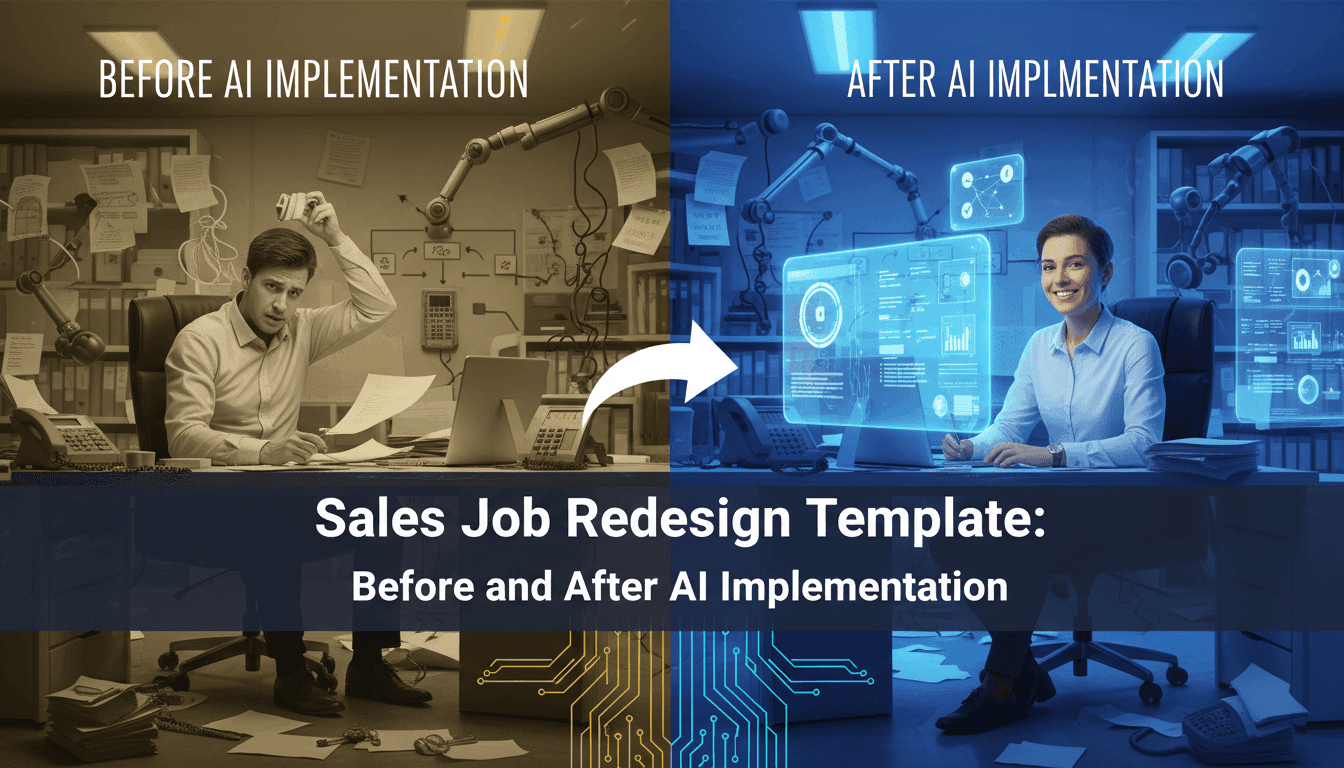
Table Of Contents
- Understanding the Imperative for Sales Job Redesign
- The Sales Job Redesign Framework
- Before AI: Traditional Sales Role Template
- After AI: Redesigned Sales Role Template
- Role-by-Role Transformation Examples
- Implementation Roadmap for Sales Redesign
- Measuring Success: KPIs for Redesigned Roles
- Common Pitfalls and How to Avoid Them
The integration of artificial intelligence into sales operations isn't just about adding new tools to existing workflows. It fundamentally changes what sales professionals should be doing with their time, how they create value, and which skills matter most for success.
Yet most organizations approach AI adoption by layering new technology onto unchanged job descriptions. They expect salespeople to magically transform their work habits while their formal responsibilities, performance metrics, and organizational structures remain frozen in the pre-AI era. This misalignment creates confusion, underutilization of AI capabilities, and ultimately disappointing returns on technology investments.
This article provides a practical template for redesigning sales roles in the age of AI. You'll see specific before-and-after comparisons across key sales positions, understand which responsibilities to eliminate versus amplify, and gain a structured framework for implementing these changes in your organization. Whether you're a sales leader planning your team's evolution or an executive evaluating your go-to-market structure, these templates offer a concrete starting point for transformation.
AI Sales Job Redesign Template
Transform roles from tactical execution to strategic value creation
The Core Problem
Sales professionals spend only 28% of their time actually selling. Without job redesign, AI tools gather dust while old habits persist.
The 4-Category Framework
Automate
Lead scoring, scheduling, data entry
Augment
Research, proposals, forecasting
Amplify
Strategic planning, negotiations
Preserve
Trust building, reading cues
Before vs. After: Time Allocation
❌ Before AI
✓ After AI
Role Transformation Examples
Sales Development Rep (SDR)
From: High-volume tactical executor (50-60 daily touches)
To: Strategic opportunity architect (200-300 personalized accounts with AI)
Account Executive (AE)
From: Process manager handling proposals and coordination
To: Business consultant focused on strategic problem-solving
Customer Success Manager (CSM)
From: Reactive account manager with periodic check-ins
To: Proactive growth strategist with AI-powered insights
Expected Results
Revenue per sales professional increase
Time in customer-facing activities
Reduction in administrative time
7-Step Implementation Roadmap
Audit current time allocation
Identify quick automation wins
Pilot with volunteers
Develop new competency models
Update compensation & metrics
Create transition support
Iterate based on results
Ready to transform your sales organization with AI?
Join Business+AI CommunityUnderstanding the Imperative for Sales Job Redesign
AI isn't automating sales—it's redistributing where human judgment creates the most value. According to recent research, sales professionals spend approximately 28% of their time on actual selling activities, with the remainder consumed by administrative tasks, data entry, research, and internal coordination. AI can now handle many of these non-selling activities with greater speed and consistency than humans.
This shift creates both an opportunity and a responsibility. The opportunity is to refocus human effort on genuinely consultative work, relationship building, and strategic problem-solving. The responsibility is to deliberately redesign jobs so this refocusing actually happens rather than remaining aspirational.
Without intentional job redesign, organizations typically see one of two failure patterns. Either salespeople continue their old habits while AI tools gather dust, or they become overwhelmed trying to maintain traditional responsibilities while learning entirely new AI-driven workflows. Both scenarios waste the technology investment and frustrate the team.
Successful AI integration requires rethinking three fundamental elements of each sales role: core responsibilities (what the role exists to accomplish), time allocation (how professionals in this role should spend their days), and success metrics (how performance is measured and rewarded).
The Sales Job Redesign Framework
Before diving into specific role templates, understanding the framework for redesign ensures consistent thinking across your sales organization.
Start by categorizing every current responsibility into one of four buckets:
Automate completely: Tasks that AI can perform with minimal human oversight, such as initial lead scoring, meeting scheduling, basic data enrichment, and routine follow-up communications. These should be removed from human job descriptions entirely.
Augment significantly: Activities where AI handles the heavy lifting while humans provide direction and judgment. Examples include account research, proposal customization, and pipeline forecasting. These remain in job descriptions but with dramatically reduced time allocation.
Amplify and elevate: High-value human activities that become more impactful when supported by AI insights. Strategic account planning, complex negotiations, and executive relationship building fall into this category. These should receive increased time allocation and more sophisticated expectations.
Preserve unchanged: Certain human-centric activities that AI doesn't meaningfully improve, such as building trust through authentic conversation, reading non-verbal cues in high-stakes meetings, or navigating complex political dynamics within client organizations.
This framework prevents the common mistake of simply adding AI tools to already overloaded job descriptions. Instead, it forces explicit choices about what stops, what shrinks, and what expands.
Before AI: Traditional Sales Role Template
To appreciate the transformation, let's first document what a typical sales role looked like before AI integration. This template represents common patterns across B2B sales organizations.
Core Purpose: Generate revenue by identifying prospects, qualifying opportunities, and closing deals within assigned territory or account list.
Time Allocation:
- Administrative tasks and CRM updates: 20%
- Research and preparation: 15%
- Prospecting and outreach: 25%
- Customer meetings and calls: 25%
- Proposal creation and follow-up: 10%
- Internal coordination: 5%
Key Responsibilities:
- Maintain accurate records of all sales activities in CRM system
- Research potential customers and identify decision-makers
- Conduct outbound prospecting through calls, emails, and social channels
- Qualify inbound leads and schedule discovery meetings
- Deliver product demonstrations and presentations
- Develop proposals and negotiate contract terms
- Coordinate with internal teams for implementation planning
- Forecast monthly and quarterly revenue
Success Metrics:
- Monthly/quarterly revenue achievement
- Number of new opportunities created
- Average deal size
- Win rate percentage
- Sales cycle length
This traditional template isn't inherently broken, but it reflects an environment where human effort was the only option for nearly every task. AI fundamentally changes this constraint.
After AI: Redesigned Sales Role Template
The AI-enhanced version of the same role shifts dramatically toward consultative value creation and strategic relationship development.
Core Purpose: Serve as trusted advisor to clients by applying deep industry and product expertise to solve complex business problems, leveraging AI to maximize time spent on high-value strategic activities.
Time Allocation:
- Strategic account planning and research: 15%
- Customer meetings and consultative conversations: 45%
- Complex problem-solving and solution design: 20%
- Relationship building with key stakeholders: 15%
- AI system training and quality oversight: 5%
Key Responsibilities:
- Review and validate AI-generated account insights and opportunity scores
- Engage in deep discovery conversations to uncover strategic business challenges
- Design customized solutions for complex client requirements
- Build relationships with C-level executives and key decision-makers
- Lead value-based negotiations on strategic deals
- Provide feedback to improve AI model accuracy for territory/vertical
- Mentor junior team members on consultative selling techniques
- Collaborate on strategic account expansion opportunities
Success Metrics:
- Revenue achievement and growth
- Customer lifetime value in managed accounts
- Strategic deal (above threshold) conversion rate
- Executive-level engagement percentage
- AI-assisted deal velocity improvement
- Net revenue retention in account base
Notice the fundamental shift: the AI-enhanced role eliminates routine administrative work, dramatically reduces time on basic research and standard prospecting, and approximately doubles time spent in actual customer-facing consultative activities.
Role-by-Role Transformation Examples
Let's examine specific transformations across common sales roles to see how the redesign framework applies in practice.
Sales Development Representative (SDR)
Before AI: SDRs typically spent their days manually researching accounts, sending individualized emails, making cold calls, and tracking all activities in CRM. A productive SDR might reach 50-60 prospects daily through these manual efforts, with conversion rates around 2-3% for qualified meetings.
After AI: The redesigned SDR role focuses on high-judgment activities that AI struggles with—identifying truly strategic accounts, crafting positioning for complex value propositions, and having sophisticated conversations with senior contacts.
AI handles initial account identification, contact discovery, basic personalization, email cadence management, and activity logging. This allows one SDR to effectively work 200-300 accounts simultaneously with personalized touchpoints.
The human SDR now invests time in:
- Reviewing AI-surfaced signals indicating actual buying intent
- Researching complex organizational dynamics at strategic target accounts
- Crafting industry-specific value hypotheses
- Conducting conversational outreach to warm leads
- Qualifying opportunities through nuanced discovery discussions
Critical change: The role evolves from high-volume tactical executor to strategic opportunity architect. Organizations often need fewer SDRs but require significantly higher business acumen from those who remain.
Account Executive
Before AI: Account executives managed the full sales cycle from qualified lead to closed deal, spending substantial time on proposal creation, presentation preparation, internal coordination, and forecasting activities. Much of their expertise involved knowing where to find information and which internal resources to engage.
After AI: The redesigned account executive becomes a strategic orchestrator and trusted advisor. AI handles proposal generation, meeting preparation briefs, schedule coordination, and dynamic forecasting.
Human AEs now concentrate on:
- Conducting deep business discovery to understand strategic context
- Mapping political dynamics and stakeholder motivations
- Designing solutions for complex, multi-faceted business problems
- Leading value-based negotiations on deal structure
- Building authentic relationships with economic buyers
- Synthesizing cross-functional expertise during complex sales cycles
Critical change: The role shifts from process manager to business consultant. Success requires deeper industry knowledge, stronger executive presence, and more sophisticated problem-solving skills. Organizations at Business+AI workshops frequently discover that their top-performing AEs in the old model aren't always the best fit for this elevated role.
Customer Success Manager
Before AI: Customer success managers monitored account health through periodic check-ins, manual usage reviews, and reactive problem-solving. They often learned about dissatisfaction too late to prevent churn.
After AI: AI continuously monitors product usage patterns, identifies early warning signals, surfaces expansion opportunities, and automates routine check-ins. The redesigned CSM becomes a proactive growth strategist.
Human CSMs now focus on:
- Developing strategic success plans aligned with customer business objectives
- Conducting executive business reviews with senior stakeholders
- Identifying transformation opportunities that require product expansion
- Resolving complex adoption challenges that require organizational change management
- Building advocacy relationships that generate referrals and case studies
Critical change: The role transforms from reactive account manager to proactive growth driver with strategic advisory responsibilities.
Implementation Roadmap for Sales Redesign
Knowing what roles should become and actually making the transition happen are entirely different challenges. This roadmap provides a structured approach to implementation.
1. Audit current time allocation – Before redesigning anything, measure how your sales team actually spends time today. Use time-tracking for a two-week period across a representative sample. This baseline data reveals which activities consume disproportionate time and creates a concrete reference point for measuring change. Most organizations discover their assumptions about time allocation don't match reality.
2. Identify quick automation wins – Start with tasks that are highly repetitive, rules-based, and time-consuming. Meeting scheduling, basic data entry, standard email sequences, and simple lead scoring typically offer immediate returns. Implement these automations first to free capacity before attempting more complex changes. Early wins build momentum and organizational confidence.
3. Pilot redesigned roles with volunteers – Select 3-5 high-performing salespeople who demonstrate curiosity about AI and strong foundational skills. Work with them to implement the redesigned job template, providing close support during the transition. Document what works, what breaks, and what requires adjustment. These pilot participants become internal champions and provide realistic feedback that improves the broader rollout.
4. Develop new competency models – Redesigned roles require different skills. Create explicit competency frameworks that define what "good" looks like in AI-enhanced positions. This might include strategic thinking, executive communication, complex problem-solving, and AI collaboration skills. Use these frameworks for hiring, development, and performance management going forward.
5. Update compensation and metrics – Align incentives with new responsibilities. If you've shifted a role toward strategic accounts and longer-term value creation, continuing to measure only monthly deal count sends contradictory signals. Compensation structures must reward behaviors you want to see in redesigned roles. Many organizations participating in Business+AI consulting engagements find that misaligned metrics undermine otherwise well-designed role changes.
6. Create transition support programs – Not everyone will successfully navigate the transition from traditional to AI-enhanced roles. Some team members will thrive in elevated positions, while others may struggle with more strategic responsibilities. Provide coaching, training, and honest assessment. Be prepared to make tough decisions about fit, but give people genuine opportunity to develop new capabilities.
7. Iterate based on results – Treat initial redesign templates as hypotheses rather than final answers. Monitor performance data, gather qualitative feedback, and refine role definitions over 6-12 months. The optimal design emerges through experimentation and learning, not perfect upfront planning.
Measuring Success: KPIs for Redesigned Roles
Traditional sales metrics don't fully capture the value created by AI-enhanced roles. Your measurement framework should evolve alongside job redesign.
Productivity metrics track whether AI is actually freeing human capacity:
- Percentage of time spent in customer-facing activities (target: 60%+ for redesigned AE roles)
- Ratio of accounts managed per sales professional (should increase significantly)
- Administrative time per deal (should decrease 50%+)
- Time from initial contact to qualified meeting (should compress)
Quality metrics assess whether elevated responsibilities drive better outcomes:
- Average deal size (should increase as salespeople focus on strategic opportunities)
- Win rate on strategic accounts (should improve with deeper engagement)
- Customer lifetime value (should grow with more consultative approach)
- Executive-level engagement percentage (should increase substantially)
Adoption metrics measure how effectively your team leverages AI capabilities:
- Percentage of deals utilizing AI-generated insights
- Sales professional satisfaction with AI tool quality
- Accuracy rate of AI predictions and recommendations
- Time saved through automation per week
Business outcome metrics connect role redesign to organizational performance:
- Revenue per sales professional (should increase 30-50% within first year)
- Cost of sales as percentage of revenue (should decrease)
- Sales cycle length (should shorten for standard deals)
- Net revenue retention (should improve)
The organizations achieving the strongest results from AI integration, as discussed regularly at the Business+AI Forum, typically see productivity gains of 30-40% and quality improvements of 20-30% within the first year after thoughtful role redesign.
Common Pitfalls and How to Avoid Them
Role redesign sounds straightforward in theory but involves predictable challenges in practice. Anticipating these pitfalls improves your chances of successful implementation.
Pitfall 1: Adding AI without subtracting anything – This is the most common mistake. Organizations implement AI tools while keeping all existing responsibilities in place, creating unsustainable workloads. The solution is explicit subtraction: create a "stop doing" list that's as detailed as your "start doing" list.
Pitfall 2: Underestimating the skill gap – Redesigned roles often require capabilities your current team hasn't developed. Moving an SDR from high-volume calling to strategic account research requires analytical skills, business acumen, and research capabilities that weren't previously necessary. Address this through a combination of training, selective hiring, and honest assessment of current team fit.
Pitfall 3: Changing roles without changing management – If sales managers continue leading with traditional assumptions about what good selling looks like, redesigned roles will revert to old patterns. Manager enablement, updated coaching frameworks, and revised pipeline review processes must evolve in parallel with role changes.
Pitfall 4: Treating all team members identically – Not everyone will transition successfully from traditional to AI-enhanced roles. Some excel at high-volume execution but struggle with strategic thinking. Others are natural consultants who were constrained by administrative burdens. Differentiate your approach rather than assuming one-size-fits-all transitions.
Pitfall 5: Neglecting change management – Role redesign creates anxiety about job security, competence, and career trajectory. Transparent communication, involvement in design decisions, and visible executive commitment reduce resistance. The human side of this transformation matters as much as the technical elements.
Pitfall 6: Optimizing for current AI capabilities – AI technology continues advancing rapidly. Design roles with flexibility to absorb new capabilities rather than perfectly optimizing for today's tools. What AI can't do well today might be solved next quarter.
Perhaps most importantly, avoid the pitfall of theoretical redesign without practical implementation support. Job descriptions on paper mean little without the training, tools, management support, and cultural reinforcement to make new approaches stick.
Creating Your Organization's Redesign Template
The templates provided in this article offer starting points, but your optimal design depends on your specific context—your sales model, customer base, competitive environment, and organizational culture.
Begin by selecting one role for focused redesign rather than attempting to transform your entire sales organization simultaneously. Choose a position where AI can create obvious value and where you have strong current performers willing to experiment.
Use the before/after framework to document current state, then envision the future state using the four categories: automate, augment, amplify, and preserve. Be specific about time allocation changes and updated success metrics.
Test your redesigned template with a small pilot group, measuring both productivity and quality outcomes. Gather detailed feedback about what works in practice versus what sounded good in theory. Refine based on these learnings before broader rollout.
As you develop confidence with one role, expand to adjacent positions, building a comprehensive approach to AI-enhanced sales organization design.
For organizations seeking expert guidance through this transformation, Business+AI masterclasses provide hands-on support for developing customized role redesign frameworks that align with your specific business context and strategic objectives.
The question isn't whether AI will transform sales roles—that transformation is already underway. The question is whether you'll proactively redesign roles to maximize this opportunity or passively allow AI tools to create confusion and inefficiency within unchanged organizational structures. The template approach outlined here provides a structured path forward, turning the abstract promise of AI into concrete job descriptions, clear expectations, and measurable business results.
Redesigning sales roles for the AI era isn't a one-time project but an ongoing evolution as technology capabilities advance and market expectations shift. The organizations that will thrive are those that view job design as a strategic capability rather than a static HR function.
The templates and frameworks in this article provide a concrete starting point, but successful implementation requires committed leadership, thoughtful change management, and willingness to iterate based on results. Start with careful observation of how your team currently spends time, make explicit choices about what should stop and what should expand, and create the support structures that allow redesigned roles to succeed in practice, not just on paper.
Most importantly, remember that AI doesn't replace salespeople—it redefines what sales professionals should be doing with their talent and expertise. The most successful organizations use this technology to elevate their people into more strategic, more consultative, and ultimately more valuable roles. That elevation requires intentional design, and the time to begin that work is now.
Ready to Transform Your Sales Organization?
Redesigning sales roles for AI integration requires more than templates—it demands strategic thinking, practical implementation support, and connection with others navigating similar transformations.
Join the Business+AI membership community to access exclusive resources, connect with executives leading AI transformations, and participate in hands-on workshops that turn theoretical frameworks into practical results for your organization.