
SaaS AI Implementation: From Pilot to Production in 90 Days
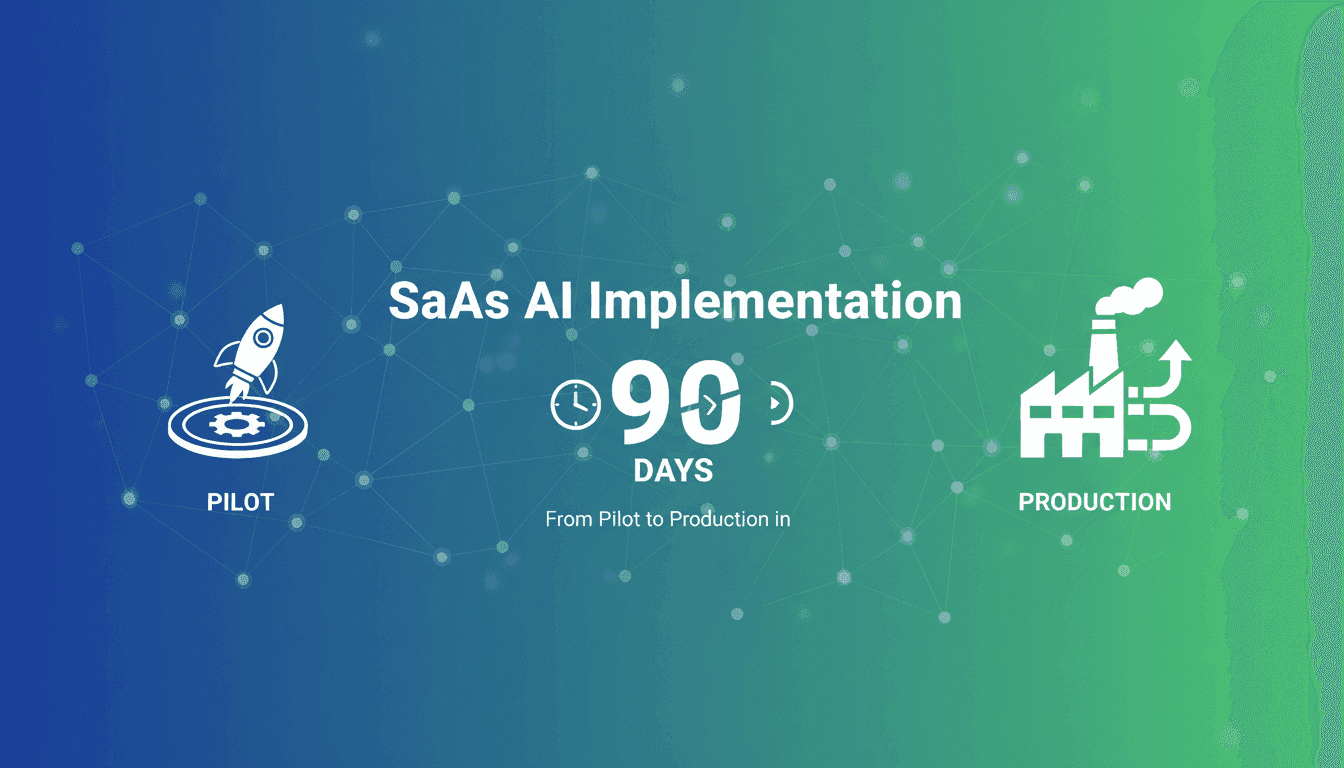
Table Of Contents
- Why Most AI Pilots Never Reach Production
- The Case for a 90-Day Framework
- Phase 1 (Days 1–30): Diagnose Before You Build
- Phase 2 (Days 31–60): Run a Disciplined Pilot
- Phase 3 (Days 61–90): Move to Production With Confidence
- The People Problem: Change Management Is Not Optional
- How to Select the Right Use Case
- Measuring What Actually Matters
- Common Failure Modes and How to Avoid Them
SaaS AI Implementation: From Pilot to Production in 90 Days
Every boardroom in Asia has a slide about AI. Fewer have a production deployment.
The gap between ambition and execution is wider than most leaders realize. Enterprise AI initiatives are failing at a rate that should give any decision-maker pause, and the reasons almost never have anything to do with the technology itself. The real obstacles are strategic, organizational, and structural. Getting SaaS AI implementation right requires more than selecting the right tool; it demands a structured path from exploratory pilot to scalable, revenue-generating production.
This article lays out a practical 90-day framework for doing exactly that. Whether your organization is evaluating its first AI deployment or trying to rescue a stalled pilot, the phases, decision criteria, and governance principles below give you a clear, repeatable path to production.
Why Most AI Pilots Never Reach Production
Recent data from S&P Global Market Intelligence reveals that the share of businesses scrapping most of their AI initiatives has surged from 17% in 2024 to a staggering 42% in 2025, and MIT's comprehensive NANDA study found that only 5% of enterprise AI pilots achieve rapid revenue acceleration. These are not edge cases or outliers — they represent the dominant outcome for organizations that invest heavily in AI without a disciplined implementation strategy.
The crisis stems not from technological limitations but from fundamental organizational and strategic execution failures. When AI projects fail, the instinct is to blame the model, the vendor, or the data. The evidence points elsewhere. 84% of AI project failures are attributed to leadership and organizational issues, not technology failures, and 73% of failed AI projects lack clear executive alignment on what success looks like before the project starts.
For SaaS companies, the stakes are compounded. AI is increasingly embedded in core product offerings, customer-facing workflows, and operational infrastructure. A failed pilot doesn't just waste budget — it erodes internal confidence, delays competitive differentiation, and signals to the market that your AI strategy is more promise than delivery.
The Case for a 90-Day Framework
A 90-day AI roadmap is a structured sprint plan that sequences the diagnostic, selection, launch, and early validation work an enterprise needs to get from zero to a functioning AI pilot in under three months. It is not a shortcut, and it is not a silver bullet. It is, however, the fastest credible path from board approval to evidence.
A 90-day AI roadmap is not a strategy. It is evidence. It generates the organizational confidence, the data infrastructure insights, and the internal champions that make a full AI transformation roadmap viable. The 90-day window is short enough to maintain momentum and executive attention, but long enough to collect real performance data on a real workflow before committing to enterprise-wide rollout.
The timeline breaks into three critical phases: the Data Audit (Days 1–30), the Prototype and Pilot Program (Days 31–60), and Production and Refinement (Days 61–90). Each phase has distinct objectives, deliverables, and decision gates — and skipping any of them is the single most reliable way to end up in pilot purgatory.
Phase 1 (Days 1–30): Diagnose Before You Build
The first 30 days are not about AI. They are about organizational readiness. Phase 1 is not about the AI. It's about the organisation's readiness to absorb the AI. Teams that skip this phase and rush straight to tool selection invariably discover their data, governance, or infrastructure gaps at the worst possible moment — mid-deployment.
During this phase, focus on four core activities:
- Use case identification: Map your operations and identify high-frequency, measurable workflows where AI could reduce cycle time, error rates, or cost.
- Data audit: Assess the quality, completeness, and accessibility of the data that would feed your AI system. 85% of AI projects fail due to poor data quality or lack of relevant data, according to Gartner.
- Baseline measurement: Document current performance metrics for the target process — cycle time, cost per transaction, error rate, and labor hours. You cannot claim ROI without a credible before-and-after comparison.
- Stakeholder alignment: Confirm executive sponsorship and identify a cross-functional team with clear ownership. Research consistently shows that sponsorship accounts for 30 to 50 percent of implementation success.
By Day 30, you should have a signed-off use case, a baseline performance snapshot, a data readiness assessment, and a named executive sponsor who is visibly committed to the outcome. Anything less is a risk multiplier in Phase 2.
Phase 2 (Days 31–60): Run a Disciplined Pilot
The pilot phase is where most organizations either build real momentum or quietly drift into indefinite experimentation. The difference comes down to one factor: whether success was defined before the pilot began.
The most common reason enterprise AI pilots don't reach production is no defined success criteria — the pilot runs indefinitely because nobody agreed on what 'success' looks like. Define your success threshold in writing before Day 31. Tie it to the baseline metrics you captured in Phase 1.
Rather than deploying AI across all operations simultaneously, go for a phased implementation. Gradual adoption allows you to identify potential challenges and make necessary adjustments before scaling. During the pilot, run AI outputs in parallel with existing processes wherever possible. This creates a direct comparison, builds team confidence, and surfaces edge cases that never appear in demos.
Structure the pilot around three principles:
- Narrow scope — One workflow, one team, one measurable outcome. Unlike a full AI transformation roadmap, the 90-day version is deliberately narrow: one or two use cases, one team, one measurable outcome.
- Continuous logging — Track model outputs, user adoption rates, error flags, and process deviations from day one. The data you collect in Phase 2 is the business case you present in Phase 3.
- Rapid iteration — Use initial insights to refine and optimize AI-driven processes. Weekly retrospectives should be focused on process improvement, not blame.
The Business+AI workshops and masterclasses are specifically designed to help implementation teams navigate this phase — building the hands-on capability to run structured pilots that generate board-ready evidence, not just interesting demos.
Phase 3 (Days 61–90): Move to Production With Confidence
The final thirty days of the 90-day AI implementation plan mark the critical inflection point where the controlled pilot evolves into a scalable enterprise rollout. This is where the organizational and technical infrastructure built in Phases 1 and 2 is put to its real test.
Moving to production requires more than flipping a switch. When moving to production, you have to consider the entire pipeline. The requirements must feature the ways in which the results from the model will be evaluated, used, and updated. Governance, monitoring, and escalation paths must all be in place before any AI system touches live business operations at scale.
Key activities in Days 61–90 include:
- Infrastructure hardening: Confirm data pipelines, API integrations, security controls, and access permissions are production-grade, not pilot-grade.
- Monitoring setup: Implement dashboards that track model performance, adoption rates, and business outcomes in real time. Define alert thresholds for when human review is required.
- Stakeholder sign-off: Present pilot results against the success criteria defined in Phase 1. Once you've completed a successful pilot, look to evaluate its effectiveness towards your objectives. If you determine that the pilot proved enough value — with clearly defined and quantified KPIs — then you should seek to move the pilot to production.
- Rollout planning: Define the broader deployment scope and timeline for expanding beyond the initial team. Document what worked, what didn't, and what the next use case will be.
At day 90, the organization knows whether to invest in scaling this use case, whether to pivot to a different one, or whether foundational data and organizational infrastructure requirements need to be addressed before AI programs can succeed. For teams trying to secure ongoing investment, that decision point is what turns a successful pilot into a funded transformation program.
The People Problem: Change Management Is Not Optional
No AI implementation succeeds through technology alone. When implementing AI initiatives, the technical challenges often prove to be only the 'tip of the iceberg.' The larger, less visible challenge is the human factor: getting people to change their behaviors, learn new skills, and trust new systems. Many experts argue that technology is the easy part — the hard part is guiding an entire workforce to alter their routines and embrace a different way of working.
An independent study by Prosci, surveying 1,107 professionals across multiple industries, found that 63% of organizations cite human factors as a primary challenge in AI implementation. Resistance, skills gaps, and unclear communication about how AI will affect roles are consistently ranked higher than technical complexity as barriers to successful adoption.
Active executive sponsorship is the single most effective lever for overcoming these barriers. Deloitte's 2024 'State of AI in the Enterprise' report found that sustained executive sponsorship was the single strongest predictor of AI program success, outweighing both budget and technical talent. But this sponsorship must be visible and behavioral, not just declarative. Executive sponsorship in AI transformation means something specific: leaders must actively use AI tools themselves. They must ask about AI adoption in operational reviews. They must celebrate examples of teams using AI effectively.
Building internal AI champions — employees who adopt early, share results, and mentor colleagues — is the most cost-effective way to scale adoption beyond the pilot team. The Business+AI consulting practice helps organizations identify these champions and structure the change management approach that makes AI adoption stick beyond the initial 90-day sprint.
How to Select the Right Use Case
Use case selection is the most consequential decision in your entire 90-day sprint. A well-chosen use case builds credibility, generates ROI evidence, and creates internal momentum. A poorly chosen one depletes budget and executive patience simultaneously.
The use cases that generate the clearest financial outcomes share a specific profile: they are high-frequency, contain repetitive decision logic, have measurable cycle times or error rates, and connect directly to a P&L line. Starting anywhere else is a common and expensive mistake.
Score candidate use cases across four dimensions before committing:
- Business impact: Does this workflow connect to a revenue, cost, or efficiency metric your CFO tracks?
- Feasibility: Can this be implemented within 60 days using available tools and data?
- Data readiness: Is the data that would feed this AI system accessible, clean, and sufficient in volume?
- Risk: What is the consequence of an incorrect AI output? Start with low-stakes, human-reviewable outputs before automating high-stakes decisions.
Each use case should meet three criteria: measurable business impact (documented cost savings or revenue improvement), technical feasibility (implementable within 90 days with available tools), and scalability (value increases as the company grows).
For SaaS companies specifically, the fastest-returning use cases typically include customer support automation, churn prediction, lead scoring, and internal knowledge retrieval. Customer support automation delivers the fastest ROI for most SaaS companies. These workflows are high-frequency, measurable, and low-risk — exactly the profile that produces results within 90 days. The Business+AI Forum is a strong resource for connecting with peers who have already implemented similar use cases and can share what worked in their context.
Measuring What Actually Matters
One of the clearest signals that an AI pilot is heading toward failure is when the team reports on model metrics rather than business metrics. Accuracy percentages, token counts, and latency figures are engineering concerns. Business leaders need to see process cycle time, cost per transaction, revenue impact, and customer satisfaction scores.
Baseline establishment means measuring the current state of the target process with precision before AI is introduced. At minimum, measure: process cycle time, error or exception rate, labor hours per unit of output, and cost per transaction. Without this baseline, any improvement claim is anecdotal.
Each use case has a direct metric. Calculate ROI as cost saved or revenue retained minus tool cost plus implementation cost, measured at 90 days and 12 months. The 90-day measurement gives you the business case for continued investment; the 12-month measurement gives you the full picture of compounding returns.
Common Failure Modes and How to Avoid Them
Even with a structured framework, certain patterns derail AI implementations repeatedly. Recognizing them early is the difference between a stalled project and a production deployment.
Scope creep in the pilot phase. One of the biggest mistakes teams make is biting off more than they can chew. Instead of focusing on a single, measurable workflow, they aim to create an 'enterprise brain' from day one. This leads to massive, overly ambitious roadmaps that are nearly impossible to execute within 90 days. The discipline to stay narrow in Phase 2 is what makes Phase 3 possible.
Governance as an afterthought. The technical team builds and tests for 60 days, then hands it to legal and IT security — who flag data residency, access control, and audit logging issues that require rebuilding significant parts of the system. Involve compliance and security from Day 1, not Day 60.
Treating AI as an IT project. 61% of organisations that fail at AI treat it as an IT project rather than a business transformation. The business owner of the target workflow, not the IT team, must own the success criteria and drive adoption within their team.
Undefined success criteria. The most common reason pilots remain stuck is the absence of defined success criteria before the pilot begins. Without a clear, measurable definition of success, there is no moment where the pilot can be declared complete and ready for production approval. This is the simplest and most frequently overlooked fix in enterprise AI.
Avoiding these failure modes is precisely what structured frameworks, peer learning, and expert guidance accelerate. It is the reason that organizations engaged in communities like Business+AI — where executives, consultants, and solution vendors exchange real implementation experience — consistently move faster from pilot to production than those navigating the journey in isolation.
From Ambition to Evidence
The 90-day framework is not a promise of effortless AI adoption. It is a structure that forces the right decisions in the right order: use case selection before tool selection, baseline measurement before benefit claims, governance design before production deployment, and change management before scale.
AI transformation succeeds when organizations replace ambiguity with structure, and experiments with execution. A 90-day plan provides the urgency, clarity, and governance needed to move from scattered pilots to measurable enterprise impact.
The companies extracting real value from SaaS AI are not necessarily the ones with the largest budgets or the most sophisticated models. The companies getting real, measurable value from AI are not the ones with the biggest budgets. They are the ones that picked one specific, painful, repeatable problem, applied a tool with discipline, measured the result honestly, and decided what to do next based on data.
That discipline is learnable. It is also, increasingly, a competitive necessity.
Ready to Move From Pilot to Production?
Business+AI brings together the executives, consultants, and solution vendors who have already navigated the journey you are on. Whether you need structured guidance through our consulting practice, hands-on capability building through our workshops and masterclasses, or peer exchange through the Business+AI Forum, the ecosystem is built to turn AI ambition into measurable business results.
Join the Business+AI membership and connect with the community that is getting AI into production.