
Remote Work Meets AI: How Agents Bridge the Distance for Modern Teams
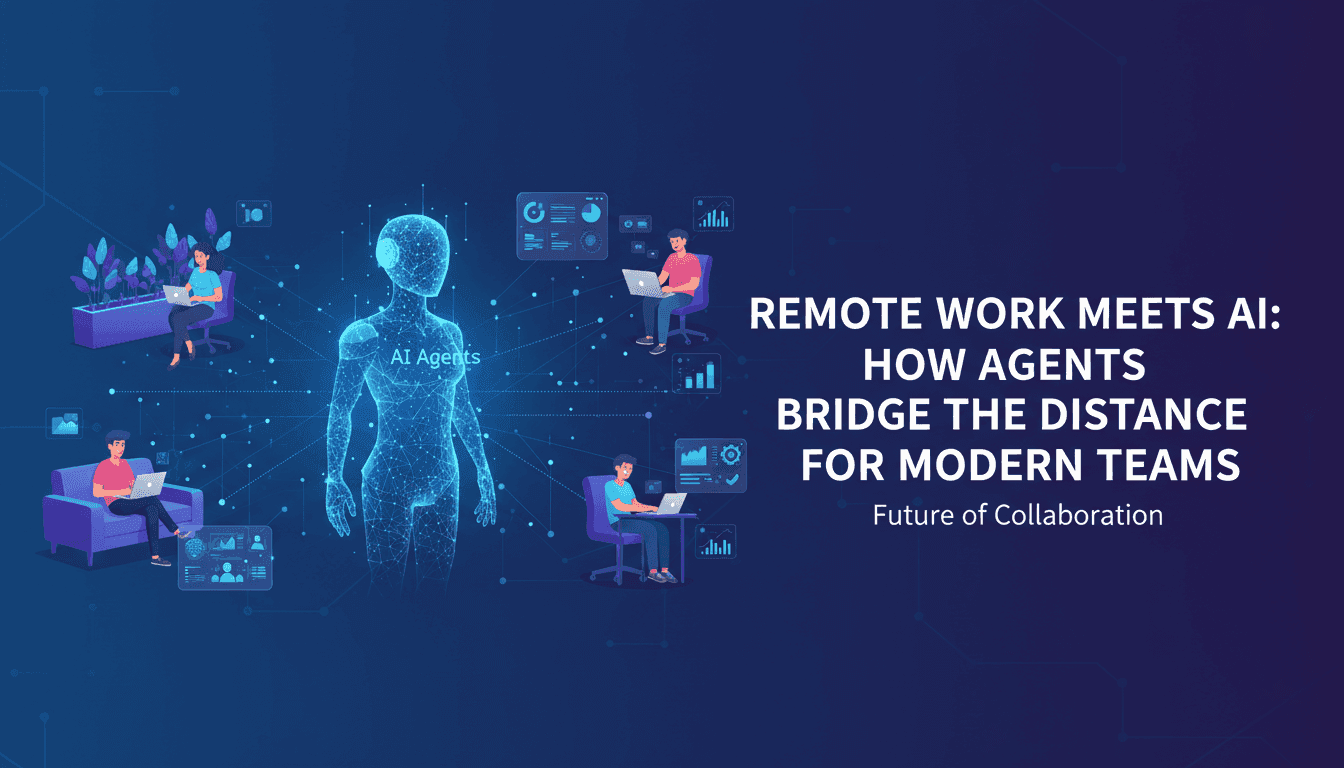
Table Of Contents
- The Remote Work Reality Check
- What Makes AI Agents Different from Basic Automation
- Five Ways AI Agents Bridge the Distance
- 1. Closing the Time-Zone Gap 24/7
- 2. Eliminating Information Asymmetry Between Remote and In-Office Teams
- 3. Automating the Coordination Overhead That Drains Distributed Teams
- 4. Preserving Institutional Knowledge Across a Distributed Workforce
- 5. Enabling Smarter, Faster Decision-Making Regardless of Location
- The Leadership Shift: Orchestrating, Not Just Delegating
- Where to Start: A Practical Adoption Framework
- The Bottom Line for Business Leaders
Remote Work Meets AI: How Agents Bridge the Distance for Modern Teams
The debate about where people should work has been loud. The quieter, more consequential debate is about how they should work — and that one is already being settled by AI agents.
Across Asia-Pacific and globally, the distributed workforce is now a permanent fixture. <According to a 2025 Gartner report, 75% of companies have adopted hybrid or fully remote models, and over 60% plan to invest more in AI tools to support distributed teams.> Yet the familiar friction points — missed handoffs across time zones, fragmented communication, knowledge that lives only in someone's head three countries away — haven't disappeared on their own. What has changed is that a new generation of AI agents is purpose-built to solve exactly these problems.
This article goes beyond the surface-level promise of "AI makes remote work better." It breaks down the specific, measurable ways autonomous AI agents are eliminating the structural disadvantages of distributed teams, examines what business leaders need to understand before deploying them, and offers a practical starting point for organisations ready to move from AI conversation to AI execution.
The Remote Work Reality Check {#remote-work-reality}
Remote and hybrid work has become the dominant model for knowledge-intensive industries, but it has never been frictionless. <Remote workers are on average 13% more productive on individual tasks, but cross-team collaboration drops 17% in fully hybrid versus fully remote settings, according to Microsoft Research.> That gap between personal productivity and team-level collaboration is precisely where the most value is being lost — and where AI agents have the highest potential impact.
The scale of the inefficiency is striking. <A McKinsey study found that remote employees waste up to 1.8 hours daily on inefficient communication alone,> and the compounding effect across a global team is enormous. When you multiply that friction across dozens or hundreds of distributed workers, the business case for intervention becomes impossible to ignore. AI agents don't just automate tasks — they remove the structural causes of that waste.
What Makes AI Agents Different from Basic Automation {#what-are-ai-agents}
Before exploring what AI agents can do for distributed teams, it is worth being precise about what they actually are. Most organisations have already experimented with chatbots, rule-based workflows, or basic automation scripts. AI agents operate at a fundamentally different level.
<Unlike simple automation tools or chatbots, AI agents understand context, learn from interactions, and make decisions that adapt to your team's unique working patterns.> <They can plan, adapt, and execute tasks with a degree of autonomy that requires them to be managed as team members rather than just software applications.> A rule-based bot follows a script; an AI agent reads the situation, sets sub-goals, takes action across multiple systems, and surfaces results — all without being explicitly prompted at every step.
Consider the difference in practical terms. A traditional automation tool might send a meeting reminder. An AI agent reads the meeting agenda, retrieves relevant project data, summarises the last three updates, flags a potential scheduling conflict with a team member in another time zone, and prepares a briefing document — before the meeting has even started. That distinction matters enormously for distributed teams where coordination complexity multiplies with every additional time zone.
Five Ways AI Agents Bridge the Distance {#five-ways}
1. Closing the Time-Zone Gap 24/7 {#time-zone-gap}
<When your team spans Asia, Europe, and North America, the window for synchronous collaboration shrinks to just a few hours daily — if any overlap exists at all.> This forces distributed teams into a painful trade-off: either schedule meetings at unsociable hours for someone, or accept that important decisions will be delayed by 12 to 18 hours while messages sit in inboxes.
AI agents dissolve that trade-off by acting as always-on intermediaries. <They never sleep, never take breaks, and maintain organisational knowledge that would otherwise exist only in scattered team members' heads,> creating a layer of continuity that human effort alone cannot sustain. <A summary agent can close out a collaboration channel at the end of a shift with the decisions made, the open questions, and the next owner noted — so the next team comes in already caught up instead of spending an hour reconstructing context.> <In fact, 92% of remote teams now reportedly use AI-powered collaboration tools for meeting summaries, calendar management, and routine documentation, saving an average of six hours per employee each week.>
2. Eliminating Information Asymmetry Between Remote and In-Office Teams {#information-asymmetry}
One of the most corrosive dynamics in hybrid teams is the invisible advantage held by people in the room. The colleague who catches a hallway conversation, the in-office team member who hears a strategy update before it is formally documented — these micro-advantages accumulate over time into real career and performance disparities. AI agents level that playing field.
<AI-powered transcription, real-time translation, and meeting summaries are reducing the information asymmetry between in-office and remote participants.> Context-aware agents can automatically generate meeting recaps, distribute action items to the right stakeholders regardless of whether they attended, and translate communications for multilingual teams in real time. <73% of knowledge workers report that generative AI tools have helped them avoid miscommunication, improving collaboration across distributed teams.> When every team member — remote or in-office — receives the same contextualised update at the same time, the structural disadvantage of working remotely begins to erode.
3. Automating the Coordination Overhead That Drains Distributed Teams {#coordination-overhead}
Knowledge workers in distributed environments spend a disproportionate share of their time on coordination rather than creation. Scheduling across time zones, chasing status updates, compiling weekly reports, triaging inbound messages — these activities generate no direct business value but consume enormous amounts of cognitive energy. <AI agents are amplifying human potential by handling the coordination overhead that typically consumes 30–40% of knowledge workers' time.>
The data on what happens when that overhead is removed is compelling. <Employees using AI tools save on average 40–60 minutes per day on routine tasks,> and <organisations that integrate AI-powered automation into their remote work environments experience a 30% increase in productivity.> <AI scheduling tools specifically increase uninterrupted focus time by 30%, reducing task-switching by 25%.> For business leaders managing distributed teams, this is not incremental improvement — it is a structural shift in how time gets allocated across the organisation.
4. Preserving Institutional Knowledge Across a Distributed Workforce {#institutional-knowledge}
In a co-located office, institutional knowledge travels informally — through conversations, observation, and proximity. In a distributed team, it has no natural home. When a key team member in Singapore finishes a project and moves on, the context, decisions, and reasoning behind their work can vanish unless someone explicitly documented it. Most of the time, nobody did.
AI agents function as persistent organisational memory. They capture, organise, and surface distributed knowledge automatically, ensuring that critical information is accessible regardless of who is currently online or which continent they are working from. Over time, an AI agent that has been integrated into a team's workflows accumulates a contextual understanding of how that team operates — the recurring blockers, the preferred communication patterns, the projects that are at risk. This kind of distributed institutional memory is something that even well-managed human teams struggle to maintain.
5. Enabling Smarter, Faster Decision-Making Regardless of Location {#decision-making}
Decision-making in distributed organisations is slowed by information gaps. By the time a manager in one time zone has the full picture, the window for a timely decision may have closed. AI agents change this by providing real-time, contextualised data synthesis at the point of decision.
<AI agents are now capable of understanding context, learning team dynamics, and proactively addressing workflow bottlenecks before they impact project timelines — excelling at intelligent task prioritisation, seamless information synthesis, and predictive problem-solving.> <Predictive problem-solving features have reduced project delays by 28%, with AI agents identifying potential roadblocks by analysing communication patterns, resource allocation, and external dependencies, then proactively suggesting solutions before issues escalate.> For executives overseeing teams across multiple geographies, this kind of proactive intelligence is genuinely transformative. It shifts decision-making from reactive to anticipatory.
The Leadership Shift: Orchestrating, Not Just Delegating {#leadership-shift}
Deploying AI agents in a distributed team is not simply a technology implementation — it requires a meaningful shift in how leaders think about their role. <The rise of agentic AI has transformed these tools into active participants within the organisational structure, necessitating a new approach to leadership that focuses on orchestration rather than just task delegation.> The manager who was once primarily a task-delegator must now function as a conductor, ensuring that human and AI contributors are working in concert rather than at cross-purposes.
This also means rethinking how teams are structured and how performance is measured. <New roles are emerging specifically to manage hybrid human-AI workforces, with 28% of managers already considering hiring AI Workforce Managers — professionals who oversee both human and AI team members, optimising collaboration and performance.> <Traditional input-based metrics like hours logged are giving way to output- and outcome-based evaluation,> a shift that ultimately makes the case for remote work stronger, not weaker. When results are what count, location becomes far less relevant.
For organisations in Asia-Pacific — where distributed teams spanning Singapore, Australia, India, and beyond are the norm rather than the exception — this orchestration capability is not a future aspiration. It is an operational necessity right now.
Where to Start: A Practical Adoption Framework {#adoption-framework}
Understanding the potential of AI agents is one thing. Knowing where to begin is another. The organisations seeing the strongest returns are not those that attempted the broadest deployments first — they are those that started with the highest-friction, highest-frequency pain points in their existing distributed workflows.
A practical approach follows three stages:
1. Identify your team's coordination bottlenecks — Map the specific activities where time-zone differences, information gaps, or communication delays are costing your team the most time per week. Common starting points include meeting documentation, status reporting, and cross-time-zone handoffs.
2. Deploy focused agents before broad platforms — <The fastest win is a triage agent that reads every incoming message and routes it, so no one wakes up to a wall of noise with no idea what matters.> Start narrow, measure the impact, and build the business case for broader deployment from demonstrated results.
3. Build human-AI workflows, not just human-to-AI handoffs — The highest-value configurations are not those where humans throw tasks at agents and wait for outputs. They are iterative loops where agents surface information and options, humans make judgment calls, and agents execute and track. <These hybrid teams combine human creativity, strategy, and empathy with the speed, precision, and scalability of AI in handling repetitive and data-intensive tasks.>
For organisations that want to accelerate this journey with expert guidance, Business+AI's consulting services offer a structured path from strategy to implementation — helping leadership teams cut through the noise and deploy AI capabilities that generate measurable business outcomes. Our workshops and masterclasses are designed specifically for executives and teams who want hands-on, practical exposure to agentic AI in a business context.
The Bottom Line for Business Leaders {#bottom-line}
The question facing business leaders is no longer whether AI agents will reshape distributed work — it is whether their organisation will be among those leading that shift or reacting to it. <In 2026, 83% of employees report improved productivity from AI tools in remote and hybrid work environments,> and the competitive gap between AI-enabled and AI-absent organisations is widening every quarter.
The distance between your team members — measured in time zones, kilometres, and communication channels — is a solvable problem. AI agents are solving it today, in organisations across the Asia-Pacific region and beyond. The leaders who understand that agents are not productivity tools but strategic infrastructure will be the ones who build the most resilient, capable distributed teams of the next decade.
The Business+AI Forum brings together executives, consultants, and solution providers who are navigating exactly these challenges — sharing what is working, what is not, and where the next wave of agentic AI will reshape business operations. Join the conversation and turn AI talk into tangible business gains.
Final Thoughts
Remote and hybrid work created the challenge. AI agents are delivering the infrastructure to meet it. The gap between distributed team members — whether measured in kilometres, time zones, or communication channels — is no longer a structural disadvantage that organisations simply have to manage. It is a problem that agentic AI is actively, measurably solving.
But technology alone is never the full answer. The organisations seeing the greatest gains are those pairing smart agent deployment with deliberate leadership, clear workflow redesign, and a culture that treats AI as a genuine collaborative partner rather than a back-office tool. That combination — strategic vision plus practical execution — is exactly what the Business+AI ecosystem is built to support.
Ready to Turn AI Strategy Into Business Results?
Business+AI is Singapore's leading ecosystem for executives and organisations ready to move beyond AI theory and into real-world impact. Whether you're exploring how AI agents can transform your distributed team or looking to build an enterprise-wide agentic AI strategy, we have the community, expertise, and programming to accelerate your journey.
Join the Business+AI Membership →
Connect with executives, consultants, and AI solution providers who are solving the same challenges you face — and discover what's actually working.