
Peer Learning for AI: How Teams Teach Each Other to Drive Business Results
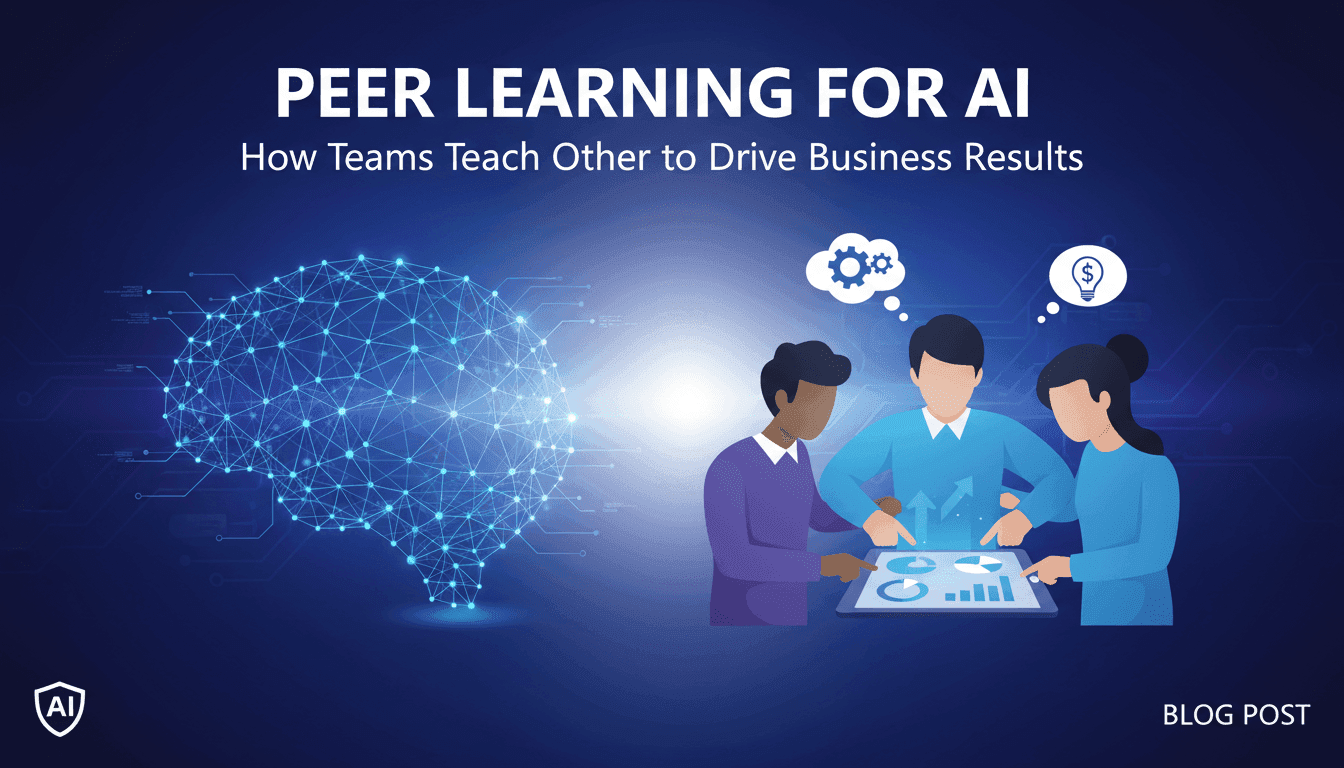
Table Of Contents
- Why Peer Learning Matters for AI Adoption
- The Four Pillars of Effective AI Peer Learning
- Creating Psychological Safety for AI Experimentation
- Structured Peer Learning Formats That Work
- The Role of AI Champions and Knowledge Brokers
- Overcoming Common Peer Learning Obstacles
- Measuring the Impact of Peer Learning Initiatives
- Building Your AI Peer Learning Roadmap
The most successful AI transformations don't happen in boardrooms or training centers. They happen in the everyday moments when a marketing analyst shows a colleague how to use ChatGPT for customer segmentation, or when a finance team member shares a workflow automation they built over lunch. This is peer learning for AI, and it's becoming the secret weapon of organizations that are turning artificial intelligence talk into tangible business gains.
While formal training programs and external consultants have their place, peer learning creates something more valuable: a self-sustaining culture where AI knowledge multiplies organically across teams. When employees teach each other, they don't just transfer technical skills. They build confidence, break down silos, and create the psychological safety needed for genuine innovation.
This comprehensive guide explores how to build effective peer learning systems for AI in your organization. You'll discover proven frameworks, practical implementation strategies, and methods to measure success. Whether you're leading a small team or driving enterprise-wide transformation, these insights will help you accelerate AI adoption through the power of collaborative learning.
Peer Learning for AI: The New Competitive Advantage
How teams teaching each other accelerate AI adoption and drive measurable business results
Formal training becomes outdated before rollout completes. Peer learning spreads knowledge at the speed of innovation.
The 4 Pillars of Effective AI Peer Learning
Dedicated Time
Protected time for knowledge sharing—make it non-negotiable
Psychological Safety
Celebrate failures as learning moments without penalty
Knowledge Infrastructure
Systems to capture and distribute insights easily
Recognition
Measure and reward knowledge sharing as a core competency
5 Proven Peer Learning Formats
AI Show & Tell Sessions
15-20 minute demos rotating across all levels and departments
Cross-Functional Working Groups
Monthly meetings across departments for powerful cross-pollination
Peer Mentoring Partnerships
Pairing complementary skills for mutual learning relationships
Lightning Round Lunch & Learns
Five presenters × five minutes = diverse insights fast
Internal AI Hackathons
Time-bound intensive collaboration on real business problems
Your 12-Month Implementation Roadmap
Establish Foundation
Identify champions, launch initial formats, build early wins
Expand & Formalize
Broaden participation, implement measurement, formalize recognition
Embed & Scale
Integrate into processes, create peer educator pathways, make self-sustaining
Optimize & Evolve
Continuously refine, experiment with formats, maintain momentum
💡 The Biggest Obstacle
Fear of looking incompetent kills more AI initiatives than technical limitations. Create psychological safety by celebrating failures as learning moments.
✅ Success Indicator
When junior employees present to senior leaders and when teams share failed experiments openly, you've built a thriving peer learning culture.
What to Measure
Participation
Breadth & depth across departments
Application
Tools adopted after sessions
Diffusion
Speed insights spread
Business Impact
Efficiency & revenue outcomes
Qualitative
Confidence & culture shifts
Ready to Accelerate Your AI Transformation?
Join Singapore's leading ecosystem for AI adoption. Connect with executives, consultants, and solution vendors through workshops, masterclasses, and collaborative forums.
Why Peer Learning Matters for AI Adoption
Artificial intelligence adoption faces a unique challenge that sets it apart from previous technology transformations. Unlike learning a new software platform with fixed features, AI tools evolve rapidly, use cases vary dramatically across functions, and the gap between awareness and application remains frustratingly wide for most organizations.
Traditional top-down training approaches struggle to keep pace with AI's evolution. By the time a formal training program is designed, approved, and rolled out, the tools have changed and new capabilities have emerged. This is where peer learning becomes transformative. When team members actively share their discoveries, failures, and successes with AI tools, knowledge spreads at the speed of innovation rather than at the pace of curriculum development.
Peer learning also addresses the relevance problem. A finance professional learning AI from another finance colleague receives context-specific insights that generic training cannot provide. They see real applications with actual company data, understand domain-specific challenges, and gain confidence that these tools work in their particular environment. This contextual learning accelerates the journey from theoretical understanding to practical implementation.
The psychological dimension matters equally. Many professionals feel vulnerable admitting they don't understand AI or that they've failed in their attempts to use it effectively. Learning from peers creates a safer environment than learning from external experts or senior leaders. When colleagues share their own learning curves and mistakes, it normalizes the experimentation process and reduces the fear of appearing incompetent.
The Four Pillars of Effective AI Peer Learning
Building a successful peer learning culture for AI requires intentional design across four foundational pillars. Organizations that excel at peer learning don't leave knowledge sharing to chance. They create structures, incentives, and environments that make collaborative learning the path of least resistance.
Pillar One: Dedicated Time and Space
Peer learning cannot happen in the margins of already overloaded schedules. High-performing organizations carve out protected time for knowledge sharing. This might take the form of weekly "AI office hours" where team members can drop in with questions, monthly showcase sessions where employees demonstrate their AI applications, or quarterly innovation days focused on collaborative experimentation. The key is making this time non-negotiable and visible in organizational calendars. When leaders consistently attend and participate in these sessions, they signal that peer learning is valued work, not an optional extra.
Pillar Two: Psychological Safety
Teams will only share their AI experiments, including failed ones, when they trust they won't be penalized for mistakes. Creating psychological safety means explicitly celebrating learning moments, reframing failures as data points, and ensuring that asking questions is rewarded rather than seen as weakness. Leaders play a crucial role by modeling vulnerability, sharing their own AI learning journey including struggles, and responding to questions with curiosity rather than judgment. Organizations serious about peer learning often establish ground rules for sharing sessions that emphasize confidentiality, respect, and learning-focused feedback.
Pillar Three: Knowledge Infrastructure
Informal conversations are valuable, but sustainable peer learning requires systems to capture and distribute insights. This infrastructure might include shared repositories where team members document their AI use cases and prompts, internal newsletters highlighting peer success stories, or Slack channels organized by AI application domain. The infrastructure should balance discoverability with simplicity. Overly complex knowledge management systems become digital graveyards where information goes to die. The best systems make it easier to share knowledge than to hoard it.
Pillar Four: Recognition and Incentives
What gets measured and rewarded gets repeated. Organizations that build thriving peer learning cultures recognize and celebrate knowledge sharing as a core competency. This recognition might include formal acknowledgment in performance reviews, spotlight features in company communications, or opportunities to present at leadership meetings. Some organizations create "AI Champion" designations or peer educator roles that come with status and development opportunities. The specific incentives matter less than the clear message that teaching others is valued as much as individual achievement.
Creating Psychological Safety for AI Experimentation
The fear of looking incompetent kills more AI initiatives than technical limitations ever could. Many professionals worry that admitting they don't understand AI tools will mark them as behind the curve or resistant to innovation. Others hesitate to share AI experiments that didn't work, concerned these failures will reflect poorly on their capabilities.
Leaders must actively counteract these fears by normalizing the learning process. One effective approach is the "failure showcase" where team members present an AI experiment that didn't work, what they learned from it, and what they'll try next. When organizations celebrate these stories alongside success stories, they communicate that experimentation itself is the goal, not just positive outcomes.
Establishing clear guidelines around AI experimentation also builds safety. Teams need to know what's encouraged, what requires approval, and what's off-limits. When boundaries are clear and reasonable, people feel more confident exploring within them. These guidelines should address data privacy, customer-facing applications, budget thresholds, and quality standards while leaving ample room for creativity and testing.
Language matters in building psychological safety. Replace phrases like "AI expertise" with "AI exploration" in communications. Frame discussions around "learning together" rather than "training sessions." Ask "what are you discovering about AI?" instead of "are you using AI yet?" These subtle shifts reduce pressure and create space for honest dialogue about progress and challenges. Through Business+AI's workshops, teams can build this foundation in facilitated environments designed specifically for safe experimentation.
Structured Peer Learning Formats That Work
While organic knowledge sharing is valuable, structured formats ensure peer learning happens consistently and reaches everyone who needs it. Different formats serve different purposes, and effective organizations deploy a mix of approaches tailored to their culture and needs.
AI Show and Tell Sessions
These regular gatherings give team members a platform to demonstrate AI applications they've developed or discovered. The format is informal and time-bound, typically 15-20 minutes of demonstration followed by questions and discussion. The key is rotating presenters across departments and seniority levels. When junior employees see peers presenting, they recognize that expertise isn't required, just willingness to share. These sessions work best when scheduled consistently and when recordings are made available for those who cannot attend live.
Cross-Functional AI Working Groups
Bringing together representatives from different departments to explore AI applications creates powerful cross-pollination. A working group might include members from marketing, operations, finance, and IT who meet monthly to share what they're testing, discuss common challenges, and identify opportunities for collaboration. These groups often surface insights that wouldn't emerge in department-specific learning because participants see how the same tools solve different problems across contexts.
Peer Mentoring Partnerships
Pairing team members with complementary skills creates focused learning relationships. This might mean connecting someone with strong prompt engineering skills with someone who has deep domain expertise, or matching early adopters with curious skeptics. Unlike traditional mentoring where expertise flows one direction, AI peer mentoring works best when positioned as mutual learning. Both partners bring valuable perspectives, and structured check-ins keep the relationship productive.
Lunch and Learn Lightning Rounds
These compressed sessions feature multiple short presentations rather than a single speaker. Five team members each take five minutes to share one specific AI tip, tool, or technique they've found useful. The rapid-fire format keeps energy high, exposes participants to diverse applications quickly, and lowers the barrier for presenting since the time commitment is minimal. The variety also increases the likelihood that each participant finds at least one immediately applicable idea.
Internal AI Hackathons
Time-bound intensive events where teams collaborate to solve real business problems using AI tools combine learning with tangible output. These work best when structured around actual organizational challenges rather than theoretical exercises. Teams typically include mixed skill levels, and the competitive element adds energy while the collaborative structure ensures knowledge sharing. The demos and debriefs at the end become rich learning opportunities for all participants. Business+AI's forums provide excellent venues for organizations to see these formats in action and adapt them to their contexts.
The Role of AI Champions and Knowledge Brokers
Every successful peer learning culture has individuals who naturally emerge as connectors, translators, and catalysts. These AI champions and knowledge brokers don't need to be technical experts or senior leaders. Their power comes from enthusiasm, communication skills, and willingness to help others learn.
AI champions typically excel in specific domains or tools and make themselves available as go-to resources. They're the person you ask when you can't figure out why your prompt isn't working or when you need to know which tool to use for a specific task. Organizations should identify these natural champions and support them with time, resources, and recognition. This might mean reducing other responsibilities to make room for knowledge sharing or providing them with advanced training so they stay ahead of the curve.
Knowledge brokers serve a different function. They connect people with questions to people with answers, even when they don't have the answers themselves. They maintain awareness of who's working on what across the organization and actively make introductions. They spot patterns, noticing when multiple teams are solving similar problems independently and bringing them together. These individuals are invaluable for breaking down silos and ensuring knowledge flows across organizational boundaries.
Both roles should be formalized to some degree without making them bureaucratic. This might mean creating a visible roster of AI champions organized by domain or tool, establishing regular office hours where champions are available, or including knowledge brokering in certain role descriptions. The formalization signals organizational commitment while providing structure that makes these individuals easier to find and engage.
Investing in these champions and brokers multiplies learning impact. When organizations provide them with opportunities like Business+AI's masterclasses, they're not just developing individual skills. They're amplifying the reach of that learning across entire teams through the peer networks these individuals cultivate.
Overcoming Common Peer Learning Obstacles
Even well-designed peer learning initiatives encounter predictable challenges. Recognizing and proactively addressing these obstacles increases the likelihood of building a sustainable knowledge-sharing culture.
The "Too Busy" Problem
When deadlines loom and workloads are heavy, peer learning feels like a luxury organizations cannot afford. This short-term thinking creates a vicious cycle where teams remain inefficient because they never invest time in learning better approaches. The solution requires leadership commitment to protect learning time even during busy periods. Some organizations implement a rule that a percentage of capacity must always be reserved for learning and improvement activities. Others build peer learning into existing meetings rather than adding new ones, such as starting team meetings with brief AI share-outs.
Knowledge Hoarding
Some individuals resist sharing what they've learned, viewing their AI skills as job security or competitive advantage. This mindset is often rooted in fear or organizational cultures that have historically rewarded individual heroics over team success. Addressing knowledge hoarding requires both cultural shifts and practical interventions. Make collaboration and knowledge sharing explicit performance criteria. Celebrate team achievements over individual ones. Create visible career paths that reward those who develop others, not just those who develop impressive individual capabilities.
The Expertise Gap
Sometimes the gap between those experimenting with AI and those who haven't started feels too wide for peer learning to bridge. Beginners may feel they're wasting advanced users' time with basic questions, while advanced users may struggle to remember what it was like not to know these concepts. Structuring peer learning by skill level can help. Create separate tracks for absolute beginners, active experimenters, and advanced users, with clear pathways for progression. Ensure that learning resources exist for the earliest stages so peer learning can focus on application rather than foundational concepts.
Lack of Immediate Relevance
Peer learning sessions sometimes feel abstract when they don't connect to participants' immediate work challenges. The solution is grounding knowledge sharing in real problems and projects. Instead of general AI capability showcases, frame sessions around specific business challenges like "reducing report generation time" or "improving customer segmentation accuracy." When participants see direct connections between peer insights and their daily frustrations, engagement and application increase dramatically.
Measuring the Impact of Peer Learning Initiatives
What gets measured signals what matters, and effective measurement helps refine peer learning approaches over time. However, measuring peer learning impact requires looking beyond simple attendance metrics to capture genuine behavior change and business outcomes.
Participation Metrics
Track both breadth and depth of engagement. How many unique individuals attend peer learning sessions? How many actively present or contribute versus passively observe? What's the distribution across departments and seniority levels? Are participation rates increasing over time? These metrics reveal whether your peer learning culture is spreading or remaining concentrated in pockets. Declining participation signals that formats may need refreshing or that competing priorities are overwhelming learning time.
Knowledge Application Metrics
The true test of peer learning is whether participants actually apply what they learn. Track indicators like the number of AI tools or techniques adopted following peer learning sessions, documented use cases that originated from shared ideas, and time-to-implementation for new AI applications. Post-session surveys asking "what will you try this week based on what you learned?" followed by check-ins can reveal application rates. Some organizations create simple internal databases where employees log their AI experiments and tag them with their learning source, making peer learning impact visible.
Knowledge Diffusion Metrics
How quickly does a new insight or technique spread across the organization? When one team discovers an effective AI application, how long before other teams adopt similar approaches? Network analysis can reveal knowledge flow patterns, identifying which individuals and teams are most connected to information flows and which remain isolated. You might track how many "generations" removed from the original source an insight reaches, measuring whether knowledge spreads beyond immediate connections.
Business Outcome Metrics
Ultimately, peer learning should drive measurable business results. Connect learning initiatives to outcomes like process efficiency improvements, cost reductions, revenue impacts, or customer satisfaction changes. While attributing causation is complex, organizations can compare business metrics between teams with high peer learning engagement and those with low engagement, or measure outcomes before and after implementing structured peer learning programs. Business+AI's consulting services help organizations establish these measurement frameworks aligned with strategic objectives.
Qualitative Feedback
Numbers tell part of the story, but qualitative insights reveal nuances that metrics miss. Regular focus groups or interviews with peer learning participants uncover what's working, what's frustrating, and what gaps remain. Ask about confidence levels, cultural shifts, and whether people feel more comfortable experimenting with AI. These conversations often surface early warning signs of problems and generate ideas for improvement that wouldn't emerge from quantitative data alone.
Building Your AI Peer Learning Roadmap
Transforming your organization into a peer learning powerhouse doesn't happen overnight. A phased approach that builds momentum and demonstrates value creates sustainable culture change.
Phase One: Establish Foundation (Months 1-3)
Begin by identifying your natural AI champions and early adopters. These individuals become your initial peer educators and help design learning formats that will resonate with your culture. Launch one or two structured peer learning formats rather than trying to implement everything at once. Create basic knowledge infrastructure like a shared repository for AI use cases and insights. Most importantly, secure visible leadership support through participation and communication that emphasizes learning as a priority. This phase focuses on proving the concept and building early wins that generate organizational interest.
Phase Two: Expand and Formalize (Months 4-8)
With initial traction established, broaden participation by introducing additional learning formats and actively recruiting presenters from diverse departments and levels. Formalize recognition systems that celebrate knowledge sharing. Implement measurement frameworks to track participation, application, and impact. Begin addressing cultural barriers more directly through leadership messaging, policy adjustments, and incentive alignment. This phase transforms peer learning from an experiment into an established program with growing reach.
Phase Three: Embed and Scale (Months 9-12)
Integrate peer learning into standard organizational rhythms and processes. Include knowledge sharing expectations in role descriptions and performance reviews. Create peer educator pathways with development opportunities and recognition. Establish cross-organizational communities of practice that extend beyond individual teams. Connect peer learning initiatives to strategic priorities, ensuring that knowledge sharing directly supports business objectives. This phase makes peer learning self-sustaining rather than dependent on champions or special initiatives.
Phase Four: Optimize and Evolve (Ongoing)
Continuously refine approaches based on measurement data and feedback. Experiment with new formats as organizational needs evolve and AI capabilities advance. Address knowledge gaps that emerge as some areas race ahead while others lag. Maintain momentum through fresh content, rotating leadership, and connections to emerging business challenges. Consider external connections through industry peer learning networks that expose your team to insights beyond organizational boundaries. Participating in broader ecosystems like those facilitated through Business+AI's membership program can inject new energy and perspectives into internal peer learning efforts.
The roadmap should be adapted to your organization's starting point, culture, and resources. Smaller organizations might move through phases more quickly or combine them, while larger enterprises may need longer timelines and more structured approaches. The key is maintaining consistent forward progress rather than achieving perfect implementation.
Peer learning for AI represents a fundamental shift from centralized knowledge distribution to distributed collaborative learning. When organizations create the structures, culture, and incentives for team members to teach each other, they unlock learning velocity that formal training programs cannot match. More importantly, they build the adaptive capability to keep pace with AI's continued evolution.
The most successful AI transformations don't rely solely on external expertise or top-down mandates. They cultivate internal communities where curiosity is rewarded, experimentation is safe, and knowledge flows freely across traditional boundaries. These organizations recognize that their competitive advantage lies not in hiring the most AI-savvy individuals but in building cultures where everyone continuously increases their AI capabilities through mutual support.
Starting your peer learning journey doesn't require massive investment or perfect planning. It requires commitment to treating learning as real work, creating safe spaces for experimentation, and celebrating those who help others grow. The frameworks and formats outlined in this guide provide starting points, but your peer learning culture will ultimately reflect your organization's unique context and needs.
The question isn't whether peer learning will play a role in your AI transformation. In some form, it already does through informal conversations and organic knowledge sharing. The question is whether you'll intentionally design and support these peer learning systems to maximize their impact, or leave them to chance. Organizations that choose intentional design are turning AI potential into tangible business gains while building cultures of continuous learning that will serve them long beyond current AI tools and trends.
Ready to Accelerate Your Organization's AI Journey?
Building a thriving peer learning culture is just one piece of successful AI transformation. Business+AI provides the ecosystem, expertise, and connections that help Singapore companies turn artificial intelligence talk into tangible business results.
Our membership program gives you access to a community of executives, consultants, and solution vendors who are navigating the same AI challenges you face. Through hands-on workshops, expert-led masterclasses, and collaborative forums, you'll gain both the strategic insights and practical skills your organization needs.
Explore Business+AI Membership to connect with peers, learn from experts, and accelerate your AI transformation with proven frameworks and real-world guidance.