
Model Context Protocol MCP: How AI Agents Connect to External Tools
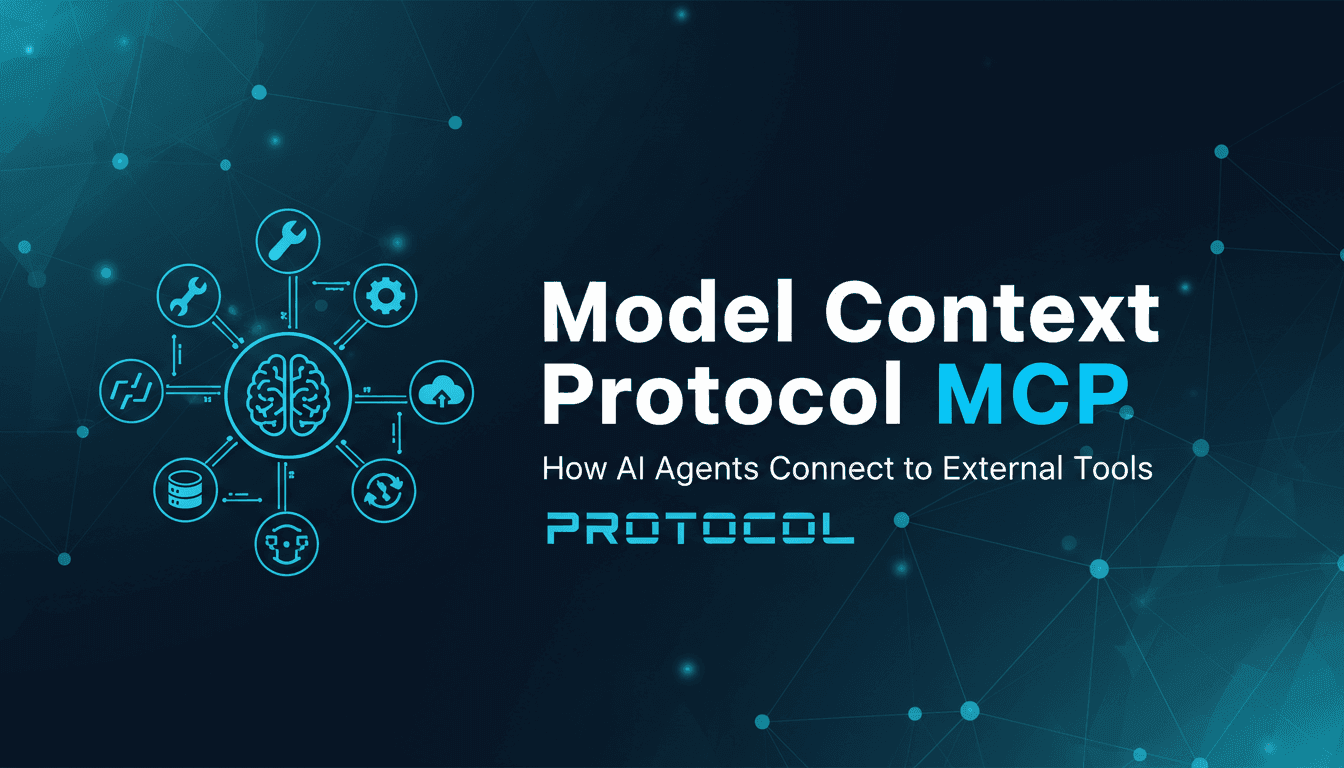
Table Of Contents
- Understanding the Context Problem in AI Systems
- What is Model Context Protocol (MCP)?
- How MCP Works: Architecture and Components
- Business Applications and Use Cases
- Getting Started with MCP Implementation
- Strategic Considerations for Enterprises
- The Future of Connected AI Systems
Artificial intelligence has achieved remarkable advances in reasoning, language understanding, and content generation. Yet even the most sophisticated AI models face a fundamental limitation: they operate in isolation, disconnected from the dynamic data and systems that power modern businesses. This disconnect creates a critical gap between AI's theoretical capabilities and its practical business value.
The Model Context Protocol (MCP), introduced by Anthropic in November 2024, addresses this challenge head-on. As an open standard for connecting AI assistants to external data sources and tools, MCP represents a significant shift in how organizations can deploy AI systems. Rather than building custom integrations for every data source and application, businesses can now leverage a universal protocol that enables AI agents to access information across content repositories, business tools, and development environments.
For business leaders and technology decision-makers, understanding MCP is essential for evaluating how AI can deliver tangible returns on investment. This guide explores the technical foundations of MCP, its business applications, and strategic considerations for implementation within enterprise environments.
Model Context Protocol (MCP)
Connecting AI Agents to External Tools & Data
The Context Problem
Even the most sophisticated AI models face a critical limitation: they operate in isolation, disconnected from dynamic business data and systems.
🔗 MCP Solution: Universal AI Connectivity
An open standard that connects AI assistants to external data sources and tools—replacing fragmented custom integrations with a single protocol.
MCP Servers
Data providers that expose organizational information securely
MCP Clients
AI applications that consume data from multiple sources
Key Business Applications
Customer Service
AI assistants access CRM, order history, and knowledge bases for contextual support
Software Development
Coding assistants reference internal docs and codebases for accurate suggestions
Business Intelligence
AI correlates data across systems for natural language insights
🚀 Getting Started with MCP
Identify high-value data sources for AI connectivity
Deploy pre-built or custom MCP servers
Run focused pilot programs
Scale with governance frameworks
💡 Key Strategic Insight
"MCP transforms AI from isolated intelligence into integrated business solutions—the difference between generic responses and genuine business value."
Ready to transform your AI strategy from theoretical potential to practical business value?
Join Business+AI Community →Understanding the Context Problem in AI Systems
The artificial intelligence industry has invested billions in improving model capabilities, resulting in systems that can reason through complex problems, generate sophisticated content, and analyze patterns across vast datasets. However, these advances have revealed a paradox: the more capable AI models become, the more apparent their isolation from real-world data becomes. Without access to current information, proprietary databases, and integrated business systems, even advanced AI models deliver generic responses that lack the specificity required for business decision-making.
This isolation creates several challenges for organizations attempting to implement AI solutions. First, every new data source requires custom integration work, consuming development resources and creating technical debt. Second, maintaining these fragmented connections becomes increasingly complex as organizations expand their AI use cases. Third, the lack of standardization means that knowledge and implementations don't transfer between different AI systems or vendors, limiting flexibility and increasing vendor lock-in risks.
The cost implications extend beyond development time. Organizations often discover that their AI initiatives deliver limited value because the models cannot access the specific, current information needed to support actual business processes. A customer service AI that cannot check inventory levels, a financial analysis tool disconnected from accounting systems, or a development assistant unable to reference internal code repositories all represent missed opportunities for automation and efficiency gains.
What is Model Context Protocol (MCP)?
Model Context Protocol establishes a universal standard for connecting AI systems with data sources, replacing the patchwork of custom integrations with a single, open protocol. Think of MCP as a common language that allows AI applications to communicate with any data source or tool that supports the standard. This approach mirrors how HTTP enabled the web to scale by providing a universal method for browsers to request information from servers, regardless of the underlying systems.
The protocol's design emphasizes security, bidirectional communication, and developer accessibility. Organizations can expose their data through MCP servers while building AI applications (MCP clients) that connect to these servers. This architecture separates concerns cleanly: data providers focus on exposing information securely, while AI application developers concentrate on creating valuable user experiences without worrying about the specifics of each data source.
What distinguishes MCP from previous integration approaches is its position as an open standard. Rather than a proprietary solution controlled by a single vendor, MCP is released as open-source software with publicly available specifications. This openness encourages ecosystem development, allowing developers, vendors, and enterprises to contribute improvements and build compatible tools. For businesses, this translates to reduced dependency on any single technology provider and greater flexibility in choosing AI solutions that best fit their needs.
The protocol supports a wide range of data interactions, from simple read operations to complex workflows involving multiple systems. AI agents using MCP can retrieve documents from content management systems, query databases, execute operations in business tools, and even control development environments. This versatility makes MCP applicable across diverse business functions, from customer service and sales to software development and data analysis.
How MCP Works: Architecture and Components
The Model Context Protocol's architecture follows a client-server model that will be familiar to most technical teams, but with specific adaptations for AI workloads and security requirements. Understanding these components helps organizations evaluate implementation approaches and identify integration points within their existing infrastructure.
MCP Servers: The Data Providers
MCP servers function as gateways that expose organizational data and functionality to AI applications. Each server implements the MCP specification to provide standardized access to specific data sources or tools. For example, a company might deploy an MCP server for their Salesforce instance, another for their internal documentation system, and a third for their PostgreSQL database.
These servers handle authentication, authorization, and data formatting, ensuring that AI applications receive information in a consistent structure regardless of the underlying system's native format. The server layer also provides an enforcement point for data governance policies, allowing organizations to control which information is accessible to AI systems and under what conditions. This architectural choice addresses a critical concern for enterprises: maintaining security and compliance while enabling AI access to sensitive business data.
Developers can build MCP servers using official SDKs available for popular programming languages, or they can adopt pre-built servers for common enterprise systems. Anthropic's open-source repository includes ready-to-deploy servers for platforms like Google Drive, Slack, GitHub, and Postgres, accelerating implementation for organizations using these tools. Claude 3.5 Sonnet has demonstrated particular proficiency in generating custom MCP server implementations, making it practical for businesses to create servers for proprietary or specialized systems.
MCP Clients: The AI Applications
On the other side of the protocol, MCP clients are AI-powered applications that consume data from MCP servers. These could be conversational interfaces, automated workflow systems, development tools, or any application that benefits from AI capabilities enhanced by access to specific data sources. The client handles the complexity of discovering available servers, establishing connections, and requesting information relevant to user queries or automated tasks.
What makes MCP clients powerful is their ability to maintain context across multiple data sources. Rather than treating each system as an isolated silo, clients can synthesize information from various servers to provide comprehensive responses. A business intelligence AI, for instance, might pull customer data from a CRM server, financial metrics from an accounting system server, and market research from a document repository server, combining these sources to answer strategic questions.
Major development tool providers including Zed, Replit, Codeium, and Sourcegraph are integrating MCP client capabilities into their platforms. This integration allows AI coding assistants to access project documentation, internal libraries, and development environment configurations, producing more accurate and contextually appropriate code suggestions. For enterprises, this means AI tools become genuinely useful for working with proprietary codebases rather than being limited to generic programming knowledge.
The Communication Layer
The protocol itself defines how clients and servers exchange information, including message formats, authentication methods, and error handling. MCP uses a structured approach to requests and responses, enabling AI systems to not only retrieve data but also understand the capabilities of each server. This discovery mechanism allows clients to adapt their behavior based on available data sources, making AI applications more flexible and resilient.
Security considerations are built into the protocol's communication layer. MCP supports various authentication mechanisms, allowing organizations to enforce the same access controls for AI systems that they apply to human users. Encrypted connections protect data in transit, while the server-side implementation provides granular control over which operations AI applications can perform. These security features make MCP suitable for regulated industries where data protection and audit trails are essential requirements.
Business Applications and Use Cases
The practical value of Model Context Protocol becomes apparent when examining specific business applications where connected AI systems deliver measurable improvements over isolated models. Understanding these use cases helps organizations identify high-impact opportunities for implementation within their own operations.
In customer service environments, MCP enables AI assistants to access real-time information across customer relationship management systems, knowledge bases, order management platforms, and support ticket histories. Instead of providing generic troubleshooting advice, these connected assistants can reference specific customer accounts, check order statuses, verify warranty coverage, and even initiate actions like processing returns or scheduling service appointments. This contextual awareness dramatically reduces resolution times and improves customer satisfaction while decreasing the workload on human agents.
Software development teams benefit from AI coding assistants that understand project-specific contexts through MCP connections. These tools can reference internal documentation, analyze existing codebases, check dependency versions, and even interact with development environment configurations. The result is code suggestions that align with organizational standards, properly integrate with existing systems, and require fewer revisions. Early adopters like Block have highlighted how MCP-enabled systems remove mechanical burdens, allowing developers to focus on creative problem-solving rather than routine implementation tasks.
Business intelligence and data analysis represent another high-value application area. AI systems connected to databases, analytics platforms, and business software through MCP can generate insights by correlating information across previously disconnected sources. Analysts can ask natural language questions that span multiple systems, receiving answers that would previously require manual data extraction, transformation, and analysis. This capability democratizes data access, enabling business users to gain insights without deep technical expertise or data science resources.
For organizations implementing AI workshops and training programs, MCP-connected systems provide more relevant, context-aware learning experiences. AI tutors can reference company-specific processes, internal case studies, and proprietary methodologies, making training materials immediately applicable to participants' actual work environments.
Getting Started with MCP Implementation
Implementing Model Context Protocol within an organization requires thoughtful planning and a phased approach that balances quick wins with long-term architectural considerations. The good news for businesses is that MCP's design allows for incremental adoption, starting with low-risk, high-value use cases before expanding to more complex scenarios.
The first step involves evaluating which data sources and business systems would provide the most value if accessible to AI applications. Rather than attempting to connect every system simultaneously, successful implementations typically begin with one or two high-impact sources. For many organizations, this might be a document repository containing product information, a customer relationship management system, or a business intelligence database. The selection should consider both the potential business value and the technical feasibility of creating or deploying an MCP server.
For organizations using Claude, the Claude Desktop application provides immediate MCP support, allowing teams to test connections with local MCP servers. This environment serves as a sandbox for evaluating pre-built servers from Anthropic's open-source repository or for developing custom servers for proprietary systems. Claude for Work customers can begin these tests locally, with remote production server deployment capabilities planned for broader organizational rollout.
Technical teams should review Anthropic's quickstart guide and examine the MCP specification to understand implementation requirements. For common platforms like Google Drive, Slack, GitHub, or PostgreSQL, pre-built servers available in the open-source repository can accelerate deployment. These reference implementations also serve as templates for building custom servers for other systems, particularly when combined with Claude 3.5 Sonnet's ability to generate server code based on system documentation and requirements.
A pilot program focused on a specific department or use case provides valuable learning before organization-wide deployment. This approach allows technical teams to address integration challenges, establish security protocols, and demonstrate tangible value to stakeholders. Successful pilots also generate internal champions who can advocate for broader adoption and share practical insights with other teams.
Governance and security considerations should be addressed from the beginning rather than retrofitted later. Organizations need clear policies about which AI systems can access which data sources, how authentication and authorization are managed, and what audit trails are maintained. These policies should align with existing data governance frameworks and compliance requirements, ensuring that AI connectivity doesn't create new regulatory risks.
Strategic Considerations for Enterprises
Beyond technical implementation, business leaders should consider several strategic factors when evaluating Model Context Protocol adoption. These considerations influence not only implementation success but also the long-term value organizations derive from connected AI systems.
The open-source nature of MCP represents both an opportunity and a responsibility. Unlike proprietary integration solutions, MCP's development occurs in public, with contributions from diverse organizations and developers. This openness reduces vendor lock-in risks and ensures that the protocol can evolve to meet changing business needs. However, it also means that organizations benefit most when they actively participate in the ecosystem, whether through contributing code, sharing use cases, or providing feedback on the specification. Companies that engage strategically with the MCP community position themselves to influence the protocol's direction while benefiting from collective innovation.
Interoperability becomes increasingly valuable as the MCP ecosystem matures. AI systems that support MCP can theoretically work with any MCP-compatible data source, creating flexibility in technology selection and reducing switching costs. For organizations already committed to specific AI platforms, MCP provides a path to enhance those investments without replacing them entirely. For businesses still evaluating AI solutions, MCP support should factor into vendor selection criteria, as it indicates a commitment to open standards and ecosystem collaboration.
The skills and expertise required for MCP implementation align closely with general software development capabilities rather than specialized AI knowledge. This accessibility means that existing technical teams can contribute to MCP deployments without extensive retraining. Organizations offering AI consulting services and maintaining strong development capabilities are well-positioned to help clients navigate implementation challenges and customize solutions for specific business contexts.
Timing considerations vary by industry and organizational maturity. Early adoption provides competitive advantages for organizations in rapidly evolving sectors where AI capabilities directly influence market position. However, businesses in highly regulated industries may prefer to wait for more mature governance frameworks and compliance guidance specific to MCP implementations. The key is making a deliberate choice based on strategic positioning rather than defaulting to either immediate adoption or indefinite delay.
As organizations scale their MCP deployments, architecture decisions made during initial implementations become increasingly important. Centralizing MCP server management, establishing clear ownership for different data sources, and creating standardized approaches to authentication and monitoring all contribute to long-term sustainability. These architectural choices should align with broader enterprise integration strategies and IT governance frameworks.
The Future of Connected AI Systems
Model Context Protocol represents more than a technical standard; it signals a fundamental shift in how AI systems integrate with enterprise infrastructure. As the ecosystem develops, several trends are likely to shape the evolution of connected AI applications and their business impact.
The expansion of pre-built MCP servers will accelerate adoption by reducing implementation friction. As more vendors add native MCP support to their platforms, organizations will increasingly find that major business systems come with MCP connectivity out of the box. This shift parallels how API-first design became standard in SaaS applications, transforming integration from a technical challenge into an expected feature.
AI agents capable of autonomous, multi-step workflows become practical when they can reliably access and manipulate data across systems through standardized protocols like MCP. These agents move beyond simple question-answering to execute complex business processes, from research and analysis to decision-making and action execution. The business value of such capabilities extends across virtually every organizational function, from supply chain optimization to financial planning and customer engagement.
The communities forming around MCP development will likely produce specialized servers and clients optimized for specific industries and use cases. Healthcare organizations might develop HIPAA-compliant MCP implementations, while financial services firms create servers that meet regulatory requirements for data access and audit trails. This specialization will make MCP more immediately valuable for regulated industries while maintaining the benefits of a common underlying standard.
For organizations participating in programs like Business+AI's masterclasses or attending events such as the Business+AI Forum, understanding MCP provides a framework for evaluating AI initiatives and vendor claims. The protocol offers a concrete reference point for discussions about AI integration, moving conversations from abstract possibilities to specific implementation approaches and architectural decisions.
As AI capabilities continue advancing, the context problem MCP addresses will become more rather than less important. More sophisticated AI models amplify the value of accurate, current, and comprehensive context, making the difference between generic responses and genuinely useful business intelligence. Organizations that establish robust MCP implementations now position themselves to maximize value from future AI improvements without requiring fundamental architecture changes.
Model Context Protocol addresses one of the most significant barriers to practical AI implementation: the disconnect between sophisticated AI capabilities and the real-world data needed to apply those capabilities effectively. By establishing an open standard for AI-data connectivity, MCP enables organizations to move beyond isolated, generic AI applications toward integrated systems that enhance business operations with contextually aware intelligence.
For business leaders, the strategic question isn't whether connected AI systems will become standard but rather how quickly to adopt the enabling infrastructure. Organizations that develop MCP implementation expertise, establish governance frameworks, and identify high-value use cases position themselves to capitalize on the protocol's maturation while managing adoption risks appropriately.
The open-source nature of MCP creates opportunities for collaborative innovation that benefits the entire ecosystem. As more organizations contribute servers, share implementations, and refine best practices, the collective value of the standard increases. This network effect makes early, thoughtful engagement particularly valuable for enterprises seeking sustainable competitive advantages from AI technology.
Success with Model Context Protocol ultimately depends on aligning technical implementation with business strategy, ensuring that connectivity serves clear organizational objectives rather than existing as technology for its own sake. Organizations that maintain this focus while building the technical foundations for connected AI systems will find themselves well-prepared for an increasingly AI-augmented business environment.
Ready to transform your AI strategy from theoretical potential to practical business value? Join the Business+AI community to connect with executives, consultants, and solution vendors who are successfully implementing AI systems like MCP in real-world business environments. Gain access to hands-on workshops, expert guidance, and a network of professionals turning AI talk into tangible gains.