
LMS Integration for AI Agents: Complete Guide to Learning Platform Connections
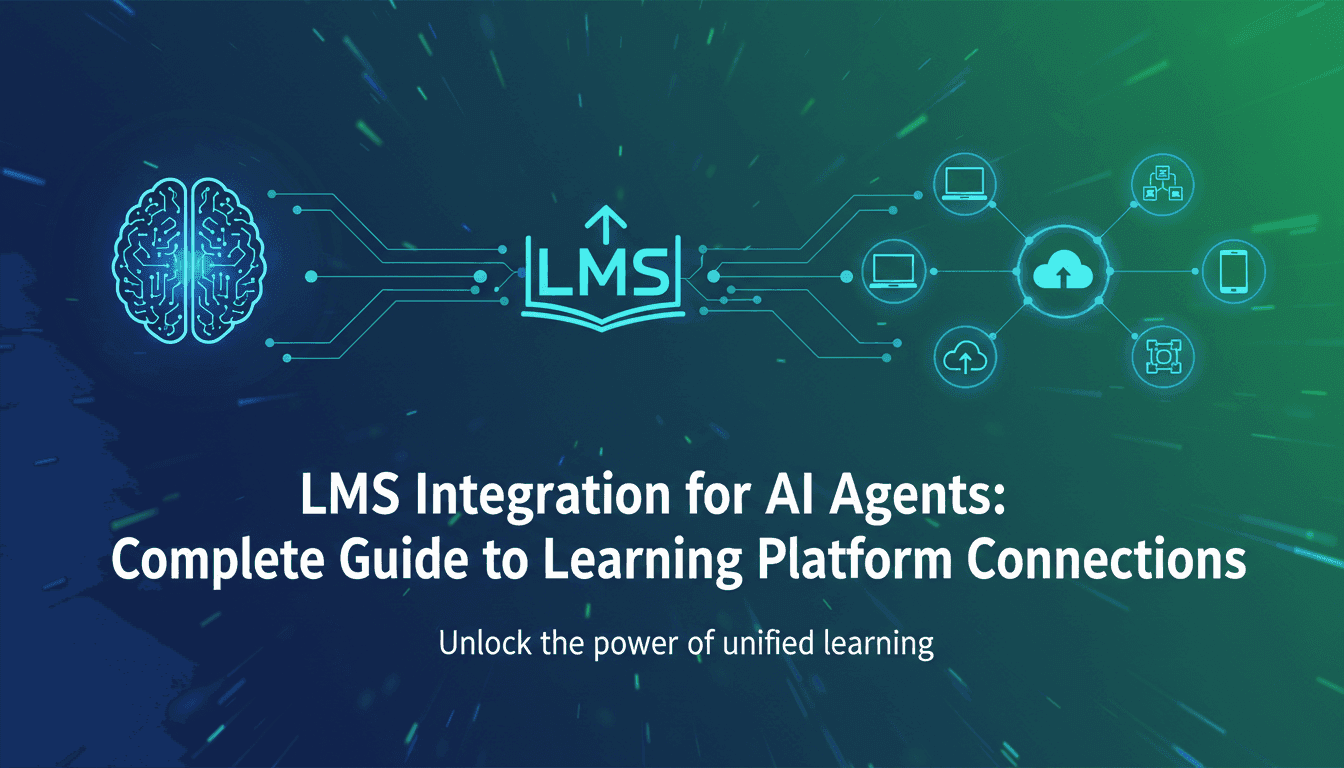
Table Of Contents
- What is LMS Integration for AI Agents?
- Why AI Agents Need LMS Integration
- Common LMS Integration Methods
- Technical Requirements for Successful Integration
- Key Use Cases and Applications
- Implementation Challenges and Solutions
- Selecting the Right Integration Approach
- Security and Compliance Considerations
- Measuring Integration Success
- Future Trends in AI-LMS Integration
Artificial intelligence is no longer confined to research labs or futuristic predictions. Today's AI agents are actively reshaping how organizations deliver training, assess competencies, and personalize learning experiences. But there's a critical bridge that must be built first: the connection between these intelligent systems and your existing Learning Management Systems (LMS).
LMS integration for AI agents represents one of the most practical applications of artificial intelligence in corporate learning environments. When properly implemented, these integrations allow AI agents to access learner data, deliver personalized content recommendations, automate administrative tasks, and provide real-time learning support—all while working seamlessly within your established learning infrastructure.
For executives and learning leaders, understanding how to connect AI capabilities with learning platforms isn't just a technical consideration. It's a strategic imperative that can accelerate workforce development, improve learning outcomes, and deliver measurable ROI on your AI investments. This guide explores the architecture, methods, and strategic considerations for successfully integrating AI agents with learning management systems, turning AI potential into tangible business results.
What is LMS Integration for AI Agents?
LMS integration for AI agents refers to the technical and architectural connections that enable artificial intelligence systems to interact with learning management platforms. These integrations create bidirectional communication channels where AI agents can retrieve learner information, course data, and performance metrics while simultaneously delivering personalized recommendations, automated responses, and intelligent interventions back into the LMS environment.
Unlike traditional software integrations that simply move data between systems, AI agent integrations are dynamic and adaptive. The AI component continuously learns from learner interactions, adjusts its recommendations based on performance patterns, and evolves its responses to better serve educational objectives. This creates a living learning ecosystem where technology actively contributes to improved outcomes rather than simply managing administrative workflows.
The integration layer acts as the nervous system connecting your LMS (the established learning infrastructure) with AI capabilities (the intelligent processing layer). Through APIs, webhooks, and standardized protocols, AI agents gain context about learners, courses, and organizational learning goals, enabling them to function as intelligent assistants rather than isolated tools.
Why AI Agents Need LMS Integration
The value proposition for integrating AI agents with learning management systems extends far beyond technological novelty. Organizations investing in these integrations are solving real business challenges that impact workforce productivity, skill development velocity, and competitive positioning.
Contextual Understanding: AI agents disconnected from your LMS operate in a vacuum, lacking critical context about learner history, competency levels, and organizational learning pathways. Integration provides the contextual foundation that transforms generic AI responses into personalized, relevant guidance aligned with your specific learning objectives.
Seamless User Experience: Learners resist switching between multiple platforms and interfaces. When AI agents are integrated directly into the LMS environment, they become native features rather than external tools, dramatically improving adoption rates and consistent usage.
Data-Driven Personalization: The most powerful AI capabilities emerge from comprehensive data access. Integrated AI agents can analyze completion rates, assessment scores, time-on-task metrics, and engagement patterns to deliver truly personalized learning experiences that adapt to individual needs.
Automated Administrative Efficiency: Learning and development teams spend countless hours on routine tasks like enrollment management, progress tracking, and basic learner support. Integrated AI agents can automate these workflows, freeing human experts to focus on strategic initiatives and complex learner needs.
Measurable Business Impact: Integration enables closed-loop tracking where AI interventions can be directly correlated with learning outcomes, completion rates, and business performance metrics. This measurement capability is essential for demonstrating ROI and refining AI applications over time.
At Business+AI workshops, executives consistently identify LMS integration as a critical success factor when implementing AI learning solutions, recognizing that isolated AI tools rarely deliver the transformative results that integrated systems provide.
Common LMS Integration Methods
Successful LMS integration for AI agents can be achieved through several technical approaches, each with distinct advantages depending on your existing infrastructure, technical capabilities, and specific use cases.
API-Based Integration
Application Programming Interfaces (APIs) represent the most flexible and powerful integration method. Most modern learning management systems expose RESTful APIs that allow external applications—including AI agents—to programmatically access learner data, course catalogs, enrollment information, and performance metrics.
API integrations enable real-time data exchange where AI agents can query the LMS for current information and push updates, recommendations, or automated actions back into the platform. This bidirectional communication supports sophisticated use cases like adaptive learning paths, intelligent content recommendations, and predictive analytics for learner success.
The primary advantage of API-based integration lies in its flexibility and scalability. Development teams can precisely control which data elements are shared, implement robust security protocols, and build custom functionality tailored to organizational needs. However, this approach requires technical expertise and ongoing maintenance as both the LMS and AI systems evolve.
LTI (Learning Tools Interoperability) Standards
LTI is an industry-standard protocol developed by the IMS Global Learning Consortium specifically for connecting learning applications with LMS platforms. This standardized approach simplifies integration by providing pre-defined methods for authentication, data exchange, and tool embedding.
For AI agent integration, LTI standards allow intelligent tools to appear as native LMS features while maintaining their own processing environments. Learners can access AI-powered assistants, recommendation engines, or assessment tools directly within their familiar LMS interface without separate logins or context switching.
LTI integration is particularly valuable for organizations with limited technical resources or those seeking to deploy multiple AI tools across their learning ecosystem. The standardization reduces development complexity and ensures compatibility across different LMS platforms that support the protocol.
Webhook-Based Event Triggers
Webhooks enable event-driven integration where specific LMS actions trigger automated AI agent responses. When a learner completes a course, fails an assessment, or remains inactive for a defined period, the LMS can send real-time notifications to AI systems that then execute predetermined or intelligent responses.
This integration method excels for automation workflows like sending personalized encouragement messages, recommending remedial content after poor assessment performance, or escalating learner issues to human instructors when AI confidence thresholds aren't met. Webhook integrations are typically simpler to implement than comprehensive API connections but offer less flexibility for complex, bidirectional interactions.
Single Sign-On (SSO) Integration
While not a data integration method per se, SSO protocols like SAML or OAuth are essential for creating seamless user experiences when AI agents operate as companion applications to your LMS. SSO eliminates duplicate authentication requirements, automatically provisioning learner access to AI tools based on their LMS credentials and permissions.
This authentication integration layer ensures that AI agents can securely identify users, maintain appropriate data access controls, and provide personalized experiences without creating additional friction in the learner journey.
Technical Requirements for Successful Integration
Implementing LMS integration for AI agents demands careful attention to technical prerequisites that ensure reliable, secure, and performant connections between systems.
Data Access and Permissions: Your LMS must expose the necessary data endpoints through APIs or other integration protocols. This requires administrative access to enable integrations, configure permissions, and potentially work with your LMS vendor to activate specific features or data access capabilities.
Authentication Infrastructure: Secure integration requires robust authentication mechanisms that verify AI agent identity and authorize appropriate data access levels. Modern approaches leverage OAuth 2.0 or similar token-based authentication that allows granular permission control without exposing sensitive credentials.
Data Mapping and Transformation: Learner profiles, course structures, and assessment data often exist in different formats across systems. Successful integration requires middleware that can translate data structures, standardize formats, and maintain referential integrity as information flows between the LMS and AI agents.
Scalability and Performance: AI processing can be computationally intensive, and LMS databases contain substantial user populations and historical data. Integration architecture must handle high-volume data exchanges, implement appropriate caching strategies, and maintain responsive user experiences even under peak loads.
Error Handling and Monitoring: Production integrations inevitably encounter edge cases, connectivity issues, and unexpected data scenarios. Robust error handling mechanisms, comprehensive logging, and real-time monitoring ensure that integration failures are quickly identified and resolved before impacting learner experiences.
Version Management: Both LMS platforms and AI systems evolve over time, introducing new features, deprecating old endpoints, and potentially breaking existing integrations. Effective integration requires version management strategies and regular maintenance to ensure continued compatibility as systems update.
Organizations exploring these technical requirements benefit from Business+AI consulting services, where experienced practitioners help navigate the complexity of enterprise AI implementations and avoid common integration pitfalls.
Key Use Cases and Applications
The practical applications of LMS-integrated AI agents span the entire learning lifecycle, delivering value across content delivery, learner support, administrative efficiency, and strategic planning.
Intelligent Learning Assistants: AI agents connected to your LMS can function as 24/7 learning companions that answer learner questions, clarify concepts, and provide explanations tailored to individual knowledge levels. By accessing course materials and learner history, these assistants deliver contextually relevant support that accelerates understanding and reduces instructor workload.
Adaptive Learning Path Recommendations: Integrated AI systems analyze learner performance, skills gaps, and career objectives to recommend personalized learning sequences. Rather than following rigid course progressions, learners receive intelligent guidance that adapts to their strengths, weaknesses, and professional goals, optimizing time investment and learning outcomes.
Automated Content Curation: AI agents can continuously scan course catalogs, external resources, and emerging industry trends to suggest relevant learning materials. When integrated with your LMS, these recommendations appear directly in learner dashboards, keeping content fresh and aligned with evolving organizational needs.
Predictive Analytics for Learner Success: By analyzing patterns across completion rates, engagement metrics, and assessment performance, integrated AI can identify learners at risk of disengagement or failure before problems become critical. Early intervention recommendations enable proactive support that improves completion rates and learning effectiveness.
Intelligent Assessment and Feedback: AI agents can generate practice questions aligned with learning objectives, provide instant formative feedback on learner responses, and adapt assessment difficulty based on demonstrated competency. Integration ensures these assessments align with formal course structures and contribute to official progress tracking.
Natural Language Interfaces: Learners can interact with LMS functionality through conversational AI interfaces, using natural language to enroll in courses, check progress, find resources, or request support. This reduces interface complexity and makes learning platforms more accessible to diverse user populations.
Administrative Workflow Automation: Integrated AI handles routine tasks like enrollment processing, certificate generation, reporting, and basic learner inquiries. This automation reduces administrative burden while ensuring consistency and eliminating manual processing delays.
Implementation Challenges and Solutions
While LMS integration for AI agents offers substantial benefits, implementation journeys often encounter predictable challenges that require strategic navigation.
Legacy System Limitations: Many organizations operate learning management systems that predate modern API standards or lack comprehensive integration capabilities. Addressing this challenge may require LMS upgrades, middleware development, or in some cases, platform migration to systems with robust integration features.
Data Quality and Consistency: AI agents are only as effective as the data they access. Inconsistent learner profiles, incomplete course metadata, or fragmented historical records undermine AI capabilities. Successful implementations often require data cleanup initiatives before integration to ensure AI agents have reliable information foundations.
Privacy and Data Governance: Learner data is sensitive, and AI access raises legitimate privacy concerns. Organizations must establish clear data governance frameworks that specify which information AI agents can access, how data is used, retention policies, and compliance with regulations like GDPR or industry-specific requirements.
Change Management and Adoption: Technical integration success doesn't guarantee user adoption. Learners and instructors need clear communication about AI capabilities, training on new features, and ongoing support to integrate AI tools into their workflows. Change management strategies are as critical as technical implementation.
Vendor Lock-In Risks: Some LMS vendors offer proprietary AI features that create dependency on specific platforms. Organizations should evaluate whether native LMS AI capabilities meet their needs or if vendor-agnostic integration approaches provide greater flexibility and prevent lock-in.
Performance and Cost Implications: AI processing, especially for large user populations, can introduce computational costs and potential performance impacts. Implementation plans should include capacity planning, cost modeling, and performance testing to ensure sustainable operations at scale.
The Business+AI masterclass series provides executives with frameworks for anticipating and addressing these implementation challenges, drawing on real-world case studies from organizations that have successfully navigated AI integration projects.
Selecting the Right Integration Approach
Choosing the optimal LMS integration method for AI agents depends on multiple factors specific to your organizational context, technical capabilities, and strategic objectives.
Assess Your Current LMS Capabilities: Begin by thoroughly evaluating your existing learning platform's integration features. What APIs are available? Does it support LTI standards? What data can be accessed and modified? Understanding current capabilities determines which integration approaches are feasible without major infrastructure changes.
Define Your AI Use Cases: Different integration methods suit different applications. Simple chatbot support might work well with webhook triggers and basic API access, while comprehensive adaptive learning systems require deep, bidirectional API integration with extensive data access. Clearly defining your priority use cases guides appropriate technical choices.
Evaluate Technical Resources: API-based custom integration offers maximum flexibility but demands substantial development expertise and ongoing maintenance. If internal technical resources are limited, standardized approaches like LTI or vendor-provided integrations may be more practical despite reduced customization options.
Consider Scalability Requirements: Will your AI implementation serve dozens of learners or tens of thousands? Different integration architectures have varying performance characteristics. Ensure your chosen approach can scale to meet current and projected user populations without degradation.
Plan for Future Flexibility: Learning technology evolves rapidly, and today's AI capabilities will expand significantly in coming years. Select integration approaches that provide extensibility and avoid locking you into rigid architectures that limit future innovation.
Budget Realistic Timelines and Costs: Integration projects consistently take longer and cost more than initial estimates suggest. Factor in time for discovery, development, testing, security review, and iterative refinement. Realistic planning prevents mid-project resource constraints that compromise implementation quality.
Security and Compliance Considerations
Integrating AI agents with learning management systems creates new security and compliance responsibilities that demand careful attention throughout implementation and operations.
Data Access Controls: Implement principle of least privilege by granting AI agents access only to data elements essential for their specific functions. Granular permission management reduces exposure risks if AI systems are compromised or behave unexpectedly.
Encryption in Transit and at Rest: All data exchanged between LMS and AI systems should be encrypted during transmission using TLS protocols. Additionally, any data stored by AI systems for processing or learning should be encrypted at rest to protect against unauthorized access.
Audit Logging and Monitoring: Comprehensive logging of all AI agent interactions with your LMS creates accountability and enables security monitoring. Track what data was accessed, when, and what actions were taken. This audit trail is essential for security investigations and regulatory compliance.
Compliance with Education Regulations: Depending on your jurisdiction and industry, learner data may be subject to specific regulations like FERPA (Family Educational Rights and Privacy Act) in the United States or similar protections elsewhere. Ensure AI integration respects these legal requirements and includes appropriate consent mechanisms.
AI Model Security: The AI models themselves represent valuable intellectual property and potential security risks. Implement protections against model extraction, adversarial attacks, or manipulation that could compromise AI decision-making or expose training data.
Third-Party Risk Management: If using external AI vendors or cloud services, conduct thorough due diligence on their security practices, data handling policies, and compliance certifications. Contractual agreements should clearly specify data protection responsibilities and liability allocation.
Incident Response Planning: Develop specific incident response procedures for scenarios like AI system compromise, data breaches involving learner information, or AI behaviors that violate policies or regulations. Rapid response capabilities minimize damage when security issues occur.
Measuring Integration Success
Demonstrating return on investment for LMS integration for AI agents requires establishing clear metrics and measurement frameworks that connect technical implementation to business outcomes.
Learner Engagement Metrics: Track changes in course completion rates, time-on-platform, content consumption patterns, and voluntary learning activities. Effective AI integration should increase engagement through personalization and improved support.
Learning Effectiveness Measures: Monitor assessment scores, competency achievement rates, time-to-proficiency, and knowledge retention over time. AI-enhanced learning should demonstrate measurable improvements in learning outcomes, not just engagement.
Operational Efficiency Gains: Quantify reductions in administrative workload, instructor support hours, and manual processes. Calculate time savings and cost reductions resulting from AI automation to demonstrate operational ROI.
User Satisfaction Indicators: Survey learners and instructors about their experience with AI-enhanced features. Track Net Promoter Scores, satisfaction ratings, and qualitative feedback to understand whether AI additions improve or complicate the learning experience.
Business Impact Correlation: Whenever possible, connect learning metrics to business outcomes like job performance improvements, project success rates, customer satisfaction, or revenue impact. This correlation demonstrates strategic value beyond learning-specific metrics.
Technical Performance Metrics: Monitor integration reliability, response times, error rates, and system availability. Technical performance directly impacts user experience and determines whether AI capabilities enhance or hinder the learning environment.
Adoption and Utilization Rates: Track what percentage of eligible users actually engage with AI features and how frequently. Low adoption rates may indicate usability issues, insufficient training, or misalignment between AI capabilities and user needs.
Participants in the Business+AI Forums regularly share measurement frameworks and benchmark data that help organizations contextualize their AI integration results and identify optimization opportunities.
Future Trends in AI-LMS Integration
The landscape of LMS integration for AI agents continues evolving rapidly as both artificial intelligence capabilities and learning platform architectures advance.
Multimodal AI Interactions: Future integrations will extend beyond text-based interactions to incorporate voice interfaces, computer vision for analyzing learner engagement through video, and gesture recognition. These multimodal capabilities will create more natural, accessible learning experiences.
Predictive Skill Mapping: Advanced AI will increasingly predict future skill requirements based on industry trends, organizational strategy, and individual career trajectories. These predictions will automatically generate personalized learning roadmaps aligned with both business needs and individual aspirations.
Emotional Intelligence and Wellbeing Support: Next-generation AI agents will incorporate emotional intelligence capabilities that recognize learner frustration, stress, or disengagement and respond with appropriate support, encouragement, or human escalation. Learning becomes not just intellectually adaptive but emotionally responsive.
Decentralized Learning Ecosystems: Rather than single LMS platforms, organizations are moving toward federated learning ecosystems with multiple specialized platforms. AI agents will serve as intelligent orchestrators across these distributed systems, maintaining learner context and continuity regardless of platform boundaries.
Continuous Competency Verification: AI integration will enable real-time, ongoing competency assessment woven seamlessly into work activities rather than separate training events. This continuous verification provides organizations with current skill visibility and triggers just-in-time learning interventions.
Collaborative Learning Networks: AI will facilitate connections between learners with complementary skills or shared learning objectives, creating dynamic peer learning networks. Integration with LMS platforms enables these networks to form organically based on course enrollments, skill profiles, and learning preferences.
Ethical AI and Explainability: As AI plays increasingly significant roles in learning decisions, integration architectures will incorporate explainability features that help learners and administrators understand why specific recommendations were made or how AI assessments were determined. This transparency builds trust and enables oversight.
These emerging trends represent significant opportunities for organizations prepared to evolve their learning technology strategies. Staying informed about AI developments and maintaining flexible integration architectures positions organizations to capitalize on innovations as they mature.
LMS integration for AI agents represents a critical capability for organizations seeking to harness artificial intelligence for meaningful learning transformation. The technical connections between learning platforms and intelligent systems create possibilities that extend far beyond what either technology could achieve independently.
Successful integration requires balancing multiple considerations: technical architecture decisions, security and compliance requirements, user experience design, change management, and strategic alignment with organizational learning objectives. Organizations that approach integration systematically, starting with clearly defined use cases and building on solid technical foundations, consistently achieve better outcomes than those chasing technology for its own sake.
The integration journey is iterative rather than finite. As AI capabilities evolve and organizational needs shift, your LMS integration strategy should adapt accordingly. Building flexible, extensible architectures and maintaining active engagement with emerging trends positions your organization to continuously enhance learning effectiveness.
Most importantly, remember that technology integration serves human learning and business outcomes. The most sophisticated AI-LMS integration delivers little value if it doesn't demonstrably improve how people learn, how quickly they develop needed capabilities, and how effectively those capabilities translate into business results. Keep these human and organizational outcomes at the center of your integration strategy, using technology as the enabler rather than the objective.
Ready to Transform Your Learning Strategy with AI?
Integrating AI agents with your learning management systems requires strategic vision, technical expertise, and practical implementation knowledge. Business+AI brings together executives, consultants, and solution vendors who are successfully deploying AI in learning environments across industries.
Join the Business+AI membership community to access exclusive resources, connect with practitioners who have navigated LMS integration challenges, and stay informed about emerging capabilities that can accelerate your learning transformation journey.
Turn AI possibilities into practical learning results. Your membership includes access to workshops, masterclasses, consulting resources, and the annual Business+AI Forum where the future of AI-enhanced learning takes shape.