
Large Language Model Routing: Optimizing GPT-4o, Claude, Gemini, and DeepSeek for Business
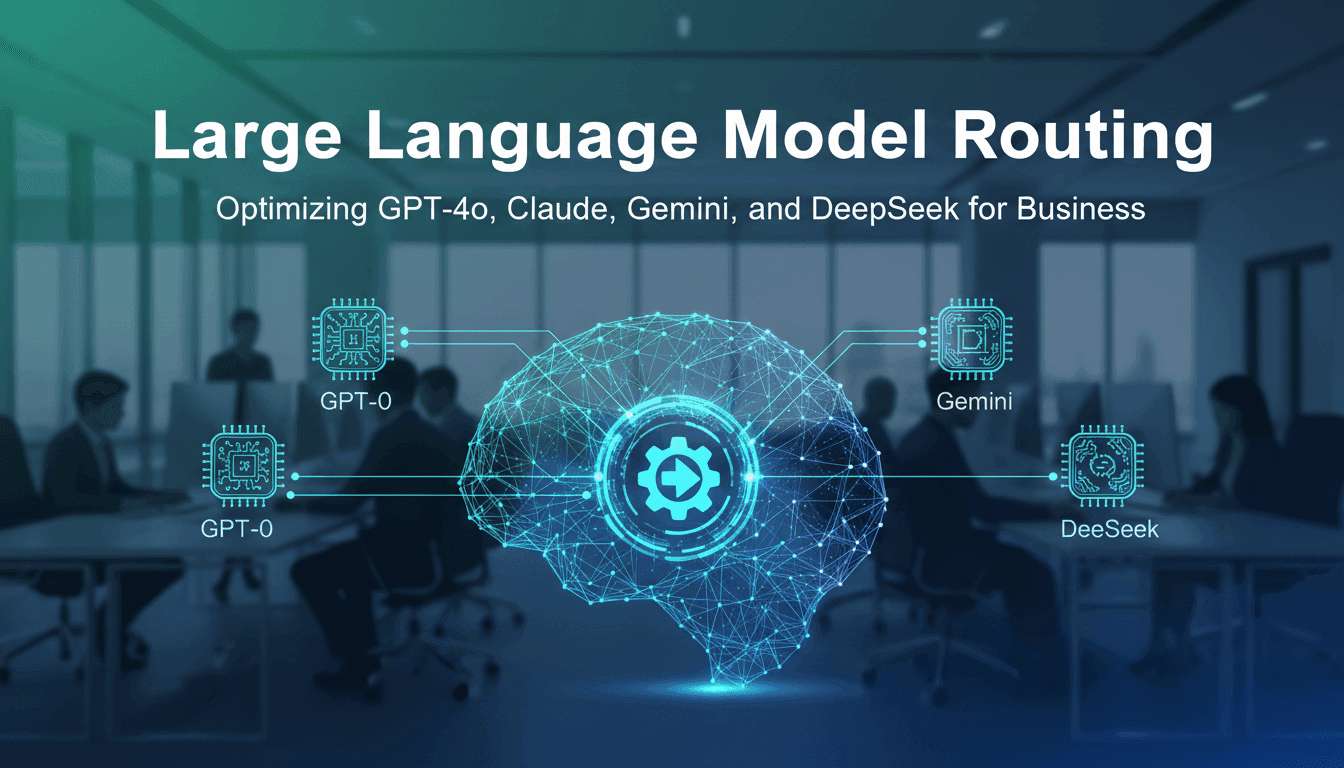
Table Of Contents
- What Is Large Language Model Routing?
- Why Businesses Need LLM Routing
- The Four Leading Models for Routing Strategies
- How LLM Routing Works in Practice
- Building an Effective Routing Strategy
- Cost Optimization Through Intelligent Routing
- Implementation Considerations for Asian Markets
- Common Routing Architectures
- Measuring Success: Key Performance Indicators
Businesses implementing artificial intelligence today face a critical challenge that rarely makes headlines but directly impacts their bottom line. Every API call to a large language model carries a cost, and not every task requires the most powerful (and expensive) model available. A customer service chatbot answering "What are your business hours?" doesn't need the same computational firepower as a legal document analyzer reviewing complex contracts.
Large language model routing has emerged as the solution that allows organizations to intelligently distribute queries across multiple AI models based on complexity, cost, and performance requirements. By strategically routing requests between GPT-4o, Claude, Gemini, and DeepSeek, forward-thinking companies are achieving 60-80% cost reductions while maintaining or even improving response quality.
This comprehensive guide explores how LLM routing works, why it matters for your business operations, and how to implement a routing strategy that transforms AI from an expensive experiment into a sustainable competitive advantage. Whether you're running AI pilots or scaling enterprise deployments, understanding model routing is essential for maximizing your AI investment returns.
LLM Routing: The Smart Way to Cut AI Costs
Reduce costs by 60-80% while improving response quality
The Challenge: Not every AI task needs the most expensive model. Using GPT-4o for simple queries like "What are your business hours?" is like hiring a surgeon to apply a bandage.
How LLM Routing Works
Analyze Query Complexity
System evaluates incoming requests using semantic analysis, keyword patterns, and complexity signals
Route to Optimal Model
Simple queries → DeepSeek (low cost), Complex tasks → GPT-4o/Claude (high capability)
Continuous Learning
Monitor performance and refine routing decisions based on accuracy, cost, and satisfaction metrics
The Four Model Powerhouses
GPT-4o
Versatile workhorse for complex reasoning
Claude
Context champion with 200K tokens
Gemini
Multimodal specialist for images & video
DeepSeek
Cost-efficient for routine tasks
Real-World Cost Impact
Key Benefits Beyond Cost Savings
- Better Performance: Match tasks to model strengths for improved accuracy
- Faster Responses: Lightweight models process simple queries quicker
- Vendor Resilience: Multi-provider strategy prevents single-point failures
- Scalability: Distribute workloads efficiently across multiple endpoints
Transform AI from an expensive experiment into a sustainable competitive advantage
What Is Large Language Model Routing?
Large language model routing is an orchestration strategy that automatically directs user queries to the most appropriate AI model based on predefined criteria. Rather than sending every request to a single model, routing systems analyze incoming queries and select from a portfolio of available models, optimizing for factors like task complexity, response speed, accuracy requirements, and cost constraints.
Think of it as a sophisticated traffic management system for AI workloads. Simple queries get routed to faster, more economical models, while complex reasoning tasks are directed to premium models with advanced capabilities. This approach mirrors how businesses already allocate human resources, assigning routine tasks to junior staff while reserving senior expertise for complex challenges.
The technical implementation typically involves a classifier or routing layer that sits between the user and the model endpoints. This layer evaluates each query using various signals such as keyword patterns, semantic complexity, required reasoning depth, domain specificity, and expected response format. Based on this evaluation, the router forwards the request to the optimal model, creating an efficient workflow that balances performance with operational costs.
Why Businesses Need LLM Routing
The business case for LLM routing extends far beyond simple cost savings, though the financial impact alone justifies implementation for most organizations. Companies operating AI applications at scale quickly discover that treating all queries equally creates unsustainable economics and operational inefficiencies.
Cost management represents the most immediate benefit. Premium models like GPT-4o can cost 20-30 times more per token than smaller, specialized models. When 60-70% of typical customer service queries involve straightforward information retrieval, routing these to cost-efficient models like DeepSeek delivers substantial savings without quality degradation. Organizations processing millions of monthly queries have documented six-figure annual savings through strategic routing.
Performance optimization offers equally compelling advantages. Different models excel at different tasks based on their training, architecture, and design priorities. Claude demonstrates superior performance on long-document analysis with its 200,000 token context window, while Gemini's multimodal capabilities make it ideal for image and video processing tasks. Routing requests to models aligned with their strengths improves accuracy, reduces hallucinations, and delivers faster response times.
Scalability and resilience also improve through routing architectures. Distributing workloads across multiple model providers prevents vendor lock-in and creates fallback options when specific models experience downtime or rate limiting. This redundancy proves critical for customer-facing applications where availability directly impacts revenue and brand reputation.
For organizations exploring AI implementation, Business+AI workshops provide hands-on experience developing routing strategies tailored to specific business contexts and regional requirements.
The Four Leading Models for Routing Strategies
GPT-4o: The Versatile Workhorse
OpenAI's GPT-4o (optimized) has established itself as the benchmark for general-purpose language understanding and generation. The model excels across diverse tasks from creative content generation to technical problem-solving, making it a reliable default choice for medium-to-high complexity queries.
Key strengths include exceptional reasoning capabilities that handle multi-step problems effectively, strong performance across multiple languages crucial for regional businesses, consistent output quality that maintains brand voice, and extensive fine-tuning options for domain-specific applications. The model's pricing structure positions it in the premium tier, making selective routing essential for cost management.
Optimal use cases for GPT-4o routing include complex customer inquiries requiring nuanced understanding, content creation demanding creativity and coherence, technical support questions involving troubleshooting logic, and business analysis tasks requiring synthesis of multiple information sources. Organizations typically route 20-30% of their highest-value queries to GPT-4o while leveraging more economical options for routine workloads.
Claude: The Context Champion
Anthropic's Claude distinguishes itself through industry-leading context handling capabilities and strong safety characteristics. The model's 200,000 token context window enables processing of entire books, lengthy contracts, or extensive conversation histories within a single request, eliminating the fragmentation issues that plague smaller context windows.
Claude demonstrates particular strength in analytical tasks requiring deep reading comprehension, nuanced instruction following with reduced need for prompt engineering, ethical reasoning and balanced perspective generation, and maintained coherence across extended interactions. These capabilities make Claude especially valuable for professional services, legal applications, and complex research tasks.
Routing strategies typically direct long-document analysis, contract review and summarization, research synthesis from multiple sources, and complex conversational interactions requiring extensive memory to Claude. The model's pricing falls between premium and mid-tier options, offering good value for tasks leveraging its context advantages. Businesses in finance, legal, and consulting sectors find Claude particularly cost-effective when routing replaces manual document processing.
Gemini: The Multimodal Specialist
Google's Gemini brings native multimodal processing to routing strategies, handling text, images, audio, and video within unified workflows. This capability eliminates the need for separate vision models or audio transcription services, simplifying architecture while expanding application possibilities.
The model excels at visual question answering and image analysis, video content understanding and summarization, integrated web search capabilities for current information, and strong performance on scientific and technical content. Gemini's tight integration with Google Cloud services provides additional advantages for organizations already invested in that ecosystem.
Strategic routing to Gemini makes sense for product support involving equipment photos, content moderation across image and text, visual quality control in manufacturing or logistics, educational applications combining text and diagrams, and research queries benefiting from web-grounded responses. The multimodal capabilities often eliminate the need for multiple specialized models, streamlining both architecture and costs.
DeepSeek: The Cost-Efficient Performer
DeepSeek has emerged as the cost optimization champion in routing strategies, delivering surprisingly strong performance at price points 80-90% below premium models. While less recognized in Western markets, DeepSeek has gained significant traction among cost-conscious enterprises and high-volume applications.
The model demonstrates capable performance on routine classification and routing tasks, solid comprehension for straightforward question answering, reliable output for template-based content generation, and acceptable quality for high-volume, low-stakes applications. DeepSeek's pricing structure makes it economically viable for use cases where premium model costs would be prohibitive.
Optimal routing scenarios include initial customer service triage before human or premium model escalation, FAQ responses and simple information retrieval, high-volume data processing and extraction, development and testing environments, and internal tools where absolute accuracy is less critical. Organizations often route 40-50% of their simplest queries to DeepSeek, reserving more expensive models for complex or customer-facing responses.
Businesses seeking guidance on model selection for their specific requirements can explore Business+AI consulting services for tailored strategy development.
How LLM Routing Works in Practice
Implementing LLM routing requires both technical infrastructure and strategic decision-making frameworks. The routing process typically follows a multi-stage pipeline that evaluates, routes, executes, and learns from each interaction.
The evaluation stage begins when a query enters the system. A classifier analyzes the request using various signals including query length and structural complexity, keyword and semantic content indicators, required reasoning depth estimation, domain and subject matter identification, and response format expectations. This analysis happens in milliseconds, adding negligible latency to the overall response time.
Routing decisions leverage this evaluation to select the appropriate model. Simple rule-based systems might use keyword matching or query length thresholds, while sophisticated implementations employ machine learning classifiers trained on historical query data. The routing logic considers the task complexity assessment, cost constraints and budget allocation, latency requirements for the application, model availability and current load, and confidence thresholds for routing decisions.
Execution involves forwarding the query to the selected model with appropriate prompting and parameters. The routing system may apply model-specific prompt optimization, adjust temperature and sampling parameters, implement retry logic for failed requests, and aggregate responses when using ensemble approaches. Response quality monitoring at this stage feeds back into routing improvement.
Continuous learning distinguishes advanced routing systems from static implementations. By tracking accuracy metrics across different routes, cost per query by routing decision, user satisfaction signals, and model performance trends, the system refines routing logic over time. This creates a virtuous cycle where routing decisions become progressively more efficient and accurate.
Building an Effective Routing Strategy
Successful routing implementation follows a structured approach that aligns technical capabilities with business objectives. Organizations should begin by thoroughly understanding their query landscape through detailed analysis of query volume and distribution patterns, complexity variation across different use cases, accuracy requirements for various application areas, latency tolerance for different user contexts, and current cost baseline and optimization targets.
1. Query Classification and Segmentation – Develop a taxonomy that meaningfully categorizes your queries. Simple information retrieval, moderate complexity reasoning, complex analytical tasks, and specialized domain applications each have different routing requirements. Create representative samples for each category to guide classifier training and rule development.
2. Model Capability Mapping – Systematically benchmark each candidate model against your query categories. Testing should use real queries from your application rather than generic benchmarks. Document performance across accuracy, latency, cost, and consistency metrics. This empirical data drives routing logic rather than assumptions about model capabilities.
3. Routing Logic Development – Start with conservative rules that route only clear-cut cases, gradually expanding as you build confidence. Initial implementations might route only the simplest 20% of queries to economical models and the most complex 10% to premium models, sending everything else to a reliable middle-tier option. Progressive refinement expands these percentages as classification confidence improves.
4. Integration and Infrastructure – Implement routing infrastructure that supports your operational requirements. Consider API management and rate limiting across providers, caching strategies to avoid redundant model calls, fallback mechanisms for model failures, monitoring and logging for performance tracking, and cost tracking at the routing decision level. Cloud-native routing platforms simplify these technical requirements but may introduce vendor dependencies.
5. Testing and Validation – Conduct thorough testing before production deployment. A/B testing comparing routed versus single-model approaches validates the strategy, while shadow deployment running routing in parallel with existing systems builds confidence. User acceptance testing ensures routing decisions don't degrade experience, and cost modeling confirms projected savings materialize in practice.
The Business+AI masterclass series offers structured guidance on implementing these routing strategies within organizational contexts, addressing both technical and change management dimensions.
Cost Optimization Through Intelligent Routing
The financial impact of routing becomes clear when examining real-world implementations. A customer service application handling 1 million queries monthly might face costs of $3,000 using GPT-4o exclusively. Strategic routing can reduce this to $600-900 while maintaining quality.
The savings mechanism operates through query distribution optimization. If 50% of queries route to DeepSeek at $0.0002 per query, 30% to a mid-tier model at $0.001 per query, and 20% to GPT-4o at $0.003 per query, the blended cost drops dramatically. The actual distribution varies by application, but 60-80% reductions are achievable without quality compromise.
Beyond direct model costs, routing reduces total cost of ownership through decreased infrastructure requirements from load distribution, reduced need for human escalation through better model-task matching, lower latency costs in time-sensitive applications, and minimized wasted capacity from right-sized model selection. These secondary benefits often equal or exceed direct API cost savings.
Cost optimization requires ongoing attention rather than one-time configuration. Monthly reviews should track cost per query trends by routing category, model performance evolution and pricing changes, query distribution shifts indicating changing user needs, and opportunities to expand routing to additional models or use cases. Organizations treating routing as a continuous improvement process rather than a set-and-forget solution achieve superior long-term results.
Implementation Considerations for Asian Markets
Businesses operating in Singapore and broader Asian markets face unique routing considerations that differ from North American and European implementations. Language support represents the most obvious requirement, particularly for applications serving multilingual populations.
While GPT-4o and Claude offer strong English performance, their capabilities vary significantly across Asian languages. Organizations should specifically benchmark Mandarin, Malay, Tamil, and other relevant languages using domain-specific content. Gemini often demonstrates advantages in Asian language processing given Google's regional market presence. DeepSeek, despite lower recognition, sometimes outperforms premium models on Chinese language tasks at fraction of the cost.
Data residency and regulatory compliance create additional routing dimensions. Singapore's Personal Data Protection Act and emerging AI governance frameworks may influence model selection and hosting choices. Routing strategies should consider where model inference occurs, how training data was sourced, data retention policies for logged queries, and compliance with sector-specific regulations in finance and healthcare. Some organizations implement geographic routing that uses different models based on user location and applicable regulations.
Cultural and contextual appropriateness also matters. Models trained predominantly on Western content may struggle with local context, cultural references, business practices, and communication norms. Testing should specifically evaluate performance on locally relevant scenarios. Organizations sometimes maintain regional fine-tuned models alongside global options, routing local queries to specialized models while using general models for universal tasks.
Network topology and latency considerations affect user experience. Model endpoints hosted in different regions introduce varying latency. Singapore-based applications might see 50-200ms latency differences between models hosted in Southeast Asia versus North America. For real-time applications, routing logic should factor latency alongside cost and quality. Regional model deployments, edge caching, and predictive pre-fetching can mitigate geography-related performance issues.
Common Routing Architectures
Organizations implement routing through several architectural patterns, each offering different trade-offs between complexity, performance, and operational overhead.
Sequential Routing represents the simplest approach where queries pass through models in predefined sequence. A fast, inexpensive model attempts the query first, and if confidence is low or the response uncertain, the system escalates to progressively more capable models. This pattern minimizes cost for queries solvable by simple models while ensuring complex queries eventually reach appropriate models. The main drawback is potential latency accumulation from sequential processing.
Parallel Ensemble Routing sends queries to multiple models simultaneously, then selects the best response based on consistency, confidence scoring, or voting mechanisms. This approach maximizes quality and provides redundancy but increases cost since multiple models process each query. Organizations typically reserve parallel routing for high-stakes queries where accuracy justifies expense, such as financial advice or medical information.
Classifier-Based Routing uses a dedicated classification model to analyze queries and predict the optimal target model. The classifier, often a smaller specialized model or traditional machine learning system, learns from historical routing outcomes. This approach enables sophisticated routing logic without per-query multi-model costs. The challenge lies in maintaining classifier accuracy as query patterns and model capabilities evolve.
Hybrid Adaptive Routing combines multiple approaches with real-time adjustment based on system state. Routing logic considers model availability and current load, recent performance metrics by query type, cost budgets and spending velocity, and user-specific requirements or service tiers. This flexibility optimizes for changing conditions but requires more sophisticated infrastructure and monitoring.
The architectural choice depends on query volume, budget constraints, latency requirements, complexity distribution, and team technical capabilities. Most organizations begin with simpler approaches and evolve toward sophistication as they gain operational experience and can quantify optimization opportunities.
Measuring Success: Key Performance Indicators
Effective routing requires comprehensive measurement across multiple dimensions. Organizations should establish baseline metrics before implementation and track ongoing performance to validate strategy effectiveness and identify improvement opportunities.
Cost metrics form the foundation of routing business cases. Track total monthly AI spending, cost per query by category and routing path, cost reduction percentage versus single-model baseline, and cost per business outcome (such as cost per resolved customer inquiry). Breaking down costs by routing decision reveals which strategies deliver value and which need refinement.
Quality metrics ensure cost optimization doesn't degrade user experience. Monitor response accuracy against ground truth where available, user satisfaction scores and feedback, task completion rates for goal-oriented interactions, and hallucination or error rates by model and query type. Quality should remain stable or improve with routing despite reduced costs. Degradation signals miscalibrated routing logic.
Performance metrics track operational health. Measure end-to-end latency including routing overhead, model response time distribution, routing decision time, and system availability across model providers. Performance issues often emerge at routing boundaries where queries transition between systems or when fallback mechanisms activate.
Business impact metrics connect routing to organizational objectives. Depending on your application, track customer service resolution rates and escalation reduction, content production volume and quality, revenue per AI interaction for commercial applications, and user engagement and retention rates. Routing should demonstrably improve or maintain these metrics while reducing costs.
Leading organizations establish dashboards that surface these metrics in real-time, enabling rapid response to issues and continuous optimization. The Business+AI membership program provides access to frameworks and benchmarking data that help contextualize routing performance against industry standards.
Routing represents an evolving practice rather than a solved problem. As new models emerge, capabilities shift, and pricing changes, optimal routing strategies require ongoing attention and adjustment.
Large language model routing has evolved from an experimental optimization technique to an essential capability for organizations operating AI applications at scale. By strategically distributing queries across GPT-4o, Claude, Gemini, and DeepSeek based on task requirements, businesses achieve substantial cost reductions while maintaining or improving response quality and performance.
The routing approach transforms AI economics from unsustainable expense to manageable investment. Organizations processing hundreds of thousands or millions of monthly queries find that intelligent routing makes the difference between AI pilots that stall due to budget constraints and production deployments that scale profitably. Beyond immediate cost savings, routing creates operational resilience through multi-provider strategies and enables continuous optimization as the model landscape evolves.
Successful implementation requires both technical infrastructure and strategic thinking. Understanding your query landscape, systematically benchmarking model capabilities, developing thoughtful routing logic, and measuring outcomes comprehensively form the foundation of effective routing strategies. For businesses in Singapore and across Asia, additional considerations around language support, regulatory compliance, and regional performance characteristics shape optimal approaches.
The rapidly evolving AI landscape means routing strategies developed today will need refinement tomorrow. New models with different capabilities and pricing emerge regularly, shifting optimal routing decisions. Organizations that treat routing as a continuous improvement discipline rather than a one-time project position themselves to maximize AI value sustainably over time. The companies turning AI experimentation into competitive advantage aren't necessarily those with the largest budgets, but those implementing intelligent systems that optimize every query for maximum business impact.
Turn AI Strategy Into Business Results
Ready to implement cost-effective LLM routing strategies tailored to your organization's specific needs? Business+AI connects Singapore executives and technical leaders with the expertise, frameworks, and peer networks needed to transform AI investments into measurable business gains.
Join our community of forward-thinking leaders at the Business+AI Forums to discuss routing implementations and share experiences, or explore our comprehensive resources through Business+AI membership for ongoing access to workshops, masterclasses, and consulting support.
Discover how leading organizations are optimizing their AI operations and building sustainable competitive advantages through intelligent model routing and deployment strategies.