
Hybrid Human-AI Teams: The Dominant Organizational Model for Business Success
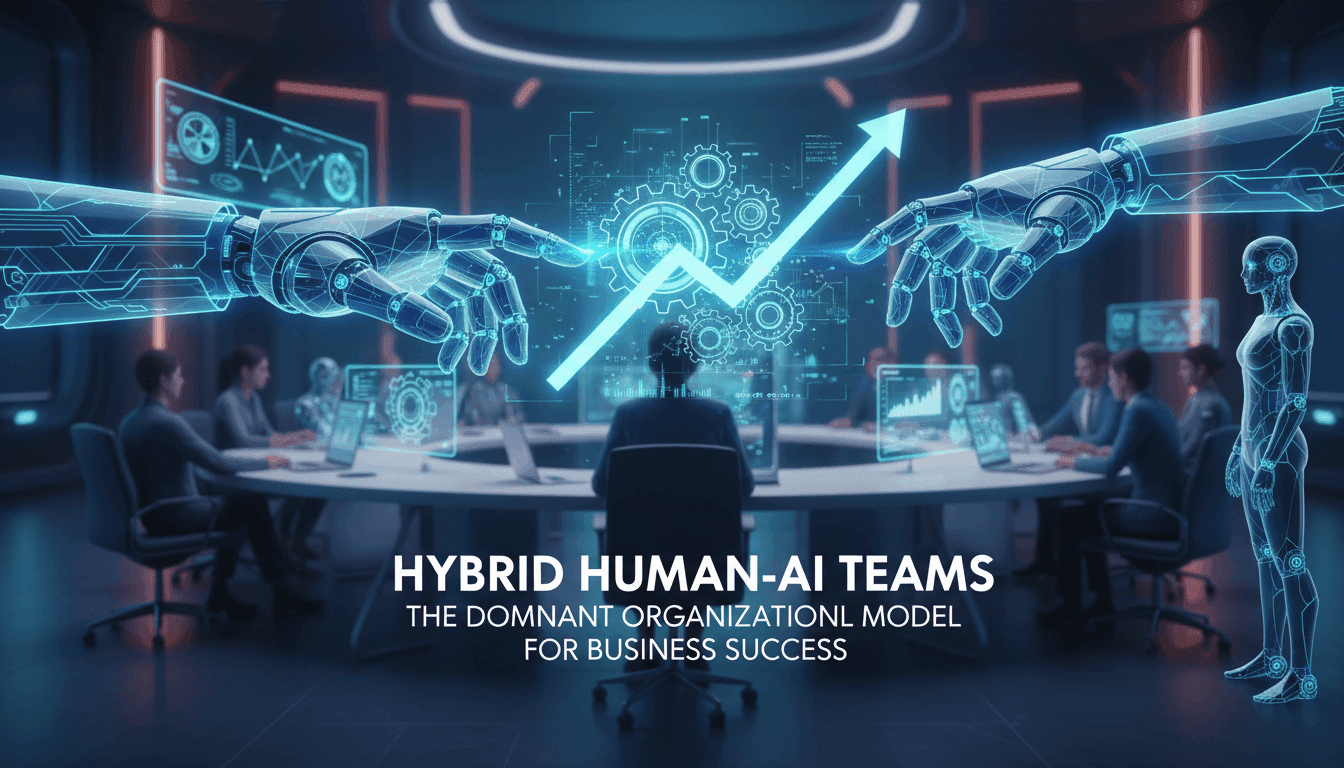
Table Of Contents
- Understanding Hybrid Human-AI Teams
- Why Hybrid Teams Are Becoming the Standard
- The Three Core Models of Human-AI Collaboration
- Building Effective Hybrid Teams: A Strategic Framework
- Critical Success Factors for Hybrid Teams
- Common Pitfalls and How to Avoid Them
- The Future of Work: What Leaders Need to Know
The question is no longer whether artificial intelligence will transform how organizations operate, but rather how quickly companies can adapt to the new reality of hybrid human-AI collaboration. Across industries from finance to healthcare, manufacturing to professional services, a clear pattern has emerged: the most successful organizations aren't replacing humans with AI or resisting automation entirely. Instead, they're strategically building hybrid teams that leverage the complementary strengths of both human intelligence and artificial intelligence.
This shift represents more than a technological upgrade. It's a fundamental reimagining of organizational structure, workflow design, and talent management. Companies that master hybrid team dynamics are seeing productivity gains of 30-40%, faster decision-making cycles, and improved employee satisfaction as workers are freed from repetitive tasks to focus on higher-value activities. Those that fail to adapt risk falling behind competitors who are already reaping these benefits.
This comprehensive guide explores why hybrid human-AI teams have emerged as the dominant organizational model, provides actionable frameworks for implementation, and shares proven strategies from companies successfully navigating this transformation. Whether you're just beginning to explore AI integration or looking to optimize existing hybrid workflows, you'll find practical insights to accelerate your journey from AI talk to tangible business gains.
Understanding Hybrid Human-AI Teams
Hybrid human-AI teams represent a collaborative organizational structure where human workers and artificial intelligence systems work together on shared objectives, each contributing their unique capabilities. Unlike traditional automation that simply replaces human labor, hybrid teams are designed around the principle of augmentation, where AI amplifies human abilities and humans provide context, creativity, and ethical judgment that machines cannot replicate.
The fundamental premise is straightforward: humans excel at tasks requiring emotional intelligence, creative problem-solving, ethical reasoning, and contextual understanding. AI systems, conversely, outperform humans in processing vast datasets, identifying patterns, executing repetitive tasks with consistency, and making calculations at speeds impossible for the human mind. When these complementary strengths are strategically combined, the resulting team performance exceeds what either humans or AI could achieve independently.
In practice, hybrid teams take many forms depending on industry and function. A customer service team might combine AI chatbots handling routine inquiries with human agents managing complex cases requiring empathy and nuanced judgment. Financial analysts increasingly work alongside AI systems that process market data and identify trends, while humans interpret findings within broader economic contexts and make final investment decisions. Manufacturing facilities deploy collaborative robots (cobots) working side-by-side with human workers, handling physically demanding tasks while humans oversee quality control and manage exceptions.
What distinguishes truly effective hybrid teams from simple automation is intentional design. These teams are structured with clear role definitions, established collaboration protocols, and continuous feedback loops that allow both human and AI team members to learn and improve. The relationship is genuinely collaborative rather than humans merely supervising automated processes or AI serving as an isolated tool.
Why Hybrid Teams Are Becoming the Standard
Several converging forces are driving the rapid adoption of hybrid human-AI teams as the dominant organizational model. Understanding these dynamics helps explain why this shift is accelerating across virtually every sector.
Economic Pressure and Competitive Advantage creates perhaps the strongest driver. Organizations implementing hybrid teams report significant productivity improvements, with some studies showing gains between 30-50% depending on the application. These aren't marginal improvements but transformational changes that directly impact bottom-line results. In competitive markets where operational efficiency determines survival, companies cannot afford to ignore these performance gains. Early adopters are already establishing competitive moats that will be difficult for laggards to overcome.
Workforce Evolution and Talent Shortages have made hybrid models increasingly attractive. Many industries face critical talent shortages, particularly in specialized technical roles. Rather than competing for scarce talent, organizations are using AI to extend the capabilities of existing teams. A single data scientist working with sophisticated AI tools can now accomplish what previously required an entire department. This talent multiplication effect allows companies to achieve ambitious goals without unsustainable hiring.
Technology Maturation and Accessibility have reached an inflection point where AI capabilities are both powerful and practical. Cloud-based AI services, pre-trained models, and no-code AI platforms have dramatically lowered barriers to entry. Organizations no longer need massive R&D budgets or specialized AI teams to begin implementation. This democratization means hybrid team structures are accessible to companies of all sizes, not just technology giants.
Employee Expectations and Job Satisfaction surprisingly support hybrid adoption. Initial fears that workers would resist AI collaboration have proven largely unfounded. When implemented thoughtfully, employees often welcome AI tools that eliminate tedious tasks and allow them to focus on more interesting, high-value work. At Business+AI workshops, executives consistently report that resistance comes primarily from management layers fearing disruption rather than frontline workers who see tangible benefits.
Risk Management and Resilience considerations have accelerated adoption, particularly following global disruptions. Hybrid teams provide operational resilience by creating redundancy and flexibility. When human workers face constraints (whether from pandemics, supply chain disruptions, or other crises), AI systems provide continuity. Conversely, AI systems still require human oversight for quality control and exception handling, creating a balanced approach that reduces organizational vulnerability.
The Three Core Models of Human-AI Collaboration
Successful hybrid teams typically follow one of three fundamental collaboration models, each suited to different organizational contexts and objectives. Understanding these models helps leaders choose the right approach for their specific needs.
Model 1: AI-Augmented Decision Making positions artificial intelligence as an advisor that provides insights, recommendations, and analysis while humans retain final decision authority. This model is common in strategic planning, financial services, medical diagnosis, and legal research. The AI processes extensive information and presents options, but experienced professionals make final judgments incorporating factors the AI cannot fully evaluate, including stakeholder relationships, cultural considerations, and ethical implications.
A financial advisory firm might use AI to analyze market trends, evaluate portfolio risk, and suggest rebalancing strategies. However, human advisors consider each client's unique circumstances, risk tolerance, life goals, and emotional responses to market volatility before making recommendations. The AI dramatically accelerates research and analysis, while humans provide the personalized judgment that builds client trust and delivers superior outcomes.
Model 2: Collaborative Task Execution structures workflows where humans and AI work simultaneously on different aspects of the same project, each handling components aligned with their strengths. This model appears frequently in content creation, software development, research, and complex problem-solving where tasks have both routine and creative elements.
Marketing teams exemplify this approach, with AI handling tasks like audience segmentation, performance analytics, and initial content drafts, while humans develop creative strategy, refine messaging for emotional resonance, and manage stakeholder relationships. Neither operates independently; instead, they engage in continuous handoffs where AI output becomes human input and vice versa, creating a workflow greater than the sum of its parts.
Model 3: Human-Supervised Automation involves AI systems handling primary execution while humans provide oversight, quality assurance, and exception management. This model suits high-volume, process-oriented work where consistency and speed are paramount but occasional complexity requires human intervention. Customer service, data processing, supply chain management, and manufacturing frequently adopt this structure.
In automated customer service, AI chatbots might successfully resolve 70-80% of inquiries without human involvement, dramatically reducing response times and operational costs. Complex cases, emotional situations, or requests requiring policy interpretation are seamlessly escalated to human agents who can access the conversation history and provide personalized assistance. The system learns from these escalations, gradually expanding the AI's capabilities while ensuring customers always receive appropriate support.
Most mature organizations don't choose a single model but rather implement different approaches across various functions, matching each model to specific operational requirements and strategic priorities.
Building Effective Hybrid Teams: A Strategic Framework
Successfully transitioning to hybrid human-AI teams requires more than deploying technology. Organizations need a structured approach that addresses strategy, implementation, and ongoing optimization. This framework provides a roadmap for building hybrid teams that deliver sustainable business value.
1. Start with Business Outcomes, Not Technology
The most common implementation mistake is beginning with AI capabilities and searching for applications. Instead, start by identifying specific business challenges or opportunities where hybrid teams could create measurable impact. What processes are bottlenecked by data processing limitations? Where do talented employees spend time on low-value repetitive work? Which decisions could benefit from analysis of patterns across larger datasets than humans can process?
Define clear success metrics before implementation. Productivity improvements, cost reductions, quality enhancements, customer satisfaction scores, and employee engagement should be quantified as baselines against which you'll measure progress. This business-first approach ensures AI investments align with strategic priorities and provides objective criteria for evaluating success.
2. Map Tasks to Capabilities
Conduct a detailed analysis of current workflows, breaking down processes into component tasks. For each task, evaluate whether it primarily requires human capabilities (creativity, emotional intelligence, ethical judgment, contextual understanding) or AI capabilities (data processing, pattern recognition, consistency, speed). Many tasks will benefit from combining both.
This mapping exercise often reveals surprising insights. Tasks assumed to require human judgment may have algorithmic components that AI can handle more effectively. Conversely, processes targeted for full automation may have hidden complexity requiring human oversight. The goal isn't maximum automation but optimal collaboration.
3. Design Collaborative Workflows
With task mapping complete, redesign workflows around hybrid collaboration. Define clear handoff points where work transfers between AI and human team members. Establish protocols for escalation when AI encounters situations requiring human intervention. Create feedback mechanisms where humans can correct AI errors, allowing systems to learn and improve.
Effective workflow design considers both technical integration and human factors. How will information flow between systems and people? What training do team members need to work effectively with AI tools? How will you maintain human skill development even as AI handles routine tasks? These questions must be answered during design rather than addressed reactively after implementation.
4. Implement Iteratively with Pilot Programs
Resist the temptation to deploy hybrid systems organization-wide immediately. Instead, identify a contained pilot project with manageable scope, clear success metrics, and stakeholder support. A successful pilot provides proof of value, surfaces unexpected challenges in a controlled environment, and creates internal champions who can advocate for broader adoption.
Choose pilot projects with high visibility but manageable risk. The ideal pilot delivers meaningful business impact if successful but won't jeopardize critical operations if adjustments are needed. Throughout the pilot, gather both quantitative performance data and qualitative feedback from team members working with new hybrid structures.
5. Scale with Governance and Standards
After validating the approach through pilots, create governance frameworks to guide scaling across the organization. Establish standards for AI system selection, data quality requirements, performance monitoring, and ethical guidelines. Define clear accountability structures specifying who owns decisions at each point in hybrid workflows.
Governance shouldn't stifle innovation but rather provide guardrails ensuring consistency, managing risk, and facilitating knowledge sharing across teams. As different departments implement hybrid structures, centralized governance prevents fragmented approaches and captures learnings that benefit the entire organization.
For executives looking to accelerate this process with expert guidance, Business+AI consulting services provide strategic support throughout the hybrid team transformation journey, from initial assessment through scaling and optimization.
Critical Success Factors for Hybrid Teams
Beyond the implementation framework, certain factors consistently differentiate successful hybrid team initiatives from those that struggle to deliver value.
Leadership Commitment and Change Management rank among the most critical factors. Hybrid team transformation requires sustained executive sponsorship, not just initial approval. Leaders must actively communicate the vision, model new behaviors, and allocate resources for training and adjustment periods. Organizations where leadership treats AI as an IT project rather than a strategic business transformation consistently underperform those with engaged executive champions.
Change management deserves particular attention. Even when hybrid teams objectively improve work quality and employee satisfaction, transitions create anxiety. Transparent communication about how roles will evolve, investment in reskilling programs, and celebration of early successes help teams navigate uncertainty. The most successful organizations involve frontline workers in design decisions, incorporating their insights and building ownership of new approaches.
Data Infrastructure and Quality directly determine hybrid team effectiveness. AI systems are only as good as the data they access. Organizations must invest in data collection, cleaning, integration, and governance before expecting sophisticated AI collaboration. Many pilot projects fail not because of AI limitations but because underlying data infrastructure is inadequate for advanced applications.
This doesn't mean perfection is required before starting. Begin with available data while systematically improving quality. As hybrid teams demonstrate value, justify incremental investments in data infrastructure that enable progressively sophisticated applications.
Continuous Learning and Adaptation separate static implementations from thriving hybrid teams. Build mechanisms for regular performance review, both of AI systems and overall team effectiveness. Create feedback loops where human team members can flag AI errors or inappropriate recommendations. Track performance metrics consistently and be prepared to adjust workflows based on real-world results.
Equally important, invest in ongoing skill development for human team members. As AI handles more routine tasks, humans must develop higher-level capabilities in areas like critical thinking, creative problem-solving, and ethical reasoning. Organizations viewing training as a one-time event rather than continuous investment will find their hybrid teams plateauing after initial gains.
Ethical Frameworks and Human Oversight become increasingly important as AI takes on more significant roles. Establish clear principles governing AI use, particularly for decisions affecting people (hiring, performance evaluation, customer treatment). Ensure human oversight remains embedded at critical decision points, especially where errors could cause significant harm.
Transparency matters both internally and externally. Team members should understand how AI systems make recommendations. Customers deserve to know when they're interacting with AI versus humans and should have clear escalation paths when needed. Organizations neglecting these ethical considerations face not only reputational risks but also potential regulatory challenges as AI governance frameworks evolve globally.
Common Pitfalls and How to Avoid Them
Learning from others' mistakes accelerates your own success. These common pitfalls trap many organizations attempting hybrid team transformation.
Technology-First Thinking leads organizations to deploy impressive AI capabilities without clear business applications. The result is expensive technology that generates interesting demos but little business value. Avoid this by maintaining relentless focus on business outcomes. Every AI initiative should answer: What specific business problem does this solve? How will we measure success? What's the expected return on investment?
Underestimating Change Management causes technically successful implementations to fail in practice because people don't adopt new approaches. Organizations assume that obviously superior tools will be embraced automatically, neglecting the human factors that determine actual usage. Invest as much in change management, training, and communication as in technology implementation itself.
Insufficient Human Oversight creates quality and ethical problems when organizations automate too aggressively. AI systems are probabilistic, meaning they make mistakes, sometimes in subtle ways that compound over time. Maintain appropriate human oversight, especially in early implementation stages, and create clear escalation procedures for ambiguous situations.
Neglecting Data Foundations dooms hybrid teams before they start. Organizations enthusiastic about AI applications often discover too late that their data is fragmented, low quality, or inaccessible. Conduct honest data readiness assessments early and address gaps systematically rather than hoping sophisticated AI will compensate for poor data quality.
Isolated Pilots That Never Scale waste resources when organizations run successful pilots but fail to capture learnings or build organizational capability. Each pilot should be designed with scaling in mind, documenting what works, what doesn't, and why. Create mechanisms to share insights across teams and build on successes rather than repeatedly solving similar problems in isolation.
Static Implementations that don't evolve quickly become outdated as both AI capabilities and business needs advance rapidly. Build continuous improvement into hybrid team operations from the start, with regular reviews and optimization cycles.
The Business+AI masterclass program helps leaders navigate these pitfalls by sharing real-world case studies and providing frameworks for avoiding common mistakes based on successful implementations across industries.
The Future of Work: What Leaders Need to Know
As hybrid human-AI teams become the organizational standard rather than an innovative experiment, several trends will shape how this model evolves.
Democratization of AI Capabilities will accelerate as tools become more accessible and user-friendly. Within five years, working with AI will be as commonplace as using spreadsheets or presentation software today. This democratization shifts the competitive advantage from having AI to using it strategically and creatively. Organizations must focus on developing uniquely human capabilities that differentiate them even as technical capabilities commoditize.
Specialization of Human Roles will intensify as AI handles broader ranges of routine cognitive work. The most valuable human skills will be those most distinctly human: complex problem-solving in ambiguous situations, creative innovation, emotional intelligence and relationship building, ethical reasoning, and strategic thinking. Organizations should be actively developing these capabilities across their workforce rather than waiting for the shift to fully manifest.
New Forms of Human-AI Interaction will emerge beyond current text and voice interfaces. Brain-computer interfaces, augmented reality collaborations, and more intuitive AI systems will create seamless integration between human thinking and AI processing. While this sounds futuristic, early versions are already appearing in specialized applications, and mainstream adoption will arrive faster than many expect.
Regulatory Frameworks and Accountability Standards will mature as governments worldwide grapple with AI governance. Organizations should anticipate increasing requirements for transparency, fairness testing, and human oversight of AI systems. Rather than viewing regulation as burden, forward-thinking companies are building ethical frameworks that exceed current requirements, positioning themselves favorably as standards crystallize.
Competitive Separation Between Leaders and Laggards will widen dramatically. Organizations successfully implementing hybrid teams are already seeing compound advantages as their AI systems learn from more data, their teams develop more sophisticated collaboration skills, and their processes become more efficient. This creates a flywheel effect where advantages accumulate and accelerate.
The window for easy adoption is already closing. As hybrid teams become standard, the question shifts from whether to adopt them to whether your organization is adopting them fast enough to remain competitive. Leaders who wait for complete clarity before beginning implementation will find themselves not cautiously wise but dangerously behind.
For organizations ready to accelerate their hybrid team journey, connecting with peers facing similar challenges provides invaluable insights and support. The Business+AI Forums bring together executives, consultants, and solution vendors to share experiences, explore emerging practices, and build partnerships that accelerate transformation from concept to results.
Hybrid human-AI teams represent more than a technological upgrade. They mark a fundamental evolution in how organizations structure work, develop talent, and compete in increasingly dynamic markets. The evidence is clear: companies successfully implementing hybrid models are achieving significant competitive advantages in productivity, innovation, and operational resilience.
The transition requires more than deploying AI tools. It demands strategic thinking about which tasks benefit from human versus AI capabilities, thoughtful workflow redesign that enables true collaboration, investment in both technology infrastructure and human skill development, and sustained leadership commitment to navigate inevitable challenges.
Yet the path forward need not be overwhelming. By starting with clear business objectives, implementing iteratively through focused pilots, learning from both successes and setbacks, and systematically scaling what works, organizations of any size can successfully build hybrid teams that deliver tangible business value.
The dominant organizational model of the future is taking shape now in leading companies across industries. The question facing executives today isn't whether hybrid human-AI teams will define competitive success, but whether your organization is moving quickly and strategically enough to capture the opportunities this transformation creates. The time for planning has passed. The time for action is now.
Ready to Transform AI Talk Into Tangible Business Gains?
Join Singapore's premier ecosystem for executives navigating the AI transformation. Become a Business+AI member and gain access to hands-on workshops, expert masterclasses, exclusive forums with industry leaders, and the strategic guidance your organization needs to build high-performing hybrid human-AI teams.
Whether you're just beginning your AI journey or looking to optimize existing implementations, Business+AI provides the community, expertise, and practical frameworks to accelerate your success. Connect with executives, consultants, and solution vendors who are turning AI potential into measurable business results.