
How AI Cut Month-End Close from 10 Days to 6: A Finance Transformation Blueprint
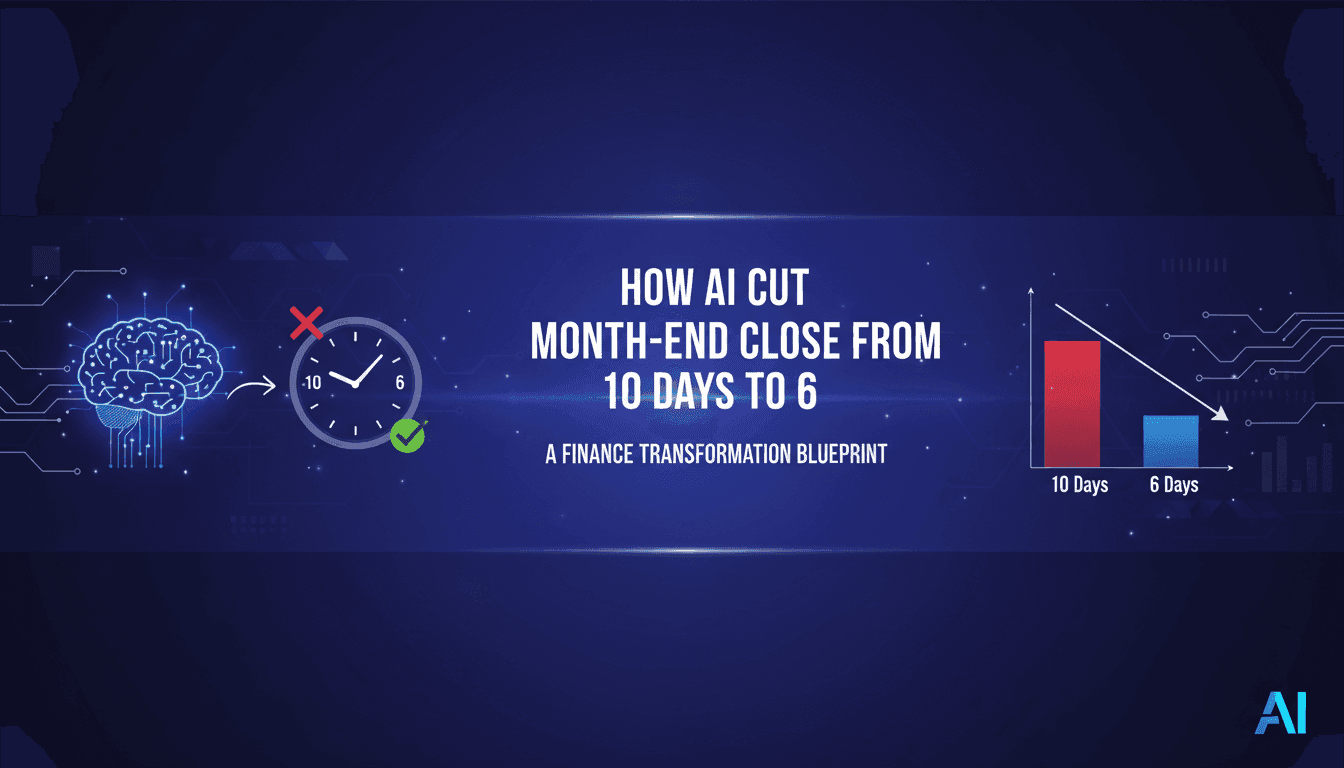
Table Of Contents
- The Month-End Close Bottleneck
- Where AI Creates the Biggest Impact
- The 10-Day to 6-Day Transformation: A Real-World Breakdown
- Key Technologies Driving the Change
- Implementation Roadmap: From Pilot to Full Deployment
- Measuring Success Beyond Time Savings
- Common Pitfalls and How to Avoid Them
- The Future: Continuous Close and Real-Time Insights
For finance teams worldwide, month-end close represents a recurring pressure point. The process typically consumes 7 to 10 days of intense work, requiring accountants to manually consolidate data from multiple systems, reconcile thousands of transactions, hunt down discrepancies, and prepare reports under tight deadlines. It's a period marked by long hours, high stress, and limited capacity for strategic work.
But a transformation is underway. Leading organizations are leveraging artificial intelligence to fundamentally redesign their close processes, achieving what once seemed impossible: cutting close time nearly in half while simultaneously improving accuracy and freeing finance professionals to focus on analysis rather than data processing. Companies that previously needed 10 days now consistently close in 6 days or less.
This isn't a distant future scenario. It's happening now, and the technology has matured to the point where mid-sized organizations can implement these solutions with manageable investment and clear ROI. This article breaks down exactly how AI accelerates month-end close, which processes benefit most, and what a practical implementation roadmap looks like for finance leaders ready to make the leap from month-end marathon to streamlined sprint.
The Month-End Close Bottleneck
To understand how AI creates such dramatic time savings, we first need to examine where the 10 days actually go. Traditional month-end close follows a predictable pattern that hasn't changed much in decades, despite technological advances in other areas.
The typical timeline breaks down as follows: Days 1-3 involve data collection and consolidation from disparate systems (ERP, CRM, procurement, treasury, and subsidiary ledgers). Days 4-6 focus on reconciliations and variance analysis, where accountants compare balances, investigate discrepancies, and make adjusting entries. Days 7-9 consist of management reporting preparation, consolidation adjustments, and initial reviews. Day 10 involves final reviews, sign-offs, and report distribution.
The bottlenecks are embedded throughout this process. Manual data extraction from systems that don't communicate seamlessly creates delays and introduces transcription errors. Account reconciliations require accountants to match thousands of transactions across systems, a tedious process prone to human oversight. Exception investigation pulls senior staff into detective work, tracking down why balances don't match or why variances exceed thresholds. Review cycles create dependencies where delays cascade through the entire process.
These bottlenecks aren't just about time. They also impact quality. When teams rush to meet deadlines, errors slip through. When 80% of effort goes to data wrangling, only 20% remains for the analysis that actually drives business value. The opportunity cost is enormous, with skilled finance professionals spending their days on repetitive tasks rather than providing strategic insights.
Where AI Creates the Biggest Impact
AI doesn't simply speed up existing processes. It fundamentally transforms how work gets done during close, automating entire workflows that previously required manual intervention.
Automated Data Consolidation
AI-powered tools now connect to multiple source systems, automatically extracting, validating, and consolidating financial data without manual intervention. Machine learning algorithms understand the structure of different data sources and map them to the appropriate general ledger accounts.
The time savings here are substantial. What previously took 2-3 days of data gathering and reformatting now happens overnight. More importantly, the automation eliminates the transcription errors that typically require hours of investigation later in the process. AI systems validate data completeness in real-time, flagging missing information immediately rather than surfacing issues days into the close cycle.
Modern solutions incorporate robotic process automation (RPA) to log into various systems, extract reports, and move data to centralized platforms. Combined with AI that learns organizational data patterns, these systems become increasingly efficient over time, handling exceptions that initially required human oversight.
Intelligent Reconciliation
Reconciliation represents the most time-intensive component of month-end close, and it's where AI delivers perhaps the most dramatic impact. Traditional reconciliation requires accountants to manually match transactions between systems, investigating why a bank statement doesn't align with the cash ledger or why intercompany balances don't net to zero.
AI reconciliation engines use pattern recognition and fuzzy matching to automatically match transactions, even when details don't align perfectly. They understand that "ABC Company" in one system might appear as "ABC Co." in another. They recognize timing differences and standard adjusting entries based on historical patterns.
The results speak for themselves. Organizations report reconciliation time reductions of 60-75%, with many account reconciliations now completing in minutes rather than hours. One multinational manufacturing company reduced its bank reconciliation time from 8 hours to 45 minutes per entity, multiplied across 30 subsidiaries, this single improvement saved nearly three full days from their close cycle.
Even more valuable than speed is the exception-based workflow AI enables. Rather than reviewing every reconciliation, accountants now focus only on items the AI flags as unusual or unmatched. This transforms the accountant's role from data matcher to investigative analyst, a shift that better utilizes their professional judgment.
Exception Management and Anomaly Detection
AI excels at identifying unusual patterns that warrant investigation. Machine learning models trained on historical financial data can spot anomalies that might indicate errors, fraud, or significant business changes requiring disclosure.
These systems learn what "normal" looks like for every account and dimension of the business. When gross margin in a particular product line drops unexpectedly, when expense ratios deviate from historical patterns, or when transaction volumes spike without explanation, the AI flags these items for review.
This proactive exception management prevents the last-minute surprises that typically extend close timelines. Rather than discovering issues during final review on day 9, finance teams identify and resolve them on day 2 or 3. The shift from reactive to proactive dramatically compresses the critical path of the close process.
The 10-Day to 6-Day Transformation: A Real-World Breakdown
Let's examine how the timeline transforms when AI capabilities are fully deployed. A regional financial services firm with $800 million in annual revenue provides an instructive example.
Before AI implementation (10-day close):
- Days 1-2: Manual data extraction from 6 source systems, spreadsheet consolidation
- Days 3-5: Manual reconciliation of 200+ accounts, variance analysis
- Days 6-7: Investigating exceptions, preparing adjusting entries
- Days 8-9: Report preparation, management review
- Day 10: Final adjustments, sign-off
After AI implementation (6-day close):
- Day 1 morning: Automated data consolidation completes overnight, validation review (2 hours)
- Day 1 afternoon: AI-powered reconciliation of 85% of accounts completes automatically, team focuses on flagged exceptions
- Day 2: Exception investigation and resolution, adjusting entries
- Day 3: Automated report generation, preliminary management review
- Days 4-5: Analysis of AI-flagged trends, strategic review discussions
- Day 6: Final sign-off, distribution
The transformation created 4 days of time savings, but the benefits extended beyond speed. Error rates dropped by 40% due to elimination of manual data entry. The finance team's satisfaction increased measurably as they spent more time on analysis and less on repetitive tasks. Perhaps most significantly, the earlier close enabled the company to share results with the board and investors faster, improving stakeholder confidence.
These outcomes weren't achieved overnight. The firm partnered with consultants who understood both finance processes and AI capabilities, ensuring the technology addressed actual bottlenecks rather than automating processes that weren't rate-limiting. This is precisely the type of strategic implementation expertise available through Business+AI's consulting services, where experts help organizations identify the highest-value AI applications for their specific context.
Key Technologies Driving the Change
Several specific AI technologies work together to enable faster close cycles. Understanding these components helps finance leaders evaluate solutions and set realistic expectations.
Machine learning models power automated classification and reconciliation. These algorithms learn from historical transaction data, understanding which general ledger accounts correspond to different transaction types. As they process more data, their accuracy improves, reducing the volume of transactions requiring manual review.
Natural language processing (NLP) enables AI systems to read and understand unstructured data in emails, invoices, and contracts. This capability is particularly valuable for accruals and estimates, where AI can scan contract terms to identify revenue recognition triggers or warranty obligations without manual review.
Robotic process automation (RPA) handles the repetitive, rules-based tasks that consume enormous time during close. RPA bots log into multiple systems, extract data, populate templates, and move information between applications with perfect consistency.
Computer vision processes scanned documents and images, extracting relevant financial data from invoices, receipts, and supporting documentation. This technology accelerates expense processing and payables reconciliation.
Predictive analytics anticipates issues before they occur. These models forecast expected account balances based on business activity, flagging accounts that are likely to require adjustment before the formal reconciliation begins.
The most effective solutions integrate multiple technologies into cohesive platforms rather than requiring finance teams to cobble together point solutions. When evaluating vendors, finance leaders should prioritize systems that address their specific bottlenecks while fitting within their existing technology ecosystem.
Implementation Roadmap: From Pilot to Full Deployment
Moving from traditional close to AI-powered close requires thoughtful planning. Organizations that achieve the best results follow a structured approach that builds capability progressively.
1. Process Assessment and Prioritization – Begin by mapping your current close process in detail, identifying which activities consume the most time and where errors most frequently occur. Not every process benefits equally from AI. Focus on high-volume, repetitive tasks with clear rules as initial targets. This assessment phase typically takes 2-4 weeks and should involve both finance staff who execute the close and technology teams who understand your systems landscape.
2. Pilot Selection – Choose 2-3 specific processes for initial implementation. Bank reconciliations and intercompany eliminations are common starting points because they're well-defined, time-consuming, and have clear success metrics. Starting with a focused pilot allows the team to learn AI capabilities and change management requirements without overwhelming the organization. This stage includes vendor selection, solution configuration, and training on a limited scope.
3. Training and Model Development – AI systems require historical data to learn patterns. Plan for 2-3 months of model training using past close data before deploying into production. During this period, run AI processes in parallel with existing manual processes to validate accuracy and build confidence. This parallel period is essential for identifying edge cases and refining the system.
4. Phased Rollout – After successful pilots, expand AI capabilities to additional processes and accounts. Many organizations roll out by materiality, automating high-volume, low-complexity accounts first, then progressively tackling more nuanced areas. This phased approach typically takes 6-12 months for full deployment, depending on organizational complexity.
5. Continuous Improvement – AI systems improve with use. Establish feedback loops where accountants flag incorrect classifications or matches, enabling the system to learn. Schedule quarterly reviews to assess performance metrics and identify opportunities for expanding automation.
Change management deserves equal attention to technology implementation. Finance teams may feel threatened by automation or skeptical of AI accuracy. Successful organizations frame the transformation as augmentation rather than replacement, emphasizing how AI eliminates tedious tasks and creates capacity for higher-value analytical work. Involving staff in pilot selection and testing builds buy-in and surfaces practical concerns early.
For organizations seeking structured guidance through this journey, Business+AI workshops offer hands-on experience with AI finance tools and implementation best practices, while masterclasses provide deeper dives into specific technologies and use cases.
Measuring Success Beyond Time Savings
While reducing close time from 10 days to 6 is the headline benefit, comprehensive success measurement considers multiple dimensions. Leading organizations track a balanced scorecard of metrics to assess their AI investment.
Close cycle time is the obvious starting point. Track not just the total duration but also the time required for specific sub-processes like reconciliations, variance analysis, and report preparation. This granular view reveals where AI delivers value and where opportunities remain.
Error rates provide insight into quality improvements. Measure adjusting entries after initial close, financial statement restatements, and reconciliation breaks. Organizations typically see 30-50% reductions in errors after AI implementation, as automation eliminates transcription mistakes and anomaly detection catches issues earlier.
Staff capacity utilization reflects the shift from data processing to analysis. Track the percentage of close time spent on manual data tasks versus analytical activities. The goal is to flip the traditional 80/20 split, with finance teams spending the majority of their time on interpretation and insight rather than data wrangling.
Process standardization often improves as organizations implement AI. The technology requires clearly defined processes, which drives beneficial standardization across business units or subsidiaries that previously followed different approaches.
Employee satisfaction matters more than many finance leaders initially recognize. High turnover in accounting roles often stems from repetitive, low-value work. Organizations report improved retention and recruitment when they showcase modern, AI-augmented work environments.
Business responsiveness measures how quickly finance can answer management questions or model scenarios. With close completed earlier and more capacity available, finance becomes a strategic partner rather than a backward-looking scorekeeper.
Establish baseline metrics before implementation and track progress monthly. Some benefits materialize quickly while others emerge gradually as the organization develops new capabilities enabled by freed capacity.
Common Pitfalls and How to Avoid Them
Despite compelling benefits, some AI close initiatives underdeliver. Understanding common pitfalls helps finance leaders navigate implementation successfully.
Automating broken processes represents the most frequent mistake. AI accelerates processes, but if those processes are inefficient or illogical, you simply get faster bad results. Use AI implementation as an opportunity to redesign workflows, eliminating unnecessary steps and standardizing approaches before introducing automation.
Underestimating data quality requirements derails many projects. AI systems require clean, consistent data to function effectively. If your chart of accounts lacks discipline, if transaction descriptions are inconsistent, or if master data is poorly maintained, expect to invest in data governance before AI delivers full value. This isn't wasted effort; improved data quality benefits numerous processes beyond close.
Insufficient change management leaves staff confused or resistant. Technology is the easy part; changing how people work is harder. Invest in training, communication, and incentives that align with the new operating model. Celebrate early wins and share success stories to build momentum.
Choosing the wrong starting point can sap enthusiasm. If initial pilots tackle particularly complex or unusual processes, they may struggle to demonstrate value. Start with high-volume, rules-based processes where AI excels, building credibility before addressing more nuanced areas.
Expecting perfection immediately sets unrealistic expectations. AI systems learn over time. Early accuracy of 80-85% may improve to 95%+ after several close cycles as models learn organizational patterns. Plan for a learning period rather than expecting day-one perfection.
Neglecting integration with existing systems creates new manual steps that offset automation benefits. Ensure AI solutions connect seamlessly with your ERP, consolidation tools, and reporting systems. Point solutions that require exporting and importing data rarely deliver projected value.
Organizations that navigate these pitfalls successfully often leverage external expertise. Connecting with peers who have completed similar transformations provides invaluable insight. The Business+AI Forums create exactly these connections, bringing together finance leaders, consultants, and solution providers to share implementation experiences and best practices.
The Future: Continuous Close and Real-Time Insights
The journey from 10 days to 6 days is impressive, but it's not the end state. Leading organizations are pushing toward continuous close, where financial results are available within 1-2 days of month-end or even in real-time for key metrics.
This evolution is enabled by AI capabilities that process transactions as they occur rather than waiting for month-end batch processing. Reconciliations happen daily. Anomalies are flagged and resolved immediately. Management reports update continuously rather than awaiting month-end.
Continuous close transforms finance's role in the organization. Rather than spending the first week of each month closing the prior month, finance teams focus on forward-looking analysis, scenario modeling, and strategic decision support. Financial planning and analysis (FP&A) merges more closely with accounting as the distinction between historical reporting and forecasting blurs.
This future requires not just technology but also mindset shifts. Traditional close represents a defined event with clear completion criteria. Continuous close requires new quality control approaches, different audit procedures, and cultural changes around financial reporting.
For organizations just beginning their AI journey, continuous close may seem distant. But starting with targeted automation of current bottlenecks builds the foundation for these more advanced capabilities. Each step compounds, progressively transforming finance from a periodic reporting function to a continuous insights engine.
The organizations that will lead their industries in the coming years are those that equip their finance teams with AI capabilities today. The competitive advantage comes not just from faster close but from the strategic capacity that faster close enables. While competitors spend two weeks processing history, AI-enabled finance teams are already analyzing trends and informing forward decisions.
Conclusion
Reducing month-end close from 10 days to 6 isn't about working harder or hiring more staff. It's about fundamentally redesigning the close process around AI capabilities that automate repetitive tasks, eliminate manual errors, and free finance professionals to focus on analysis rather than data processing.
The transformation is real and achievable. Organizations across industries and sizes are implementing these solutions today, with clear ROI and measurable improvements in both speed and quality. The technology has matured beyond experimental pilots to production-ready platforms that integrate with existing systems and scale across complex organizations.
Success requires more than selecting the right technology. It demands careful process assessment, thoughtful change management, and realistic expectations about learning curves and implementation timelines. Organizations that approach AI adoption strategically, starting with focused pilots and expanding based on proven value, consistently outperform those that attempt big-bang transformations.
For finance leaders evaluating this opportunity, the question isn't whether to adopt AI for month-end close but when and how. Waiting for perfect conditions or complete certainty means falling behind competitors who are already capturing the benefits of faster close, improved accuracy, and enhanced strategic capacity.
The future of finance is data-driven, automated, and strategic. The journey begins with targeted improvements to processes like month-end close that demonstrate AI's value while building organizational capabilities for more advanced applications. Every day spent on manual reconciliations and data consolidation is a day not spent on the analysis and insights that drive business growth.
Ready to Transform Your Finance Operations with AI?
Moving from month-end close theory to implementation requires expertise, peer insights, and connections to proven solutions. Business+AI membership gives you access to the ecosystem of executives, consultants, and technology providers who are successfully deploying AI in finance operations.
Connect with finance leaders who have already achieved faster close cycles. Access workshops and masterclasses focused on practical AI implementation. Get guidance from consultants who understand both finance processes and AI capabilities.
Join Business+AI today and turn AI potential into measurable finance transformation.