
From Cost-Cutting to Value Creation: Why the AI Narrative Must Change
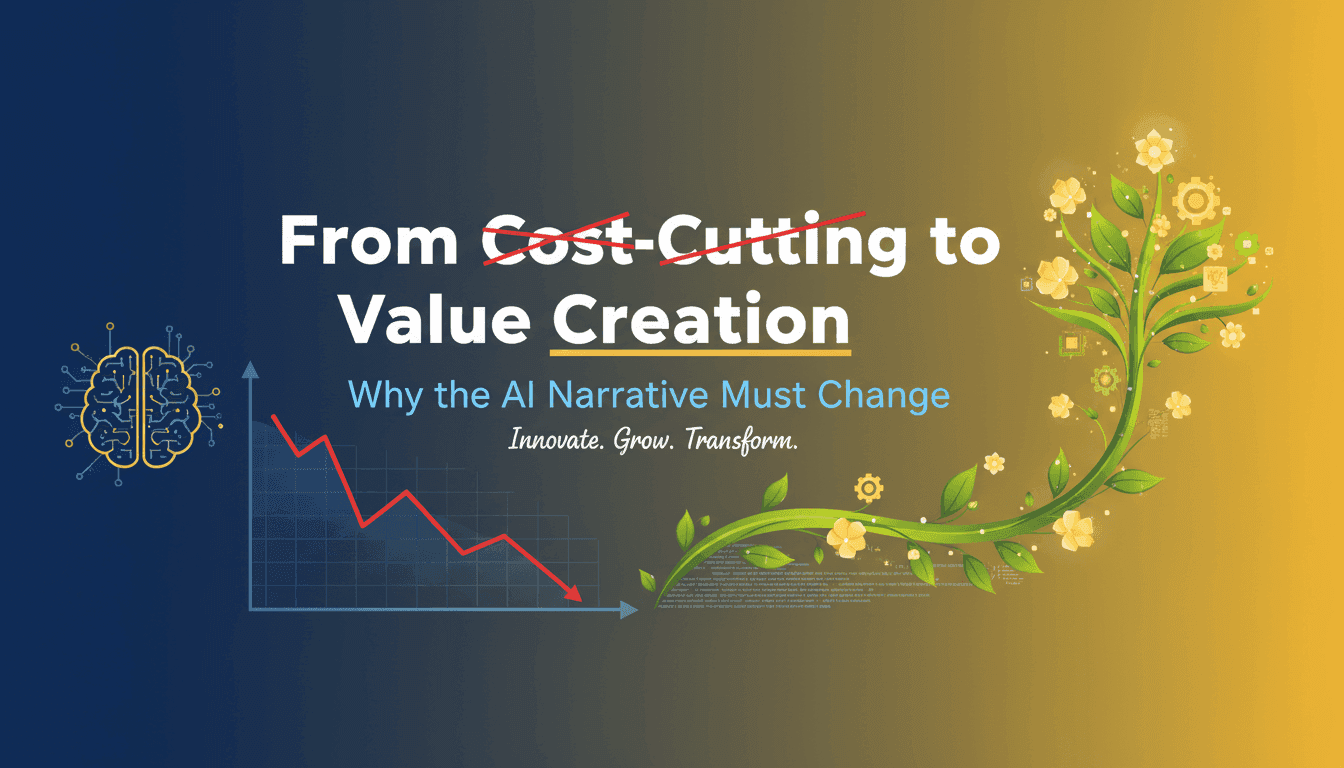
Table Of Contents
- The Cost-Cutting Trap: Why Current AI Narratives Fall Short
- The Real Problem: Missed Opportunities in Innovation
- What Value-Driven AI Actually Means
- Four Pillars of a Value-Creation AI Strategy
- Making the Narrative Shift in Your Organization
- Measuring Value Beyond Cost Savings
- The Role of Leadership in Changing the Conversation
When artificial intelligence first entered mainstream business conversations, the pitch was seductive in its simplicity: automate repetitive tasks, reduce operational costs, and do more with less. Boardrooms lit up at the prospect of efficiency gains and headcount optimization. Yet years into widespread AI adoption, many organizations find themselves in a peculiar position. They've achieved their cost reductions, automated their processes, and streamlined their operations, but they're still struggling to answer a fundamental question: what's next?
The answer lies not in doing the same things cheaper, but in doing entirely new things that were previously impossible. The AI narrative that dominates most corporate strategy sessions has become a limiting factor rather than an enabling one. When we frame AI primarily as a cost-cutting tool, we inadvertently constrain our thinking about what's possible. We optimize for efficiency when we should be architecting for transformation. We celebrate reduced expenses when we should be building new revenue streams.
This article examines why the prevailing AI narrative must evolve from cost optimization to value creation, and more importantly, how business leaders can orchestrate this shift within their organizations. The companies that will dominate the next decade won't be those that cut costs most aggressively, but those that use AI to create value in ways their competitors haven't imagined.
From Cost-Cutting to Value Creation
Why the AI narrative must evolve for lasting competitive advantage
The Trap
Local maximum problem: optimizing the wrong metrics
The Shift
Ask "what becomes possible?" not "what can we automate?"
The Real Problem: Missed Opportunities
New Business Models
Creating products and services that couldn't exist without AI, not just automating existing processes
Strategic Capabilities
Identifying market opportunities before competitors and predicting customer needs before articulation
Competitive Moats
Building differentiated experiences that are difficult to replicate, not just cost savings competitors can match
Four Pillars of Value-Creation AI Strategy
Revenue Generation
New revenue streams and premium pricing, not margin protection
Customer Experience
Personalization at scale and competitive differentiation
Innovation Acceleration
Compressed timelines and expanded R&D possibilities
Strategic Intelligence
Superior market sensing and decision advantage
Making the Narrative Shift
Key Takeaway
The companies that will dominate the next decade won't be those that cut costs most aggressively, but those that use AI to create value in ways their competitors haven't imagined.
Ready to transform your AI strategy?
Join Business+AI CommunityThe Cost-Cutting Trap: Why Current AI Narratives Fall Short {#the-cost-cutting-trap}
The cost-cutting narrative surrounding AI adoption didn't emerge in a vacuum. It developed because early AI implementations delivered measurable, immediate returns in operational efficiency. Chatbots reduced customer service costs. Robotic process automation eliminated manual data entry. Predictive maintenance prevented expensive equipment failures. These wins were tangible, quantifiable, and easy to justify to stakeholders focused on quarterly results.
However, this focus has created what strategists call a "local maximum" problem. Organizations climb the efficiency hill, celebrating each incremental improvement, without realizing they're on the wrong mountain entirely. A manufacturing company that uses AI to optimize its supply chain by 15% has achieved something meaningful, but if a competitor uses AI to design an entirely new product category, that 15% efficiency gain becomes strategically irrelevant.
The cost-cutting trap also creates a self-fulfilling prophecy in talent acquisition and project prioritization. When organizations frame AI primarily as an efficiency tool, they attract efficiency-minded professionals and fund efficiency-focused projects. Innovation initiatives struggle for resources because they can't demonstrate immediate cost savings. The result is an AI strategy that makes the company progressively better at doing things that may become progressively less relevant.
Perhaps most concerning is the cultural message this narrative sends. When employees hear that AI is being implemented to "reduce costs" or "improve efficiency," they correctly interpret this as a potential threat to their roles. This creates resistance, reduces knowledge sharing, and ensures that the organization never accesses the innovative ideas that emerge when people feel empowered to reimagine their work rather than simply defend their positions.
The Real Problem: Missed Opportunities in Innovation {#the-real-problem}
While companies have been focused on trimming operational fat, they've largely missed the more substantial opportunity AI presents: the ability to create products, services, and business models that simply couldn't exist without artificial intelligence. This isn't about doing existing tasks more efficiently but about doing fundamentally new things.
Consider the financial services sector. Banks that used AI purely for cost reduction automated loan processing and fraud detection, achieving respectable efficiency gains. Meanwhile, entirely new companies built business models around AI-native experiences: hyper-personalized financial advice at scale, real-time risk assessment that enables instant credit decisions, and predictive cash flow management for small businesses. These weren't efficiency plays; they were value creation strategies that opened new markets.
The innovation gap extends beyond products to strategic capabilities. AI can identify market opportunities before competitors, predict customer needs before they're articulated, and simulate business scenarios with unprecedented accuracy. These capabilities don't reduce costs in any traditional sense, but they create competitive advantages worth multiples of what efficiency improvements deliver. An organization that can identify and capture a new market opportunity six months before its competitors doesn't need to worry much about operational efficiency gains.
At Business+AI workshops, executives frequently share a common realization: they've been solving the wrong problems. They've spent resources teaching AI to do their current jobs more efficiently when they should have been using AI to reimagine what their jobs could become. This mindset shift, from optimization to reinvention, represents the fundamental change needed in AI strategy.
What Value-Driven AI Actually Means {#what-value-driven-ai-means}
Value-driven AI strategy starts with a different question than cost-focused approaches. Instead of asking "what can we automate?", value-driven organizations ask "what becomes possible?" This subtle shift in framing opens entirely different strategic pathways.
Value creation in the AI context means using artificial intelligence to generate new revenue streams, create differentiated customer experiences, develop innovative products, or build competitive moats that didn't previously exist. A healthcare provider that uses AI to predict patient deterioration isn't primarily reducing costs (though that may be a side effect). They're creating value by improving outcomes, reducing complications, and delivering care that competitors can't match.
The value-creation framework also recognizes that AI's most significant contributions often come from enabling human capabilities rather than replacing them. When radiologists use AI to detect subtle patterns in imaging, they don't become redundant; they become dramatically more effective. They can see more patients, catch problems earlier, and apply their expertise to the complex cases where human judgment remains irreplaceable. The value created isn't measured in reduced radiologist hours but in improved diagnostic accuracy and patient outcomes.
Critically, value-driven AI aligns with how organizations actually create sustainable competitive advantage. Cost reductions are relatively easy to replicate. If one company uses AI to reduce customer service costs by 30%, competitors can implement similar systems and capture similar savings. But if a company uses AI to create a fundamentally better customer experience or an entirely new category of service, replication becomes much more difficult. The value created compounds over time as customer relationships deepen and brand differentiation strengthens.
Four Pillars of a Value-Creation AI Strategy {#four-pillars}
Shifting from cost-cutting to value creation requires a structured approach built on four foundational pillars that work together to transform how organizations think about and implement AI initiatives.
Revenue Generation and New Business Models
The first pillar focuses on using AI to create new sources of revenue rather than simply protecting existing margins. This might involve developing AI-enhanced products that command premium pricing, creating entirely new product categories enabled by AI capabilities, or building platform business models where AI creates network effects. A logistics company that uses AI purely to optimize routes saves money, but one that offers AI-powered supply chain visibility as a service to customers creates a new revenue stream.
Successful revenue-focused AI strategies typically start by identifying customer problems that are currently unsolvable or poorly addressed. AI's ability to process vast amounts of data, recognize complex patterns, and make sophisticated predictions often makes previously impossible solutions feasible. The key is matching AI capabilities to unmet market needs rather than applying AI to existing solutions.
Customer Experience and Competitive Differentiation
The second pillar recognizes that in increasingly commoditized markets, customer experience often represents the primary basis for differentiation. AI enables personalization at scale, anticipatory service, and seamless experiences that create meaningful competitive separation. When a retailer uses AI to understand individual customer preferences and curate selections accordingly, they're not reducing costs; they're creating loyalty and willingness to pay that translates directly to lifetime customer value.
This pillar extends beyond customer-facing applications to the entire customer journey. AI can identify at-risk customers before they churn, predict which prospects are most likely to convert, and determine optimal engagement timing and channels. These capabilities create value by improving conversion rates, reducing acquisition costs, and increasing retention, but the strategic lens is value creation rather than cost reduction.
Innovation Acceleration and R&D Enhancement
The third pillar leverages AI to compress innovation timelines and expand what's possible in research and development. In pharmaceuticals, AI models can screen millions of potential drug compounds in silico, identifying promising candidates that would take years to discover through traditional methods. In manufacturing, AI can simulate thousands of design iterations, optimizing for multiple variables simultaneously in ways that human designers couldn't match.
This pillar creates value by accelerating time-to-market for innovations, reducing R&D failure rates, and enabling organizations to explore solution spaces too large for traditional approaches. The Business+AI consulting team has observed that companies embracing this pillar often discover that their innovation capacity, not their operational efficiency, becomes their primary competitive weapon.
Strategic Intelligence and Decision Advantage
The fourth pillar uses AI to create superior strategic intelligence that informs better, faster decisions. This includes market sensing that identifies trends before they become obvious, competitive intelligence that reveals strategic moves early, and scenario planning that helps organizations prepare for multiple futures simultaneously. When a company can see market shifts six months earlier than competitors, they gain time to adapt, reposition, or capitalize that no amount of operational efficiency can replicate.
Strategic intelligence AI doesn't appear on balance sheets as cost savings, but its value manifests in better capital allocation, more successful strategic initiatives, and reduced strategic errors. Organizations operating with superior strategic intelligence make fewer expensive mistakes and capture more high-value opportunities, creating compounding advantages over time.
Making the Narrative Shift in Your Organization {#making-the-shift}
Changing the AI narrative within an established organization requires more than updated PowerPoint presentations. It demands a systematic approach to reshaping how people think about, discuss, and evaluate AI initiatives.
The shift typically begins with leadership language. When executives discuss AI initiatives, the framing matters enormously. Instead of leading with "this will reduce costs by X%," value-focused leaders lead with "this enables us to serve customers in ways we couldn't before" or "this creates a new capability that differentiates us competitively." This linguistic shift, consistently applied across town halls, strategy sessions, and project approvals, gradually reorients organizational thinking.
Project evaluation criteria must evolve in parallel. Traditional ROI calculations that emphasize cost savings and payback periods inadvertently bias decision-making toward incremental efficiency projects and against transformational value-creation initiatives. Organizations making this shift successfully develop dual-track evaluation frameworks. They still measure efficiency gains where appropriate, but they also evaluate strategic value, competitive positioning, innovation potential, and long-term optionality that AI capabilities create.
Employee engagement strategies need fundamental rethinking when the narrative shifts. Under a cost-reduction narrative, AI implementation is something done to employees, often threatening their roles. Under a value-creation narrative, AI implementation becomes something done with employees, augmenting their capabilities and enabling them to deliver more value. This requires actively involving staff in reimagining their work, identifying opportunities for AI augmentation, and developing new skills that complement AI capabilities.
The Business+AI masterclass programs emphasize that narrative change happens through storytelling and proof points, not mandates. Organizations need to identify, celebrate, and share stories of AI initiatives that created new value rather than simply cutting costs. These narratives become templates that help others imagine value-creation possibilities in their own domains.
Measuring Value Beyond Cost Savings {#measuring-value}
One of the most challenging aspects of shifting to a value-creation narrative is developing measurement frameworks that capture the full impact of AI initiatives beyond simple cost reduction metrics. Traditional financial metrics weren't designed to capture innovation value, strategic positioning improvements, or enhanced organizational capabilities.
Value-creation measurement requires a balanced scorecard approach that tracks multiple dimensions simultaneously. Financial metrics still matter, but they expand beyond cost savings to include revenue growth from AI-enhanced products, premium pricing enabled by AI-driven differentiation, and increased customer lifetime value from improved experiences. These metrics tell a different story than cost reduction figures and justify different types of AI investments.
Strategic positioning metrics assess how AI initiatives improve competitive standing. This might include time-to-market improvements for new products, market share gains in specific segments, or customer preference scores compared to competitors. While less precise than financial metrics, these indicators capture value that eventually translates to financial performance but might take quarters or years to fully manifest.
Organizational capability metrics evaluate how AI builds institutional strengths that create compounding advantages. Can the organization now identify market opportunities faster? Can it personalize at scale in ways competitors can't? Has innovation cycle time decreased? These capabilities represent value even before they're fully monetized because they create optionality and resilience that matter in dynamic markets.
Leading indicators provide early signals of value creation before it appears in revenue or profit figures. Increased customer engagement, improved product reviews, higher employee satisfaction in AI-augmented roles, or faster problem resolution all suggest value creation in progress. Organizations that track these indicators can identify successful value-creation initiatives early and double down on what's working.
The Role of Leadership in Changing the Conversation {#leadership-role}
Ultimately, shifting the AI narrative from cost-cutting to value creation is a leadership challenge more than a technical one. The technology capabilities required exist today; what's often missing is the vision, commitment, and organizational alignment that only leadership can provide.
Executive teams must first examine their own mental models about AI. Leaders who came of age during decades when competitive advantage came primarily from operational excellence naturally gravitate toward efficiency narratives. Recognizing this bias is the first step toward consciously choosing a different strategic frame. The most effective leaders acknowledge that what got them here won't get them where they need to go next.
Leaders must also be willing to make investment decisions that look unconventional through traditional lenses. Value-creation AI initiatives often have longer payback periods, less certain outcomes, and harder-to-quantify benefits than efficiency projects. Approving these initiatives requires comfort with ambiguity and commitment to strategic positioning over short-term optimization. This becomes easier when leadership teams engage with ecosystems like Business+AI where they can learn from peers navigating similar transitions.
Communication consistency matters enormously. Mixed messages where leadership speaks about value creation in strategy sessions but continues to emphasize cost cutting in quarterly reviews creates cynicism and confusion. The narrative shift succeeds when every significant leadership communication reinforces the value-creation frame, from how projects are announced to how successes are celebrated to how resources are allocated.
Finally, leaders must model the mindset shift they're asking the organization to make. This means personally engaging with AI tools to understand their possibilities, asking "what becomes possible?" questions in strategy discussions, and demonstrating genuine curiosity about value-creation opportunities rather than reflexively focusing on efficiency metrics. Leadership behavior, more than leadership speeches, ultimately determines whether the narrative actually changes.
Building an AI Strategy That Creates Lasting Value
The distinction between cost-cutting and value-creation AI narratives isn't merely semantic. It fundamentally shapes what organizations build, how they compete, and ultimately whether they thrive or struggle in AI-enabled markets. Companies trapped in efficiency narratives find themselves in races to the bottom, competing primarily on price in commoditizing markets. Those embracing value-creation narratives position themselves to build differentiated offerings, command premium positioning, and create sustainable competitive advantages.
The path forward requires courage to move beyond the comfortable metrics of cost reduction into the less certain but more rewarding territory of innovation and value creation. It demands investment in capabilities that may not pay off in the current quarter but will determine competitive positioning for the next decade. Most importantly, it requires recognizing that AI's greatest potential lies not in helping us do current things more cheaply, but in enabling us to do valuable things we couldn't do before.
Organizations don't need to choose exclusively between efficiency and value creation. The most sophisticated AI strategies pursue both, but with clear prioritization and recognition that value creation ultimately matters more for long-term success. The companies that get this right will find that AI becomes not just a tool for optimization, but a foundation for transformation that reshapes their markets and redefines what's possible in their industries.
The AI narrative that dominates your organization shapes everything from the projects you fund to the talent you attract to the competitive position you build. If that narrative centers primarily on cost reduction and efficiency gains, you're likely leaving the most valuable opportunities unexplored. The shift to value-creation thinking isn't automatic or easy, but it's increasingly necessary as AI moves from novel technology to fundamental infrastructure.
The question facing business leaders isn't whether to adopt AI, which most organizations have already decided, but how to think about AI in ways that unlock its full strategic potential. This requires moving beyond the safe, measurable territory of cost cutting into the more ambitious domain of value creation, innovation, and competitive differentiation. The organizations making this shift successfully are building capabilities, market positions, and business models that will define industry leadership for years to come.
The narrative change starts with leadership commitment but succeeds through organizational alignment, evolved measurement frameworks, and consistent reinforcement of value-creation thinking across all AI initiatives. It's not a one-time decision but an ongoing commitment to asking better questions, imagining bigger possibilities, and building AI strategies worthy of the technology's transformative potential.
Ready to transform your AI strategy from cost-cutting to value creation? Join the Business+AI community to connect with executives, consultants, and solution vendors who are turning AI potential into tangible business gains. Access exclusive workshops, masterclasses, and peer insights that will help you build an AI strategy focused on creating lasting competitive advantage.