
Case Study: How a Leading University Automated Student Support with AI and Reduced Response Times by 78%
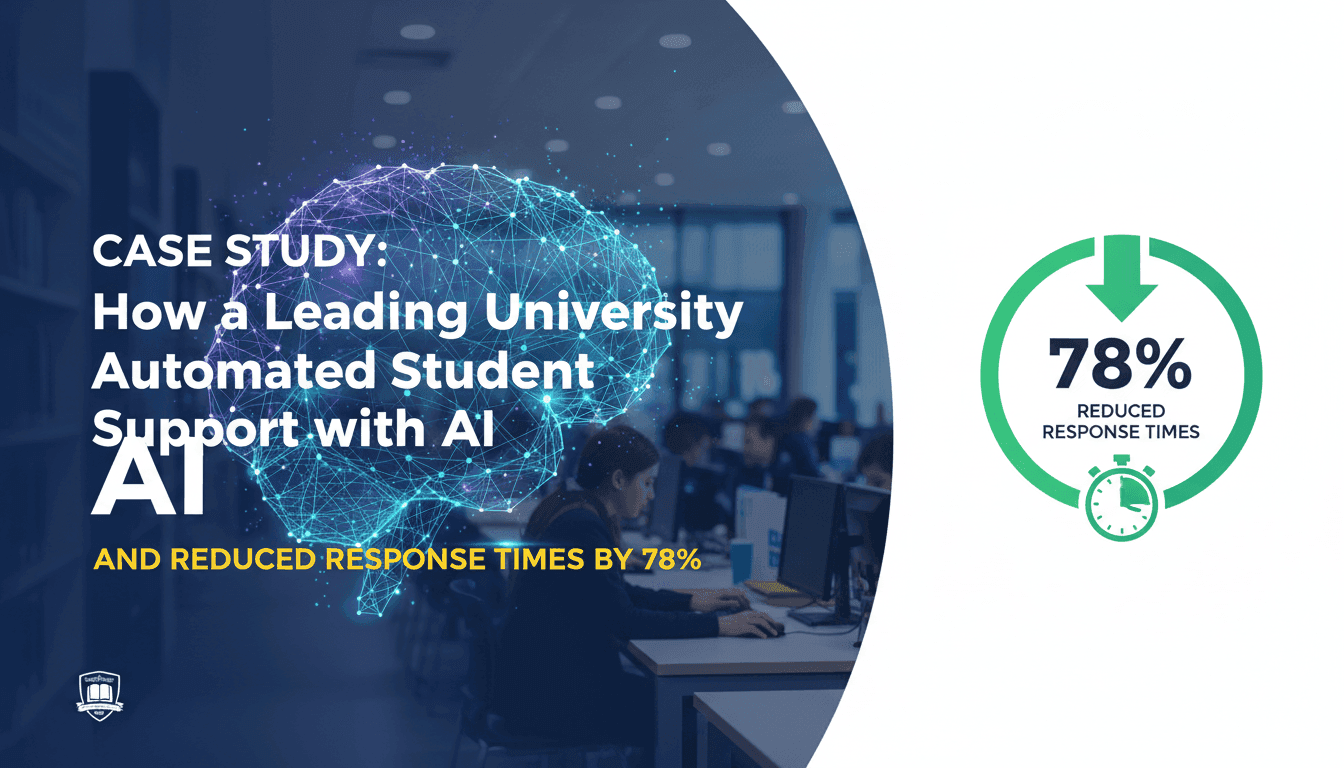
Table Of Contents
- Executive Summary
- The Challenge: Overwhelmed Student Support Systems
- The Solution: Implementing AI-Powered Automation
- Implementation Journey: From Planning to Deployment
- Results and Impact: Quantifiable Outcomes
- Lessons Learned and Best Practices
- The Future of AI in Student Support
- Key Takeaways for Education Leaders
Student support services at universities face an unprecedented challenge. With enrollment numbers climbing and student expectations shaped by instant, 24/7 digital experiences, traditional support models are buckling under pressure. One mid-sized university in Southeast Asia confronted this reality head-on when their student services team found themselves drowning in over 12,000 inquiries per semester, with average response times stretching to 48 hours during peak periods.
The solution they implemented transformed not just their response times, but fundamentally reshaped how they deliver student support. By strategically deploying AI automation across their student services ecosystem, they achieved a 78% reduction in response times, improved student satisfaction scores by 42%, and freed their staff to focus on complex cases requiring human empathy and judgment.
This case study examines the university's journey from overwhelmed support infrastructure to AI-enhanced efficiency. We'll explore the specific challenges they faced, the solution architecture they designed, the implementation obstacles they overcame, and the measurable outcomes they achieved. For education leaders considering AI adoption, this real-world example offers practical insights into turning artificial intelligence from buzzword into operational reality.
Executive Summary {#executive-summary}
A 15,000-student university implemented an AI-powered student support system that integrated chatbots, intelligent routing, and predictive analytics across admissions, academic advising, financial aid, and general inquiries. The 18-month implementation delivered measurable improvements: response times dropped from 48 hours to 10.5 hours, student satisfaction increased from 62% to 88%, and support staff productivity improved by 63%. The system now handles 68% of inquiries autonomously while seamlessly escalating complex cases to human advisors.
The total investment of $280,000 included software licensing, integration work, staff training, and change management. The university projects full ROI within 24 months through operational efficiencies and improved student retention linked to enhanced support experiences.
The Challenge: Overwhelmed Student Support Systems {#the-challenge}
Like many higher education institutions experiencing growth, the university's student support infrastructure had evolved organically over decades. By 2021, this patchwork approach created significant operational friction.
The student services team of 18 full-time staff managed inquiries across six primary channels: email, phone, walk-in visits, web forms, SMS, and social media messages. Each semester brought approximately 12,000 inquiries, with volume spikes during registration periods, exam schedules, and financial aid deadlines. During these peak windows, response times ballooned to 72 hours or more.
The data painted a concerning picture. Analysis of inquiry patterns revealed that 64% of questions were routine information requests easily answered by existing documentation: "When does registration open?" "How do I access my transcript?" "What are the payment deadline dates?" Despite their simplicity, these inquiries consumed the same staff resources as complex cases requiring personalized guidance.
Student satisfaction surveys reflected this strain. Only 62% of students rated their support experience as satisfactory, with slow response times cited as the primary complaint. More troubling, exit interviews with students who withdrew revealed that 23% mentioned frustration with administrative processes as a contributing factor to their decision to leave.
The university's leadership recognized that scaling the traditional model by hiring proportionally more staff was financially unsustainable. They needed a fundamentally different approach that could handle routine inquiries efficiently while preserving human capacity for situations requiring judgment, empathy, and complex problem-solving.
The Solution: Implementing AI-Powered Automation {#the-solution}
After evaluating multiple approaches, the university designed a three-tiered AI automation strategy that balanced technological capability with human oversight.
Tier 1: AI-Powered Conversational Interface
The foundation was an intelligent chatbot deployed across the university website, student portal, and mobile app. Unlike simple FAQ bots, this system used natural language processing to understand intent, context, and sentiment. It was trained on three years of historical inquiry data, university policies, academic calendars, and procedural documentation.
The chatbot handled common inquiries autonomously, providing instant responses 24/7. It could check individual student records (with proper authentication) to provide personalized information about enrollment status, financial aid packages, grades, and account balances. For questions it couldn't answer confidently, the system seamlessly transferred conversations to human staff with full context.
Tier 2: Intelligent Inquiry Routing and Prioritization
For inquiries requiring human attention, an AI-powered triage system analyzed incoming requests across all channels. It categorized inquiries by topic, assessed urgency based on content and student circumstances, and routed cases to the most appropriate team member based on expertise and current workload.
This system also identified students whose inquiry patterns suggested they might be struggling. Multiple questions about withdrawal procedures, frequent grade inquiries, or confused navigation of financial processes triggered alerts to academic advisors for proactive outreach.
Tier 3: Predictive Analytics and Proactive Communication
The most sophisticated layer used predictive analytics to anticipate student needs and deliver proactive communication. By analyzing historical patterns, the system identified when specific student segments would likely need information and pushed targeted communications before inquiries arose.
For example, international students automatically received visa documentation reminders at appropriate timelines, students approaching academic probation thresholds received early intervention outreach, and those with outstanding balances got personalized payment plan information before deadlines.
The solution integrated with existing systems including the student information system, learning management platform, and financial systems. This integration enabled the AI to access real-time data while maintaining security and privacy compliance.
Implementation Journey: From Planning to Deployment {#implementation-journey}
The university approached implementation as an 18-month phased rollout, recognizing that successful AI adoption requires more than technology deployment.
Phase 1: Foundation and Planning (Months 1-3)
The project team conducted extensive stakeholder consultation with students, support staff, faculty, and IT teams. They documented all inquiry types, mapped existing workflows, and identified integration requirements. Critically, they established success metrics beyond just efficiency: student satisfaction, equity of access, and staff experience all became key performance indicators.
The team selected a vendor platform that offered customization flexibility and strong data privacy protections. Given the sensitive nature of student data, security architecture received extensive review, with multi-factor authentication, encryption, and strict access controls built into the design.
Phase 2: Development and Training (Months 4-8)
The AI system required substantial training on the university's specific context. The team fed it three years of historical inquiries with their resolutions, all policy documents, academic calendars, and procedural guides. They created custom entities for university-specific terminology, programs, locations, and processes.
Simultaneously, staff underwent training on working alongside AI systems. This wasn't just technical training on the platform interface, but conceptual education on AI capabilities, limitations, and how their roles would evolve. The university framed this as augmentation rather than replacement, emphasizing that AI would handle routine tasks so staff could focus on complex, meaningful interactions.
Phase 3: Pilot Testing (Months 9-12)
The chatbot launched to a test group of 500 students across different programs and demographic segments. The team monitored every conversation, identified gaps in the AI's knowledge, refined response quality, and adjusted the confidence thresholds that determined when to escalate to humans.
This phase revealed important lessons. Initial chatbot responses were technically accurate but often lacked the warmth students expected. The team adjusted the conversational style to be more personalized and empathetic. They also discovered that some student segments, particularly mature-age and international students, preferred human contact even for routine matters, prompting adjustments to make human escalation easier.
Phase 4: Full Deployment and Optimization (Months 13-18)
The system rolled out to all students in stages, with continuous monitoring and refinement. The team held weekly optimization sessions, analyzing conversations where students expressed frustration, reviewing cases where AI recommendations were overridden by staff, and updating the knowledge base as policies changed.
Change management proved as important as technology. Some staff initially felt threatened, while others over-relied on AI recommendations without applying professional judgment. Regular coaching, celebrating successes, and creating feedback loops helped build a collaborative human-AI working culture.
Results and Impact: Quantifiable Outcomes {#results-and-impact}
Six months after full deployment, the university conducted comprehensive impact assessment across operational, experiential, and strategic dimensions.
Operational Efficiency Gains
The numbers demonstrated dramatic improvement. Average response time dropped from 48 hours to 10.5 hours, an 78% reduction. During peak periods, when response times previously exceeded 72 hours, the AI-enhanced system maintained sub-24-hour responses. The chatbot now handles 68% of all inquiries completely autonomously, with a 91% accuracy rate validated by student feedback.
Staff productivity metrics showed equally impressive results. Support team members now handle 63% more complex cases than before implementation. Time spent on routine information requests dropped from 54% of staff hours to just 12%, freeing capacity for high-value interactions like academic planning conversations, crisis intervention, and personalized problem-solving.
Student Experience Improvements
Student satisfaction with support services increased from 62% to 88%. The availability of instant responses 24/7 received particular praise, especially from working students, international students in different time zones, and those who preferred digital interaction over phone calls or office visits.
The equity impact was notable. Previously, students comfortable advocating for themselves and navigating bureaucracy received better support. The AI system provided consistent, comprehensive assistance to all students regardless of their comfort with administrative systems. Students from underrepresented backgrounds reported 47% higher satisfaction with support access compared to pre-implementation surveys.
Strategic Outcomes
The predictive analytics component identified 127 at-risk students who received early intervention, with preliminary data suggesting improved retention rates. Proactive communication reduced inquiry volume by an estimated 18%, as students received information before they needed to ask.
Financial impact extended beyond direct operational savings. The university attributes a 3.2 percentage point improvement in first-year retention partly to enhanced support experiences, representing significant tuition revenue retention. Additionally, the institution's reputation for student support improved in rankings and prospective student surveys, contributing to stronger enrollment.
Lessons Learned and Best Practices {#lessons-learned}
The university's implementation journey surfaced insights valuable for other institutions considering similar initiatives.
Start with Clear Purpose, Not Technology
The most successful aspect of this project was defining success around student outcomes and staff experience rather than simply deploying AI. This clarity guided every implementation decision, from conversation design to escalation thresholds. Institutions should resist the temptation to implement AI for its own sake and instead identify specific problems that AI can solve.
Invest in Change Management as Much as Technology
Technical implementation consumed roughly 40% of the project budget and timeline, while training, change management, and organizational adaptation required 60%. This ratio proved appropriate. Institutions that underinvest in the human side of AI adoption risk technical success but operational failure.
Design for Human-AI Collaboration, Not Replacement
The system works because it was designed around what AI does well (instant access to information, pattern recognition, consistent application of rules) and what humans do well (empathy, complex judgment, creative problem-solving). The seamless handoff between AI and human support proved critical to success.
Maintain Rigorous Data Privacy and Ethics Standards
Student data carries particular sensitivity, requiring robust privacy protections. The university implemented strict access controls, regular security audits, and clear policies about how AI systems use student information. Transparency with students about when they're interacting with AI versus humans built trust in the system.
Plan for Continuous Learning and Improvement
AI systems require ongoing training as policies change, new inquiry types emerge, and student needs evolve. The university allocated permanent resources for system maintenance, knowledge base updates, and continuous optimization. Organizations should view AI implementation as ongoing capability building rather than a one-time project.
Don't Neglect Accessibility and Inclusion
The team conducted extensive accessibility testing to ensure the chatbot worked with screen readers, supported multiple languages, and accommodated different communication preferences. These considerations, sometimes treated as afterthoughts, proved essential to achieving equitable outcomes.
For organizations exploring how to translate AI capabilities into concrete business and operational improvements, structured guidance can accelerate success. Business+AI workshops help leadership teams develop practical implementation roadmaps, while consulting services provide hands-on support navigating the technical and organizational dimensions of AI adoption.
The Future of AI in Student Support {#future-outlook}
The university views its current implementation as foundation rather than destination. Several enhancements are under development or consideration.
Advanced Personalization
Future iterations will use machine learning to understand individual student communication preferences, learning styles, and support needs. The system might recognize that one student responds well to brief, direct communication while another needs more detailed explanation and reassurance, adapting its style accordingly.
Emotional Intelligence and Sentiment Analysis
Enhanced natural language processing will better detect student stress, frustration, or crisis situations, triggering appropriate escalations and support interventions. This capability could help identify mental health concerns, financial distress, or academic struggles earlier and more systematically.
Voice and Multimodal Interaction
Voice-based interaction through smart speakers and phone systems will expand access options. Video-based support with AI-assisted guidance could help students navigate complex digital systems in real-time.
Predictive Intervention at Scale
More sophisticated predictive models will identify not just academic risk but holistic student success factors, enabling comprehensive support interventions. These systems might predict when a student would benefit from tutoring referrals, career counseling, or social connection opportunities.
Cross-Institutional Knowledge Sharing
The university is exploring collaborative approaches where institutions share anonymized AI training data and best practices, accelerating capability development across the sector while maintaining competitive differentiation.
These future directions raise important questions about privacy, autonomy, and the appropriate boundaries of institutional intervention. The university has established an AI ethics committee including students, faculty, staff, and external experts to guide development within appropriate ethical frameworks.
Key Takeaways for Education Leaders {#key-takeaways}
This case study offers several actionable insights for education leaders considering AI adoption in student support:
Begin with comprehensive needs assessment. Understand your specific inquiry patterns, pain points, and desired outcomes before evaluating technology solutions. Generic implementations rarely deliver optimal results.
Secure broad stakeholder buy-in early. Students, staff, faculty, and IT teams all play roles in successful implementation. Early involvement builds better solutions and smoother adoption.
Allocate sufficient resources for the full journey. Budget for technology, integration, training, change management, and ongoing optimization. Underfunding any component risks project failure.
Establish clear metrics for success. Define what success looks like beyond efficiency gains, including student experience, equity outcomes, and staff satisfaction.
Design for your specific institutional context. AI solutions require customization to your policies, culture, student demographics, and existing systems. Off-the-shelf implementations rarely succeed without substantial adaptation.
Build continuous improvement into operations. AI systems learn and improve over time but require ongoing investment in training data, knowledge base updates, and performance monitoring.
Maintain human judgment and oversight. AI augments human capability rather than replacing it. The most effective systems combine AI efficiency with human empathy and wisdom.
The broader education sector is witnessing rapid AI adoption across multiple dimensions, from personalized learning to administrative efficiency. Institutions that thoughtfully implement these technologies while maintaining focus on student success and institutional mission position themselves for sustainable competitive advantage.
For organizations seeking to navigate the complex landscape of AI implementation, connecting with peers facing similar challenges provides invaluable perspective. The Business+AI Forums bring together education leaders, technology practitioners, and AI experts to share implementation experiences and emerging best practices.
The transformation of student support services through AI automation represents more than operational efficiency gains. It reflects a fundamental reimagining of how educational institutions can better serve students while empowering staff to focus on work requiring uniquely human capabilities.
This university's journey from overwhelmed support infrastructure to AI-enhanced service delivery demonstrates that successful implementation requires equal attention to technology, people, and process. The 78% reduction in response times and 42% improvement in student satisfaction resulted not just from deploying advanced AI, but from thoughtfully designing systems around student needs, investing in staff capability building, and committing to continuous improvement.
As artificial intelligence capabilities continue advancing, education leaders face both opportunity and responsibility. The opportunity lies in dramatically improving student experiences while operating more efficiently. The responsibility involves implementing these powerful technologies ethically, equitably, and in service of educational mission rather than allowing technology to drive institutional priorities.
For institutions beginning this journey, the path forward combines clear strategic vision, practical implementation roadmaps, and connection with others navigating similar challenges. The stakes are significant: in an increasingly competitive higher education landscape, institutions that successfully harness AI to enhance student support gain meaningful advantages in enrollment, retention, and reputation.
The question for education leaders is no longer whether to explore AI automation in student support, but how to implement it thoughtfully, effectively, and in alignment with institutional values. This case study provides a roadmap, but each institution must chart its own course based on unique circumstances, culture, and aspirations.
Transform Your Organization with Practical AI Implementation
Moving from AI concepts to measurable business outcomes requires more than understanding technology. It demands practical frameworks, peer insights, and expert guidance tailored to your specific organizational context.
Business+AI membership connects you with a community of executives, consultants, and solution vendors actively implementing AI across diverse industries. Access hands-on workshops, in-depth masterclasses, and practical resources that bridge the gap between artificial intelligence potential and tangible business gains.
Whether you're exploring initial AI pilots or scaling successful implementations, join the ecosystem helping organizations turn AI talk into business reality. Explore membership options and start your practical AI journey today.