
Before and After AI: How a Marketing Team of 12 Became 6 Humans + 7 Agents
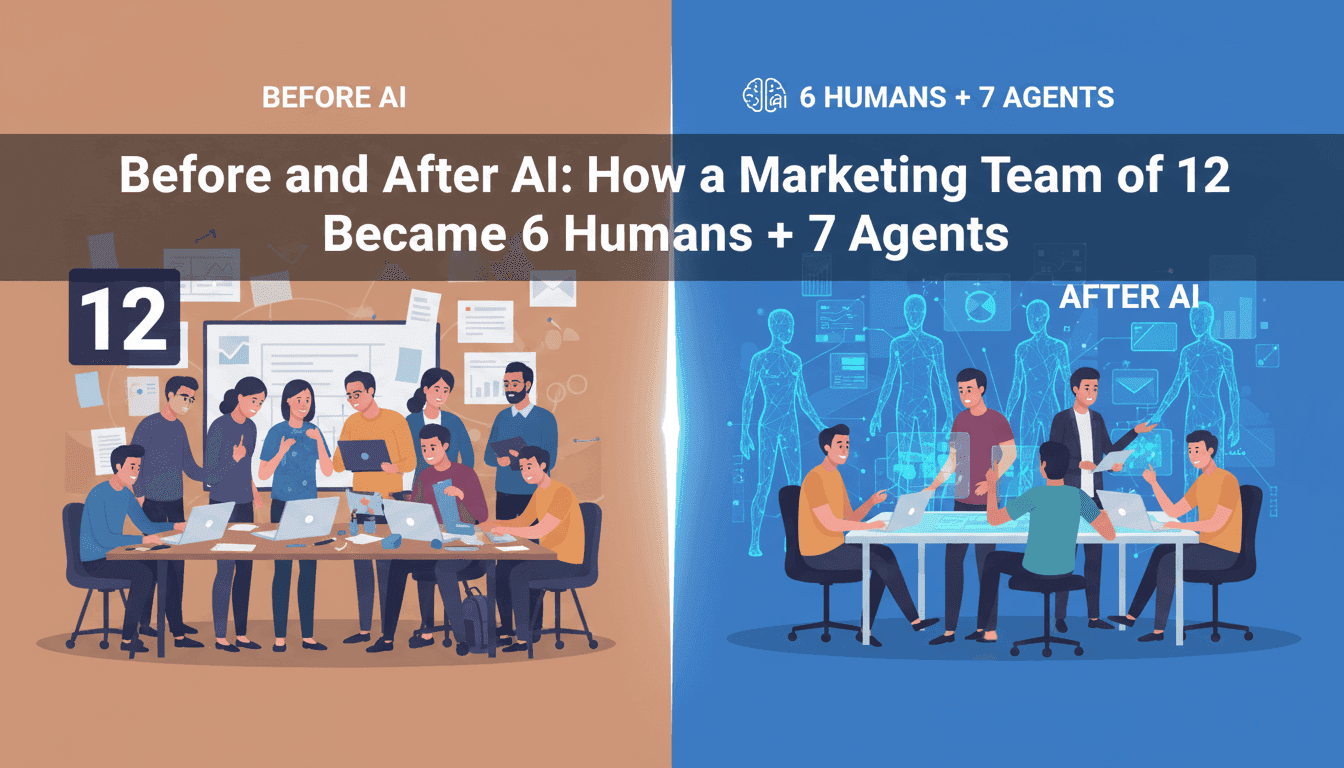
Table Of Contents
- The Marketing Team That Outgrew Itself
- What the Old 12-Person Team Actually Looked Like
- The Shift: Why Headcount Stopped Scaling Output
- Meet the 7 AI Agents Now on the Team
- What the 6 Humans Do Now
- The Results: What Changed After the Transition
- What This Model Gets Wrong (And How to Avoid It)
- Is Your Team Ready for This Transition?
Before and After AI: How a Marketing Team of 12 Became 6 Humans + 7 Agents
Imagine walking into a Monday morning marketing standup where half the attendees don't have salaries, don't need sleep, and completed three campaign reports before you finished your first coffee. That is not a future scenario—it is a description of how a growing number of marketing teams are operating right now.
The idea of replacing headcount with AI agents used to feel like a cost-cutting story dressed up in tech language. But what is actually happening in high-performing marketing departments is more nuanced, and frankly more interesting. Teams are not simply trimming bodies from a org chart. They are redesigning how work gets done: keeping the humans who think, judge, and create relationships, and deploying AI agents to handle the execution layers that were quietly eating everyone's best hours.
This article walks through exactly what that transition looks like—from a traditional 12-person marketing team to a leaner, faster hybrid of 6 humans and 7 AI agents. We will break down who does what, where the real gains appear, and what the honest pitfalls are for any business leader considering a similar move.
The Marketing Team That Outgrew Itself {#outgrew-itself}
Most marketing teams grow by addition. A new channel appears—add a person. A campaign volume increases—add a person. A reporting need emerges—add a person. Over time, a 12-person team becomes the default shape for a mid-sized B2B or B2C marketing function: a few content creators, a paid media specialist, a social media manager, an email marketer, a data analyst, a designer, and several generalist coordinators holding everything together.
The problem is not the people. The problem is the kind of work filling their days. Research consistently shows that a significant chunk of every marketer's week goes toward tasks that are repetitive, rule-bound, and data-heavy—exactly the category of work that AI agents are engineered to absorb. Traditional marketing teams face a fundamental constraint problem, and it is not what you might expect. It is not about budget versus engineering hours—it is about cognitive bandwidth and reaction speed. When your best strategists are spending hours pulling reports or scheduling posts, the team has an execution problem disguised as a capacity problem.
What the Old 12-Person Team Actually Looked Like {#old-team}
Before the transition, a representative 12-person marketing team typically carried these roles:
- Head of Marketing – strategy, budget ownership, stakeholder reporting
- Content Manager – editorial calendar, blog, thought leadership
- 2 Copywriters – campaign copy, ads, email, website
- Social Media Manager – scheduling, community management, platform monitoring
- Paid Media Specialist – Google Ads, Meta, LinkedIn campaign management
- SEO Specialist – keyword research, on-page optimization, technical audits
- Email Marketing Specialist – flows, broadcasts, segmentation
- Data Analyst – reporting dashboards, attribution, performance analysis
- Graphic Designer – creative assets across channels
- Marketing Coordinator (x2) – project management, admin, briefing, traffic
Every one of these roles is valuable. But a closer look reveals how much of each job description is execution rather than strategy. Consider how AI agents handle campaign optimization today. Instead of marketers manually analyzing performance data, adjusting targeting parameters, and A/B testing creative variations, intelligent agents continuously monitor campaign metrics, automatically adjust bidding strategies, and generate personalized content variations in real time. That is a description of what used to occupy the paid media specialist, the data analyst, and part of the copywriter's workload every single week.
The Shift: Why Headcount Stopped Scaling Output {#the-shift}
The clearest signal that a marketing team needs to restructure is when adding people no longer adds proportional output. A twelfth hire does not double the team's productivity; coordination costs grow, briefing cycles lengthen, and the best thinkers spend increasing time managing rather than doing.
Traditional marketing growth often means adding more people to manage campaigns, channels, and reporting. But AI agents open a more scalable path forward. They can run multiple campaigns at once, test creative variations, and fine-tune messaging or targeting in real time—all without the usual linear increase in costs or coordination overhead. This is the core economic argument for the hybrid model: you are not cutting corners by deploying agents, you are removing the ceiling on what a smaller, more senior human team can actually produce.
AI campaigns now finish 60–70% faster, and 19.20% of marketing teams are deploying AI agents for end-to-end automation of initiatives. For business leaders, that kind of time compression changes the ROI calculation on headcount entirely. The question becomes less "how many people do we need?" and more "which decisions genuinely require a human?"
Meet the 7 AI Agents Now on the Team {#seven-agents}
In a restructured 6+7 hybrid team, the seven AI agents each carry a defined scope of work. They are not general chatbots. Unlike basic chatbots or workflow tools, these agents analyze context, learn from interactions, and autonomously execute multi-step processes that previously required human oversight. Here is how a typical agent roster breaks down:
1. The SEO Content Agent researches keywords, generates optimized content briefs, drafts blog posts, and monitors ranking changes. It does not wait for prompts. It autonomously plans, executes, and iterates on content strategy—researching keywords, writing drafts, optimizing for search, publishing to your CMS, and recovering rankings when they drop.
2. The Paid Media Agent manages bid adjustments, budget pacing, and creative rotation across Google, Meta, and LinkedIn. AI agents now manage the execution level of ad campaign management with far greater precision than any human. They react to spikes in CPM or drops in conversion rates within milliseconds, ensuring not a single dollar of your budget is wasted on underperforming segments.
3. The Social Media Agent schedules posts, monitors engagement signals, responds to routine comments, and surfaces trending topics relevant to the brand. Content generation agents analyze past performance data and write post variations at scale, allowing teams to expand their reach without increasing headcount.
4. The Email Marketing Agent manages segmentation logic, triggers behavioral flows, runs A/B tests on subject lines, and compiles deliverability reports. It handles what used to require a dedicated specialist plus coordinator.
5. The Analytics and Reporting Agent replaces the static weekly PDF with live, conversational performance data. The days of static weekly PDF reports are over. AI agents now provide live, conversational analytics. You no longer ask "What happened?" but "What should we do next?" The agent analyzes market intelligence and provides actionable pivots rather than just raw data.
6. The Lead Nurturing and CRM Agent scores inbound leads, updates contact records, triggers personalized outreach sequences, and flags high-intent accounts for human follow-up. A sales enablement agent integrated with CRM and marketing automation can autonomously segment prospects, draft hyper-personalized outreach messages, and schedule follow-ups based on engagement patterns. It can detect when a lead interacts with marketing content, infer buying intent, and trigger the most relevant touchpoint.
7. The Creative Production Agent generates first-draft ad copy, social captions, email subject lines, and headline variations at scale. Humans review and approve; the agent iterates based on feedback and performance data. An AI agent trained on brand voice and audience behavior data can generate campaign ideas, draft content variations, schedule posts, and adjust ad spend in real time.
These seven agents do not operate in silos. In more complex scenarios, multiple AI agents work together, each specializing in a different task. For example, one agent might be responsible for data analysis, another for content personalization, and a third for channel selection, all collaborating to deliver a seamless customer experience.
What the 6 Humans Do Now {#six-humans}
Reducing from 12 to 6 humans is not about the company caring less about marketing. It is about concentrating human effort where it cannot be replicated. This is not about mass layoffs. It is about job shape-shifting—roles dissolving into agents, and humans moving up the stack into orchestration, strategy, and oversight.
The six remaining human roles in a well-designed hybrid team tend to look like this:
- Head of Marketing / AI Orchestrator – owns strategy, budget, brand direction, and defines what the agents are permitted to do autonomously versus what requires approval
- Creative Lead – sets brand guardrails, reviews high-risk outputs, develops campaign concepts that agents then execute at scale. The Creative Lead defines brand guardrails, reviews high-risk outputs, and maintains reusable creative systems including prompts, templates, and style rules.
- Content Strategist – decides what stories to tell, which audiences to target, and what the agents should never write without human judgment
- Marketing Ops and Data Partner – ensures tracking, attribution logic, and clean data pipelines so agents can learn from reliable signals
- Demand Generation Lead – manages the full funnel from awareness through to pipeline, using agents as execution arms across paid, email, and SEO
- Brand and Community Manager – handles real conversations with customers, partners, and media; the irreplaceable human presence in relationship-driven channels
The real transformation goes deeper than productivity gains. Marketing roles are evolving from task executors to AI orchestrators, strategic thinkers, and creative directors. The humans who thrive in this structure are those who can think in systems, set clear parameters for agent behavior, and apply judgment at the moments that matter most.
The Results: What Changed After the Transition {#results}
The headline numbers from teams that have made this transition are striking. Data shows that around 45% of Fortune 500 companies are actively piloting agentic systems today, and the technology has shown the ability to reduce human task time by up to 86% in multi-step workflows. For marketing teams specifically, the impact shows up across several dimensions.
Speed: Campaign cycles that once took weeks now compress to days. Briefing, drafting, approving, and publishing no longer requires sequential handoffs between multiple humans.
Volume: Agents can handle up to 80% of routine tasks, and this arrangement results in faster response times and enables organizations to scale operations by up to 40% without proportional increases in staffing costs.
Consistency: Another advantage lies in narrative uniformity. When teams scale content production manually, message drift is inevitable. But AI trained on your positioning guidelines keeps your story coherent even across hundreds of pieces.
Strategic focus: With execution largely automated, the human team reclaims time for the work that genuinely moves the needle—customer insight, positioning, partnerships, and creative direction that no agent can originate.
The transformation demonstrates the potential of thoughtful AI integration. With a 450% ROI and significant improvements across key metrics, it is clear that AI can deliver substantial value when implemented strategically.
What This Model Gets Wrong (And How to Avoid It) {#what-goes-wrong}
The 6+7 hybrid model is not a guaranteed win. Several well-documented failure modes catch teams off guard.
Deploying agents before the data is clean. AI agents finish campaigns 60–70% faster—but only if your data is clean, centralized, and governed before you turn them on. AI tools cannot deliver insights from fragmented data. Teams that rush to agents without fixing their data infrastructure simply automate confusion at higher speed.
Skipping governance frameworks. Some tasks should never be fully autonomous. High-stakes decisions and sensitive communications—crisis messaging, major budget shifts beyond pre-approved ranges, legal or regulated claims, and strategy that changes positioning—require humans to stay accountable, with agents providing research and options.
Treating it as a tool upgrade rather than a structural change. Successful AI marketing implementations require significant change management. Teams need training, new workflows, and cultural adaptation to AI-assisted work. The org chart, the hiring criteria, and the performance metrics all need to shift alongside the tooling.
Losing the human signal in the noise. AI can churn out content quickly, but it lacks experience-based judgment. It can recommend keywords but will not understand your audience's pain points and industry knowledge the way you do. The best-performing content today blends AI-generated efficiencies with human creativity and strategy.
Is Your Team Ready for This Transition? {#ready}
The honest answer is that readiness is less about your current tool stack and more about your leadership's ability to redesign how work flows through the team. An effective AI marketing team structure starts with a simple idea: humans own outcomes and accountability, while agents own repeatable execution under clear constraints.
Start by auditing where your current human hours actually go. If more than 40% of your team's weekly effort is going toward tasks that are data-driven, repetitive, or rule-bound—reporting, scheduling, briefing, and basic copy generation—you have more than enough to justify a structured AI agent deployment. Then build in phases. The most important rule is not to attempt to replace everything simultaneously. Start with social media and reporting, the lowest risk areas with the fastest proof of value. Add SEO content in the next phase, then layer in email and paid ads after that. Teams that transition all channels at once overwhelm themselves with review tasks and eliminate the efficiency gain they were seeking.
For business leaders in Singapore and across Asia who are navigating this shift, the opportunity is real—but so is the implementation complexity. The teams that get it right are the ones who treat AI integration as an organizational design challenge, not a software procurement decision. They invest in understanding the principles before they invest in the platforms. Explore Business+AI's workshops and masterclasses designed specifically for executives making exactly this kind of transition, and connect with peers navigating the same decisions at the Business+AI Forum.
The Real Lesson From the 6+7 Model
The story of a marketing team going from 12 to 6 humans plus 7 AI agents is not a story about replacing people. It is a story about redeploying human intelligence to where it actually compounds—strategy, creativity, relationships, and judgment calls that no model can confidently make alone.
AI agents do not eliminate marketing. They eliminate middle execution layers. The marketers who thrive in this new structure are those who learn to think of themselves as designers of intelligent systems rather than individual executors of tasks. AI agents do not replace teams. They replace habitual execution. The future belongs to marketers who can design intelligence, not just operate tools.
For organizations still running fully manual marketing operations, the question is no longer whether to make this shift—it is how to make it well. That means investing in the right knowledge, the right frameworks, and the right peer network before you flip the switch on your first agent.
Ready to design your own human+AI marketing team?
Business+AI brings together Singapore's leading executives, consultants, and AI solution vendors to turn exactly these conversations into action. Whether you are looking for strategic guidance through our consulting practice, hands-on skills through our workshops and masterclasses, or a peer community at our annual Forum, we have built the ecosystem to help you move from AI curiosity to measurable business results.