
AI Recruiting Agent vs Talent Acquisition Specialist: What Smart Companies Actually Do
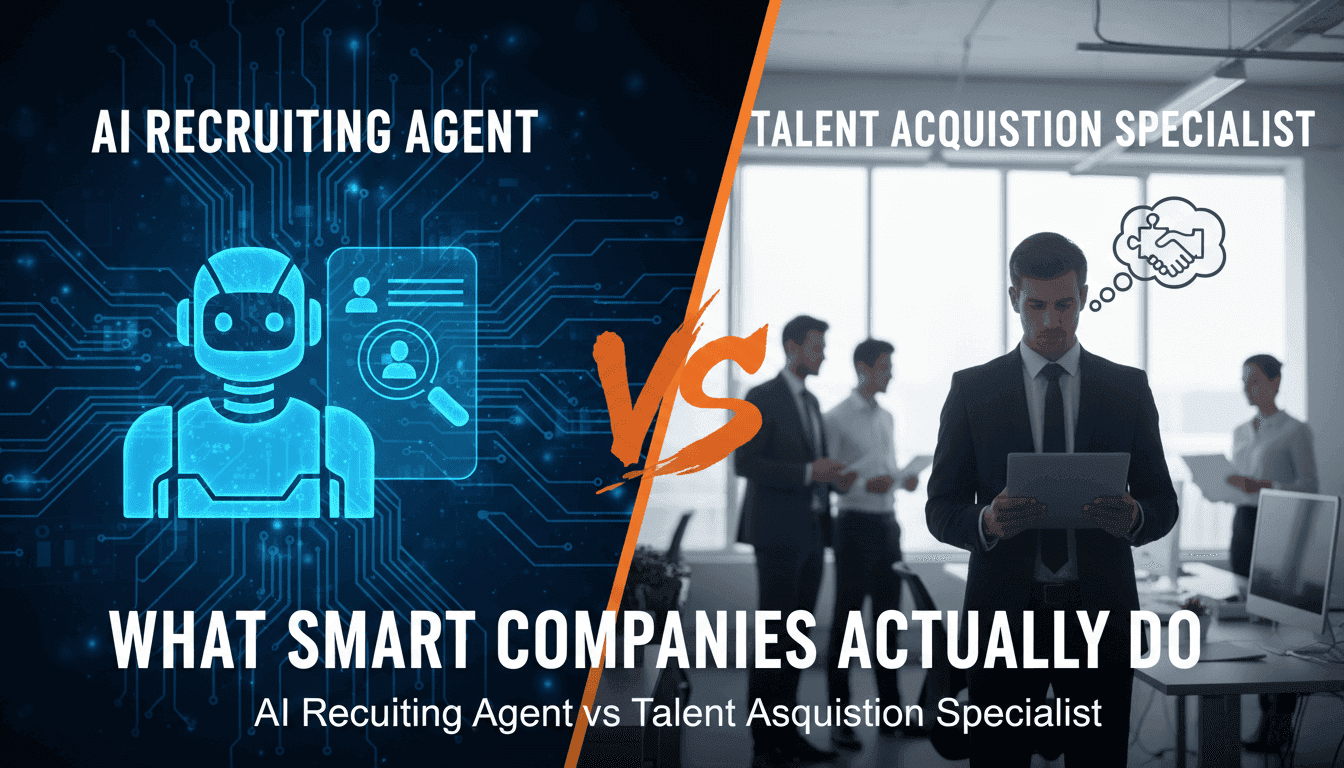
Table Of Contents
- The Hiring Decision Behind Your Hiring Decisions
- What Is an AI Recruiting Agent?
- What Does a Talent Acquisition Specialist Actually Do?
- AI Recruiting Agent vs Talent Acquisition Specialist: A Direct Comparison
- Where AI Recruiting Agents Fall Short
- Where Human Talent Acquisition Specialists Still Win
- The Smarter Question: Integration, Not Replacement
- How to Decide What Your Organisation Actually Needs
- Conclusion
AI Recruiting Agent vs Talent Acquisition Specialist: What Smart Companies Actually Do
Every company is under pressure to hire faster, cut costs, and still land the right people. So when AI recruiting agents entered the conversation, many HR leaders asked an obvious question: does this replace our talent acquisition team, or just add another tool to manage?
The answer is neither simple nor universal — and getting it wrong in either direction is expensive. Companies that automate too aggressively risk losing the human judgment that makes great hires possible. Those that ignore AI entirely find themselves outpaced by competitors who screen and shortlist candidates in minutes rather than weeks.
This article breaks down the real capabilities and real limitations of AI recruiting agents versus human talent acquisition specialists. More importantly, it shows how leading organisations are making these two work together — and what you need to consider before deciding where to invest your hiring resources.
What Is an AI Recruiting Agent? {#what-is-ai-recruiting-agent}
An AI recruiting agent is a software system that uses artificial intelligence — typically a combination of natural language processing, machine learning, and increasingly, large language models — to automate key parts of the recruitment workflow. These tools can parse thousands of CVs in seconds, rank candidates against predefined criteria, send personalised outreach messages, schedule interviews, and even conduct preliminary screening conversations through chat or voice interfaces.
Modern AI recruiting agents go well beyond the basic keyword-matching applicant tracking systems of a decade ago. Today's platforms can assess writing quality, infer skills from non-linear career histories, flag inconsistencies in applications, and adapt shortlisting criteria based on hiring manager feedback over time. Some enterprise-grade solutions integrate directly with HR information systems to trigger onboarding workflows the moment an offer is accepted.
The appeal is straightforward: scale and speed without proportional headcount growth. A single AI recruiting agent can process applicant volumes that would require an entire sourcing team to manage manually — and it does so around the clock, without fatigue affecting decision quality.
What Does a Talent Acquisition Specialist Actually Do? {#what-does-talent-acquisition-specialist-do}
A talent acquisition specialist is a trained HR professional responsible for identifying, attracting, evaluating, and securing candidates for open roles within an organisation. Unlike a general recruiter focused on filling immediate vacancies, a talent acquisition specialist typically takes a longer view — building talent pipelines, nurturing passive candidate relationships, advising hiring managers on role design, and contributing to employer branding strategy.
The best talent acquisition specialists bring something that no algorithm currently replicates well: contextual human judgment. They can sense when a candidate's nerves are masking genuine capability. They know when a technically perfect CV belongs to someone whose values will clash with the team. They can negotiate sensitively with a senior candidate who is being headhunted by three competitors simultaneously. These are relationship-driven, emotionally intelligent capabilities that sit at the core of hiring for cultural fit and leadership roles.
Talent acquisition specialists also serve as internal consultants. They push back when hiring managers write unrealistic job descriptions. They flag diversity gaps in candidate pools before they become legal or reputational issues. They represent the company's brand in every candidate interaction — and that representation has measurable downstream effects on offer acceptance rates and employee retention.
AI Recruiting Agent vs Talent Acquisition Specialist: A Direct Comparison {#direct-comparison}
Understanding where each option genuinely excels — and where it struggles — is the starting point for any meaningful hiring strategy decision.
Speed and volume handling: AI recruiting agents process hundreds or thousands of applications simultaneously, shortlisting candidates within minutes. A human specialist managing the same volume would require days or weeks, and cognitive fatigue would inevitably affect consistency.
Consistency and bias: AI systems apply the same criteria to every application, which eliminates certain types of human bias — name-based discrimination, for example, or unconscious preferences for certain universities. However, AI trained on historical hiring data can also encode and amplify existing biases if the training data reflects a non-diverse past workforce. Human specialists can exercise conscious bias mitigation, but are also vulnerable to in-the-moment cognitive shortcuts.
Relationship quality: Candidates consistently report that personalised, empathetic communication from a human recruiter improves their perception of the employer — even when they are ultimately rejected. AI-generated outreach, even when sophisticated, carries a transactional quality that experienced candidates often detect. For senior, passive, or highly sought-after talent, relationship quality is often the deciding factor in whether they engage at all.
Cost: At scale, AI recruiting tools reduce cost-per-hire significantly by compressing the time-to-shortlist and reducing the volume of human hours spent on initial screening. The total cost of ownership, however, includes software licensing, implementation, integration, and ongoing training of the models — costs that are sometimes underestimated in initial business cases.
Adaptability: When a role changes mid-search, or a business pivot requires a fundamentally different candidate profile, a human specialist can adapt immediately. AI systems require reconfiguration, retraining of criteria, and sometimes vendor support — introducing delays that can offset speed advantages.
Where AI Recruiting Agents Fall Short {#where-ai-falls-short}
Despite impressive capabilities, AI recruiting agents have genuine blind spots that any organisation should understand before deploying them at scale.
First, they struggle with ambiguity. A talent acquisition specialist can read a hiring manager's evolving brief and adjust intuitively. An AI agent needs structured, well-defined criteria — and when those criteria are fuzzy or contested internally, the system tends to either over-filter or produce a shortlist that misses the point.
Second, they are backward-looking by default. AI recruiting models are trained on historical data, which means they tend to favour candidates who resemble past successful hires. For organisations trying to build genuinely diverse teams or hire for emerging skill sets that don't yet have a strong historical precedent in their workforce, this creates a structural problem that requires active human intervention to overcome.
Third, candidate experience at the top of the funnel is increasingly important to employer brand. Research from LinkedIn's Global Talent Trends reports consistently shows that a negative application experience — including impersonal or automated-feeling early interactions — leads candidates to actively discourage others from applying. For companies competing for specialist talent, that reputational cost is real and compounding.
Finally, AI agents cannot navigate the informal intelligence that shapes great hiring decisions: the industry whisper network, the off-the-record reference, the awareness that a particular candidate is managing a personal situation that requires flexibility in start dates. These nuances require human relationships that take years to build.
Where Human Talent Acquisition Specialists Still Win {#where-humans-still-win}
Human talent acquisition specialists remain decisive in high-stakes, relationship-dependent, or strategically complex hiring scenarios. Executive and leadership recruitment almost always falls into this category — where the wrong hire carries costs measured in millions and the right candidate needs to be courted, not just screened.
They are also essential for hiring in niche technical domains where candidate pools are small and every interaction with a potential hire matters enormously. In these markets, a specialist who has spent years building relationships with a specific community — data engineers, regulatory affairs specialists, quantitative researchers — delivers access and credibility that no AI tool can substitute.
Internal mobility programs, succession planning, and diversity hiring initiatives all benefit from human judgment and sensitivity. These are areas where the process itself communicates organisational values, and where getting the human element right directly affects whether the company can deliver on its talent strategy.
The Smarter Question: Integration, Not Replacement {#integration-not-replacement}
The companies seeing the best results from AI in talent acquisition are not the ones that replaced their human recruiters. They are the ones that redesigned the recruitment workflow to give each party what they do best.
In a well-designed hybrid model, AI recruiting agents handle sourcing at scale, initial application screening, interview scheduling, and candidate status communications. This frees talent acquisition specialists to spend their time on the work that genuinely requires human intelligence: building relationships with passive candidates, advising hiring managers, conducting behavioural interviews, negotiating offers, and refining the employer value proposition based on candidate feedback.
This redesign also changes what skills are most valuable in a talent acquisition specialist. The ability to manage and interrogate AI-generated shortlists, to spot when a model is producing biased outputs, and to set appropriate screening criteria becomes as important as traditional relationship-building skills. Forward-thinking HR teams are investing in upskilling their people accordingly — and organisations like Business+AI are actively supporting this transition through hands-on workshops and executive masterclasses designed to help business leaders understand and deploy AI tools responsibly.
For HR and people strategy leaders looking to benchmark their approach against peers, the Business+AI Forum brings together executives navigating exactly these decisions, sharing real implementation experiences rather than vendor-driven narratives.
How to Decide What Your Organisation Actually Needs {#how-to-decide}
Before investing in either direction, it helps to assess your current hiring reality against a few honest questions.
What is your hiring volume? If your organisation hires fewer than fifty people per year across relatively senior roles, the ROI case for a sophisticated AI recruiting agent is weak. The upfront investment in implementation, integration, and change management may not justify the efficiency gains at that scale. If you are hiring hundreds of people across repetitive role profiles, AI becomes compelling very quickly.
How differentiated is your employer brand? Organisations competing in talent-scarce markets on the strength of their culture and reputation need to protect every candidate touchpoint. In these contexts, premature automation of the early candidate experience can undermine years of employer brand investment.
What does your current process data tell you? Before assuming AI will fix your hiring challenges, map your existing funnel. If your core problem is that great candidates drop off after a first interview because the process takes too long, AI screening won't solve that. If your problem is that your recruiters are drowning in applications and can't give quality candidates adequate attention, AI screening directly addresses the bottleneck.
What internal capability exists to manage AI tools responsibly? AI recruiting agents are not set-and-forget solutions. They require ongoing configuration, monitoring for bias, and human oversight of outputs. Organisations without the internal HR or data capability to manage this tend to either over-trust AI outputs or abandon the tools after poor early results.
For organisations that want expert guidance through this evaluation, Business+AI's consulting services offer structured frameworks for assessing AI readiness and designing human-AI workflows that match your actual business context rather than a generic best practice template.
Conclusion
The debate between AI recruiting agents and talent acquisition specialists is ultimately a false binary. Both exist to solve a real problem — finding and securing the right people for your organisation — and both have genuine, non-overlapping strengths.
AI recruiting agents bring scale, consistency, and speed to the parts of the hiring process that benefit most from those qualities. Human talent acquisition specialists bring judgment, relationship intelligence, and strategic counsel to the decisions that carry the highest risk and the highest value. The organisations winning the talent competition are those that have stopped asking 'which one?' and started asking 'how do we design a process that deploys each where it matters most?'
That is not a technology question. It is a business strategy question — and answering it well requires the same clear thinking you would bring to any other significant operational decision.
Ready to move from AI curiosity to AI capability in your organisation?
Business+AI brings together executives, HR leaders, and AI solution experts to work through exactly these decisions — with practical frameworks, peer learning, and expert consulting support.
Explore Business+AI Membership and get access to workshops, masterclasses, consulting resources, and a community of leaders building AI-driven businesses the right way.