
AI Paid Media Agent: Automated Bidding, Targeting, and Creative Rotation for Maximum ROI
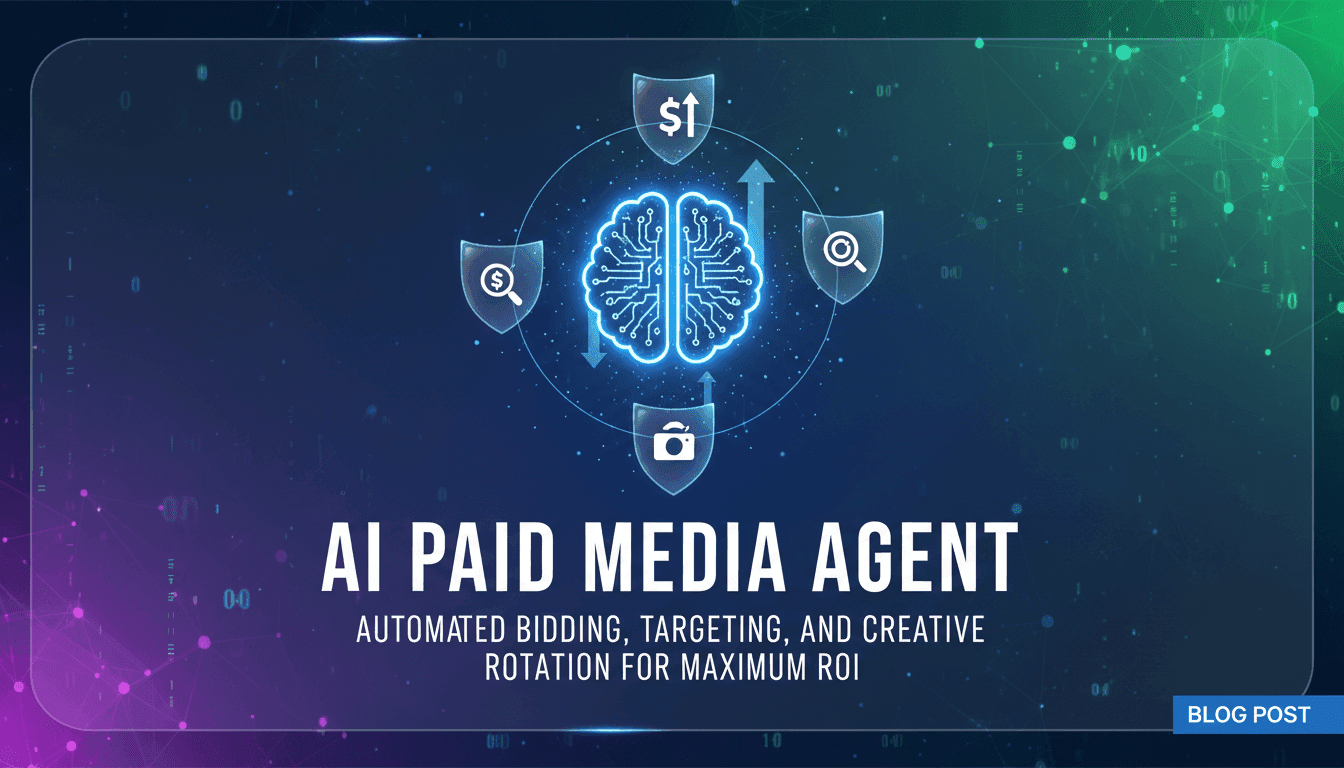
Table Of Contents
- What is an AI Paid Media Agent?
- The Three Pillars of AI-Powered Campaign Management
- Automated Bidding: Beyond Manual Optimization
- Intelligent Targeting: Precision at Scale
- Dynamic Creative Rotation: The Right Message at the Right Time
- Implementation Roadmap for Businesses
- Measuring Success: KPIs That Matter
- Common Challenges and How to Overcome Them
The digital advertising landscape has reached a complexity threshold that exceeds human cognitive capacity. With thousands of bidding decisions per second, millions of potential audience combinations, and endless creative variations, marketing teams face an impossible optimization challenge using traditional methods.
Enter the AI paid media agent, an intelligent system that transforms how businesses approach campaign management. These sophisticated platforms leverage machine learning algorithms to automate three critical functions: bidding optimization, audience targeting, and creative rotation. The result is not just operational efficiency but breakthrough performance improvements that manual management simply cannot achieve.
For executives and marketing leaders navigating digital transformation, understanding how AI paid media agents work is no longer optional. Companies implementing these systems report 20-40% improvements in return on ad spend while simultaneously reducing the hours spent on campaign management. This article explores the mechanics behind AI-driven paid media automation and provides a practical framework for implementation that turns artificial intelligence capabilities into tangible business gains.
AI Paid Media Agent Revolution
Automated Bidding, Targeting & Creative Rotation for Maximum ROI
⚡ The Impact at a Glance
The Three Pillars of AI Campaign Management
Automated Bidding
Adjusts prices in milliseconds based on conversion likelihood, competitive landscape, and business objectives—processing hundreds of contextual signals humans can't manually evaluate.
Intelligent Targeting
Identifies high-value audiences by analyzing behavioral patterns and intent signals—moving beyond basic demographics to predictive customer discovery.
Dynamic Creative Rotation
Delivers personalized ad experiences by matching creative elements to audience characteristics—continuously testing and serving the most effective combinations.
🚀 Implementation Roadmap
Key Success Metrics to Track
Ready to transform AI potential into marketing performance?
Join Business+AI MembershipWhat is an AI Paid Media Agent?
An AI paid media agent is an autonomous or semi-autonomous system that manages paid advertising campaigns across platforms like Google Ads, Facebook, LinkedIn, and programmatic display networks. Unlike traditional campaign management tools that require constant human intervention, these agents use machine learning models to make real-time decisions about budget allocation, audience selection, and creative presentation.
The fundamental difference lies in the decision-making process. Traditional campaign management relies on marketers setting rules and thresholds based on historical data and intuition. AI agents, conversely, continuously learn from performance data, identify patterns invisible to human analysts, and adjust strategies across thousands of variables simultaneously. This creates a feedback loop where the system becomes progressively more effective as it accumulates campaign data.
For businesses in Singapore and across the APAC region, AI paid media agents represent a competitive advantage in increasingly crowded digital marketplaces. They level the playing field, allowing mid-sized companies to compete with enterprises that have larger marketing teams, while enabling large organizations to scale their efforts without proportionally increasing headcount.
The Three Pillars of AI-Powered Campaign Management
Successful AI paid media agents operate on three interconnected pillars that work in concert to optimize campaign performance:
Automated Bidding manages the price you pay for ad placements, continuously adjusting bids based on conversion likelihood, competitive landscape, and business objectives. Rather than setting static bids or simple rules, AI systems evaluate hundreds of contextual signals to determine optimal bid amounts in milliseconds.
Intelligent Targeting identifies and reaches the most valuable audiences by analyzing behavioral patterns, conversion histories, and predictive indicators. These systems move beyond basic demographic targeting to understand intent signals and customer journey stages, ensuring ads reach prospects at moments of maximum receptivity.
Dynamic Creative Rotation delivers personalized ad experiences by matching creative elements to audience characteristics and contextual factors. AI systems test creative variations, learn which elements perform best for different segments, and automatically serve the most effective combinations.
These pillars don't operate in isolation. The most sophisticated AI paid media agents create synergies between them, using insights from creative performance to inform targeting decisions, or leveraging audience response patterns to adjust bidding strategies. This holistic approach generates compound performance improvements that exceed the sum of individual optimizations.
Automated Bidding: Beyond Manual Optimization
Automated bidding represents perhaps the most immediate and measurable impact of AI in paid media. Every ad auction involves dozens of variables: time of day, device type, geographic location, user search history, competitive bid levels, and conversion probability. Processing this information manually is impossible at the scale and speed modern advertising requires.
How AI Bidding Algorithms Work
AI bidding systems operate on predictive models trained on vast datasets of previous auctions and outcomes. When an ad opportunity arises, the algorithm evaluates the likelihood of different outcomes (click, conversion, qualified lead) based on contextual signals. It then calculates the maximum bid that aligns with your target cost-per-acquisition or return on ad spend.
The sophistication lies in the learning mechanism. As campaigns run, the algorithm observes which predictions proved accurate and adjusts its models accordingly. A bid that seemed optimal based on initial data might be refined as the system discovers that mobile users in a specific postal code convert at higher rates on weekday mornings. These micro-optimizations compound across thousands of auctions daily.
Modern AI bidding systems also incorporate portfolio optimization, where the algorithm manages budgets across multiple campaigns to maximize overall performance rather than optimizing each campaign in isolation. This prevents the common scenario where individual campaign optimization creates suboptimal total results.
Common Automated Bidding Strategies
Businesses implementing AI paid media agents can choose from several bidding strategies aligned with different objectives:
- Target CPA (Cost Per Acquisition): The system aims to generate conversions at a specified cost, automatically adjusting bids to maintain your target while maximizing volume
- Target ROAS (Return on Ad Spend): Ideal for e-commerce, this strategy optimizes for revenue value rather than conversion volume, bidding more aggressively for high-value transactions
- Maximize Conversions: When you want volume over efficiency, this approach spends your budget to generate the highest possible number of conversions
- Maximize Conversion Value: Similar to maximize conversions but prioritizes total revenue or transaction value rather than conversion count
- Enhanced CPC: A hybrid approach that allows manual control while giving the AI limited authority to adjust bids up or down based on conversion likelihood
The choice depends on your business maturity and campaign objectives. Companies new to AI automation often start with enhanced CPC before graduating to fully automated strategies as they build confidence in the system's performance.
Intelligent Targeting: Precision at Scale
While bidding optimization focuses on price efficiency, intelligent targeting ensures you're reaching the right people. AI transforms targeting from a static exercise in demographic selection to a dynamic process of audience discovery and refinement.
Audience Discovery and Segmentation
Traditional targeting begins with assumptions about who your customers are based on basic attributes like age, location, or job title. AI-powered targeting inverts this approach, starting with conversion data and working backward to identify common characteristics and behaviors among high-value customers.
Machine learning algorithms analyze thousands of data points across your customer base to identify patterns that humans might miss. Perhaps your best customers don't fit the demographic profile you expected but share specific browsing behaviors or content consumption patterns. AI targeting surfaces these insights and automatically creates audience segments based on actual conversion propensity rather than assumed relevance.
Lookalike modeling represents one powerful application of this capability. By analyzing characteristics of your existing customers, AI systems can identify prospects who share similar attributes but haven't yet engaged with your brand. These models continuously refine as new conversion data provides feedback on which similarities prove most predictive.
For businesses attending Business+AI workshops, understanding how to prepare customer data for AI targeting systems becomes a critical implementation consideration. Clean, comprehensive data serves as the foundation for effective audience intelligence.
Predictive Targeting Models
The most advanced AI paid media agents don't just identify who to target but predict when to target them. Predictive models analyze behavioral signals that indicate purchase intent or readiness to convert, allowing systems to increase investment in prospects showing high-intent behaviors while reducing spend on those in early awareness stages.
These models consider factors like:
- Recent website interactions and page visit sequences that correlate with conversion
- Content engagement patterns that signal problem awareness or solution research
- Temporal patterns indicating optimal contact times for different customer segments
- Cross-channel behavior showing coordinated research across multiple platforms
- Lifecycle stage indicators suggesting readiness for upsell or renewal
By integrating predictive targeting with automated bidding, AI systems can bid more aggressively for high-intent prospects while maintaining efficiency targets across the entire audience. This creates a tiered approach where investment matches opportunity.
Dynamic Creative Rotation: The Right Message at the Right Time
Even perfect targeting and bidding cannot compensate for poor creative. Dynamic creative rotation completes the AI paid media trinity by ensuring the message matches both the audience and the moment.
Creative Testing and Performance Learning
Traditional A/B testing requires manual setup, predetermined test duration, and human interpretation of results. AI-powered creative rotation operates continuously, testing multiple variables simultaneously and automatically shifting impressions toward winning combinations.
This approach, often called multivariate testing or dynamic creative optimization, evaluates performance across creative elements like headlines, images, calls-to-action, and value propositions. Rather than testing complete ad variations, the system assesses individual components to understand which elements drive performance for different audience segments.
The learning happens in real-time. If the algorithm detects that a specific headline performs better for mobile users in the evening, it automatically increases the frequency of that combination for matching contexts. This granular optimization creates thousands of micro-targeted experiences from a limited set of creative assets.
For marketing teams, this transforms creative production. Instead of creating dozens of complete ad variations, you provide a library of modular components that the AI system assembles based on performance data. This reduces production burden while increasing creative relevance.
Personalization Through AI
Dynamic creative rotation extends beyond testing to true personalization when connected to customer data platforms and behavioral insights. AI systems can customize creative elements based on individual user attributes or behaviors:
A first-time website visitor might see messaging focused on brand introduction and category education, while a returning visitor who abandoned a shopping cart receives creative emphasizing specific product benefits and urgency-based offers. The AI system determines which creative approach matches each user's journey stage.
Product recommendations represent another personalization dimension. E-commerce advertisers can serve dynamic product ads featuring items the AI predicts each user is most likely to purchase based on browsing history, purchase patterns of similar customers, and inventory availability. This creates advertising experiences that feel helpful rather than intrusive.
The Business+AI masterclass program explores how companies across industries implement creative personalization strategies that balance automation efficiency with brand consistency, a critical consideration for organizations scaling AI-driven campaigns.
Implementation Roadmap for Businesses
Transitioning from manual campaign management to AI-powered automation requires thoughtful planning and staged implementation. Rushing into full automation without proper foundation often produces disappointing results that undermine confidence in AI capabilities.
1. Establish Performance Baselines: Before implementing AI systems, document current campaign performance across all relevant metrics. This baseline enables you to measure AI impact accurately and identify which improvements stem from automation versus other factors like seasonal trends or market conditions.
2. Audit Data Quality and Integration: AI systems require clean, comprehensive data to learn effectively. Review your conversion tracking implementation, ensure customer data is properly organized, and verify that all relevant platforms can share data with your AI paid media agent. Poor data quality produces poor AI performance.
3. Start with Single-Function Automation: Rather than automating everything simultaneously, begin with one pillar such as automated bidding. This allows your team to understand how the system operates, build confidence in AI decision-making, and develop monitoring processes before expanding to targeting and creative automation.
4. Define Clear Success Metrics: Establish specific KPIs that define successful AI implementation for your business context. These might include improved conversion rates, reduced cost per acquisition, increased return on ad spend, or time savings in campaign management. Clear metrics prevent the common pitfall of expecting AI to improve everything simultaneously.
5. Provide Sufficient Learning Data: AI algorithms require adequate data volume to learn effectively. Most platforms recommend minimum thresholds like 30 conversions per month for automated bidding strategies. If your campaigns don't meet these thresholds, consider starting with broader targeting or longer learning periods.
6. Maintain Strategic Oversight: Automation doesn't eliminate the need for strategic thinking. Human marketers should focus on higher-level decisions like campaign objectives, budget allocation across initiatives, creative strategy, and competitive positioning while allowing AI to handle tactical execution.
Businesses seeking hands-on guidance through this implementation process often benefit from Business+AI consulting services that provide customized roadmaps based on specific organizational readiness and objectives.
Measuring Success: KPIs That Matter
Effective measurement of AI paid media performance requires looking beyond surface-level metrics to understand both efficiency improvements and business impact. Focus on these key performance indicators:
Efficiency Metrics demonstrate how AI automation improves cost-effectiveness. Compare cost per acquisition, cost per click, and return on ad spend before and after AI implementation. Look for sustained improvements rather than short-term fluctuations, as AI systems typically show progressive enhancement over weeks or months as learning accumulates.
Scale Metrics reveal whether AI enables growth that wasn't possible with manual management. Track total conversion volume, qualified lead generation, and revenue contribution from paid channels. Successful AI implementation often allows businesses to profitably expand budgets beyond previous thresholds because improved efficiency unlocks new viable audiences.
Time Savings quantify the operational benefit of automation. Calculate hours previously spent on bid management, audience adjustment, and performance reporting. This freed capacity allows marketing teams to focus on strategic initiatives like campaign planning, creative development, and cross-channel integration.
Learning Velocity indicates how quickly the AI system improves performance. Track week-over-week or month-over-month performance trends during the initial implementation period. Faster improvement suggests the system has sufficient data and is optimizing effectively, while stagnant performance may indicate data quality issues or inappropriate strategy selection.
Incrementality measures whether AI-driven campaigns generate truly new business or simply redistribute existing demand. Use techniques like geo-holdout tests or conversion lift studies to understand the additive impact of AI optimization beyond what would have occurred anyway.
Regular performance reviews should evaluate these metrics collectively rather than in isolation. A slight increase in cost per acquisition might be acceptable if total conversion volume increases significantly, improving overall business contribution.
Common Challenges and How to Overcome Them
Implementing AI paid media agents presents predictable challenges that businesses can proactively address with proper planning and realistic expectations.
The Learning Period Paradox represents a common frustration where performance temporarily declines during initial AI implementation as the system explores different strategies and learns which approaches work best. This exploration is necessary for long-term optimization but can be unsettling for stakeholders expecting immediate improvements. Address this by setting clear expectations about learning periods (typically 2-4 weeks for most platforms), maintaining sufficient budget during this phase, and resisting the urge to make manual interventions that disrupt the learning process.
Data Insufficiency occurs when campaign volume doesn't provide enough signal for effective machine learning. Small businesses or those targeting niche audiences may struggle to generate the conversion volume AI systems need to optimize confidently. Solutions include broadening targeting initially to accelerate learning, focusing AI on your highest-volume campaigns first, or using platform-provided data extensions that supplement your first-party data with broader market insights.
Black Box Anxiety emerges when marketing teams feel uncomfortable ceding control to algorithms they don't fully understand. This discomfort often leads to excessive manual interventions that undermine AI performance. Overcome this through education about how AI systems work, establishing clear decision frameworks that define when human intervention is appropriate, and creating visibility into AI decision-making through reporting and explanation features most platforms provide.
Creative Stagnation happens when AI systems optimize for short-term performance at the expense of creative diversity, repeatedly serving the same proven combinations while neglecting to test new approaches. Combat this by periodically refreshing creative assets, maintaining some campaigns for deliberate testing of new concepts outside AI optimization, and using platform settings that enforce minimum impression shares for new creative variations.
Attribution Complexity increases as AI systems optimize across multiple touchpoints and channels. Understanding which optimizations drive results becomes more difficult in multi-touch customer journeys. Address this through robust attribution modeling, cross-channel tracking implementation, and focusing on business outcomes rather than channel-specific metrics.
The Business+AI Forums provide opportunities to learn how other executives have navigated these challenges, sharing practical solutions developed through real-world implementation experience across different industries and company sizes.
AI paid media agents represent a fundamental shift in how businesses approach digital advertising. By automating the tactical complexity of bidding, targeting, and creative rotation, these systems free marketing teams to focus on strategic imperatives while simultaneously improving campaign performance beyond what manual optimization can achieve.
The transition from manual to AI-driven campaign management is not instantaneous, nor should it be. Successful implementation requires proper foundation setting, realistic expectations about learning periods, and ongoing strategic oversight. Yet for businesses willing to invest in this transformation, the results are compelling: improved efficiency, expanded scale, and enhanced competitive positioning in increasingly complex digital marketplaces.
As AI capabilities continue advancing, the gap between businesses leveraging these tools and those relying on manual approaches will widen. Early adopters develop organizational capabilities and competitive advantages that become progressively more difficult for laggards to overcome. The question for marketing leaders is not whether to adopt AI paid media automation but how quickly and effectively you can implement these systems to generate tangible business gains.
For executives ready to move beyond AI experimentation toward practical implementation, the ecosystem of expertise, education, and peer connection makes the difference between successful transformation and frustrating false starts.
Transform AI Potential Into Marketing Performance
Are you ready to move beyond AI discussion and implement systems that deliver measurable improvements to your paid media results? Join the Business+AI membership community to access exclusive workshops, implementation frameworks, and peer insights from executives successfully deploying AI paid media agents across APAC markets. Turn artificial intelligence capabilities into tangible business gains with expert guidance and practical resources designed for real-world application.