
AI Mentoring in the Workplace: Why Human Guidance Still Drives Digital Change
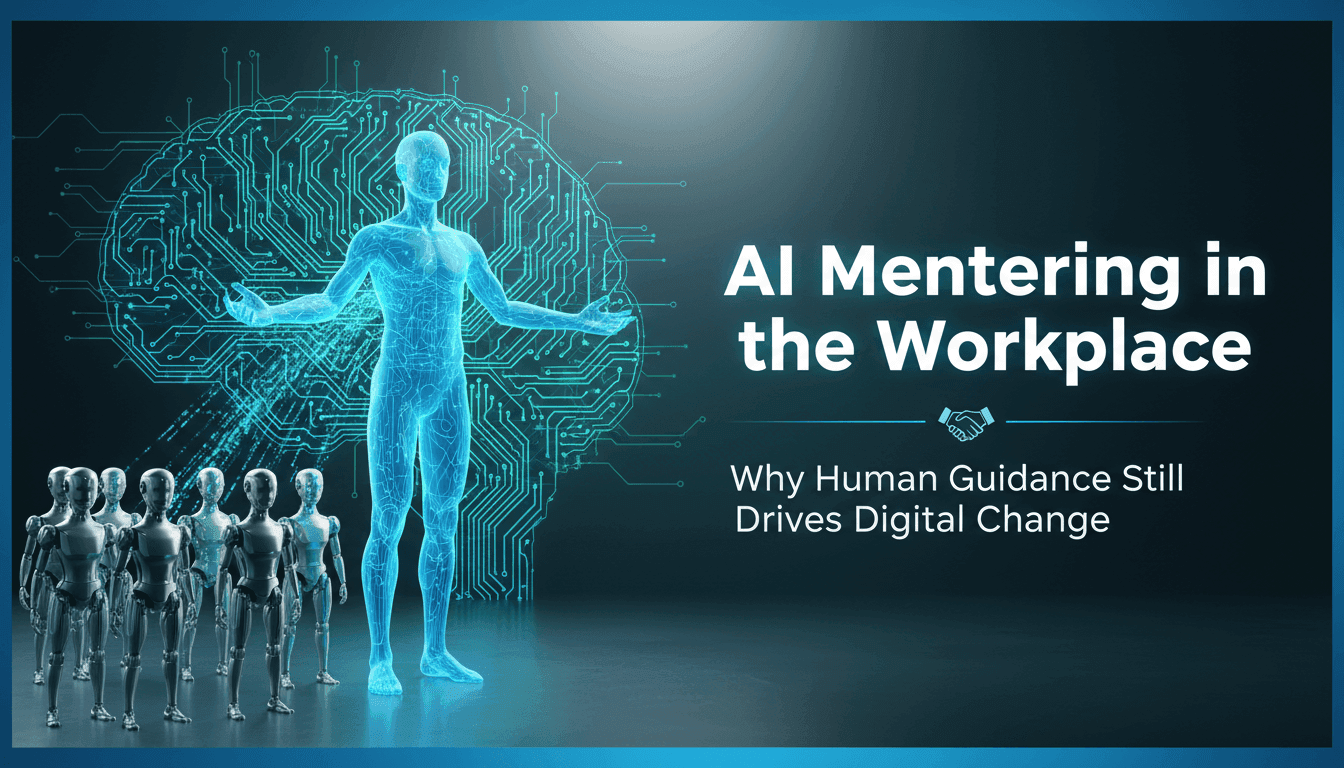
Table Of Contents
- The Mentorship Gap Nobody Is Talking About
- What AI Can and Cannot Teach
- The New Mentoring Models for an AI-Augmented Workplace
- Why Judgment Is the New Core Skill
- Building a Mentoring Architecture That Works
- The Singapore Context: A Region Already Acting
- What Leaders Should Do Right Now
AI Mentoring in the Workplace: Why Human Guidance Still Drives Digital Change
Here is a tension most business leaders feel but rarely name out loud: AI tools are being deployed faster than the people using them can adapt. Across industries, organizations are rolling out generative AI, agentic workflows, and automation platforms — and then discovering that the technology alone does not produce the transformation they expected. The missing ingredient is rarely the software. It is the human guidance that helps people know what to do with it.
This is the core argument for AI mentoring in the workplace. Not mentoring by AI, and not mentoring that teaches people to use AI as a feature. Rather, it is the deliberate, human-led mentorship that equips employees to work with AI thoughtfully — building judgment, navigating uncertainty, and translating machine outputs into real business decisions.
The stakes are higher than they appear. According to a 2026 L&D report, while 61% of organizations have adopted or are testing AI in their learning and development strategies, only 11% feel extremely confident in their future skills-building strategy. That gap between adoption and readiness is exactly where mentorship lives. This article explores why human guidance has become the most underinvested capability in digital transformation — and what forward-thinking organizations are doing about it.
The Mentorship Gap Nobody Is Talking About
For generations, workplace expertise was built through proximity. A junior analyst absorbed judgment by sitting near senior colleagues, listening to how they framed problems, watching the questions they asked before signing off on a recommendation. That informal apprenticeship model did not show up on any org chart, but it was the real engine of talent development. AI is quietly dismantling it.
As AI systems absorb the routine, lower-risk tasks that once filled an entry-level employee's first year — research, data cleanup, preliminary analysis, basic documentation — the scaffolding through which people once built judgment is being removed. A BCG survey of 70 C-suite leaders found that half were already observing AI-related deskilling, with more than 60% expecting it to become a material threat within three to five years. Meanwhile, a separate 2026 L&D report found that 56% of employees say they have been left to their own devices to learn about emerging technologies like AI, with no structured employer guidance in sight.
This is not an abstract future problem. It is a readiness crisis happening right now. And it will not be solved by deploying more AI tools. It requires the deliberate redesign of how people learn, and who guides them through the change.
What AI Can and Cannot Teach
AI tools are genuinely useful for learning at scale. They can deliver personalized content, simulate scenarios, provide instant feedback on technical tasks, surface relevant precedents, and flag skill gaps in real time. There is strong evidence that well-designed AI learning loops accelerate skill acquisition — particularly for early-career employees who need high-frequency repetition to build procedural confidence.
But AI training tools have a critical ceiling. They can teach tools. They cannot teach judgment. They can surface information. They cannot transfer the tacit knowledge — the instincts, the contextual awareness, the political intelligence — that experienced practitioners carry in their heads and build over years of navigating real organizations. As one study on AI learning in the workplace put it plainly: employees must learn not only how to operate an AI tool, but when to use it, how to evaluate its outputs, how to protect sensitive information, and how to remain accountable for the result.
Those last dimensions are irreducibly human. A junior employee who can produce a flawless AI-generated market analysis still needs a mentor to explain why the recommendation in that analysis might land badly with the CFO, or why the data spike signals a promotional cycle rather than genuine demand. That contextual layer cannot be automated. It can only be taught by someone who has lived it.
Furthermore, AI changes how employees feel about work, not just how they perform tasks. Many organizations are investing heavily in AI tools and digital transformation while also recognizing that employees still need guidance alongside technical change. Employees can ask questions they may feel uncomfortable raising elsewhere — talking openly about confidence, uncertainty, and how workplace changes are affecting them personally as well as professionally. That human support makes adapting to AI feel less isolating. No chatbot replicates that.
The New Mentoring Models for an AI-Augmented Workplace
The good news is that the answer is not to preserve the old apprenticeship model unchanged. It is to redesign mentorship so that it works with AI rather than against it. Several distinct models are emerging, each suited to a different organizational need.
Traditional Mentoring, Redesigned
The classic senior-to-junior mentoring relationship remains the backbone of talent development — but its focus has shifted. Rather than transferring task knowledge (increasingly handled by AI), effective mentors today focus on transferring judgment: the ability to critically evaluate AI outputs, recognize when machine-generated recommendations miss important context, and make decisions that the data alone cannot make.
This means mentoring conversations have to change. Instead of walking through how to build a model or structure an analysis, the mentor's job is increasingly to sit beside a junior employee, look at what AI has produced, and ask the hard questions: Does this recommendation hold up under different assumptions? What is the AI missing because it lacks access to our client history? What would you push back on, and how would you frame that pushback to the board? Some organizations are establishing formal programs where senior engineers or consultants mentor small cohorts of junior staff specifically around AI review skills, turning work reviews into structured teaching moments about when to trust, question, or override AI output.
For executives looking to structure this kind of mentoring at scale, Business+AI's consulting services help organizations design the human frameworks that make AI adoption stick — not just the technology layer.
Reverse Mentoring: Flipping the Knowledge Flow
One of the more underutilized tools in the AI era is reverse mentoring, where employees with stronger hands-on AI fluency help senior leaders understand emerging tools and behaviors — while the senior leader contributes business context, decision-making experience, and strategic perspective in return. This bidirectional exchange creates something neither party could achieve alone: the junior employee learns why certain AI outputs matter in a business context, and the senior leader learns how the tools actually work in practice, not just in a vendor presentation.
Reverse mentoring also addresses a real organizational problem: many senior executives have significant blind spots about how AI is being used (or misused) on their teams day to day. One account from a major company described senior management reporting great AI adoption numbers, while a junior manager revealed the team was simply using AI to summarize every meeting because there was no other guidance — hitting a metric without building any real capability. Reverse mentoring surfaces these gaps before they calcify.
The Answer-Key Model: Learning Through Comparison
Perhaps the most innovative mentoring structure emerging from the AI era is what researchers and practitioners call the answer-key model. The logic is straightforward: the employee attempts the work independently first, AI provides a benchmark or alternative output, and then a manager or mentor sits down with the employee to discuss the differences. The comparison step is what does the teaching.
Clinical research has validated this approach. Studies in medical education found that simply giving physicians access to an AI diagnostic tool barely improved their long-term performance. But a workflow that required physicians to first form their own reasoning and then compare it against AI output lifted their subsequent performance significantly — producing durable skill, not borrowed competence. The learning science holds across fields: the attempt-then-check loop builds genuine judgment, while passive reliance on AI output produces nothing that lasts beyond the tool's availability.
For workplace mentors, this model offers something apprenticeship historically never could: a measurable signal of development. The gap between what an employee independently produces and what an AI benchmark produces is observable and trackable. When that gap narrows over time, judgment is forming. Mentors can coach directly to that gap — which is far more specific than any generic feedback on "use better judgment."
Want to see this model in action? Business+AI's hands-on workshops are designed precisely around the kind of applied, structured learning that produces this type of durable skill development — not just AI familiarity.
Why Judgment Is the New Core Skill
Across virtually every piece of research on AI-era workforce development, one theme emerges with striking consistency: the organizations doing this well are hiring and developing for judgment, not tool fluency. The 2026 L&D report identified strategic and critical thinking (56%), digital fluency (44%), and leadership skills (42%) as the most critical capabilities for the year — note that AI fluency on its own does not even make the top of the list. It is the combination of human judgment and AI capability that creates real value.
This shift matters for how mentoring is designed. Roles that demand AI skills are also nearly twice as likely to demand analytical thinking, resilience, and agility alongside them. The implication is that AI is not replacing the demand for human cognitive skills — it is amplifying it, because the decisions that remain for humans are the harder ones. A junior employee in an AI-augmented organization will, earlier than ever before, be expected to interpret potent data, advise senior stakeholders, and deliver recommendations that carry real organizational weight. They need mentors who can teach them how to handle that — not just how to run a prompt.
This is also an equity argument. As AI democratizes access to information and analysis, the differentiating factor becomes the ability to apply and communicate that information wisely. Organizations that invest in mentoring create a broader pipeline of employees who can do that — not just those who happened to get the right senior patron by chance. Good mentorship, well-designed, is a structural advantage.
Building a Mentoring Architecture That Works
For organizations ready to move from conversation to action, a practical mentoring architecture for the AI era rests on four connected foundations.
Codify what your best people know. Before mentors can transfer judgment, that judgment needs to be made visible. Top performers carry frameworks, decision rules, and pattern-recognition heuristics in their heads that they rarely articulate. Organizations that invest in capturing this institutional knowledge — through structured case libraries, annotated past decisions, and explicit taxonomies of how experts think — create the raw material that both AI systems and human mentors can draw on. This is the foundation everything else builds on.
Redesign roles around AI, not against it. Entry-level and early-career roles should be explicitly structured to develop AI judgment, not just AI proficiency. Rather than assigning junior employees to work that AI has already absorbed, organizations can build roles around supervising, evaluating, and improving AI outputs — with structured mentoring checkpoints built in. The goal is for employees to learn by doing, with AI compressing the feedback loop that once took months of experience to produce.
Embed learning into real work. The least effective training programs are the ones that happen in isolation from the actual job. Mentoring works best when it is anchored to real deliverables — real decisions, real outputs, real consequences. AI tools can provide the scale and consistency; human mentors provide the interpretive layer that connects feedback to context and meaning. The 2026 LinkedIn Workplace Learning Report found that organizations with mature career-development practices were 42% more likely to describe themselves as frontrunners in generative AI adoption. Development and AI readiness are not in tension — they are the same investment.
Elevate coaching as an organizational capability. The single most important lever is manager skill. Junior employees are being pushed into higher-value work earlier than ever before. They may be presenting to senior stakeholders in their first year, working with data that has real strategic implications, and making judgment calls that once required five years of seniority. Managers who coach them on how to think and communicate, not just what to produce, are the difference between a program that works and one that does not. This is a skill that needs investment — it does not happen by default. Business+AI's masterclass programs are built to develop exactly this kind of leadership capability in the executives who drive AI adoption from the inside.
The Singapore Context: A Region Already Acting
For business leaders in Singapore and across Southeast Asia, this is not a theoretical future challenge. The region is already navigating it, and the infrastructure for action is already in place. Singapore's Budget 2026 introduced AI-focused reskilling and upskilling initiatives specifically designed to help local workers advance their careers. The NTUC AI-Ready SG initiative, launched in February 2026, includes AI-matched career mentorship as a formal component — recognizing that structured human guidance is inseparable from effective AI adoption.
At the national level, Singapore's government is using work-based learning and traineeship programs to help graduates transition into AI-augmented employment, particularly in sectors experiencing faster AI adoption. This includes government-backed AI apprenticeship programs through IMDA's TechSkills Accelerator, which provides structured pathways for developing AI capabilities within Singapore-based organizations. The message from policymakers is unambiguous: AI adoption without human guidance creates neither workforce capability nor business value.
For executives looking to connect into the broader community navigating these exact questions, Business+AI's annual Forum brings together leaders from across the region to share what is actually working — not what sounds good in a press release.
What Leaders Should Do Right Now
The window for getting ahead of the mentorship gap is narrowing. Organizations that treat human guidance as a second-order concern — something to address after the AI tools are deployed — are already behind. Those investing deliberately in mentoring architecture today are building a compounding advantage: not just AI capability, but the judgment infrastructure that makes AI capability durable.
For leaders ready to act, the priorities are clear. Start by auditing where your mentoring actually happens today — not the formal programs, but the informal moments where judgment is transferred. Then ask whether AI adoption is disrupting those moments, and what a redesigned mentoring architecture would look like. Bring junior and senior employees into the conversation together, because reverse mentoring is not a nice-to-have — it is how organizations close the gap between AI capability and AI wisdom.
The Human Layer That AI Cannot Replace
The organizations that will look back on this period as a competitive turning point are not the ones that deployed the most AI tools the fastest. They are the ones that understood, early enough, that tools alone do not produce transformation. People do — people who have been guided, coached, and developed to use those tools with judgment, confidence, and accountability.
AI mentoring in the workplace is not about teaching employees to use another piece of software. It is about preserving and accelerating the human development pipeline that every organization depends on for its future leadership. In a world where AI can produce the output, the human who can explain it, challenge it, and take responsibility for it is the scarce resource. Building more of those people — deliberately, systematically, with good mentors in the loop — is the most important investment a business leader can make right now.
Ready to turn AI adoption into real business capability?
Business+AI brings together executives, consultants, and solution experts to make AI work in practice — not just in theory. From hands-on workshops to executive masterclasses to the region's leading Business+AI Forum, we provide the community and the frameworks that make the difference.