
AI Impact by Company Size: How Enterprise and SMB Organizations Are Transforming with Artificial Intelligence
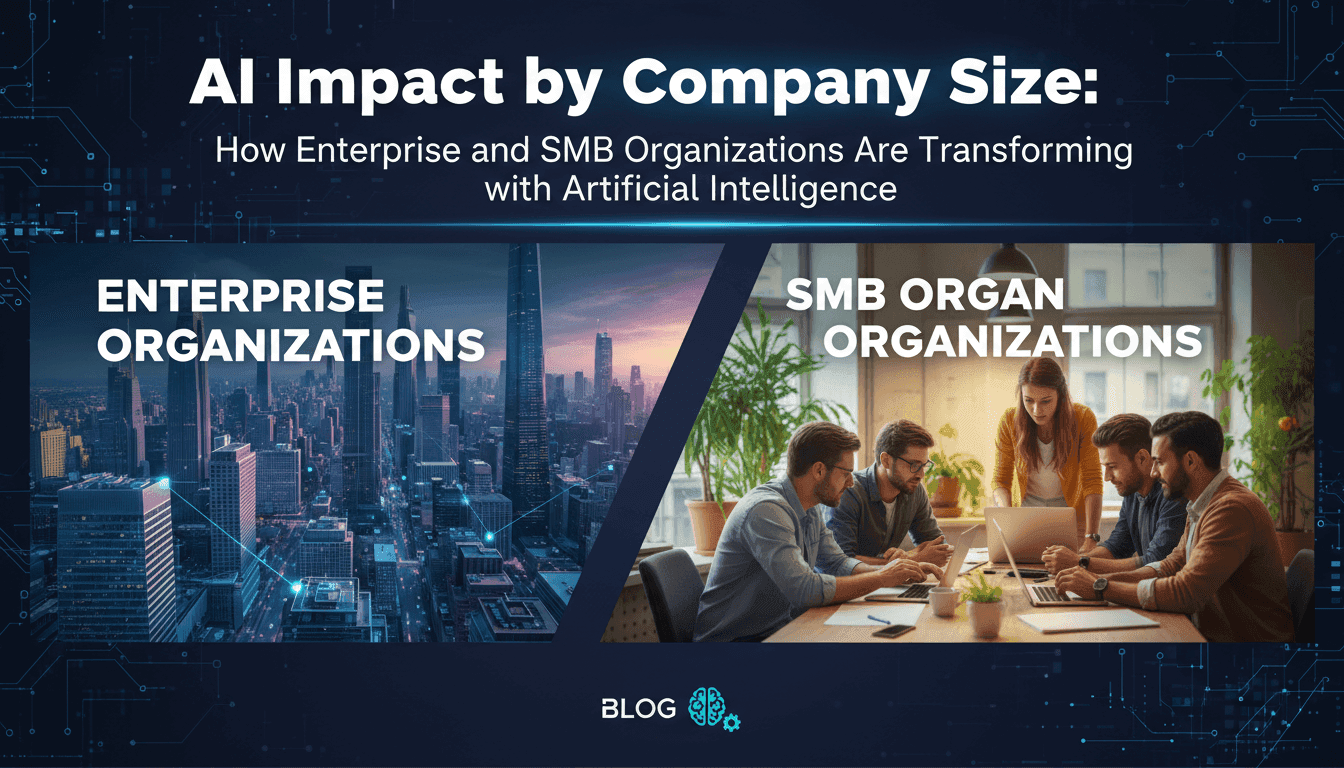
Table Of Contents
- Understanding the AI Adoption Landscape
- Enterprise AI Implementation: Scale and Complexity
- SMB AI Adoption: Agility and Focus
- Investment Patterns and Budget Allocation
- Implementation Timelines: Fast vs. Thorough
- Use Cases That Matter Most
- Measuring Success: Different Metrics for Different Sizes
- Building the Right Team Structure
- Technology Stack Decisions
- The Future: Convergence or Divergence?
The artificial intelligence revolution isn't one-size-fits-all. While headlines trumpet massive AI investments from tech giants and Fortune 500 companies, a quieter transformation is happening across small and medium-sized businesses worldwide. The reality is that enterprise organizations and SMBs are experiencing AI's impact in fundamentally different ways, each facing unique opportunities and obstacles that shape their journey toward intelligent automation.
Company size determines far more than just budget allocation. It influences everything from implementation speed and technology choices to organizational change management and ROI expectations. An enterprise with 50,000 employees faces entirely different challenges than a 50-person startup, even when deploying the same AI technology. Understanding these distinctions isn't just academic; it's essential for making smart investment decisions that align with your organizational reality.
This comprehensive analysis explores how AI adoption differs across company sizes, examining the strategic advantages each brings to the table, the obstacles they must overcome, and the practical pathways to turning AI investments into measurable business results. Whether you're leading digital transformation at a multinational corporation or exploring AI opportunities for your growing business, this guide provides the insights you need to chart your course forward.
Understanding the AI Adoption Landscape
The artificial intelligence landscape has matured dramatically over the past few years, moving from experimental pilot projects to mission-critical business systems. However, adoption rates and implementation approaches vary significantly based on company size. Recent studies indicate that while approximately 65% of enterprise organizations have deployed AI in at least one business function, SMB adoption hovers around 35-40%, though this gap is narrowing rapidly.
What's particularly interesting isn't just the adoption rate difference, but the fundamental approach these organizations take. Enterprises typically pursue comprehensive AI strategies that span multiple departments and require years to fully implement. They're building AI centers of excellence, establishing governance frameworks, and integrating machine learning capabilities into their core business processes. SMBs, conversely, tend toward focused, problem-specific AI deployments that deliver immediate value. They're adopting AI-powered tools for customer service, using intelligent automation for repetitive tasks, and leveraging predictive analytics for targeted business decisions.
The democratization of AI technology through cloud platforms, pre-trained models, and no-code solutions has fundamentally altered the playing field. SMBs can now access capabilities that were exclusively enterprise territory just five years ago. Meanwhile, enterprises are learning from the agility and speed that characterize successful SMB implementations. This creates a fascinating dynamic where size-specific advantages increasingly matter more than raw resources. Organizations that understand their natural strengths and align their AI strategy accordingly consistently outperform those that simply copy approaches designed for different organizational scales.
Enterprise AI Implementation: Scale and Complexity
Enterprise AI deployment operates on a fundamentally different scale than smaller implementations. Large organizations are integrating artificial intelligence into systems that process millions of transactions daily, serve thousands of employees, and impact revenue streams measured in billions. This scale brings remarkable opportunities but also introduces layers of complexity that would overwhelm smaller operations.
Strategic Advantages for Large Organizations
Enterprises possess several inherent advantages when implementing AI initiatives. Their most significant asset is data volume and diversity. Large organizations generate massive datasets across multiple business functions, providing the fuel that modern AI systems need to deliver accurate predictions and meaningful insights. A multinational retailer, for example, can train recommendation engines on billions of customer interactions, creating personalization capabilities that would be impossible with smaller datasets.
Financial resources enable enterprises to pursue multiple AI initiatives simultaneously, absorbing failures as learning opportunities while scaling successes across the organization. They can afford dedicated AI teams combining data scientists, machine learning engineers, and domain experts. This specialized talent pool accelerates development cycles and improves solution quality. Additionally, enterprises can negotiate better terms with technology vendors, access enterprise-grade support, and participate in beta programs for cutting-edge AI platforms.
Existing technical infrastructure provides another crucial advantage. Many large organizations have already invested in cloud computing, data warehousing, and API-based architectures that facilitate AI integration. Their established IT governance frameworks, while sometimes criticized as bureaucratic, actually provide valuable structure for managing AI risk, ensuring data privacy, and maintaining regulatory compliance. For highly regulated industries like banking and healthcare, these governance capabilities are essential for responsible AI deployment.
Enterprise-Level Challenges
However, enterprise scale introduces significant challenges that can derail even well-funded AI initiatives. Legacy system integration tops the list. Large organizations typically operate dozens or hundreds of interconnected systems, many built on outdated technology stacks. Integrating modern AI capabilities with these legacy systems requires substantial engineering effort, often involving custom middleware and complex data pipelines. A single AI deployment might require touching 15-20 different systems, each with its own technical constraints and change approval processes.
Organizational politics and change resistance become magnified at enterprise scale. AI initiatives often require cross-functional collaboration between departments with competing priorities and different performance metrics. Getting marketing, operations, IT, and finance aligned on a unified AI strategy demands significant political capital and executive sponsorship. Middle management resistance can be particularly challenging, as AI-driven automation sometimes threatens established workflows and decision-making authority.
The procurement and vendor management processes at large organizations add substantial timeline overhead. What an SMB might accomplish with a credit card and a cloud platform signup, an enterprise requires through formal RFP processes, security reviews, legal negotiations, and vendor onboarding that can stretch six to twelve months. These processes exist for valid reasons, but they significantly slow the pace of innovation. By the time an enterprise completes procurement for a specific AI tool, the technology landscape may have shifted substantially.
Data governance and privacy compliance become exponentially more complex at scale. Enterprises must navigate GDPR, CCPA, industry-specific regulations, and internal data policies while deploying AI systems that require access to sensitive information. Building AI solutions that respect data residency requirements, implement proper access controls, and maintain audit trails requires significant investment in governance infrastructure. Business+AI's consulting services help organizations navigate these governance challenges while maintaining innovation velocity.
SMB AI Adoption: Agility and Focus
Small and medium-sized businesses bring a completely different set of characteristics to their AI journey. While they lack the resources of their larger counterparts, SMBs possess organizational agility and decision-making speed that often translates into faster time-to-value for AI investments.
Why SMBs Have the Advantage of Speed
Organizational agility represents the SMB's most powerful advantage in AI adoption. Decision-making chains are shorter, with fewer approval layers between idea and implementation. A small business owner or lean executive team can evaluate an AI opportunity, make a decision, and begin implementation in days rather than months. This speed enables rapid experimentation, quick pivots when approaches aren't working, and fast scaling of successful initiatives.
SMBs typically operate with more modern technology stacks, having implemented their core systems recently. They're more likely to be cloud-native, using SaaS applications with built-in AI features rather than on-premise legacy systems. This modern infrastructure dramatically simplifies AI integration. Adding an AI-powered chatbot, predictive analytics tool, or intelligent automation platform often requires minimal technical integration when your existing systems already expose modern APIs and support standard protocols.
The focused scope of SMB operations actually becomes an advantage for AI implementation. Rather than trying to transform dozens of business processes simultaneously, SMBs can identify their highest-impact opportunity and concentrate resources there. This focused approach increases success rates and generates clear ROI that justifies further investment. A 200-person professional services firm might implement AI-powered scheduling that saves 20 hours per week, delivering immediate, measurable value without the complexity of enterprise-wide deployment.
Resource Constraints and Creative Solutions
Budget limitations force SMBs to be creative and strategic about AI investments. Rather than building custom AI models from scratch, successful SMBs leverage pre-built AI services from cloud providers and specialized vendors. They use tools like AI-powered CRM systems, intelligent document processing platforms, and automated customer service solutions that package sophisticated AI capabilities into accessible, affordable applications.
Talent constraints push SMBs toward AI solutions that don't require dedicated data science teams. The rise of AutoML platforms, no-code AI builders, and managed AI services enables SMBs to deploy sophisticated capabilities with their existing staff. A marketing manager can implement AI-driven content personalization without understanding neural network architectures. An operations lead can deploy predictive maintenance algorithms without hiring machine learning engineers. Business+AI's workshops are specifically designed to help SMB teams leverage these accessible AI tools effectively.
SMBs also benefit from learning faster through their entire organization. When a 50-person company implements AI, a much larger percentage of employees directly engage with the technology compared to a 50,000-person enterprise where AI might initially impact only specific departments. This broad exposure accelerates organizational AI literacy and helps build a culture that embraces intelligent automation rather than fearing it.
Investment Patterns and Budget Allocation
Financial approaches to AI differ dramatically across company sizes, reflecting not just resource availability but fundamental differences in investment philosophy and risk tolerance. Understanding these patterns helps organizations set realistic expectations and structure investments appropriately.
Enterprise AI budgets typically range from hundreds of thousands to tens of millions of dollars for comprehensive initiatives. These investments cover specialized talent, infrastructure, software licenses, consulting support, and change management programs. Enterprises often allocate 5-15% of their overall IT budget to AI and machine learning initiatives, with leading digital organizations pushing even higher. The budget structure includes both capital expenditure for infrastructure and platforms, plus operational expenses for ongoing model training, monitoring, and refinement.
SMBs typically invest between $10,000 and $250,000 annually on AI initiatives, focusing primarily on operational expenses through SaaS subscriptions and cloud services. This approach minimizes upfront capital requirements while providing flexibility to adjust spending based on results. SMB AI budgets often come from departmental operating budgets rather than centralized IT funding, with marketing, sales, and customer service departments leading adoption by purchasing AI-enhanced tools within their existing software budgets.
ROI expectations also differ significantly. Enterprises typically expect 18-36 month payback periods for major AI initiatives, accepting longer timelines because they're building capabilities that will scale across large operations. They measure success through metrics like process efficiency gains, revenue impact across multiple product lines, and strategic positioning advantages. SMBs demand faster ROI, typically seeking 6-12 month payback periods. They measure success through direct cost savings, immediate productivity gains, and quickly measurable revenue increases.
Implementation Timelines: Fast vs. Thorough
The pace of AI implementation varies dramatically based on organizational size, reflecting different priorities around speed, thoroughness, and risk management. These timeline differences significantly impact both the experience of implementation and the types of AI initiatives that different sized organizations pursue.
Enterprise AI implementations typically span 12-36 months for major initiatives. The timeline includes extensive discovery and requirements gathering, vendor evaluation and procurement, pilot program development, security and compliance reviews, integration with existing systems, change management and training, and phased rollout across business units. Large organizations accept these longer timelines because they're building scalable solutions designed to serve thousands of users and integrate with complex technology ecosystems.
SMB implementations move much faster, often deploying AI solutions in 4-12 weeks. This accelerated timeline is possible because SMBs can make decisions quickly, have simpler integration requirements, and often adopt packaged AI solutions rather than custom developments. An SMB might evaluate AI-powered customer service tools on Monday, sign up for a trial on Tuesday, configure the system over the next week, and go live by the end of the month. This speed enables rapid learning and iteration that compounds over time.
The optimal approach depends on your specific situation. Enterprises shouldn't necessarily try to match SMB speed if it compromises necessary governance and integration quality. Similarly, SMBs shouldn't overcomplicate implementations by adopting enterprise-style processes that don't match their organizational reality. The Business+AI masterclass programs help organizations identify the right implementation pace for their size and industry.
Use Cases That Matter Most
AI applications prioritized by enterprises versus SMBs reveal interesting patterns about organizational needs and capabilities. Understanding which use cases resonate with different company sizes helps set appropriate priorities for your own AI journey.
Enterprises focus heavily on use cases that leverage their scale advantages. Supply chain optimization using machine learning to predict demand, optimize inventory, and improve logistics represents a major enterprise AI category. Financial forecasting and risk management applications analyze vast transaction histories to improve accuracy. Fraud detection systems process millions of transactions to identify suspicious patterns. Large manufacturers deploy predictive maintenance across hundreds of facilities to reduce downtime. These applications require substantial data volumes and deliver value proportional to operational scale.
SMBs prioritize AI applications that solve immediate pain points without requiring large datasets or complex infrastructure. Customer service chatbots handle routine inquiries, freeing human staff for complex issues. Sales forecasting tools help small teams prioritize opportunities. Marketing automation platforms with AI-powered personalization improve campaign performance. Intelligent scheduling systems optimize appointments and resource allocation. Document processing solutions extract data from invoices, contracts, and forms automatically. These applications deliver quick wins that build organizational confidence in AI.
Interestingly, some use cases bridge both segments. AI-powered cybersecurity tools protect organizations of all sizes. Recruiting platforms use machine learning to screen candidates efficiently for everyone from startups to corporations. Financial planning tools leverage AI regardless of company size. These cross-segment applications often represent the most mature AI markets with solutions tailored to different organizational scales.
Measuring Success: Different Metrics for Different Sizes
How organizations measure AI success reveals fundamental differences in priorities and constraints across company sizes. Establishing the right metrics ensures AI initiatives remain focused on delivering real business value rather than pursuing technology for its own sake.
Enterprises measure AI success through comprehensive frameworks that capture multiple dimensions of impact. Financial metrics include total cost of ownership, return on investment calculated over multi-year periods, revenue impact across product lines, and cost reduction through automation. Operational metrics track process efficiency improvements, error rate reductions, cycle time decreases, and capacity increases. Strategic metrics assess competitive positioning, innovation capabilities, and organizational transformation progress. Customer impact metrics monitor satisfaction scores, retention rates, and lifetime value changes.
The sophistication of enterprise measurement reflects both resource availability and stakeholder complexity. Large organizations need detailed metrics to justify continued investment to boards and shareholders, satisfy multiple internal stakeholders with different priorities, and guide resource allocation across competing initiatives. They invest in measurement infrastructure including AI model monitoring systems, business intelligence dashboards, and analytical capabilities to assess AI performance continuously.
SMBs use simpler, more direct success metrics focused on immediate business impact. Time saved by employees remains the most common SMB metric, translated directly into cost savings or capacity for revenue-generating activities. Customer acquisition cost changes measure marketing AI effectiveness. Sales conversion rate improvements assess AI tools supporting sales processes. Support ticket resolution time tracks customer service AI performance. Revenue per employee indicates overall productivity enhancements from automation.
SMB metrics emphasize speed of feedback and direct connection to business outcomes. Rather than sophisticated measurement frameworks, successful SMBs identify one or two key metrics per AI initiative and track them consistently. This focused approach enables quick assessment of whether an AI investment is working and should be expanded, or isn't delivering value and should be adjusted or discontinued.
Building the Right Team Structure
Organizational structure for AI initiatives differs dramatically across company sizes, reflecting not just resource availability but fundamentally different approaches to building AI capabilities. Getting the team structure right significantly impacts implementation success.
Enterprises typically build dedicated AI teams or centers of excellence. These groups include data scientists who develop and train machine learning models, machine learning engineers who deploy and maintain AI systems in production, data engineers who build and manage data pipelines, AI product managers who translate business needs into technical requirements, and domain experts who ensure AI solutions address real business problems. Leading enterprises employ dozens or even hundreds of AI specialists organized into teams aligned with business units or technical specializations.
The enterprise approach enables deep technical sophistication and ensures AI capabilities scale across the organization. However, it also creates coordination challenges and potential disconnect between AI teams and business operations. Successful enterprises invest heavily in connecting their AI specialists with business stakeholders through cross-functional teams, rotation programs, and collaborative working arrangements.
SMBs rarely build dedicated AI teams, instead incorporating AI capabilities into existing roles. A marketing manager becomes the AI marketing lead, an operations director oversees automation initiatives, and a finance lead champions AI-powered analytics. This generalist approach requires different skills but leverages organizational agility. SMB staff members become "AI translators" who understand both business needs and enough about AI capabilities to identify opportunities and work effectively with external vendors or platform providers.
The SMB structure succeeds when organizations invest in practical AI education for business leaders and operational staff. Rather than training people to build AI models, SMBs need to help their teams understand what AI can do, identify high-value applications, and manage AI tool implementation. The Business+AI membership program provides exactly this type of practical AI enablement, helping business professionals develop the skills they need to drive AI adoption without becoming technical specialists.
Technology Stack Decisions
Technology choices for AI implementation reveal interesting patterns across company sizes, balancing capability, cost, complexity, and strategic control. Understanding these patterns helps organizations make appropriate decisions for their situation.
Enterprises often pursue hybrid approaches combining multiple technology layers. They invest in cloud AI platforms from major providers for infrastructure and foundational models, purchase specialized AI applications for specific use cases, build custom AI solutions for proprietary processes and competitive differentiation, and maintain on-premise infrastructure for data sovereignty and regulatory compliance. This multi-layered approach provides flexibility but requires significant integration and management overhead.
The enterprise technology philosophy emphasizes strategic control and customization. Large organizations want the ability to fine-tune AI models on their proprietary data, integrate AI capabilities deeply into their unique business processes, and avoid vendor lock-in by maintaining flexibility across multiple platforms. They're willing to accept higher complexity and cost in exchange for these capabilities.
SMBs predominantly adopt packaged AI solutions delivered through SaaS platforms. They use AI-enhanced CRM systems, marketing automation platforms with built-in intelligence, customer service tools with conversational AI, and industry-specific applications that embed relevant AI capabilities. This approach minimizes technical complexity, reduces upfront investment, and accelerates time-to-value. SMBs trade customization for simplicity and speed.
The SMB technology philosophy prioritizes practical value over strategic control. They're comfortable with vendor dependencies if the solutions deliver clear ROI. They prefer platforms that package AI capabilities in accessible interfaces rather than requiring technical expertise. They favor proven solutions with strong customer support over cutting-edge technology requiring experimentation.
Both approaches have merit within their contexts. Enterprises need customization and control to address their scale and complexity. SMBs need simplicity and speed to maximize limited resources. The mistake comes from mismatching approach to organizational reality, such as when SMBs overcomplicate implementations by trying to match enterprise technical architectures, or enterprises create unnecessary dependencies on inflexible vendor platforms.
The Future: Convergence or Divergence?
Looking ahead, the relationship between enterprise and SMB AI adoption reveals both converging and diverging trends. Understanding these dynamics helps organizations prepare for the evolving AI landscape.
Convergence is happening in several important areas. AI technology is becoming more accessible across company sizes through no-code and low-code platforms, pre-trained models and transfer learning, and cloud-based AI services with flexible pricing. SMBs gain access to capabilities once exclusively enterprise territory, while enterprises adopt the agility and rapid implementation approaches pioneered by smaller organizations. The gap in AI sophistication between large and small organizations is narrowing as technology democratization continues.
Industry-specific AI solutions are emerging that serve organizations across size ranges. Healthcare AI tools work for both hospital systems and individual practices. Financial services AI applies to both banks and credit unions. Retail AI supports both chains and independent stores. These vertical solutions often offer tiered capabilities matching different organizational scales while maintaining technology consistency.
Yet important differences will persist. Enterprises will continue pursuing custom AI development for competitive differentiation and proprietary processes. They'll invest in cutting-edge research and emerging AI techniques that require substantial resources. SMBs will continue prioritizing packaged solutions and proven applications over experimental technology. They'll focus on maximizing value from existing AI capabilities rather than pushing technical boundaries.
The most successful organizations, regardless of size, will be those that embrace their natural advantages rather than fighting against their organizational reality. Enterprises that combine their resource advantages with greater agility will outperform peers bogged down in bureaucracy. SMBs that leverage their speed and focus advantages while building systematic AI capabilities will outcompete those pursuing ad-hoc tool adoption.
The Business+AI Forum brings together executives and practitioners from organizations of all sizes, creating opportunities to learn from each other's experiences and identify approaches that work across different contexts. This cross-pollination of ideas helps both enterprises and SMBs evolve their AI strategies based on proven successes rather than theoretical frameworks.
The AI revolution manifests differently across company sizes, creating distinct pathways to value that reflect each organization's natural strengths and constraints. Enterprises leverage massive datasets, substantial resources, and technical sophistication to build comprehensive AI capabilities that transform core business processes at scale. SMBs capitalize on organizational agility, focused implementation, and rapid decision-making to deploy AI solutions that deliver immediate, measurable impact. Neither approach is inherently superior; each succeeds when aligned with organizational reality.
What matters most isn't adopting the latest AI technology or matching competitors' investments, but rather developing an AI strategy that fits your organization's size, culture, resources, and business objectives. Enterprises must guard against bureaucracy that stifles innovation while maintaining necessary governance. SMBs must build systematic capabilities while preserving the speed advantages that enable rapid learning and iteration.
The organizations that thrive in the AI era will be those that honestly assess their starting point, identify their highest-value opportunities, implement solutions appropriate to their scale, and continuously learn from results. Whether you're leading AI transformation at a multinational corporation or exploring your first AI deployment at a growing business, success comes from turning AI talk into tangible business gains through focused execution and practical application.
Ready to Transform Your AI Strategy?
Whether you're leading an enterprise AI initiative or exploring AI opportunities for your SMB, Business+AI provides the ecosystem, expertise, and practical guidance you need to succeed. Our community brings together executives, consultants, and solution vendors who are actively deploying AI across organizations of all sizes.
Join Business+AI Membership to access:
- Hands-on workshops tailored to your company size and industry
- Masterclasses led by practitioners with real implementation experience
- Consulting support to develop and execute your AI strategy
- Networking opportunities with peers solving similar challenges
- Exclusive access to our annual Business+AI Forum
Stop theorizing about AI and start building capabilities that drive measurable business results. Join the Business+AI community today.