
AI for Oil and Gas: Upstream, Midstream, and Downstream Applications Explained
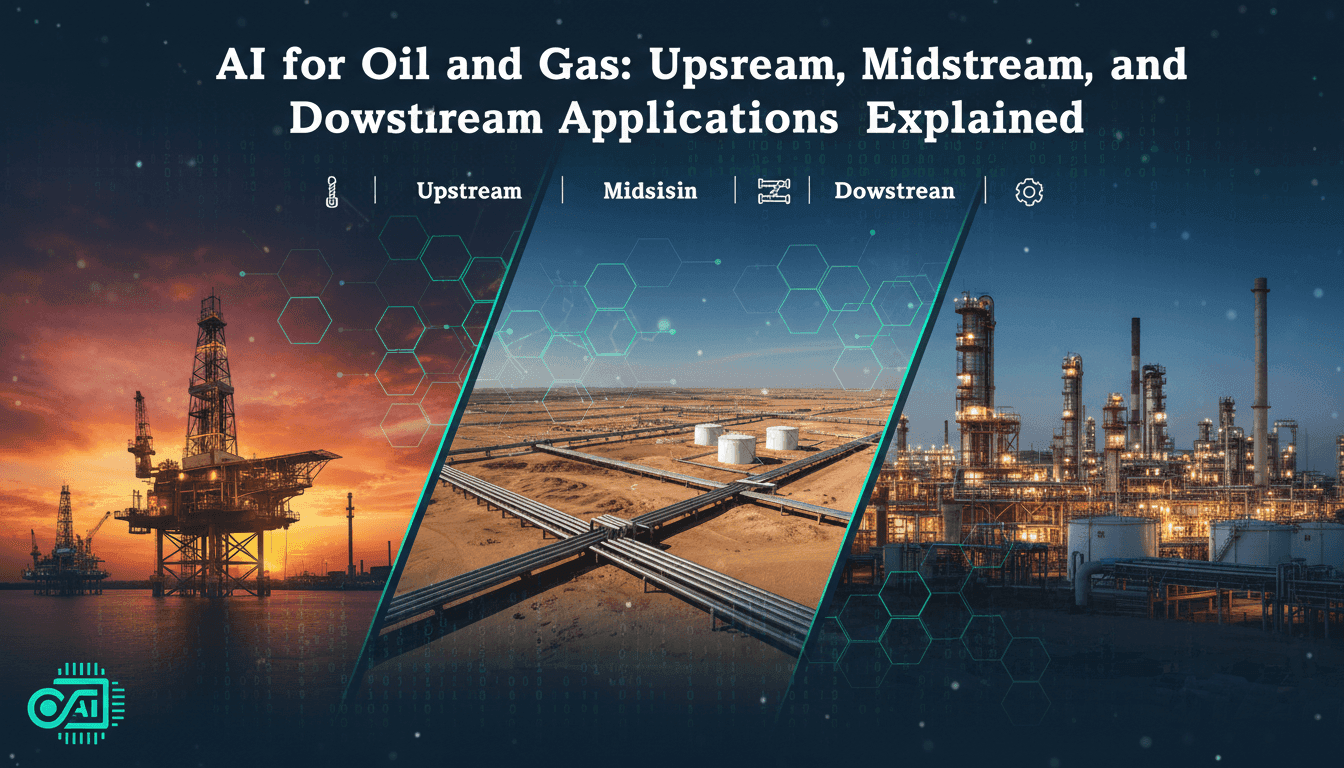
Table Of Contents
- The $230 Billion Question: Why AI and Oil and Gas Are Inseparable
- How the Oil and Gas Value Chain Breaks Down
- AI in Upstream Oil and Gas
- AI in Midstream Oil and Gas
- AI in Downstream Oil and Gas
- AI, ESG, and Safety: The Cross-Sector Imperative
- The Real Barriers to Scaling AI in Oil and Gas
- What It Takes to Move from Pilot to Value
- How Business+AI Can Help Your Organization Get There
AI for Oil and Gas: Upstream, Midstream, and Downstream Applications Explained
The oil and gas industry sits on one of the most significant AI opportunities in the global economy. According to McKinsey's August 2026 analysis, AI could unlock approximately $65 billion in near-term annual recurring value in upstream operations alone—with a credible path to $230 billion at full potential once autonomous operating modes become standard. And that figure doesn't yet account for the midstream and downstream segments, where billions more in efficiency gains are within reach.
Yet despite the scale of the prize, most companies are stuck in a frustrating middle ground: running promising pilots that never quite industrialize, investing in digital infrastructure that doesn't translate into measurable outcomes, and watching the gap between AI's potential and their actual results grow wider by the quarter.
This guide is designed to change that. Whether you're an executive at an operator, a decision-maker at an oilfield services company, or a leader navigating digital transformation across refining and trading, you'll find a clear, segment-by-segment breakdown of where AI creates the most value—upstream, midstream, and downstream—along with the strategic realities that separate successful deployments from expensive experiments.
The $230 Billion Question: Why AI and Oil and Gas Are Inseparable {#the-230-billion-question}
The oil and gas industry is undergoing the most consequential technology transformation in its history, and artificial intelligence is at the center of it. What began as isolated pilot programs for seismic interpretation and predictive maintenance has matured into a multi-billion-dollar infrastructure investment spanning upstream exploration, midstream pipeline management, and downstream refining.
Global AI investment in oil and gas reached an estimated $7.64 billion in 2025, and leading market forecasts project that figure will nearly double within the next decade. The AI in oil and gas market was valued at USD 3.79 billion in 2025 and is estimated to grow from USD 4.28 billion in 2026 to reach USD 7.91 billion by 2031, at a CAGR of 13.03% during the forecast period. The financial logic is compelling, but the operational logic is even more so. Oil and gas is among the most data-intensive industries on the planet, generating petabytes of seismic, sensor, pipeline, and refinery data every year—most of which has historically gone underutilized.
The application of AI in oil and gas spans the full value chain—from seismic interpretation and drilling optimization upstream to pipeline monitoring midstream and demand forecasting downstream. That includes automating decisions, interpreting complex subsurface and operational data, predicting equipment failures, optimizing production, and monitoring environmental performance. The question is no longer whether AI belongs in oil and gas. It's where to focus first, and how to scale what works.
How the Oil and Gas Value Chain Breaks Down {#how-the-value-chain-breaks-down}
Before examining AI applications, it's worth anchoring the conversation in how the industry is structured. The oil and gas value chain runs across three broad segments, each with its own operational profile, data environment, and AI opportunity.
Upstream focuses on exploration, drilling, and reservoir management. Midstream emphasizes pipeline integrity, throughput optimization, and leak detection. Downstream centers on refining efficiency, energy optimization, and demand forecasting. Each segment generates different types of data, operates under different cost structures, and faces different competitive pressures—which means AI strategies need to be tailored accordingly, not applied wholesale.
Understanding these distinctions is the foundation of a coherent AI investment strategy. Companies that treat the value chain as a single problem tend to spread resources too thin and capture value from none of the segments well.
AI in Upstream Oil and Gas {#ai-in-upstream}
Upstream dominates AI spending in oil and gas with 61.05% of 2025 revenue, because data-heavy exploration and production workflows benefit most from advanced analytics. This concentration makes sense: upstream operations generate continuous, high-frequency data from wells, reservoirs, and drilling equipment, and the economic stakes of each decision—where to drill, how to optimize production, how to prevent equipment failure—are enormous.
Seismic Interpretation and Exploration {#seismic-interpretation}
AI is used in exploration to analyze seismic data using deep learning models that can interpret subsurface structures much faster than traditional methods. It also enables automated fault and horizon detection, while AI-driven prospect ranking helps prioritize drilling locations with the highest probability of success.
The practical impact is a compression of the exploration cycle. Workflows that once took months of manual geological analysis can now run in days or weeks with AI-assisted interpretation. For operators facing large exploration portfolios across multiple basins, this speed advantage translates directly into capital efficiency—fewer wasted dry holes and faster time to first oil.
Drilling Optimization {#drilling-optimization}
Drilling remains one of the largest cost pools in upstream operations, with significant spend in directional drilling, fluids, cementing, and logging. AI is creating measurable value across the entire well delivery process.
Market growth is being propelled by real-time hydraulic-fracturing control enabled through edge analytics, autonomous drilling systems that trim crew exposure in deepwater projects, and predictive-maintenance programs that curb unplanned downtime. On the planning side, AI improves well design and equipment selection before a bit ever turns. During execution, closed-loop drilling automation can reduce non-productive time and optimize placement within the reservoir in real time.
The commercial implications extend beyond the operator. When AI-driven automation reduces days on well, operators benefit immediately through lower day rates. This creates a well-documented tension between operators and oilfield services companies under traditional activity-based contracts—a structural challenge the industry is only beginning to resolve through outcome-based and gain-sharing models.
Reservoir Management and Production {#reservoir-management}
Production assets generate the kind of high-frequency operational data with immediate physical feedback that makes AI especially powerful. Integrated AI systems can reduce operating expenditures by up to 20% and increase production efficiency by 5–8% across upstream and downstream operations.
Specific applications include optimization of rod pumps, electric submersible pumps (ESPs), gas lift systems, and waterflood programs. AI can also accelerate subsurface interpretation, improve reservoir model updates, and generate surrogate models for faster simulation—compressing field development cycles from months and years to days and weeks. Agentic AI for oil and gas is emerging as a powerful force across the value chain. Unlike traditional automation, these autonomous systems can perceive, reason, and act, unlocking a new level of operational intelligence.
AI in Midstream Oil and Gas {#ai-in-midstream}
Midstream is where hydrocarbons move—through pipelines, storage terminals, and transportation networks. It's a segment that has historically operated on tight margins, where reliability is everything and a single failure event can trigger enormous financial and environmental consequences.
Pipeline Integrity and Leak Detection {#pipeline-integrity}
In the U.S. alone, pipeline corrosion costs the industry $1.4 billion annually—a figure that AI-based corrosion monitoring is beginning to materially reduce. Machine learning models analyze IoT sensor streams to detect micro-anomalies in pressure, temperature, and flow rates that precede structural failures, enabling operators to schedule targeted repairs rather than reactive emergency responses.
Midstream capacity reduction events trigger shipper penalties of $150,000 to $500,000 per event, and early-detection AI systems are proving their financial case rapidly in this cost environment. Beyond the direct cost avoidance, AI-driven leak detection using satellite data, fiber-optic sensors, acoustic monitoring, and computer vision is also reducing the environmental liability profile of midstream operators—an increasingly important factor in ESG reporting and regulatory compliance.
Throughput Optimization and Scheduling {#throughput-optimization}
Beyond integrity, AI is optimizing how midstream infrastructure is used. AI optimizes throughput across pipeline networks and reduces compressor downtime. This includes dynamic routing decisions, compressor scheduling, and storage allocation—all processes where AI can process far more variables simultaneously than any human operator.
In the midstream sector, agentic AI enhances pipeline and storage safety and reliability through continuous monitoring. As midstream networks grow more complex, with LNG, hydrogen, and CO₂ pipelines joining traditional hydrocarbon infrastructure, the combinatorial optimization challenge becomes more demanding. AI is increasingly the only tool capable of managing this complexity at speed.
AI in Downstream Oil and Gas {#ai-in-downstream}
Downstream is where crude oil becomes the products the world runs on—gasoline, diesel, jet fuel, petrochemicals, and lubricants. It's also where AI adoption has been somewhat slower than upstream, but where the improvement opportunities are substantial.
Refinery Process Optimization {#refinery-optimization}
Downstream AI investment is focused on two primary value drivers: process optimization and predictive maintenance of critical refinery equipment. Machine learning models analyze massive volumes of process data to continuously optimize crude distillation units, fired heaters, and fluid catalytic crackers—the core units where marginal efficiency improvements translate directly into yield and margin.
Real-world results support the investment case. Following AI integration, BP recorded a 20% increase in refining throughput efficiency and reduced maintenance-related disruptions by 25%. The system also contributed to emission control, aligning with sustainability goals. Saudi Aramco's downstream operations in Jubail and Yanbu have deployed AI process optimization across multiple refinery units as part of their $5 billion digital transformation program, with reported improvements in energy intensity and product yield across their integrated refining and petrochemical complexes.
Demand Forecasting and Supply Chain {#demand-forecasting}
Poor demand planning costs the industry an estimated $200 billion annually. Demand forecasting in oil and gas means predicting how much oil, gas, refined products, or LNG customers and markets will need before that demand materializes. Getting this wrong in either direction is expensive: produce too much and you pay for storage and sell at a discount; produce too little and you lose the sale to a competitor or pay a premium for emergency supply.
AI is attacking this problem from multiple angles. AI models process shipping AIS data, regional refinery utilization rates, and weather pattern data to optimize cargo scheduling in real time. Shell has reported that AI-assisted scheduling reduces cargo optimization time from days to hours and improves refinery feedstock planning accuracy significantly.
Predictive Maintenance in Refineries {#predictive-maintenance-downstream}
Predictive maintenance is arguably the highest-ROI AI application across all three segments. AI-driven predictive maintenance models monitor equipment health in real time. By analyzing sensor data from pumps, compressors, and pipelines, these models forecast failures days or weeks in advance, enabling proactive maintenance and avoiding unscheduled shutdowns. This shift dramatically improves asset uptime and safety compliance.
Companies that integrate AI-driven predictive maintenance and anomaly detection are projected to see a 25–35% reduction in unplanned outages, boosting profitability and lowering operational risk.
AI, ESG, and Safety: The Cross-Sector Imperative {#ai-esg-safety}
Across all three segments, AI is also becoming a strategic tool for managing the industry's environmental and safety obligations. Regulatory pressure is mounting. ESG expectations are tightening. And the penalties for non-compliance keep climbing. AI gives operators a way to stay ahead of all three.
ADNOC's Emission X tool gathers historic and real-time data from hundreds of operational sources to predict emission origins up to five years in advance, allowing operators to act before problems materialize. Across its operations, ADNOC's AI suite helped prevent up to 1 million tonnes of CO₂ emissions between 2022 and 2023—equivalent to removing 200,000 gasoline-powered cars from the road.
HSE (Health, Safety, and Environment) compliance is also emerging as the fastest-growing AI application in the sector, with a projected CAGR of 14.34%. AI-powered monitoring systems detect emissions, illegal discharges, and leaks in real time, support energy optimization and flaring reduction, and provide auditable reports for regulatory compliance and ESG reporting. For boards and investors demanding transparent sustainability disclosures, this capability is no longer optional—it's becoming a baseline expectation.
The Real Barriers to Scaling AI in Oil and Gas {#barriers-to-scaling}
The opportunity is clear. The barriers are equally real, and understanding them is essential before committing investment.
Data quality and infrastructure gaps. Many assets still operate on legacy systems with fragmented, siloed data that isn't structured for modern machine learning. Without reliable, real-time data feeds, even the best AI models produce unreliable outputs.
Change management and workforce trust. According to the 2026 GETI report, only about 45% of oil and gas professionals currently use artificial intelligence in their work—a sharp increase from prior years, yet still lagging behind other industries. Workforce readiness also plays a major role. Engineers, environmental specialists, and operations personnel require training to interpret AI-generated insights and incorporate intelligent recommendations into day-to-day decision-making. A model can be technically sound and still fail in the field if operators don't trust it.
Misaligned commercial models. Under traditional activity-based contracts, AI-driven efficiency can actually reduce revenue for service providers—creating an incentive problem that slows deployment. Operators and OFSE companies need commercial frameworks that share the value AI creates, not structures that penalize the party generating efficiency.
Prioritization spread too thin. Companies that launch dozens of AI pilots across every function rarely see the concentrated value that focused deployment delivers. The companies generating the strongest returns are treating AI as a concentration play—identifying the five to ten use cases with the highest value pools and building real capability around them.
What It Takes to Move from Pilot to Value {#pilot-to-value}
The gap between a successful AI pilot and an AI capability that generates enterprise-scale value is where most organizations get stuck. Closing that gap requires action on several fronts simultaneously.
Build the data foundation first. AI is only as good as the data it runs on. Before scaling any use case, operators need reliable sensor coverage, time-series data architecture, and data quality monitoring. This infrastructure investment is unsexy but non-negotiable.
Focus on decisions, not just insights. The most valuable AI deployments don't just surface information—they change the decisions engineers and operators make every day. Whether that means shifting from periodic surveillance to exception-based optimization, or from calendar-based maintenance to condition-based scheduling, the workflow redesign is as important as the model itself.
Measure value transparently. Many organizations deploy AI without establishing clear baselines or agreed measurement frameworks. Without these, AI programs remain vulnerable to internal skepticism and budget cuts. Tie AI performance to the KPIs that asset leaders already manage—cost per barrel, uptime percentage, non-productive time—and make results visible.
Evolve commercial models alongside technology. By 2026, AI is deeply embedded across the oil and gas value chain and increasingly treated as strategic infrastructure rather than a standalone technology. This shift demands commercial relationships to evolve too. Outcome-based pricing, gain-sharing mechanisms, and performance-linked contracts are moving from theoretical to operational in leading companies. Executives who get ahead of this transition will be better positioned to attract the technology partners and talent needed to sustain AI advantage.
The growing role of artificial intelligence in oil and gas is undeniable. Companies that navigate these challenges now are positioning themselves for safer, more efficient, and lower-emission production over the next decade.
The Path Forward for Oil and Gas Leaders
AI is not a future consideration for oil and gas—it is a present competitive reality. Across upstream exploration, midstream pipeline operations, and downstream refining, the use cases are proven, the ROI data is mounting, and the gap between early movers and laggards is widening. The companies that will capture the most value are not those with the largest AI budgets, but those that focus ruthlessly on the highest-value workflows, build the data infrastructure to support real deployment, redesign commercial models to align incentives, and invest in the workforce capability to make AI recommendations stick.
The challenge for most executives isn't understanding what AI can do in theory. It's knowing where to start, how to prioritize, and how to build the organizational capability to scale beyond the first proof of concept. That's exactly the conversation happening at the intersection of oil and gas expertise and practical AI implementation—and it's a conversation worth joining.
Ready to Turn AI Potential Into Real Business Results?
Business+AI brings together executives, consultants, and solution vendors to help companies move from AI conversations to tangible outcomes. Whether you're looking to benchmark your AI strategy, connect with specialists who understand the energy sector, or build the internal capability to lead transformation—we have the resources to help.
- Join the Business+AI Community — Access peer networks, curated insights, and a growing ecosystem of AI practitioners across industries including oil and gas.
- Attend the Business+AI Forum — Our flagship annual event where energy leaders and AI solution providers meet to share what's actually working.
- Explore AI Consulting — Work with expert consultants who can help you identify your highest-value AI use cases and build an executable roadmap.
- Attend a Workshop or Masterclass — Hands-on sessions designed to accelerate your team's AI literacy and implementation capability, including masterclasses tailored for senior decision-makers.