
AI Financial Agent vs Bookkeeper: The New Math Every Business Leader Needs to See
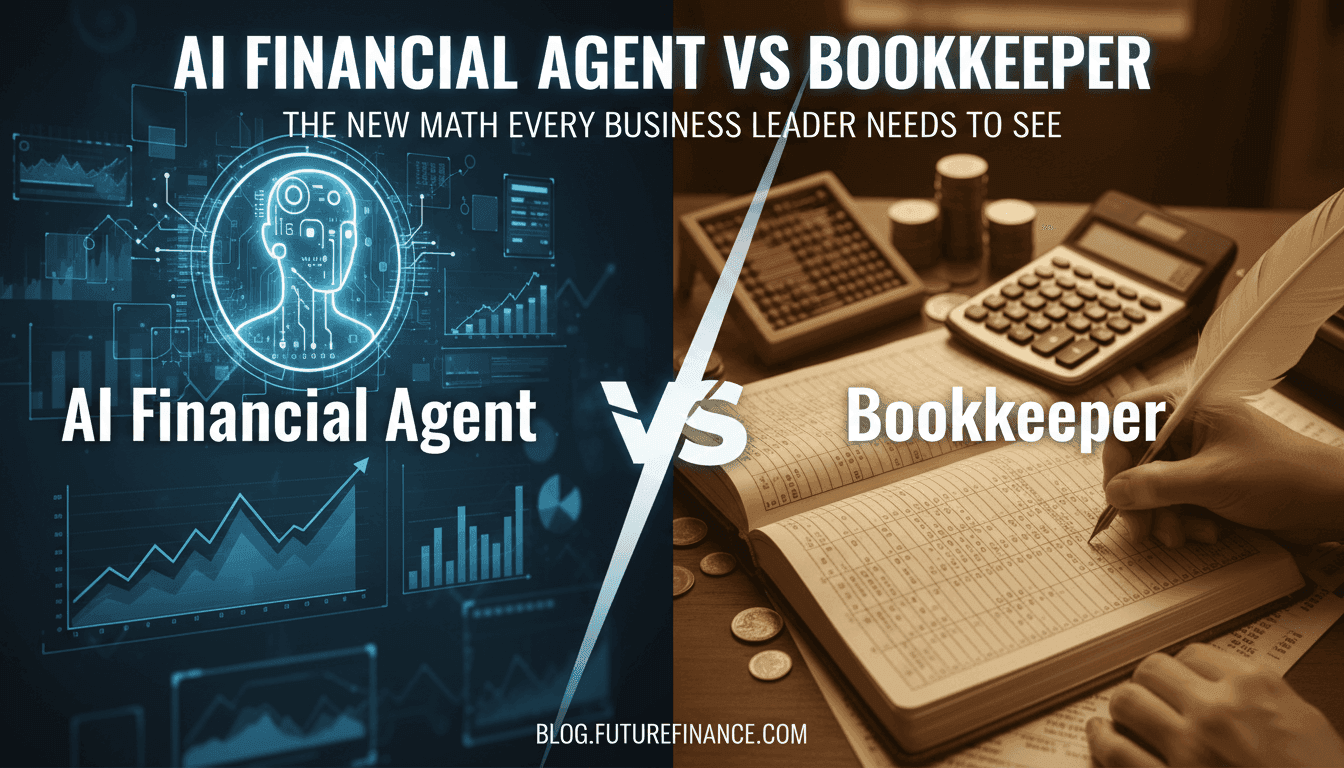
Table Of Contents
- The Question Every Finance Leader Is Now Asking
- What Is an AI Financial Agent, Really?
- What a Human Bookkeeper Actually Does
- The New Math: Comparing Costs, Speed, and Accuracy
- Where AI Financial Agents Win Decisively
- Where Human Bookkeepers Still Hold the Edge
- The Hybrid Model: Why It's Not Either/Or
- What This Means for Your Business Right Now
- Making the Transition Without the Chaos
AI Financial Agent vs Bookkeeper: The New Math Every Business Leader Needs to See
Not long ago, the idea of replacing your bookkeeper with software felt like a Silicon Valley fantasy. Today, AI financial agents are reconciling accounts, flagging anomalies, generating cash flow forecasts, and filing expense reports — often before your human bookkeeper has finished their morning coffee.
But here's where most conversations about AI and finance go wrong: they frame this as a binary choice, man versus machine, and then pick a winner. The reality is considerably more nuanced, and the math is more interesting than the headlines suggest.
For business leaders in Singapore and across Asia, where labour costs, regulatory complexity, and the pace of growth all collide, understanding the genuine trade-offs between AI financial agents and traditional bookkeepers is no longer a theoretical exercise. It's a strategic imperative. This article breaks down what each option actually delivers, where the numbers genuinely stack up, and how forward-thinking businesses are building financial operations that get the best of both.
What Is an AI Financial Agent, Really? {#what-is-ai-financial-agent}
The term "AI financial agent" gets thrown around loosely, so it's worth pinning down what we're actually talking about. Unlike basic accounting software that automates a single task (say, invoice generation), an AI financial agent is an autonomous system capable of planning and executing multiple steps in a financial workflow without constant human direction.
A modern AI financial agent can ingest bank feeds, categorise transactions, match purchase orders against invoices, flag unusual spending patterns, generate management accounts, and even send payment reminders — all within a single continuous workflow. The most sophisticated versions connect to ERP systems, tax platforms, and payroll software, creating a financial nervous system that operates around the clock.
According to McKinsey's 2025 State of AI survey, 62% of organisations are already experimenting with AI agents, with IT and knowledge management leading adoption. Finance is catching up fast, and for good reason: financial data is structured, rule-bound, and highly repetitive — precisely the conditions where agentic AI thrives.
What a Human Bookkeeper Actually Does {#what-bookkeeper-does}
Before we compare, it's worth being precise about what a skilled bookkeeper brings to the table, because the role is often underestimated. A competent bookkeeper does far more than data entry. They maintain ledgers, reconcile accounts, manage accounts payable and receivable, prepare financial statements, liaise with auditors, handle payroll, and ensure compliance with local regulations (no small feat in markets like Singapore, where GST rules and MAS guidelines demand ongoing attention).
Critically, experienced bookkeepers also exercise judgement. They notice when something feels off even before the numbers confirm it. They interpret ambiguous receipts, have conversations with vendors, and understand the business context behind a transaction. They know that the unusually large payment to a supplier last quarter was a one-off renegotiation, not a trend. That contextual intelligence is harder to replicate than most AI advocates admit.
The New Math: Comparing Costs, Speed, and Accuracy {#the-new-math}
Let's talk numbers, because this is where the conversation gets genuinely instructive.
Cost. In Singapore, a full-time in-house bookkeeper commands between SGD 2,500 and SGD 4,500 per month, plus CPF contributions, benefits, and the time cost of management. Outsourced bookkeeping services typically run SGD 500 to SGD 2,000 monthly for an SME. AI financial agent platforms — depending on complexity and integration depth — range from a few hundred dollars a month for a standalone tool to a few thousand for an enterprise-grade agentic solution. At the SME level, the cost comparison often favours AI, sometimes dramatically.
Speed. A human bookkeeper working a standard week processes transactions in batches, often with end-of-month closing cycles that create predictable bottlenecks. An AI financial agent processes transactions continuously, in real time. Month-end closing that once took three to five days can compress to hours. For businesses that need daily visibility into cash flow — retailers, F&B operators, fast-growing startups — this is not a marginal improvement; it changes how decisions get made.
Accuracy. This is where the comparison becomes more nuanced. AI agents excel at consistency: they apply the same rules the same way, every time, without fatigue. Human error in manual data entry is well-documented, with studies suggesting error rates between 1% and 5% in manual bookkeeping processes. However, AI accuracy is only as good as the quality of the data fed into it and the rules it has been trained on. Novel transactions, ambiguous categorisations, and edge cases can still trip up even sophisticated systems.
Where AI Financial Agents Win Decisively {#where-ai-wins}
There are specific arenas where AI financial agents are not just competitive but categorically superior, and business leaders should be honest about this.
Transaction volume and speed. As transaction volumes scale, human bookkeepers face diminishing returns. Adding a new product line, entering a new market, or onboarding a large client means more invoices, more reconciliations, more complexity. An AI agent scales with essentially zero marginal cost. You do not need to hire a second bookkeeper when your invoice volume doubles.
24/7 availability and real-time reporting. Businesses operating across time zones or needing live financial dashboards for investor reporting or board meetings gain a genuine edge from AI agents that never clock off. Real-time cash flow visibility has moved from a nice-to-have to a competitive necessity for growth-stage businesses.
Pattern recognition and anomaly detection. AI agents can monitor hundreds of variables simultaneously and surface anomalies that a human reviewing end-of-month reports would likely miss. Duplicate payments, vendor fraud, unusual expense patterns — these are exactly the use cases where machine learning models shine. Some platforms now detect potential compliance risks before they become actual problems.
Consistency and auditability. Every action an AI agent takes is logged. Every categorisation decision is traceable. For businesses facing audits or regulatory scrutiny, this creates a clean audit trail that is genuinely difficult to replicate with manual processes.
Where Human Bookkeepers Still Hold the Edge {#where-humans-win}
It would be intellectually dishonest to present AI financial agents as a complete replacement for human expertise, because they are not — at least not yet.
Contextual judgement and business understanding. When a long-standing client pays an invoice late for the first time, a human bookkeeper might know that the client is going through a difficult quarter and flag this for a relationship conversation rather than immediately triggering a collections process. AI agents optimise for rules; humans optimise for relationships and context.
Regulatory complexity and local nuance. Singapore's tax environment, corporate governance requirements, and evolving MAS regulations require ongoing human interpretation. While AI tools are improving at handling compliance tasks, significant regulatory changes or novel situations still benefit from human expertise and professional accountability.
Stakeholder communication. Bookkeepers often serve as the financial interface between a business and its bank, auditors, tax authorities, and investors. These relationships require human communication, negotiation, and trust-building that no AI agent currently replicates effectively.
Error recovery and edge cases. When something goes wrong — a system glitch misclassifies six months of transactions, or a data import corrupts a ledger — a human bookkeeper can diagnose, interpret, and remediate in ways that require genuine problem-solving. AI systems can fail in unexpected ways, and when they do, human expertise is essential for recovery.
The Hybrid Model: Why It's Not Either/Or {#hybrid-model}
The most strategically sophisticated businesses are not asking "AI or bookkeeper?" They are asking "How do we combine AI efficiency with human expertise to build a finance function that scales?"
In practice, this looks like AI financial agents handling the high-volume, rule-based work — transaction processing, reconciliation, expense categorisation, basic reporting — while a human financial professional (whether in-house or outsourced) focuses on interpretation, advisory, compliance oversight, and stakeholder management. The human role shifts from data processor to data interpreter. This is not a demotion; it is an upgrade. Finance professionals who learn to work with AI agents report spending more time on work they find meaningful and less time on repetitive tasks that drain them.
McKinsey's research on AI high performers is instructive here: the organisations seeing the greatest returns from AI are those that fundamentally redesign workflows rather than simply layering AI tools on top of existing processes. The same principle applies to financial operations. Implementing an AI financial agent without rethinking how your finance function operates is like buying a racing engine and putting it in a 20-year-old car.
Businesses exploring this transition are finding real value in structured learning environments. Business+AI workshops offer hands-on sessions specifically designed to help teams understand how to integrate AI tools into existing operations without the expensive trial-and-error that sinks most implementation efforts.
What This Means for Your Business Right Now {#what-this-means}
If you are running a business in 2025 and your entire financial operation still depends on a single human bookkeeper using manual processes, you are carrying more operational risk than you probably realise. Not because the bookkeeper is incompetent, but because the tools available to augment that function have fundamentally changed the risk/reward calculation.
Conversely, if you are considering replacing all human financial oversight with an AI platform you found in a product hunt newsletter, you are taking a different kind of risk — one that could surface in your next audit or regulatory review.
The honest assessment is this: AI financial agents are ready to take over the majority of transactional bookkeeping work for most SMEs, and the economics make that shift compelling. But the finance function as a whole still needs human judgment, particularly around strategy, compliance, and stakeholder relationships. The businesses that will build the most resilient, scalable financial operations are those that understand both sides of this equation.
For leaders who want to go deeper on how AI agents are reshaping finance and other business functions, Business+AI's masterclass series brings together practitioners who have actually implemented these systems — not just theorised about them.
Making the Transition Without the Chaos {#making-the-transition}
If you have decided that integrating an AI financial agent makes sense for your business, the implementation path matters enormously. Poorly executed AI implementations in finance can create data integrity problems that take months to unwind. Here is a practical framework for getting it right.
Start with a clean data audit. AI financial agents are only as reliable as the data they ingest. Before deploying any agentic system, ensure your chart of accounts is clean, your historical transaction data is well-categorised, and your banking integrations are stable. Garbage in, garbage out applies with particular force in financial AI.
Pilot on a contained scope. Rather than migrating your entire finance function at once, identify one high-volume, well-defined process — expense categorisation or accounts payable reconciliation, for example — and run a parallel process where both the AI agent and your existing system handle the same transactions. Compare outputs, identify discrepancies, and build confidence before expanding.
Redefine human roles before announcing the change. The biggest failure mode in AI-augmented finance implementations is not technical; it is organisational. If your bookkeeper or finance team learns about the AI agent as a threat to their job rather than as a tool that changes their job, you will face resistance that undermines the entire initiative. Define the new human role clearly and early.
Build in compliance checkpoints. Ensure that your AI financial agent implementation has human review points for any transaction categories that carry regulatory significance — GST claims, intercompany transactions, director-related payments. These are not areas where you want fully autonomous AI action without oversight.
For businesses navigating this transition, connecting with advisors who have walked this path with other organisations can shortcut a significant amount of costly learning. Business+AI's consulting services connect you with practitioners who specialise in exactly these kinds of operational AI integrations, tailored to the regulatory and business environment of the region.
The Bottom Line
The AI financial agent versus bookkeeper debate is really a question about how you want to allocate human intelligence in your finance function. AI agents are genuinely excellent at the high-volume, rule-based, consistency-dependent work that makes up the bulk of bookkeeping. Human bookkeepers are genuinely excellent at judgment, context, relationships, and navigating ambiguity.
The new math is not about subtraction — replacing humans with machines. It is about multiplication: combining the tireless precision of AI with the contextual intelligence of skilled finance professionals to build a function that is faster, more accurate, more scalable, and ultimately more valuable than either could deliver alone.
Businesses that treat this as a cost-cutting exercise will capture some savings and miss most of the opportunity. Businesses that treat it as a strategic redesign of how financial intelligence flows through their organisation will build a genuine competitive advantage.
The conversation about AI in finance is one worth having with peers who are actually doing the work. The Business+AI Forum is where executives across Singapore and the region share real implementation experiences, challenge assumptions, and find the practical answers that analyst reports rarely provide.
Ready to see how AI can transform your business operations beyond the finance function?
Join the Business+AI membership community and access workshops, masterclasses, expert consulting, and a network of executives who are turning AI from a talking point into a tangible business advantage.