
AI Content Agent vs Freelance Writer: A Complete Comparison for Business Leaders
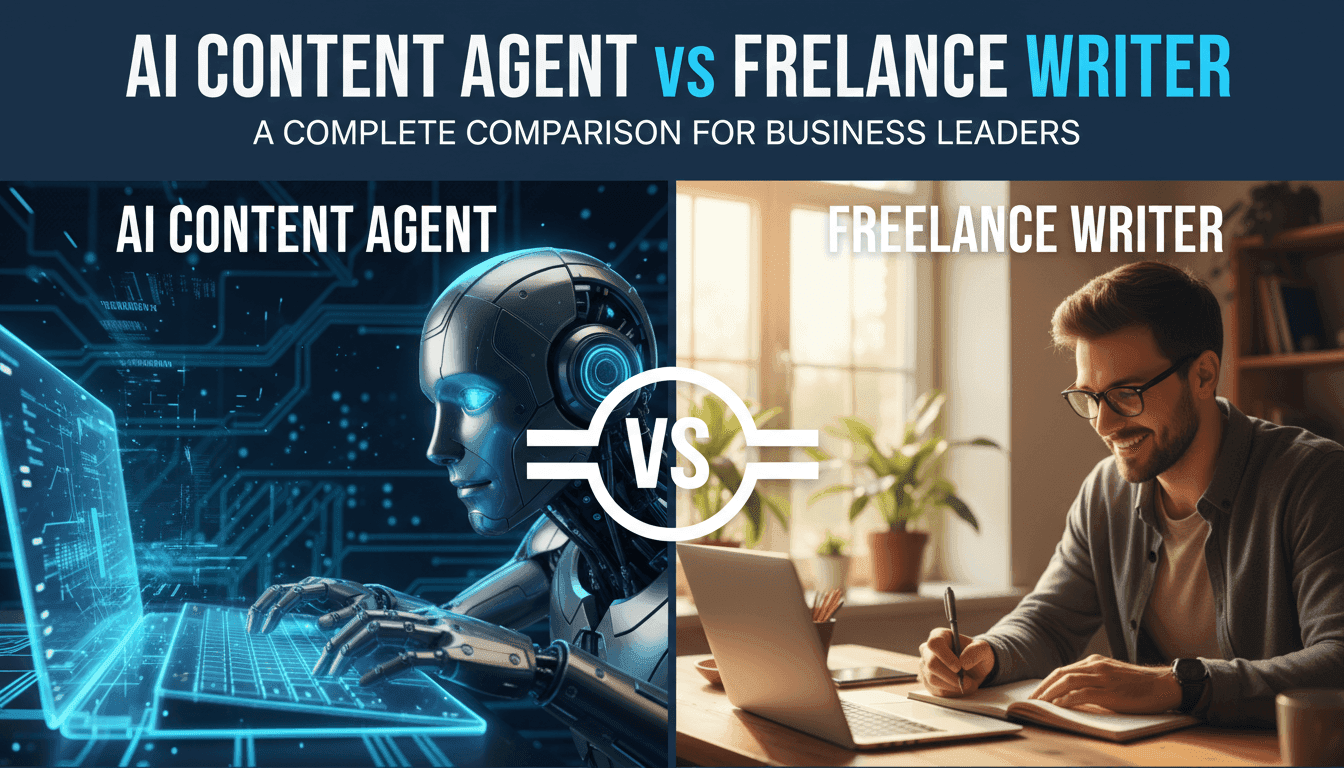
Table Of Contents
- Understanding the Content Creation Landscape
- What Are AI Content Agents?
- The Role of Freelance Writers in Modern Business
- Cost Comparison: Breaking Down the Numbers
- Quality and Consistency Analysis
- Speed and Scalability Considerations
- Use Case Scenarios: When to Choose What
- The Hybrid Approach: Best of Both Worlds
- Making the Right Choice for Your Business
The content marketing landscape has shifted dramatically. Business leaders now face a decision that seemed impossible just a few years ago: should you invest in AI content agents or stick with traditional freelance writers?
This isn't just a technology question. It's a strategic business decision that affects your budget, brand voice, content quality, and competitive positioning. As companies produce more content across more channels, the pressure to find efficient, cost-effective solutions has intensified.
The reality is more nuanced than the hype suggests. AI content agents offer unprecedented speed and scale, but freelance writers bring creativity, strategic thinking, and brand understanding that machines still struggle to replicate. Understanding when to use each option, or how to combine them effectively, can give your business a significant advantage in today's content-saturated marketplace.
This comprehensive comparison examines both solutions across the dimensions that matter most to business leaders: cost, quality, speed, scalability, and real-world application. By the end, you'll have a framework for making informed decisions about your content strategy.
AI Content Agent vs Freelance Writer
A Strategic Comparison for Business Leaders
The Core Decision
Cost Breakdown Comparison
(with editing)
(mid-range rate)
Volume Impact: At 40 posts/month, AI costs ~$2,200 vs Freelancer costs ~$12,000
When to Choose Each Approach
✓ Choose AI For:
- Product descriptions at scale
- Social media content
- Basic informational posts
- Email variations & A/B testing
- Content outlines & first drafts
✓ Choose Freelancers For:
- Thought leadership content
- Technical/specialized topics
- Brand storytelling
- Original research & interviews
- High-stakes communications
The Winning Strategy: Hybrid Approach
Most successful content operations use both strategically
Key Takeaways for Business Leaders
AI excels at speed, scale, and cost efficiency for routine content
Freelancers provide strategy, depth, and creativity for complex topics
Hybrid approaches deliver the best balance of cost, quality, and volume
Match content type to creation method based on strategic importance
Success requires strong editing processes regardless of content source
Ready to Optimize Your Content Strategy?
Learn how to leverage both AI and human capabilities strategically
Join Business+AI MembershipUnderstanding the Content Creation Landscape
Content has become the primary battleground for customer attention. Companies now publish an average of 30-50 pieces of content monthly across blogs, social media, email newsletters, and other channels. This volume creates operational challenges that many businesses struggle to address with traditional content creation methods.
The emergence of AI content agents represents a fundamental shift in how content can be produced. These tools have moved beyond simple template filling to generate coherent, contextually appropriate content across various formats. At the same time, the freelance writing market has matured, offering businesses access to specialized talent across industries and content types.
For business leaders, the question isn't whether content matters, but how to produce enough quality content without exhausting budgets or sacrificing brand standards. The answer increasingly involves understanding the strengths and limitations of both AI and human writers, then deploying each strategically.
What Are AI Content Agents?
AI content agents are sophisticated software systems that use machine learning models to generate written content based on user inputs and training data. Unlike earlier automation tools that simply filled templates, modern AI content agents can understand context, maintain consistent tone, and adapt their output to different formats and purposes.
These systems work by analyzing vast amounts of existing content to learn patterns in language, structure, and style. When given a prompt or brief, they generate original text by predicting the most appropriate words and phrases based on their training. The technology has advanced rapidly, with current systems capable of producing blog posts, product descriptions, social media content, and even technical documentation.
Key capabilities of AI content agents include:
- Generating multiple content variations quickly for A/B testing
- Maintaining consistent output across large content volumes
- Adapting to different formats and content types without retraining
- Processing and incorporating specific keywords and SEO requirements
- Operating 24/7 without breaks or downtime
- Scaling output instantly based on demand
However, AI content agents operate within constraints. They lack genuine understanding of business strategy, cannot conduct original research or interviews, and struggle with highly specialized or technical content that requires deep expertise. They also require human oversight to ensure factual accuracy and brand alignment.
The Role of Freelance Writers in Modern Business
Freelance writers represent the traditional approach to content creation, but the modern freelance market has evolved significantly. Today's professional freelancers often specialize in specific industries, content types, or marketing objectives, bringing strategic value beyond just writing ability.
A skilled freelance writer offers more than word production. They conduct research, interview subject matter experts, understand your competitive landscape, and craft content that advances specific business objectives. Many experienced freelancers also bring SEO expertise, content strategy knowledge, and an understanding of how content fits into broader marketing campaigns.
What freelance writers bring to content projects:
- Strategic thinking about content goals and audience needs
- Original research and expert interviews for unique insights
- Deep understanding of brand voice and positioning
- Ability to handle complex, technical, or sensitive topics
- Creative approaches to common subjects
- Critical thinking and fact-checking capabilities
- Relationship-building that improves output over time
The challenge with freelance writers involves scalability and consistency. Even excellent writers have capacity limits, and coordinating multiple freelancers can create management overhead. Quality varies significantly across the freelance market, making vetting and relationship-building essential but time-consuming.
Cost Comparison: Breaking Down the Numbers
Cost structures differ fundamentally between AI content agents and freelance writers, making direct comparison more complex than it initially appears.
AI content agent pricing typically follows a subscription model. Most platforms charge between $50 to $500 monthly for business plans, often with word count limits or tiered pricing based on features. Enterprise solutions with custom training and advanced capabilities can range from $1,000 to $10,000+ monthly. The key advantage is predictable costs regardless of output volume within plan limits.
For a business producing 40 blog posts monthly at 1,500 words each (60,000 words total), a mid-tier AI platform at $200 monthly provides a per-post cost of $5. Even accounting for human editing time at $50 per post, total cost reaches just $55 per post.
Freelance writer rates vary dramatically based on experience, specialization, and content complexity. Entry-level writers charge $0.03 to $0.10 per word, mid-level professionals range from $0.15 to $0.35 per word, and specialized experts command $0.50 to $1.00+ per word. A 1,500-word blog post might cost anywhere from $75 to $1,500 depending on these factors.
Using mid-range pricing of $0.20 per word, that same 1,500-word blog post costs $300, and 40 monthly posts total $12,000. This represents a significant cost difference compared to the AI approach, though the quality and strategic value may justify the premium for certain content types.
However, these calculations overlook important factors. AI-generated content often requires substantial editing, fact-checking, and refinement. Some businesses report spending 2-4 hours editing AI content that would have taken 4-6 hours to write from scratch, reducing but not eliminating the time investment. Additionally, not all content types suit AI generation equally well, potentially requiring human writers for strategic pieces regardless of cost.
Learning how to effectively leverage AI tools for business outcomes is increasingly valuable. Organizations like Business+AI offer workshops that help teams understand how to integrate AI content solutions strategically rather than just chasing cost savings.
Quality and Consistency Analysis
Quality assessment requires examining multiple dimensions: accuracy, readability, strategic value, brand alignment, and originality.
AI content agents excel at consistency. They maintain the same tone, structure, and quality level across unlimited output. This consistency is valuable for high-volume, straightforward content like product descriptions, basic blog posts, or social media updates. AI tools also handle SEO requirements systematically, incorporating keywords and following content structures that align with search optimization best practices.
However, AI-generated content often suffers from:
- Factual errors or outdated information from training data
- Surface-level analysis without genuine insights
- Repetitive phrasing and predictable structures
- Difficulty with nuance, humor, or persuasive argumentation
- Generic output that lacks distinctive brand personality
- Inability to challenge assumptions or offer contrarian perspectives
Freelance writers deliver variable quality depending on their skill, subject knowledge, and understanding of your brand. A well-matched freelancer produces content that sounds authentically human, incorporates strategic thinking, and offers genuine value beyond information regurgitation. Top freelancers craft compelling narratives, develop unique angles on common topics, and adapt their approach based on performance data and feedback.
The quality gap narrows for straightforward, informational content but widens significantly for content requiring expertise, creativity, or strategic positioning. A technical white paper, thought leadership article, or sensitive customer communication typically demands human judgment and expertise that AI cannot yet replicate reliably.
Consistency challenges with freelancers stem from individual working styles, capacity fluctuations, and the coordination required when working with multiple writers. Establishing clear brand guidelines, providing detailed briefs, and building long-term relationships with reliable writers mitigates these issues but requires investment.
Speed and Scalability Considerations
Speed and scalability represent perhaps the most significant advantages of AI content agents.
AI tools generate first drafts in minutes rather than hours or days. A task that takes a freelancer three hours can be completed by AI in three minutes, though editing time must be factored in. This speed enables rapid response to trending topics, quick content testing, or filling content calendars during busy periods.
Scalability differences are even more pronounced. An AI platform can increase output from 10 articles to 100 articles monthly without additional cost (within subscription limits) or logistical complexity. Scaling freelance capacity requires recruiting, vetting, onboarding, and managing additional writers, each step introducing delays and management overhead.
For businesses experiencing rapid growth, seasonal fluctuations, or unpredictable content demands, AI scalability provides operational flexibility that human-only approaches struggle to match.
However, speed advantages diminish when accounting for the full content production cycle. Quality AI content requires:
- Detailed prompt engineering – Crafting effective inputs takes skill and iteration
- Fact-checking and verification – AI confidently presents incorrect information
- Structural editing – Improving flow, transitions, and logical progression
- Brand voice refinement – Adjusting tone and personality to match guidelines
- Adding strategic elements – Incorporating insights, examples, and unique perspectives
When these steps are properly executed, the time advantage narrows considerably. Some content managers report that the full process takes 60-70% of the time required for human-written content rather than the 10-20% that raw generation speed suggests.
Use Case Scenarios: When to Choose What
The most strategic approach involves matching each content type to the most appropriate creation method.
Choose AI content agents for:
- High-volume product descriptions – E-commerce sites with hundreds or thousands of products benefit from AI's ability to generate unique, SEO-optimized descriptions at scale
- Social media posts – Short-form content for multiple platforms and accounts can be produced quickly and consistently
- Basic blog posts on established topics – Informational content covering common questions or frequently searched topics
- Email marketing variations – Creating multiple versions for segmentation or A/B testing
- First drafts and content outlines – Using AI to overcome blank-page syndrome and establish structure
- Content updates and refreshes – Revising existing content with new information or keywords
Choose freelance writers for:
- Thought leadership content – Articles that establish your company's expertise and unique perspective require human strategic thinking
- Technical or specialized content – Complex topics demanding deep expertise, like medical, legal, or engineering content
- Brand storytelling – Origin stories, customer success narratives, and emotional connection pieces
- Investigative or original research pieces – Content based on interviews, data analysis, or proprietary insights
- High-stakes communications – Sensitive topics, crisis communications, or content with significant business implications
- Content requiring creative approaches – Innovative formats, unconventional structures, or entertainment value
Many successful content operations use both approaches selectively. For example, businesses might use AI for the bulk of their informational blog content while engaging freelancers for monthly cornerstone articles, case studies, and thought leadership pieces.
Understanding how to structure this hybrid approach strategically is valuable. Business+AI consulting services help companies develop content strategies that leverage AI capabilities while maintaining quality and strategic differentiation.
The Hybrid Approach: Best of Both Worlds
The most sophisticated content operations don't choose between AI and human writers but rather integrate both strategically.
A hybrid workflow typically follows this pattern:
1. Strategic planning by humans – Content strategists identify topics, angles, keywords, and business objectives that content should achieve. This strategic layer ensures content serves business goals rather than just filling editorial calendars.
2. AI-powered research and outlining – AI tools quickly gather information, identify common questions, and generate content structures. This accelerates the research phase and ensures comprehensive topic coverage.
3. Selective deployment – Routine, high-volume content goes to AI with human editing, while strategic, complex, or creative content goes to skilled freelancers from the start.
4. Human refinement and enhancement – Editors and strategists review all content, adding insights, correcting errors, strengthening arguments, and ensuring brand alignment regardless of initial source.
5. Performance analysis and iteration – Track which content types and creation methods deliver the best results, continuously refining the approach based on data.
This hybrid model provides cost efficiency for routine content while maintaining quality and strategic value where it matters most. Companies using this approach report 40-60% cost savings compared to all-human content creation while maintaining or improving overall content quality and consistency.
The key is establishing clear criteria for routing content to AI versus human creation, developing effective editing processes, and building team capabilities in both AI tool usage and freelancer management.
Organizations can build these capabilities through structured learning. Business+AI masterclasses provide hands-on training in implementing AI content solutions within broader business contexts.
Making the Right Choice for Your Business
The AI versus freelancer decision depends on your specific situation, priorities, and constraints.
Choose AI-primary approaches when:
- Content volume requirements exceed reasonable human capacity
- Budget constraints significantly limit freelance spending
- Content types are primarily informational and straightforward
- Speed and scalability are critical competitive advantages
- You have strong editing and oversight capabilities in-house
Choose freelancer-primary approaches when:
- Brand differentiation and thought leadership are strategic priorities
- Content topics are complex, technical, or specialized
- You're building a distinct brand voice and personality
- Content serves high-stakes business objectives
- Quality and strategic value outweigh cost and speed considerations
Choose hybrid approaches when:
- You need both volume and quality across different content types
- You want cost efficiency without sacrificing strategic content
- Your content spans routine informational pieces and complex thought leadership
- You have the management capacity to coordinate both AI tools and freelancers
- You're willing to invest in developing internal AI and content management capabilities
For most businesses, the hybrid approach offers the best balance. The critical success factor is thoughtful implementation rather than simply adopting AI because it's new or sticking with freelancers because it's familiar.
Start by auditing your current content production. Categorize content types by complexity, strategic importance, and volume. Identify which categories might benefit from AI assistance and which require human expertise. Run pilot projects with AI tools on suitable content types while maintaining your freelancer relationships for strategic pieces. Measure results across quality, cost, speed, and business impact metrics.
The content creation landscape will continue evolving rapidly. AI capabilities will expand, potentially handling more complex content over time. Simultaneously, skilled human writers will become more valuable for the strategic, creative, and complex work that machines cannot replicate. The businesses that thrive will be those that understand both options deeply and deploy each strategically.
Developing organizational capabilities in AI implementation requires more than just purchasing tools. It demands strategic thinking about where AI creates genuine value versus where it introduces unnecessary risks. The Business+AI Forums provide opportunities to learn from executives and consultants who have successfully navigated these implementations across various industries and use cases.
The AI content agent versus freelance writer question doesn't have a universal answer. The right choice depends on your content types, business objectives, quality requirements, and resource constraints.
AI content agents offer unprecedented speed, scalability, and cost efficiency for routine, high-volume content. They excel at maintaining consistency and handling straightforward informational content at scale. However, they require human oversight, struggle with complexity and nuance, and cannot replace strategic thinking or genuine expertise.
Freelance writers provide strategic value, creative approaches, and quality that AI cannot yet match for complex or high-stakes content. They bring research capabilities, subject matter expertise, and brand understanding that elevates content beyond information delivery. However, they cost more and scale less easily than AI solutions.
The most effective approach for most businesses combines both strategically. Use AI for volume and efficiency where appropriate, engage skilled freelancers for strategic and complex content, and develop strong editing and oversight processes to maintain quality regardless of content source.
Success requires more than just choosing tools or hiring writers. It demands strategic thinking about where different content types fit in your business objectives, how to build internal capabilities in both AI utilization and freelancer management, and how to measure and optimize results over time.
The content creation landscape will continue evolving rapidly. Businesses that develop sophisticated approaches to leveraging both AI and human capabilities will have significant advantages over those that view this as a simple either-or decision.
Ready to Turn AI Talk Into Content Strategy Results?
Developing an effective content approach that leverages both AI and human capabilities requires strategic thinking, hands-on experience, and learning from others who have successfully implemented these solutions.
Join Business+AI membership to access exclusive resources, connect with executives and consultants who have navigated these decisions, and participate in workshops and masterclasses that provide practical frameworks for implementing AI content solutions strategically.
Transform your content operations from cost center to competitive advantage with expert guidance and a community of business leaders solving similar challenges.