
AI Change Communication by Audience: How to Engage Executives, Managers, and Staff During AI Transformation
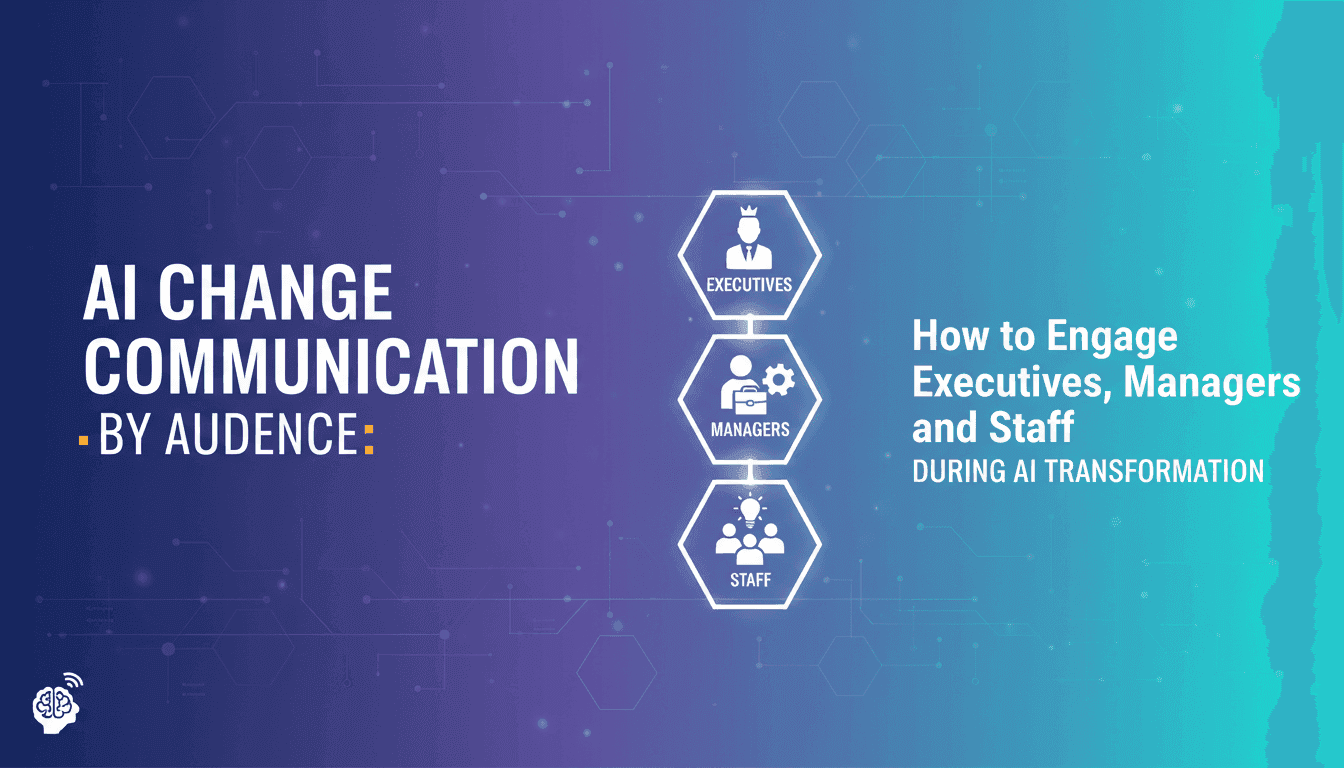
Table Of Contents
- Why Audience-Specific AI Communication Matters
- Understanding Your Three Core Audiences
- AI Change Communication for Executives
- AI Change Communication for Managers
- AI Change Communication for Staff
- Creating Your Integrated Communication Framework
- Measuring Communication Effectiveness
The failure rate for artificial intelligence initiatives remains stubbornly high, with research suggesting that up to 85% of AI projects fail to deliver expected business value. While technical challenges certainly play a role, a less obvious culprit often undermines even the most sophisticated AI implementations: inadequate change communication.
When organizations treat AI transformation as a purely technological upgrade rather than a fundamental shift in how work gets done, they inevitably encounter resistance, confusion, and ultimately, failure. The solution isn't simply communicating more—it's communicating differently to each distinct audience within your organization.
Executives require strategic context and competitive positioning. Managers need operational frameworks and team management guidance. Staff members seek reassurance, practical training, and clear answers about how AI affects their daily work. When you craft messages that resonate with each group's unique concerns and motivations, you transform potential resistance into enthusiastic adoption.
This comprehensive guide breaks down exactly how to communicate AI change across all organizational levels, providing frameworks, messaging templates, and proven strategies that turn artificial intelligence talk into tangible business gains.
AI Change Communication by Audience
Tailored strategies to engage executives, managers, and staff during AI transformation
The culprit? Inadequate change communication
Why Audience-Specific Communication Matters
One-size-fits-all messaging creates:
- Executive disengagement from operational details
- Staff anxiety without practical guidance
- Rumors, resistance, and transformation failure
3 Core Audiences, 3 Distinct Approaches
Executives
What They Need:
- Strategic rationale & competitive context
- Financial projections & ROI clarity
- Risk landscape & governance frameworks
- Connection to existing strategic priorities
Managers
What They Need:
- Early engagement as transformation partners
- Communication toolkits & talking points
- Change leadership capability building
- Clarity on their evolving role in AI era
Staff
What They Need:
- Honest answers about job security
- Accessible learning pathways & training
- Safe practice environments to build skills
- Visible leadership commitment to success
Key Success Principles
Create an Integrated Framework
Maintain consistency in core narrative while customizing emphasis and detail for each audience level
Address Real Concerns Directly
Don't dismiss anxiety with generic reassurances—provide specific, honest answers to legitimate questions
Measure and Optimize
Track awareness, comprehension, sentiment, and behavioral metrics to continuously improve your approach
The Bottom Line
AI transformation succeeds or fails based on human factors far more often than technical limitations
Why Audience-Specific AI Communication Matters
Generic, one-size-fits-all communication about AI transformation creates more problems than it solves. When executives receive messages filled with operational minutiae, they disengage. When frontline staff hear only high-level strategic rationale without practical guidance, anxiety flourishes. The disconnect between what each audience needs and what they receive creates a communication vacuum that fills rapidly with rumors, resistance, and fear.
Role-based perspective shapes how people interpret AI initiatives. Executives view AI through a strategic lens, considering market positioning, competitive advantage, and return on investment. Managers operate in the tactical middle ground, translating strategy into action while managing team dynamics and operational continuity. Staff members experience AI most personally, wondering whether their skills remain relevant and how their daily responsibilities will evolve.
The most successful AI transformations recognize these fundamental differences and craft distinct communication streams that address each audience's information needs, emotional concerns, and decision-making requirements. Organizations that invest time in audience-specific messaging report significantly higher adoption rates, faster implementation timelines, and measurably better business outcomes.
Understanding Your Three Core Audiences
Before crafting specific messages, you need to understand the distinct characteristics, concerns, and communication preferences of each audience segment. This foundation ensures your messaging resonates rather than falls flat.
Executives typically possess broad business acumen but varying levels of AI technical knowledge. They're accountable for organizational performance, shareholder value, and strategic direction. Their primary concerns center on competitive positioning, financial returns, risk management, and organizational capability building. Executives consume information quickly, prefer visual data representations, and value concise summaries with supporting detail available on demand.
Managers serve as the critical bridge between strategic vision and operational reality. They possess deep functional expertise and direct responsibility for team performance. Their concerns revolve around implementation feasibility, resource allocation, team morale, workflow disruption, and their own continued relevance as leaders. Managers need sufficient detail to answer team questions, frameworks to guide implementation, and ongoing support to navigate challenges.
Staff members bring specialized functional skills and experience AI transformation most directly in their daily work. Their concerns are intensely practical and often emotionally charged: Will I lose my job? Can I learn these new skills? How will my work change? Will I have support during the transition? Staff members need clear, honest communication, accessible training, and visible leadership commitment to their success.
These audiences aren't isolated silos. Information flows between them constantly, and inconsistencies in messaging create credibility problems. Your communication framework must maintain coherence across all levels while tailoring emphasis, detail, and framing to each audience's needs.
AI Change Communication for Executives
What Executives Need to Know
Executive communication about AI transformation must connect technological capability to business strategy. Leaders need to understand not just what AI can do, but how it advances organizational objectives, creates competitive differentiation, and generates measurable value.
Focus executive messaging on these critical elements:
- Strategic rationale: How AI addresses specific market challenges, customer needs, or operational inefficiencies
- Competitive context: What competitors and industry leaders are doing with AI, and implications of action versus inaction
- Financial projections: Expected investment requirements, timeline to value, and anticipated returns with clear assumptions
- Risk landscape: Technical, operational, and market risks with mitigation strategies
- Organizational implications: Changes to operating model, capability requirements, and cultural evolution
- Governance framework: Decision rights, oversight mechanisms, and accountability structures
Executives don't need detailed technical explanations of machine learning algorithms, but they absolutely need to understand the business logic driving AI investments and their role in championing transformation.
Communication Strategies for the C-Suite
Effective executive communication balances strategic vision with pragmatic action. Present AI transformation as a deliberate business strategy rather than a technology project, using language and frameworks executives already understand and trust.
Connect AI to existing strategic priorities rather than introducing it as a separate initiative. If customer experience improvement is already a strategic focus, frame AI as an accelerator for that existing priority. This approach reduces perceived complexity and positions AI as an enabler of established goals rather than a distraction from them.
Use financial frameworks executives already trust to evaluate AI investments. Apply the same rigor to AI business cases as any other capital allocation decision, including NPV analysis, payback periods, and sensitivity testing. This familiarity breeds confidence and enables informed decision-making.
Provide regular, structured updates through existing governance channels rather than creating special AI-specific meetings that feel disconnected from core business rhythms. Incorporate AI transformation progress into quarterly business reviews, strategy sessions, and board reporting with consistent metrics and clear accountability.
Leverage peer insights and external validation through industry benchmarking, case studies from comparable organizations, and expert perspectives. Executives value external context that helps them assess whether their AI strategy is appropriately ambitious or dangerously lagging. Business+AI Forums provide valuable opportunities for executives to engage with peers navigating similar transformations and learn from both successes and failures across industries.
Address the cultural dimension explicitly by acknowledging that AI transformation requires behavioral and mindset shifts beyond technology implementation. Discuss the leadership behaviors needed to model openness to AI-driven insights, willingness to challenge traditional decision-making approaches, and commitment to continuous learning.
AI Change Communication for Managers
The Middle Management Challenge
Managers occupy the most complex position in AI transformation. They must simultaneously champion change to their teams while managing their own uncertainty about how AI affects their role. They translate executive vision into operational reality while providing upward feedback about implementation challenges. They maintain productivity during transition periods while helping team members develop new capabilities.
This position creates unique communication needs. Managers require more tactical detail than executives but also need strategic context to explain the "why" behind changes. They need honest acknowledgment of implementation challenges rather than overly optimistic assurances. Most importantly, they need early engagement and genuine partnership rather than simply being told to execute decisions made above them.
Manager resistance often stems not from opposition to AI itself but from feeling unprepared to lead teams through transformation. When managers receive information simultaneously with their teams, they can't fulfill their expected role as guides and resources. When their own questions go unanswered, they can't credibly address team concerns.
Successful AI communication strategies engage managers as partners in transformation rather than simply messengers of executive decisions.
Equipping Managers as Change Champions
Transform middle managers from potential bottlenecks into accelerators by providing the information, tools, and support they need to lead their teams confidently through AI transformation.
Engage managers early in the planning process to tap their operational expertise and build ownership. Managers understand workflow nuances, team dynamics, and practical implementation challenges that strategic planners might miss. Their input improves implementation plans while simultaneously building their commitment to success.
Provide managers with comprehensive communication toolkits that include talking points for team meetings, answers to frequently asked questions, and guidance for handling difficult conversations. These resources reduce managers' anxiety about saying the wrong thing while ensuring message consistency across teams. Include specific scenarios and suggested responses for common concerns like job security, skill adequacy, and timeline anxiety.
Create manager-specific learning opportunities that build both technical AI understanding and change leadership capabilities. Workshops designed specifically for middle managers should address both the what of AI transformation (technical capabilities, use cases, implementation approach) and the how (managing team anxiety, coaching skill development, maintaining performance during transitions).
Establish regular manager forums where leaders can share implementation experiences, problem-solve challenges together, and provide candid feedback to senior leadership. These sessions create peer support networks while giving executives valuable ground-truth perspectives on how transformation is actually progressing.
Clarify the evolving manager role explicitly. As AI handles routine decision-making and process optimization, managerial work shifts toward coaching, strategic thinking, and complex problem-solving. Help managers understand and develop capabilities for this evolved role rather than leaving them to figure it out independently.
Recognize and celebrate manager contributions to AI transformation publicly and specifically. Highlight examples of managers who effectively helped teams navigate change, developed innovative AI applications, or provided valuable implementation feedback. This recognition reinforces desired behaviors while building manager confidence.
AI Change Communication for Staff
Addressing Employee Concerns and Resistance
Frontline staff experience AI transformation most personally and often most anxiously. While executives contemplate strategic positioning and managers focus on implementation logistics, staff members grapple with fundamental questions about their future: Will I have a job? Can I learn what's needed? Will my experience still matter?
These concerns are neither irrational nor signs of resistance to change. They're legitimate responses to genuine uncertainty. Dismissing them with generic reassurances about "exciting opportunities" or minimizing them with assertions that "everyone just needs to embrace change" compounds anxiety rather than alleviating it.
Job security concerns dominate employee thinking during AI transformation. Even when leadership has no intention of reducing headcount, staff members notice AI's efficiency gains and draw logical conclusions about implications for staffing levels. Address these concerns directly and honestly rather than avoiding the topic.
If job security is genuinely not at risk, say so explicitly and explain why. Perhaps AI enables growth that requires more people, or it handles routine work while humans focus on higher-value activities, or it addresses capacity constraints without reducing need for human expertise. Provide specific logic rather than vague assurances.
If workforce changes are anticipated, communicate this reality respectfully along with detailed information about timing, criteria, support for affected individuals, and opportunities for redeployment. Uncertainty is more damaging than difficult truth delivered with respect and support.
Skill adequacy anxiety runs close behind job security on the list of employee concerns. Staff members worry they lack the technical background to work effectively with AI, that their hard-won expertise becomes obsolete overnight, or that they're too old or too set in their ways to learn new approaches.
Address these concerns through concrete learning pathways rather than generic encouragement. What specific skills will people need? What training will be provided? How much time will they have to develop new capabilities? What support is available for those who struggle initially?
Change fatigue affects organizations that have undergone multiple transformations in recent years. Staff members may view AI as the latest in a series of initiatives that disrupt work, consume energy, and often fail to deliver promised benefits. Acknowledge this history and explain specifically how AI transformation differs and why this investment of their effort and goodwill will yield genuine improvements.
Building Staff Confidence and Capability
Moving from addressing concerns to building genuine enthusiasm requires creating early wins, providing accessible learning opportunities, and demonstrating visible leadership commitment to employee success.
Start with AI applications that clearly improve work rather than simply increasing efficiency. Tools that eliminate frustrating manual tasks, provide helpful insights, or enable work that wasn't previously possible generate enthusiasm more effectively than applications that simply do existing work faster. Early positive experiences with AI build openness to broader transformation.
Design learning experiences for diverse skill levels and learning styles. Not everyone learns effectively through the same methods, and technical background varies widely among staff. Offer multiple learning pathways including hands-on practice, visual demonstrations, peer learning, and expert instruction. Masterclass programs that combine conceptual understanding with practical application help staff build both knowledge and confidence.
Create safe practice environments where people can experiment with AI tools, make mistakes, and ask basic questions without judgment. Learning anxiety is real, and many staff members fear looking incompetent in front of colleagues or supervisors. Dedicated learning spaces with explicit permission to struggle reduce this anxiety.
Identify and leverage AI champions within teams who can provide peer-to-peer support and modeling. Colleagues teaching colleagues often proves more effective than expert-led training alone, particularly for employees intimidated by formal learning environments. Champions also provide valuable feedback about training effectiveness and ongoing support needs.
Communicate frequently and through multiple channels. Don't assume a single announcement or training session adequately informs staff. People need to hear messages multiple times, through different media, and from various sources before information truly sinks in. Use team meetings, email updates, intranet content, informal conversations, and visual displays to reinforce key messages.
Provide specific timelines and milestones so people understand the transformation pace and what to expect when. Vague assurances that change will happen "over time" create ongoing uncertainty. Clear timelines let people mentally prepare and reduce anxiety about unknown timing.
Make support resources visible and easily accessible. Ensure staff know exactly where to go with questions, who to contact for technical help, and what resources are available for skill development. The existence of support matters far less than staff awareness of and comfort accessing that support.
Creating Your Integrated Communication Framework
Effective AI change communication requires coordinated messaging across all audiences while respecting each group's distinct needs. An integrated framework ensures consistency in core messages while enabling appropriate customization for different organizational levels.
Start by defining your core narrative - the fundamental story about why AI transformation matters, where the organization is headed, and how you'll get there. This narrative should be simple enough to remember and repeat, yet substantive enough to provide genuine meaning. Every audience hears this same core story, customized in emphasis and detail for their needs.
Develop audience-specific message maps that translate the core narrative into relevant terms for executives, managers, and staff. These maps identify the key points each audience needs to understand, the concerns you must address, the language that resonates, and the evidence that builds credibility.
Establish communication cadence and channels appropriate for each audience. Executives might receive monthly strategic updates through board presentations and written briefings. Managers might need weekly tactical updates through team leader meetings and collaborative platforms. Staff might benefit from daily or weekly touchpoints through team huddles, email updates, and accessible online resources.
Create feedback mechanisms that let you assess communication effectiveness and adjust approach based on what's working and what isn't. Regular pulse surveys, focus groups, open forums, and usage analytics provide insight into whether messages are landing as intended and where confusion or resistance persists.
Build communication capability among leaders at all levels through training, coaching, and resources. Many technically skilled managers struggle with change communication. Investing in their development as communicators pays dividends throughout transformation. Consulting services can help organizations design and implement comprehensive communication strategies tailored to their specific culture and transformation needs.
Plan for communication sustainability beyond the initial announcement phase. AI transformation is a journey, not an event, and communication needs evolve as implementation progresses. Maintain communication discipline through the difficult middle phase when initial enthusiasm wanes but full benefits haven't yet materialized.
Measuring Communication Effectiveness
You can't improve what you don't measure. Effective AI change communication requires systematic assessment of whether messages reach intended audiences, land as intended, and drive desired behaviors and outcomes.
Awareness metrics assess whether people actually receive and remember key messages. Pulse surveys asking staff to identify transformation goals, timeline, or available resources reveal whether basic information is penetrating. Low awareness scores indicate need for different channels, increased frequency, or simplified messaging.
Comprehension metrics evaluate whether people understand messages correctly, not just whether they've heard them. Ask people to explain in their own words why AI transformation matters or how it will affect their work. Gaps between intended and understood messages highlight where clarification is needed.
Sentiment metrics gauge emotional responses to AI transformation. Are people anxious, excited, skeptical, or engaged? Sentiment analysis of internal communications, survey responses, and focus group discussions reveals whether your communication is building confidence or fueling resistance.
Behavioral metrics track whether communication drives desired actions like attending training, using new tools, or engaging with AI resources. Behavioral data provides objective evidence of communication effectiveness beyond what people self-report.
Outcome metrics connect communication to business results. Do teams with higher engagement in communication activities show faster AI adoption? Better performance outcomes? Higher satisfaction? These connections justify communication investments and identify high-impact approaches worth scaling.
Regularly review these metrics and adjust your communication approach based on what the data reveals. Communication isn't a one-time design challenge but an ongoing optimization process throughout AI transformation.
AI transformation succeeds or fails based on human factors far more often than technical limitations. The most sophisticated algorithms and powerful platforms deliver little value when people don't understand, trust, or effectively use them. Communication that resonates with each audience's unique perspective, concerns, and needs transforms potential resistance into active partnership.
Executives need strategic context that connects AI to business objectives and competitive positioning. Managers need tactical frameworks and support to lead their teams confidently through change. Staff need honest answers, accessible learning, and visible commitment to their success. When you deliver what each audience needs rather than generic messages aimed at everyone and no one, you create the foundation for transformation that actually transforms.
The frameworks and strategies outlined here provide a starting point, but effective communication requires adaptation to your organization's unique culture, history, and circumstances. Invest time in understanding your audiences deeply, craft messages that address their real concerns, and maintain communication discipline throughout the transformation journey.
AI's potential to drive tangible business gains is real, but only for organizations that successfully navigate the human dimension of technological change. Communication excellence isn't a nice-to-have addition to your AI strategy - it's the foundation that makes everything else possible.
Ready to Transform AI Talk Into Tangible Results?
Successful AI transformation requires more than great technology. It demands strategic communication, executive alignment, manager empowerment, and organization-wide capability building.
Join the Business+AI membership community to access exclusive resources, expert guidance, and peer connections that turn AI potential into business performance. Connect with executives, consultants, and solution vendors who are successfully navigating AI transformation and learn practical strategies you can implement immediately.
Transform how your organization communicates, implements, and benefits from artificial intelligence.