
AI-Augmented vs AI-Replaced: What Determines Who Thrives?
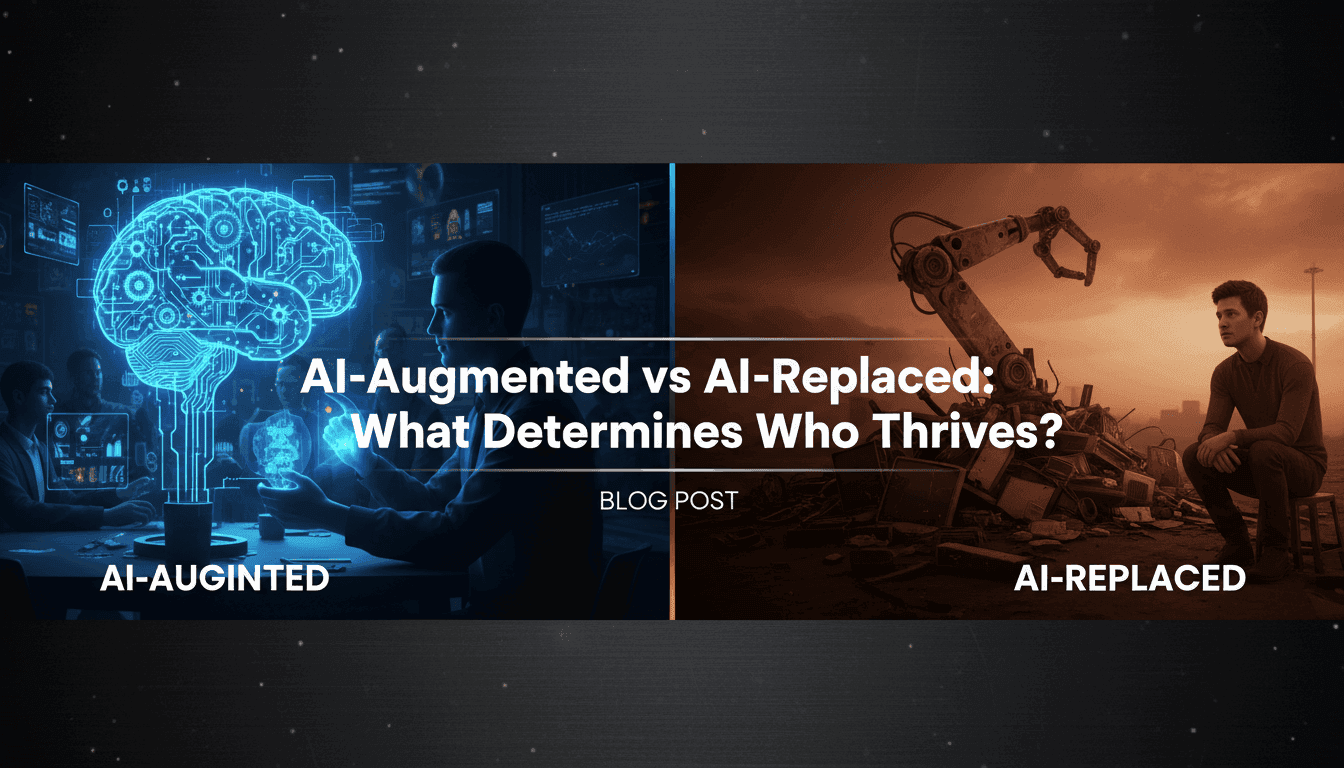
Table Of Contents
- The Question Every Professional Is Really Asking
- Augmentation vs. Replacement: What the Research Actually Shows
- The Two Forces That Decide Your Role's Fate
- The Skills That Separate Augmented Workers from Replaced Ones
- Why Companies — Not Just Individuals — Determine the Outcome
- The Asia Context: Why Singapore Professionals Face a Unique Inflection Point
- What Business Leaders Must Do Right Now
- Thriving in the AI Era Starts With the Right Conversations
There is a question that almost every professional is quietly running in the background, whether they admit it in a boardroom or not: Am I the kind of person AI will work for — or the kind it will work without?
The honest answer is that it depends on far more than the industry you work in or the tools you have access to. It depends on the nature of the tasks your role is built around, the choices your organisation makes about how to deploy AI, and critically, the skills you choose to develop right now. The line between being augmented and being replaced is real, but it is not fixed.
This article unpacks the research-backed factors that determine which side of that line professionals and organisations end up on — and what business leaders in Asia and beyond can do to make sure their people land in the right place.
The Question Every Professional Is Really Asking {#the-question}
Fear sells headlines, but it rarely gives useful guidance. Strip away the noise and what emerges is a more nuanced picture: most jobs are not disappearing, but the vast majority are changing substantially, and the pace of that change is accelerating faster than most workforce strategies can keep up with.
The 2025 World Economic Forum Future of Jobs Report states that while 92 million jobs might be eliminated by 2030, 170 million new roles will be created because of AI, resulting in a net gain of 78 million. That net positive figure is often used to reassure, but it obscures the more pressing challenge for working professionals today: the jobs being created are not automatically the jobs being lost, and the transition between the two requires deliberate action from both individuals and the organisations they work for.
What the headline numbers cannot tell you is who specifically will thrive and who will not. That question demands a more granular look at what drives augmentation versus replacement at the level of tasks, roles, and strategic choices.
Augmentation vs. Replacement: What the Research Actually Shows {#augmentation-vs-replacement}
The dominant narrative in popular media treats AI as a binary: it either takes your job or it does not. The research tells a far more textured story.
MIT Sloan research distinguishes between automation (task transfer to machines) and augmentation (AI enhancing human productivity), emphasising that many tasks benefit more from augmentation. Human-intensive tasks are less susceptible to automation but are strong candidates for augmentation. This distinction matters enormously in practice. A role is not replaced wholesale; rather, specific tasks within it are automated, while others are elevated and made more impactful by AI assistance.
The empirical evidence backs this up at scale. Research analysing AI interactions across hundreds of occupations found that 78.7% of observed AI interactions are augmentation, not automation — meaning that in the real world, right now, AI is far more commonly a collaborator than a replacement. Workers augment their jobs with AI more often than they are replaced by the technology, and notably, workers with moderate skill levels hold many of the jobs being augmented with AI. This finding upends the assumption that augmentation is only a benefit for elite knowledge workers.
PwC's 2025 Global AI Jobs Barometer found that AI is making workers more valuable, with wages rising twice as quickly in industries most exposed to AI compared to those least exposed — and wages are rising even in the most highly automatable roles, suggesting that concerns AI is devaluing automatable roles may be misplaced.
The Two Forces That Decide Your Role's Fate {#two-forces}
Understanding augmentation versus replacement requires looking beyond job titles to the underlying mechanics of a role. Two forces, working in combination, largely determine the outcome.
The nature of the tasks themselves is the first force. Roles built primarily around structured, repeatable, rule-governed tasks — data entry, scripted customer interactions, routine report generation — are highly susceptible to task-level automation. When those tasks represent the majority of a role, the role itself is at risk of substitution. Roles built around open-ended problem solving, contextual judgment, relationship management, and accountability are far more resistant. The four pillars that protect long-term stability remain consistent: human density, physical complexity, open-ended problem solving, and accountability.
The expandability of demand for the role's output is the second force. Even when AI can automate significant portions of a role's task load, the employment impact depends on whether that productivity gain generates more demand or simply reduces the headcount needed to meet existing demand. Software engineering is a frequently cited example of demand that expands alongside automation: as AI reduces the cost and time to build software, organisations build more of it, keeping engineers in demand even as individual coding tasks are increasingly AI-assisted. Call centre work is the counter-example: the volume of customer interactions does not grow proportionally when AI handles routine queries more efficiently, so fewer human agents are required.
These two forces interact to place roles into a spectrum from highly vulnerable to highly resilient. The critical insight for business leaders is that the same role can land in very different places depending on how it is redesigned in response to AI.
The Skills That Separate Augmented Workers from Replaced Ones {#skills}
If task structure and demand expandability determine a role's trajectory at the macro level, individual skills determine where a specific professional ends up within that trajectory. The skills that matter most are both technical and deeply human.
On the technical side, AI fluency has become a baseline expectation that is no longer optional. 75% of knowledge workers are already using AI tools, often without formal company deployment. The professionals who are pulling ahead are not simply using AI tools passively; they are actively integrating AI into their workflows, evaluating its outputs critically, and finding new leverage points in their daily work. This is meaningfully different from using a chatbot to draft emails. Employees drafting emails with ChatGPT is not AI adoption. End-to-end AI adoption requires data organisation, process redesign, and worker retraining.
On the human side, the skills that AI cannot easily replicate are precisely the ones rising most sharply in value. Cultivating skills that enable workers to collaborate with AI is vital. These skills include adaptability, creativity, emotional intelligence, teamwork, resilience, and critical thinking. AI increases the importance of human skills. Communication, collaboration, leadership, and judgment remain critical workforce capabilities, and surveys show that executives rank communication as the most in-demand skill and value soft skills as much as or more than technical AI skills.
Perhaps the most important meta-skill of all is adaptability itself. Adaptability and digital literacy will determine who can transition into AI-augmented roles. The professionals who thrive will not be those who mastered a fixed skill set perfectly; they will be those who can continuously learn, unlearn, and relearn as AI capabilities evolve. As AI tools become embedded in daily operations, workers are expected to go beyond technical familiarity and cultivate broader abilities such as critical thinking, adaptability, and digital literacy.
Upskilling workers to augment their jobs with AI enables them to spend more time on the human-intensive tasks that AI cannot replicate. This is the compounding advantage of intentional upskilling: it does not just protect a worker's current role, it shifts the entire value proposition of what that person contributes.
Why Companies — Not Just Individuals — Determine the Outcome {#companies}
The responsibility for navigating this shift does not rest entirely with individual workers. Organisations bear a large part of the burden, and the choices they make now will determine whether their workforce ends up augmented or simply reduced.
Organisations that prioritise developing human capabilities alongside AI skills are nearly twice as likely to have workers who feel their work is meaningful and twice as likely to achieve better financial results. Deloitte's 2025 Human Capital Trends reported that organisations investing in workforce development were 1.8 times more likely to report better financial results. The strategic case for investing in people alongside technology has never been more financially compelling.
Yet many organisations are treating upskilling as a one-time event rather than an ongoing strategic capability. Many organisations still treat upskilling as a one-time learning initiative, but AI does not introduce one-time change; it drives continuous role evolution. Employees must continuously learn new skills, apply them at work, adjust behaviours, and relearn as tools and processes change.
In the World Economic Forum's 2025 Future of Jobs Report, 77% of employers said they planned to upskill their workforce, while 47% intended to reskill employees in roles affected by AI for other positions within the organisation. The intention is there. The gap, consistently, lies in execution — in translating that intention into structured, ongoing programmes that are embedded in the flow of actual work rather than delivered as isolated training events.
Companies that avoid the trap of reactive, headline-driven workforce cuts will emerge stronger. Those that cut beyond what AI can realistically replace risk losing institutional knowledge, demoralising the employees who remain, and eroding the human capabilities that are hardest to rebuild — precisely the judgment, relationships, and contextual wisdom that make the AI-augmented model work at all.
The Asia Context: Why Singapore Professionals Face a Unique Inflection Point {#asia-context}
For business leaders in Singapore and across Southeast Asia, the augmentation imperative carries particular urgency. More enterprises in Singapore are adopting digital technologies such as AI to boost efficiency, reduce costs, streamline operations, and drive innovation. This has increased the demand for tech professionals who can effectively apply these tools, and Singapore's tech workforce grew from 208,300 in 2023 to 214,000 in 2024, reflecting the wider uptake of AI.
The government has responded with significant structural support. Singapore has set aside over S$400 million for an Enterprise Workforce Transformation Package to help companies transform their workforce and redesign jobs. Companies can claim 400% tax deductions on qualifying AI spend, capped at S$50,000 per year for YA2027 and YA2028.
Based on the Future of Jobs Report 2025, 96% of employers in Southeast Asia are prioritising upskilling, compared to 85% globally, and 86% are hiring staff with new skills — well above the global average of 70%. The urgency is clear, but the question for most organisations remains the same: how do we go from strategic intent to practical capability?
The answer lies not in finding the perfect AI tool or the right one-time training course, but in building a learning culture that is continuous, contextual, and connected to real business problems.
What Business Leaders Must Do Right Now {#what-leaders-must-do}
The research converges on several clear imperatives for leaders who want to ensure their teams land on the augmented side of the equation.
Conduct a role-level task audit. Before making any workforce decisions, map the task composition of key roles. Identify which tasks are highly structured and repetitive, which require contextual judgment, and which depend on relationship capital and accountability. This determines where AI deployment will augment versus threaten each role, and it prevents the costly mistake of cutting in the wrong places.
Invest in AI fluency as a strategic capability, not a compliance checkbox. Broad-based AI literacy across the workforce — not just in technology functions — is what enables an organisation to capture AI's productivity gains rather than simply reduce headcount. This requires structured, role-specific training that goes beyond tool familiarity into workflow integration and output evaluation.
Redesign workflows before you measure productivity gains. While AI is helping many employees work more efficiently, many organisations have not yet fundamentally redesigned workflows, roles, or processes around AI. Productivity at the individual task level does not automatically compound to organisational performance. Capturing AI's full value requires deliberate workflow redesign — and that requires bringing together business leaders, HR, and frontline teams in structured conversation.
Build the narrative deliberately. How leaders communicate the purpose of AI transformation shapes whether the workforce embraces change or resists it. Employees who understand that augmentation is the goal, and who have clear pathways to develop the skills that make them valuable in an AI-enabled environment, are far more likely to engage with transformation initiatives rather than fear them. The organisations who succeed won't be those who resisted change or waited for perfect clarity. They'll be the ones who treated uncertainty as an opportunity — building new skills, designing new workflows, and creating new value at the intersection of human expertise and AI capability.
Thriving in the AI Era Starts With the Right Conversations {#conclusion-section}
The divide between AI-augmented and AI-replaced is not a fixed feature of the labour market landscape. It is a dynamic outcome shaped by the decisions that business leaders, HR teams, and professionals make today: which skills to develop, how to redesign workflows, how aggressively to pursue structured upskilling, and how clearly to communicate the purpose behind transformation.
The data is unambiguous that augmentation is the more likely trajectory for most roles — but only for those who actively position themselves on that side. The professionals and organisations that will struggle are not necessarily those in the most automatable industries; they are the ones that mistake passive exposure to AI tools for genuine transformation.
Thriving in this era requires more than a subscription to an AI platform. It requires the kind of strategic clarity, peer learning, and expert guidance that comes from being part of a community that is actively wrestling with these questions — and turning insights into business outcomes.
Ready to move from AI talk to tangible business gains?
Business+AI brings together executives, consultants, and solution vendors through a hands-on ecosystem built for exactly this moment. Whether you are looking to benchmark your AI strategy, upskill your leadership team, or connect with peers navigating the same transformation, we have a path for you.
- Attend the Business+AI Forum — Singapore's flagship annual event for AI-driven business transformation
- Explore hands-on Workshops designed to build practical AI capability across functions
- Deepen your expertise through Masterclasses led by practitioners who have done this work at scale
- Get strategic clarity through Consulting tailored to your organisation's AI readiness and goals
Join the Business+AI membership today and put your organisation firmly on the augmented side of the equation.