
AI and Workplace Culture: How Teams Are Bonding With Digital Colleagues
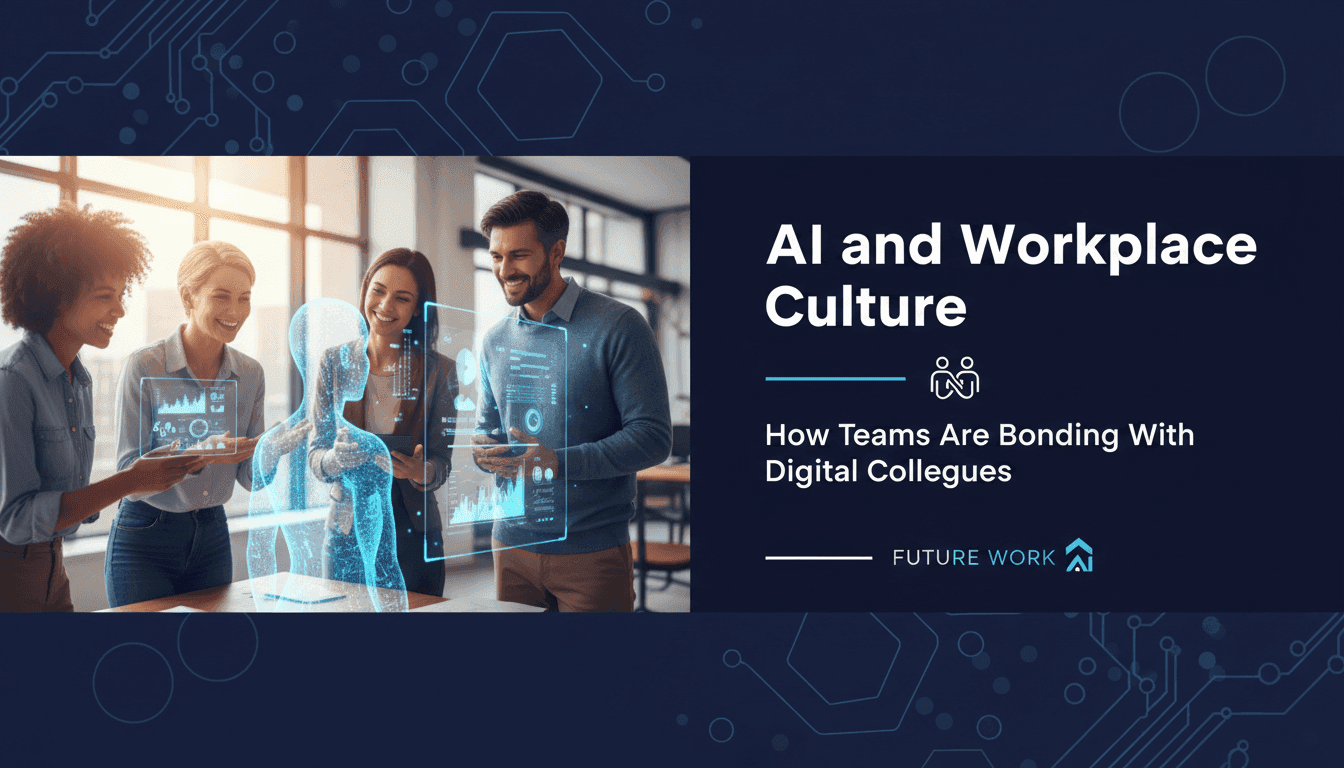
Table Of Contents
- The New Colleague in the Room
- Why Teams Naturally Bond With AI
- The Digital Colleague Paradox: Productivity Gains vs. Human Disconnection
- How AI Is Quietly Reshaping Team Dynamics
- Building a Culture That Embraces AI Without Losing Its Humanity
- Practical Steps Leaders Can Take Today
- The Road Ahead: Human-AI Teams as a Competitive Advantage
Picture a Monday morning standup. The agenda has already been summarised, action items from last week are logged, and a brief is waiting in everyone's inbox — all prepared before the first human logged on. Nobody bats an eye. This is the new normal for teams integrating AI into their daily workflows, and it raises a genuinely fascinating question: are we just using a very capable tool, or are we starting to work with a digital colleague?
The line is blurring faster than most organisations anticipated. AI and workplace culture have become inseparable topics for business leaders, HR professionals, and anyone responsible for keeping a team engaged, productive, and connected. As AI agents take on roles once filled by junior staff, coordinators, and even subject-matter experts, the social fabric of the modern workplace is being quietly rewired.
This article examines how that rewiring is happening — what the research says about why teams bond with AI, where that bonding can go wrong, and most importantly, how forward-thinking leaders can cultivate a culture where humans and digital colleagues bring out the best in each other.
The New Colleague in the Room {#new-colleague}
For decades, the idea of a digital colleague was science fiction. Today, it is a boardroom agenda item. Six in ten workers already consider AI a coworker, a statistic that would have seemed implausible just a few years ago. Tools like Microsoft Copilot, GitHub Copilot, and a growing ecosystem of AI agents are not sitting in the background processing data — they are joining meetings, drafting communications, flagging risks, and in some organisations, assigning tasks.
When AI entered the workplace, many believed it could reshape teamwork as profoundly as it boosted individual productivity. By 2025, however, AI was used mainly to accelerate individual tasks such as coding, writing, and documentation — yet it reshaped collaborative culture: efficiency became a norm, transparency and responsible use became markers of professionalism, and AI was increasingly accepted as part of teamwork.
The shift is significant. Organisations are no longer asking whether to integrate AI into their teams but how to do so in a way that sustains the trust, creativity, and human connection that make teams truly effective.
Why Teams Naturally Bond With AI {#why-teams-bond}
There is a well-documented psychological mechanism at play when humans work alongside AI: anthropomorphism, the tendency to attribute human-like qualities to non-human entities. As artificial intelligence becomes increasingly embedded in organisational workflows, employees are more frequently required to collaborate with AI as a coworker — and research analysing data from 343 employees in AI-integrated roles revealed that both cognitive and affective anthropomorphism enhanced interpersonal closeness.
Cognitive anthropomorphism significantly fostered emotional attachment, indicating that employees' perceptions of AI's human-like cognitive qualities played an especially important role in fostering deeper relational bonds in task-intensive settings. Interpersonal closeness and emotional attachment, in turn, enhanced communication satisfaction, which subsequently drove employees' intention to continue working with AI.
In plain terms: when AI behaves in ways that feel thoughtful and contextually aware, people stop thinking of it purely as software. AI has shifted human-machine interaction from traditional instrumental operational relationships toward more complex cognitive-emotional interactions. This is not irrational sentimentality. It is a natural extension of how humans are wired to relate to anything that responds, adapts, and appears to understand them.
More and more employees are turning to AI and AI chatbots — rather than coworkers — for personal support, including career advice and emotional validation. Studies also found that employees treat AI tools like humans, using human-like terms to describe chatbots and polite language when interacting with them. These patterns point to something deeper than mere tool usage. They signal the emergence of a genuine working relationship, however asymmetrical it may be.
The Digital Colleague Paradox: Productivity Gains vs. Human Disconnection {#digital-paradox}
Here is where the story gets complicated. The same AI integration that makes teams faster and more capable can quietly hollow out the human connections that sustain long-term performance and well-being.
A 2025 peer-reviewed study in Behavioral Sciences found that employee-AI collaboration in the workplace can increase feelings of loneliness, exacerbating emotional fatigue and leading to behaviors that directly erode engagement at work. This is not a fringe finding. A set of studies published in the Journal of Applied Psychology reveals that AI systems in the workplace have unintended emotional consequences of increasing loneliness and social disconnection — conducted across four countries and analysing over 794 workers who frequently interact with AI systems for work.
Interactions with AI made employees more efficient and capable of doing much more work, but at the same time left them feeling lonely. The more employees collaborated with AI, the more they felt socially deprived as work took over their entire day — awakening a strong human desire to connect with others at work.
Perhaps most telling is the data on social support: an astounding 74% of survey participants reported using AI for at least one form of social support — yet only 12% said using it made them feel less lonely while working, implying that encouraging greater use of AI is unlikely, on its own, to reduce loneliness for most employees.
The business consequences are stark. Highly lonely employees reported 27% lower job satisfaction and a 90% greater intention to quit their jobs than those low in loneliness. And in evaluating the factors that predicted satisfaction and turnover intentions, one pattern became clear: employees' relationships with their coworkers affected them more than anything measured related to AI, including using AI for social support.
For leaders and HR teams, this is a critical signal. AI may be doing more work, but it is not doing the relational work that keeps people invested in their teams and organisations.
How AI Is Quietly Reshaping Team Dynamics {#reshaping-dynamics}
Beyond individual well-being, AI integration is reconfiguring how teams operate at a structural level. While AI tools have increased individual productivity, they have not significantly improved overall organisational efficiency or collaboration, with 96% of companies reporting no dramatic gains. The implication is that individual productivity gains can mask a collective coordination problem — teams getting faster in silos while growing further apart as a unit.
Introducing a digital coworker does not just turbocharge workflows — it also scrambles workplace power dynamics. AI tools can assign tasks, escalate issues, and nudge team members toward deadlines. This shift can upend the traditional hierarchy, elevating those comfortable with technology and sidelining others.
While digital intelligence systems enhance efficiency, transparency, and coordination, they may also weaken interpersonal bonds and expand psychological distance. This psychological distance is particularly pronounced in remote and hybrid environments, where the spontaneous corridor conversations and informal bonding moments that once reinforced team cohesion have already been reduced.
There is also an interesting dynamic around psychological safety. Collaboration with AI reduces employees' impression management concerns, and high AI anthropomorphism mitigates this effect in human-AI collaboration. In other words, some employees find it easier to be candid, to try new ideas, and to admit uncertainty with AI than with human managers — which is valuable, but only if those same employees are also building honest relationships with their human colleagues.
Microsoft highlights "Frontier Firms" — early AI adopters that organise work around people plus AI. Their employees are far more likely to say their company is thriving (71% vs. approximately 37% globally) and able to take on more work (55% vs. approximately 20%). In daily collaboration, this looks like AI summarising long threads, drafting follow-ups, and turning meeting notes into next steps. The difference between these high-performing firms and the rest is not the AI tools themselves — it is how intentionally they are integrated into a human-centred culture.
Building a Culture That Embraces AI Without Losing Its Humanity {#building-culture}
The organisations getting this right are treating AI integration as a culture design challenge, not just a technology deployment challenge. Upskilling employees on AI tools is essential, but alone, it is not enough. A strong culture helps teams navigate change, build trust, and foster alignment as AI adoption accelerates.
Organisations must build trust not just in the technology, but in one another — creating 'safe-to-try' environments that encourage experimentation, shared learning, and open conversation. This is a fundamentally human leadership task, and it cannot be delegated to an algorithm.
Deloitte's research on AI cultural readiness points to concrete organisational practices. Singapore-based DBS Bank reimagined its culture to encourage employees to disrupt their own roles, experiment, and drive automation and digitisation — with employees earning recognition and reward points for contributing to transformation initiatives or participating in digital experimentation teams and hackathons. This approach does something clever: it makes AI adoption a shared, rewarded team activity rather than a top-down mandate that leaves people behind.
Companies can use AI integration as an opportunity for intentional connection, hosting "AI office hours" for people to collaborate, swap tips, and feel part of something bigger. Leaders should be trained not just on the tools, but on the mindset needed to drive change and adoption, as well as facilitate intentional connection — and by investing in continuous learning, mentorship, and leadership development programmes, companies can build a culture that truly learns out loud.
Practical Steps Leaders Can Take Today {#practical-steps}
Protecting and strengthening human connection in an AI-augmented workplace requires deliberate design. Here are the approaches that research and practice consistently support:
-
Design for human moments first. Start by mapping the moments that matter most — a manager's first check-in with a new starter, a mentor's mid-point reflection, a team's goal-setting session. These are the points of truth in a relationship, the times people remember, and the ones that shape culture more than policy ever could. Use AI to prepare for and follow up on these moments, not to replace them.
-
Invest in human skills alongside AI skills. Build AI fluency — knowing what AI can and cannot do, when to use it, and how to evaluate its output — while simultaneously investing in human skills such as adaptability, creativity, collaboration, communication, empathy, and judgement.
-
Treat transparency as a trust-building tool. Connection only grows where trust lives, and when it comes to AI, trust starts with transparency. People need to know when AI is being used, what data it touches, and what stays private.
-
Use AI to surface connection, not just content. AI can pair colleagues with similar interests or complementary skills for coffee chats, mentoring, or projects — helping friendships form naturally. This flips the script on AI from a force that reduces human interaction to one that actively engineers it.
-
Protect unoptimised time. Make room for real conversation. Not every interaction needs to be optimised. Sometimes the two-minute conversation before the meeting, the phone call instead of the email, or simply asking 'How are things going?' creates more organisational value than another efficiency gain.
-
Ritualise human connection. Teams can add "informal touchpoints" — such as a coffee chat call every two weeks and an annual company retreat — to keep the bonding alive. These rituals do not need to be grand; they need to be consistent.
Successful organisations that leverage AI for transformation focus on building a connected knowledge base, enabling AI-powered coordination, and integrating AI into team dynamics — with a shift towards prioritising collaboration over mere personal productivity being essential to unlock the full potential of AI investments.
The Road Ahead: Human-AI Teams as a Competitive Advantage {#road-ahead}
The question for business leaders is no longer whether digital colleagues will become part of the team. They already are. The question is whether organisations will be intentional enough about the cultural conditions that allow humans and AI to complement — rather than undermine — each other.
The emergence of AI as a 'cybernetic teammate' rather than merely another productivity tool demands fundamental rethinking of how organisations structure collaborative work. Evidence demonstrates that AI-augmented individuals can achieve performance levels previously requiring human teams, while simultaneously generating positive emotional experiences comparable to traditional collaboration.
But achieving that outcome is not automatic. Some of the time freed up by AI should be reinvested in each other. Trust, empathy, and psychological safety do not happen by accident — they are built through the everyday interactions that make people feel valued.
The organisations that will win the next decade are not those with the most AI adoption — they are those that use AI to free up human energy and then deliberately reinvest that energy in the relationships, creativity, and shared purpose that no algorithm can replicate. Getting there requires the kind of strategic, hands-on learning that goes well beyond a software subscription.
Conclusion
AI has arrived as a genuine presence in the modern workplace — not just as a background process, but as something teams are beginning to work with, rely on, and, in some cases, bond with in ways that blur the line between tool and colleague. That is both an extraordinary opportunity and a genuine cultural risk.
The research is clear: AI can accelerate individual performance, reshape how knowledge flows through an organisation, and even foster moments of psychological safety. But it cannot replace the human connections that sustain engagement, trust, and long-term organisational health. The leaders and organisations that get this right will be those who treat AI integration as a culture design challenge — one that requires the same intentionality, empathy, and continuous learning that any great team culture demands.
Digital colleagues are here. The work of building a workplace culture that benefits from them — without losing what makes teams human — starts now.
Ready to turn AI strategy into real cultural and business results?
Business+AI brings together Singapore's most forward-thinking executives, consultants, and solution providers to tackle exactly these challenges. Whether you're looking to learn alongside peers at our annual Business+AI Forum, get hands-on at our AI workshops, deepen your expertise through our masterclasses, or access tailored guidance through our consulting services — we have the resources to help your organisation integrate AI in a way that enhances, rather than erodes, your team culture.
Join the Business+AI membership community today and be part of the conversation shaping how Asia's businesses work, lead, and grow with AI.