
AI and Work-Life Balance: Does Automation Help or Hurt?
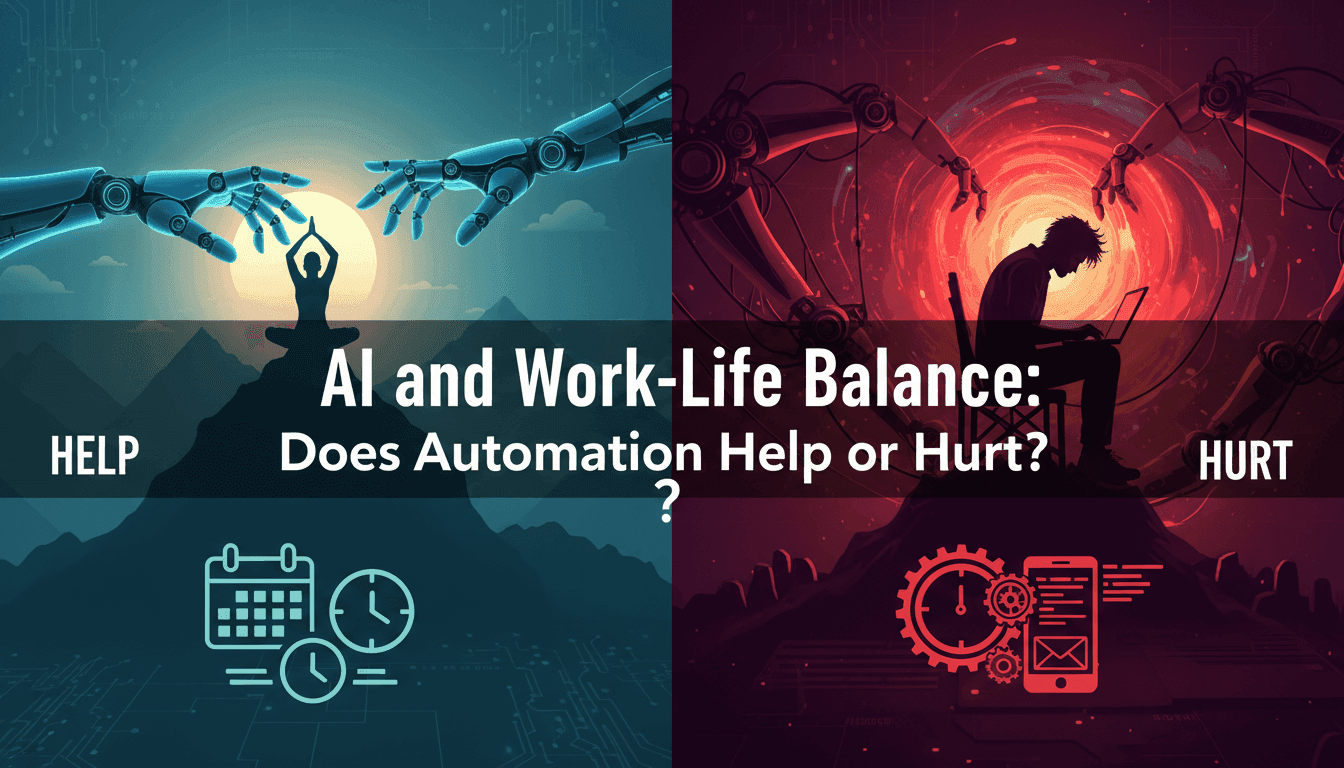
Table Of Contents
- The Promise of AI: More Time, Less Stress?
- The Reality Check: Why Automation Isn't Always Liberation
- Where AI Genuinely Improves Work-Life Balance
- The Hidden Costs: How AI Can Deteriorate Balance
- The Always-On Culture Problem
- Finding the Sweet Spot: Strategic AI Implementation
- What Leaders Must Consider Before Deploying AI
- Creating Boundaries in an Automated Workplace
- The Future of Work-Life Integration with AI
When artificial intelligence promises to automate mundane tasks and free up our calendars, the vision seems irresistible. Imagine reclaiming hours each week, delegating repetitive work to intelligent systems, and finally achieving that elusive work-life balance. Yet for every professional celebrating newfound efficiency, another struggles with AI-enabled surveillance, relentless productivity expectations, and the blurring of boundaries between work and personal time.
The relationship between AI automation and work-life balance isn't straightforward. While technology can eliminate soul-crushing administrative work, it can also create new pressures, accelerate work pace beyond sustainable levels, and enable a culture where employees are perpetually accessible. For executives and business leaders navigating digital transformation, understanding this duality is essential to building organizations that leverage AI's benefits without sacrificing employee wellbeing.
This article examines both sides of the AI and work-life balance equation, exploring where automation genuinely helps, where it creates new problems, and how organizations can implement AI strategically to enhance rather than erode the quality of work life.
AI & Work-Life Balance
Does Automation Help or Hurt?
📊 The Reality Check
✅ How AI Helps
- Eliminates soul-crushing administrative work
- Smart prioritization reduces chaos
- Enables flexible work schedules
- Protects boundaries with automation
⚠️ How AI Hurts
- Productivity ratcheting raises expectations
- Decision fatigue from endless options
- Always-on culture and notification creep
- AI-powered surveillance increases pressure
🎯 The Critical Question
Is your AI implementation designed to maximize output or enhance wellbeing?
🔑 Strategic Implementation Framework
💡 The Bottom Line
AI's impact on work-life balance isn't predetermined—it reflects the values embedded in deployment. Organizations that prioritize wellbeing alongside productivity can harness genuine quality-of-life improvements. Those focused solely on output maximization will likely see efficiency gains accompanied by burnout.
Transform AI from a productivity tool to a wellbeing enabler with strategic implementation
The Promise of AI: More Time, Less Stress?
The fundamental pitch for workplace AI has always centered on liberation from tedious tasks. Email filters that prioritize important messages, scheduling assistants that eliminate calendar Tetris, document automation that turns hours of formatting into seconds—these tools promise to give professionals their time back. And in many cases, they deliver.
Time reclamation represents AI's most tangible benefit for work-life balance. When marketing teams use AI to generate first-draft social media content, they're not creating identical final products, but they are eliminating the blank-page problem that can consume creative energy. When finance departments automate expense report processing, accountants shift from data entry to analysis—work that typically requires focused daytime hours rather than late-night catch-up sessions.
Early adopters report significant gains. A 2023 survey of knowledge workers using generative AI tools found that 64% felt they could accomplish the same work in fewer hours, while 71% reported reduced stress from repetitive tasks. These aren't marginal improvements. For professionals previously drowning in administrative overhead, AI automation can mean leaving the office at reasonable hours and genuinely disconnecting on weekends.
The appeal extends beyond individual productivity. Organizations implementing AI for customer service report that representatives handle complex, meaningful interactions while chatbots manage routine inquiries. This shift can make work more engaging and less draining, contributing to better mental health and sustainable career satisfaction. When workshops focused on practical AI implementation help teams identify which tasks to automate, the goal is exactly this type of strategic time reallocation.
The Reality Check: Why Automation Isn't Always Liberation
Yet the promised land of AI-enabled leisure hasn't materialized for most workers. Instead, many professionals find themselves working as much as ever, just differently. The problem lies not in the technology itself but in how organizations respond to newfound efficiency.
Productivity ratcheting describes what happens when efficiency gains simply raise performance expectations. If AI helps you complete reports 40% faster, many organizations won't encourage you to work 40% less—they'll expect 40% more output. The time savings evaporate as workloads expand to fill available capacity, leaving employees running faster on the same treadmill.
This phenomenon appears across industries. Legal professionals using AI research tools report that while they can analyze case law much faster, they're now expected to cover more cases simultaneously. Marketing teams that automate content creation find themselves managing more campaigns concurrently. The technology removes bottlenecks, but organizational culture fills the void with additional demands rather than improved balance.
There's also a skill shift pressure that creates its own stress. As AI handles routine tasks, the remaining human work becomes more cognitively demanding—requiring creativity, judgment, and emotional intelligence that can't be automated. While this shift can make work more meaningful, it also makes it more exhausting. The mental energy required for constant decision-making and creative problem-solving differs from repetitive task fatigue, but it's equally draining over extended periods.
Furthermore, not all professionals benefit equally. While knowledge workers with access to premium AI tools may gain efficiency, frontline workers often face AI-powered monitoring systems that increase pressure without providing autonomy. Warehouse employees tracked by AI optimization systems or customer service representatives scored by AI sentiment analysis experience automation as intensified scrutiny rather than liberation.
Where AI Genuinely Improves Work-Life Balance
Despite these challenges, specific applications of AI demonstrably improve work-life balance when implemented thoughtfully. Understanding what works helps organizations prioritize investments that genuinely benefit employees.
Administrative automation tops the list of positive interventions. Tools that schedule meetings across time zones, transcribe and summarize calls, or automatically update project management systems remove friction from collaboration without fundamentally changing work nature. These applications don't raise the performance bar—they simply eliminate irritating overhead that previously leaked into personal time.
Smart prioritization systems help professionals focus on what truly matters. AI that analyzes incoming requests, flags genuine urgencies, and filters noise can prevent the constant context-switching that makes workdays feel chaotic and incomplete. When people can identify their three critical tasks each day and trust that AI has appropriately routed everything else, they're more likely to achieve satisfying completion and mental closure at day's end.
Flexible work enablement represents another clear win. AI-powered collaboration tools that provide real-time translation, async video summaries, and intelligent handoffs between team members make it feasible for professionals to work when and where they're most effective. Parents can attend school events knowing AI tools will keep them informed of critical developments. Employees in different time zones can contribute meaningfully without requiring everyone to work odd hours.
Organizations that engage in strategic AI consulting often discover that the highest-impact applications aren't the flashiest. A simple AI system that prevents non-urgent notifications from reaching employees outside working hours can improve wellbeing more than sophisticated automation that accelerates work pace. The key lies in using AI to protect boundaries rather than just optimize productivity.
The Hidden Costs: How AI Can Deteriorate Balance
On the flip side, poorly implemented AI creates new problems that erode work-life boundaries in subtle but persistent ways. Recognizing these patterns helps organizations avoid deployment strategies that harm employee wellbeing.
Decision fatigue proliferation emerges when AI generates endless options requiring human judgment. A marketing professional might previously create one campaign concept; now AI generates ten variations, each requiring evaluation. A product manager who once reviewed three potential features now faces twenty AI-suggested possibilities. The cognitive load of constant decision-making becomes exhausting, especially when employees feel obligated to leverage every AI-generated option to demonstrate productivity.
This challenge intensifies with information overload acceleration. AI tools that promise to keep you informed can instead overwhelm you with summarized reports, trend analyses, and competitive intelligence that all seem important but collectively become impossible to process. The professional who once checked email now also monitors AI-generated insights dashboards, industry trend alerts, and automated competitor tracking—creating multiple streams demanding attention.
Surveillance and pressure represent AI's darker impact on work-life balance. When organizations deploy AI monitoring systems that track productivity metrics, keystrokes, or even analyze tone in communications, employees experience heightened stress and reduced autonomy. The knowledge that AI is constantly measuring performance makes genuine disconnection psychologically difficult, even during off-hours.
There's also a more insidious competence anxiety that automation triggers. As AI systems demonstrate impressive capabilities, professionals worry about their own relevance and feel compelled to work longer hours to prove indispensable value. This anxiety-driven overwork undermines balance even when the technology itself could reduce workload. The psychological weight of automation's implications often exceeds its practical impact.
The Always-On Culture Problem
AI's most profound challenge to work-life balance may be how it enables and normalizes constant availability. When intelligent systems can route urgent issues to you anywhere, anytime, the expectation of responsiveness intensifies.
Notification creep describes the gradual expansion of what qualifies as requiring immediate attention. AI systems designed to flag true emergencies often suffer from sensitivity calibration—either missing important issues or crying wolf so frequently that employees check everything constantly just to be safe. Over time, this conditions professionals to maintain perpetual vigilance, checking devices at dinner, before bed, and first thing upon waking.
The problem compounds with global collaboration acceleration. AI translation and scheduling tools make it feasible to work seamlessly with teams across continents, but this capability can extend working hours rather than redistribute them. When colleagues in different time zones expect responses facilitated by AI tools that make communication effortless, the traditional nine-to-five becomes meaningless. Without deliberate boundaries, professionals find themselves fielding requests around the clock.
Output expectation inflation creates a culture where good enough never suffices. Because AI enables quick iteration, stakeholders expect multiple rounds of refinement that previously would have been impractical. Documents go through endless AI-assisted revisions, presentations get perpetually optimized based on AI-analyzed feedback, and projects never truly finish—they just reach temporary states before the next improvement cycle. This perfectionism treadmill prevents the satisfaction of completion and makes detachment difficult.
Addressing these challenges requires more than individual discipline. Organizations must establish cultural norms and policies that harness AI's benefits while protecting boundaries. Masterclass sessions on responsible AI implementation often reveal that the most successful companies create explicit guidelines about communication expectations, automate boundaries rather than just work, and measure employee wellbeing alongside productivity metrics.
Finding the Sweet Spot: Strategic AI Implementation
The AI and work-life balance equation isn't predetermined. Organizations that approach automation strategically can tilt outcomes toward genuine quality-of-life improvements rather than intensified pressure.
Purpose-driven deployment starts with clarity about why you're implementing specific AI tools. The question shouldn't be "Can AI do this?" but rather "Will AI doing this improve employee wellbeing or just accelerate pace?" When the primary metric is output maximization, automation inevitably increases pressure. When the goal explicitly includes protecting personal time and reducing stress, technology choices and implementation approaches change accordingly.
This requires employee involvement in automation decisions. The professionals doing the work best understand which tasks genuinely drain energy versus which provide satisfaction. Bottom-up AI adoption, where teams identify automation opportunities that would most improve their daily experience, typically yields better balance outcomes than top-down efficiency mandates. Workers who choose their tools feel empowered rather than surveilled.
Boundary automation represents an underutilized opportunity. Rather than only automating productive work, organizations should deploy AI to protect personal time. Systems that prevent meeting scheduling outside core hours, automatically defer non-urgent communications, or even generate out-of-office responses that intelligently triage requests can create breathing room. The technology that enables constant availability can also enforce deliberate unavailability when configured with that intention.
Successful implementation also demands continuous adjustment based on wellbeing metrics. Organizations should monitor not just productivity gains but also employee stress levels, work hours, and satisfaction. When AI deployment correlates with deteriorating balance, the technology or its usage patterns need revision. This feedback loop prevents the common pattern where initial efficiency gains gradually morph into intensified expectations.
What Leaders Must Consider Before Deploying AI
Executives and business leaders bear particular responsibility for ensuring AI enhances rather than erodes work-life balance. Several critical considerations should guide deployment decisions.
Cultural prerequisites matter more than technology capabilities. Before implementing powerful automation tools, organizations need strong norms around working hours, communication expectations, and productivity measurement. Introducing AI into a culture that already glorifies overwork will simply make overwork more efficient. The technology amplifies existing values, so those values must prioritize sustainable performance over maximum extraction of effort.
Leaders should also consider equity across roles and levels. AI tools that benefit senior executives and knowledge workers but intensify pressure on frontline employees create organizational rifts and morale problems. If automation gives managers more strategic thinking time while subjecting customer service representatives to AI performance monitoring, the overall impact on workplace culture will be negative despite aggregate efficiency gains.
Skill development investment becomes crucial as AI handles routine tasks. Organizations must provide time and resources for employees to develop the creative, interpersonal, and strategic capabilities that complement automation. When workers fear AI replacement without seeing clear paths to valuable new contributions, anxiety undermines any time savings the technology provides. Professional development becomes part of work-life balance strategy, not separate from it.
There's also a need for transparency about automation's purpose and limits. When organizations deploy AI monitoring or optimization systems without clear communication about what's being measured and why, employees assume the worst. Conversely, involving teams in understanding how AI works, what decisions it influences, and where humans retain control reduces anxiety and helps people feel like technology users rather than subjects.
For executives looking to navigate these complexities, forums that bring together business leaders, AI consultants, and solution vendors provide valuable opportunities to learn from peers facing similar challenges and discover implementation approaches that balance productivity with wellbeing.
Creating Boundaries in an Automated Workplace
Beyond organizational policy, individuals need strategies for maintaining work-life balance as AI becomes ubiquitous in professional environments. These approaches work best when supported by company culture but remain valuable even in less-than-ideal organizational contexts.
Selective AI adoption gives you control over which aspects of your work to automate. Just because a tool exists doesn't mean you must use it, especially if it creates more complexity than it resolves. Professionals should evaluate AI tools based on whether they reduce cognitive load and protect personal time, not just whether they're cutting-edge. Sometimes declining to adopt every new system preserves mental bandwidth for what matters.
Time blocking with automation support leverages AI scheduling tools not to pack calendars fuller but to protect focus time and personal boundaries. Use automation to enforce periods where you're unavailable for meetings, to batch similar tasks together, and to create buffers between intense work sessions. The same technology that can enable constant availability can also defend deep work and genuine off-hours.
Notification governance represents perhaps the most critical individual action. Configure AI tools and communication systems to align with your boundary intentions. Set aggressive filters, establish quiet hours where only true emergencies break through, and regularly audit what's demanding your attention. The default settings of most AI-powered tools assume you want maximum information flow; deliberately constraining this flow is essential.
Output quality standards help prevent perfectionism spirals enabled by AI iteration tools. Decide in advance what "good enough" looks like for different types of work, and resist the temptation to endlessly refine just because AI makes revision easy. The ability to generate ten variations doesn't mean you should evaluate all ten—sometimes accepting the third good option and moving on preserves energy for higher-value activities or personal time.
Finally, regular technology audits help identify when tools that once helped have become burdensome. Every few months, review which AI systems you're using, whether they still serve your wellbeing, and which might be creating more stress than value. Technology relationships should be dynamic, with permission to abandon tools that no longer serve you.
The Future of Work-Life Integration with AI
Looking ahead, the relationship between AI and work-life balance will likely become more nuanced rather than resolving into clear help or harm. Several emerging patterns deserve attention.
Personalized AI assistants that learn individual work patterns and preferences could theoretically optimize not just productivity but also energy management and boundary protection. Imagine AI that knows you're most creative in the morning and automatically schedules generative work then, or that detects signs of burnout in your calendar patterns and suggests corrective actions. The same personalization that enables targeted advertising could support holistic wellbeing if designed with that intention.
AI-mediated asynchronous collaboration may reduce the meeting proliferation that consumes so many professional hours. Tools that intelligently summarize discussions, track decisions, and enable meaningful contribution without real-time presence could make flexible work genuinely flexible rather than just shifting where you attend video calls. This evolution depends on organizations valuing outcomes over presence, but the technology increasingly enables that cultural shift.
However, augmentation anxiety will likely intensify as AI capabilities expand. The question of what work remains distinctly human becomes more pressing, creating psychological pressure even when practical job security exists. Organizations will need to address the emotional and existential dimensions of automation, not just the operational aspects.
There's also potential for regulatory intervention as the relationship between AI monitoring and worker wellbeing gains attention. Some jurisdictions are already considering limitations on AI-powered workplace surveillance or requirements for algorithmic transparency. These developments could establish boundaries that individual workers and even well-intentioned companies struggle to maintain independently.
Ultimately, AI's impact on work-life balance will reflect the values we embed in its deployment. The technology is powerful but directionally neutral—it can liberate time or colonize it, reduce stress or intensify pressure, enable flexibility or demolish boundaries. The outcomes depend on conscious choices by organizations, leaders, and individuals about what kind of work life they want to create.
So does AI automation help or hurt work-life balance? The honest answer is both, depending entirely on how thoughtfully it's implemented and governed. The technology itself is simply capability—it can eliminate soul-crushing administrative work or accelerate expectations beyond sustainable levels, protect personal boundaries or enable invasive monitoring, create flexibility or demand constant availability.
The distinguishing factor isn't the sophistication of the AI but the intention behind its deployment. Organizations that implement automation primarily to maximize output will likely see efficiency gains accompanied by deteriorating employee wellbeing. Those that explicitly prioritize work-life balance in their AI strategy, measure success partly by employee experience, and involve workers in automation decisions can harness genuine quality-of-life improvements.
For individual professionals, navigating AI-enabled workplaces requires active boundary-setting, selective tool adoption, and regular evaluation of whether technology serves your wellbeing or undermines it. The default trajectory of most AI systems leans toward intensification unless deliberately configured otherwise.
The conversation about AI and work-life balance is ultimately about what kind of future we're building. Technology gives us choices, but realizing the positive possibilities requires conscious effort, cultural change, and sometimes the courage to prioritize human wellbeing over maximum efficiency. The tools are becoming more powerful; the question is whether our wisdom in deploying them can keep pace.
Transform AI from Productivity Tool to Wellbeing Enabler
Navigating AI implementation in ways that genuinely improve work-life balance requires strategic thinking, practical frameworks, and peer insights from leaders facing similar challenges. Business+AI membership connects you with the executive community, consultants, and solution vendors helping organizations across Singapore and the region deploy AI thoughtfully. Gain access to hands-on workshops, exclusive masterclasses, and the annual Business+AI Forum where the conversation goes beyond productivity to explore sustainable, human-centered AI transformation. Join the ecosystem turning AI potential into tangible business gains without sacrificing what matters most.