
AI and Entrepreneurship: How Small Teams Build Big Companies
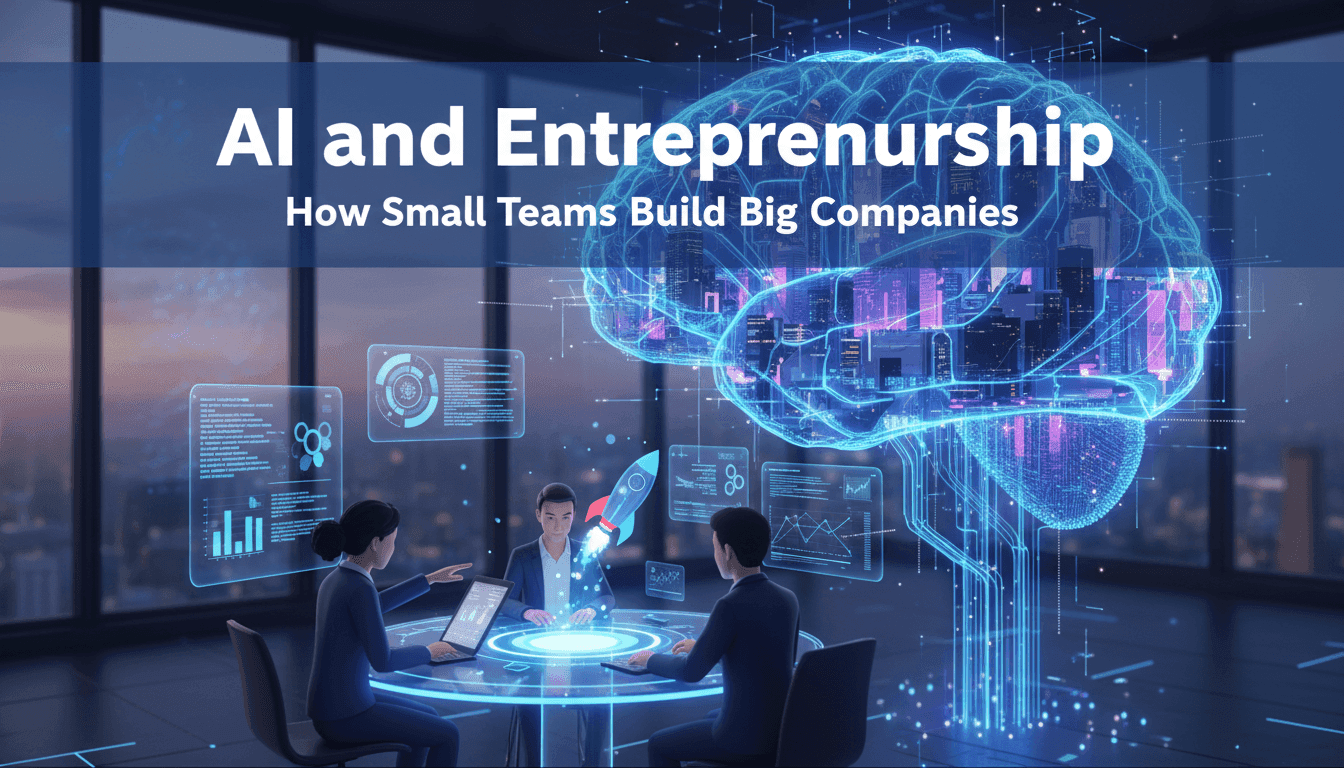
Table Of Contents
- The New Math of Entrepreneurship
- Why Small Teams Now Have a Structural Advantage
- Real-World Proof: Lean Teams, Outsized Results
- The Five Business Functions AI Changes First
- The Hidden Risks: Where Lean AI Startups Stumble
- Building an AI-First Culture from Day One
- What This Means for Entrepreneurs in Asia
- Your Next Step
AI and Entrepreneurship: How Small Teams Build Big Companies
Not long ago, building a serious company meant raising serious capital, hiring aggressively, and managing the complexity that came with size. That playbook is being rewritten — and the rewrite is faster than most executives expected.
AI is no longer a productivity add-on for the teams that can afford it. It has become the structural reason why a three-person founding team can today compete with a division fifty times its size. The economics of starting and scaling a business have fundamentally shifted, and the data behind that shift is striking.
This article explores exactly what is changing, why it matters for founders and business leaders, and how you can position your team to take full advantage of this moment — whether you are building from scratch or rethinking how your existing company operates.
How Small Teams Build
Big Companies with AI
The economics of starting and scaling a business have fundamentally shifted. Here's the data behind the change.
The Cost to $1M Revenue Has Collapsed
AI has slashed the cost to reach $1M ARR by up to 80%, making more businesses bootstrappable and fundable.
Size Is No Longer a Moat
AI agents replace workflows that once required dedicated hires, letting lean teams outpace larger competitors in speed.
Top AI Startups Earn 6× More Per Head
The top 10 AI startups average $3.48M revenue per employee — nearly 6× leading SaaS companies.
Culture Determines Whether AI Sticks
An AI-first mindset — embedded from day one — turns AI from a shiny object into a daily performance habit.
95% of AI Pilots Fail to Deliver ROI
The winners redesign workflows around AI — not just adopt tools. Execution, not technology, is the differentiator.
Product & Engineering
+21% tasks completedMarketing & Content
+$47K avg. revenue liftCustomer Support
80% routine tasks autoAdmin & Operations
5.6 hrs saved/weekMarket Intelligence
Predictive forecastingMidjourney
$2.1M per person
Cursor (Anysphere)
$3.9M per person
Top AI Startups
6× vs. SaaS peers
10/100/3 Vision
in 3 years (BGV framework)
Don't automate broken processes. Fix the workflow before layering AI on top of it — or you just move faster in the wrong direction.
Depth beats breadth. Avoid chasing every new tool. Master one system before adding another — scattered adoption delivers scattered results.
Never remove human oversight from customer comms. A single tone-deaf AI reply can cost trust that took months to earn.
Governance gaps create risk. 78% of AI users bring their own tools; only 49% of firms have a usage policy. Draft yours early.
Ready to Turn AI Ambition into Business Results?
Business+AI is Singapore's leading ecosystem for executives and entrepreneurs building AI-powered companies. Join the community, attend workshops, and get expert guidance tailored to your business.
Join the Business+AI Community →The New Math of Entrepreneurship {#new-math}
For decades, a startup's ambition was roughly proportional to its headcount. More people meant more output, more coverage, more scale. That relationship is breaking down.
The barriers to starting and running a business have been declining for years thanks to advances in cloud computing, e-commerce infrastructure, and freelance platforms. But the new crop of AI tools is now compressing the time, cost, and expertise required to build something significant, and in doing so, beginning to redraw the economics of entrepreneurship. What was once a gradual erosion of overhead has become a step-change in what a small team can realistically produce.
Businesses started in 2024 in AI-enabled industries are operating with fewer employees in their first year than those founded in 2023. At 12 months post-founding, 2024 cohorts have approximately 6% lower headcount on average. That might sound modest until you pair it with the next data point: at the same time that new businesses are getting smaller, business formation is also surging, potentially leading to overall net job growth. Fewer people per company, but more companies overall — and more of them viable.
The cost side of the equation is shifting just as dramatically. AI has significantly reduced the cost of reaching $1 million in revenue, from $1 million down to just one-fifth of that, with further declines expected. For founders, that compression is not just convenient — it is transformational. It changes what is fundable, what is bootstrappable, and what is worth attempting at all.
Why Small Teams Now Have a Structural Advantage {#structural-advantage}
Size used to be a moat. Large companies could afford the specialists, the infrastructure, and the redundancy that small ones could not. AI is dissolving that moat from below.
Founders say they are using AI agents or coding tools to automate the workflows that would once have required dedicated hires, replacing both the labor of individuals and some of the expertise those roles carried. This is not about doing the same things with fewer people. It is about restructuring which tasks require human judgment at all.
Venture firm Core Innovation Capital estimates that in 2025, a single AI-savvy engineer can achieve the output of more than five traditional coders using AI tools. This means a 5-engineer startup can do the work of 25 in old-school mode. With such leverage, lean teams build enterprise-ready products on seed-stage budgets.
Small teams also benefit from something larger organizations struggle to replicate: speed. In the fastest agent-era teams, more time is spent deciding and less time documenting. One approach is to use AI to eliminate lengthy proposal documents — when someone has a new idea, they use AI to prototype it fast, then the team plays with it and makes a go/no-go decision in an hour. A 200-person company running quarterly planning cycles cannot match that tempo.
AI-driven teams achieve scale without the scaling pains. Rather than hiring a dozen analysts, a startup might implement an AI system that analyzes data overnight and provides actionable insights each morning. Rather than outsourcing customer support, a lean team can deploy an AI chatbot that handles common inquiries 24/7. This approach aligns with the ethos of 'scale output, not headcount.' It means growth is no longer strictly tied to adding bodies; instead, growth comes from adding intelligence.
Real-World Proof: Lean Teams, Outsized Results {#real-world-proof}
The historical benchmarks for lean-team success — Instagram's 13 employees at a $1 billion acquisition, WhatsApp's 55 employees at a $19 billion deal — are well known. What has changed is that these outcomes are no longer exceptions. AI is dramatically accelerating this trend and making it feasible across a much wider range of industries.
Look at the current generation of AI-native companies. Midjourney generated $300M in revenue in 2024 with only 142 employees, translating to $2.1M per person. Anysphere, the AI coding company behind Cursor, posted $78M in year one with a 20-person team, or $3.9M per employee. The startup behind the coding assistant Cursor achieved an impressive $100 million ARR with just 20 team members.
The top 10 AI startups average $3.48M in revenue per employee, nearly six times the average among other leading SaaS companies. Revenue per employee is becoming a more meaningful performance metric than total headcount — and lean AI teams are redefining what a good number looks like.
Beyond the headline numbers, the structural pattern matters. These companies tend to reach profitability early. Core VC observes that today's AI startups often show meaningful sales before heavy fundraising, whereas 2010s tech relied on extended burn. The '10/100/3' framework from Benhamou Global Ventures illustrates this shift: they envision startups hitting $100M in ARR with just 10 people in 3 years.
The Five Business Functions AI Changes First {#five-functions}
Not every part of a business is equally ready for AI leverage. In practice, the highest-impact, fastest-return areas fall into a consistent set of functions.
1. Product Development and Engineering AI coding assistants compress the gap between idea and working product. A 2025 Faros AI study of 10,000-plus developers found teams with high AI adoption completing 21% more tasks. For a lean founding team, that acceleration on the most expensive and time-consuming part of the business is where AI delivers the most immediate value.
2. Marketing and Content Instead of hiring a ten-person support desk, a lean AI startup deploys an assistant that resolves most routine tickets automatically. Instead of a full marketing department, one founder uses AI to draft, test, and personalize campaigns overnight. The average annual revenue increase from AI marketing automation is $47,000 per HubSpot 2025 research across 2,400 surveyed businesses, with the top quartile seeing $120,000 or more.
3. Customer Service and Support AI-powered chatbots can handle up to 80% of routine tasks and customer service, according to a report by IBM. For a five-person team that cannot staff a support queue around the clock, that capability is not optional — it is what makes the business viable.
4. Administrative and Operational Workflows Administrative automation is one of the fastest-growing uses of AI among small businesses, and with good reason. Saving time and money — both the owner's and employee's time — is translating into cost savings, productivity gains, and allowing teams to focus on 'high value' work that boosts growth, competitiveness, and revenue. Small business workers save an average of 5.6 hours per week using AI tools. Business owners and managers save 7+ hours per week on average.
5. Decision-Making and Market Intelligence Predictive analytics leverages historical data to forecast future outcomes, enabling startups to make informed strategic decisions. By processing vast amounts of data quickly, AI tools can identify trends and patterns that might not be obvious through traditional methods, allowing teams to more accurately predict market demand and tailor their offerings accordingly.
The practical takeaway: the typical small business is now using a median of five AI tools, which reflects a growing 'stack' approach where tools serve different functions across the enterprise. The question for any founder is not whether to build that stack, but how deliberately to design it.
The Hidden Risks: Where Lean AI Startups Stumble {#hidden-risks}
The opportunity is real, but the failure rate among AI initiatives should temper any uncritical enthusiasm. Most AI projects fail to deliver a return, and the reason is execution, not the technology. MIT's NANDA research found about 95% of enterprise generative AI pilots delivered no measurable profit-and-loss return, with only about 5% achieving rapid revenue gains.
The pattern among the businesses that do see results is consistent. The winners are doing something specific. McKinsey found only 39% of organizations report enterprise-level earnings impact from AI, and the roughly 6% who are high performers are nearly three times as likely to have redesigned their workflows around AI. Buying a tool and expecting transformation is not a strategy. Redesigning how work is done around the tool is.
There are also category-specific constraints. Certain industries still require significant resources and manpower. Biotech and pharma drug development involves years of R&D, clinical trials, and regulatory approvals, requiring large, specialized teams. Manufacturing and hardware produce physical goods that demand factories, supply chains, and logistics teams, making a fully lean model less realistic.
Lean AI is powerful, but a few errors consistently undermine it. First, do not automate a broken process — fix the workflow before layering AI on top of it. Second, avoid chasing every new tool; depth beats breadth, so master one system before adding another. Third, never remove human oversight entirely from customer-facing communication, because a single tone-deaf AI reply can cost trust that took months to earn.
Governance matters too, even at the earliest stages. 78% of AI users bring their own tools, and only 49% of firms have a policy governing AI use. For a small team moving fast, that gap creates legal and reputational exposure that can be closed cheaply with a short internal AI policy and an approved-tools list.
Building an AI-First Culture from Day One {#ai-first-culture}
Tools matter, but culture determines whether they stick. To fully realize the promise of AI, startups need to weave it into their culture from day one. An AI-first culture means everyone — from the founder to the newest hire — continually asks: 'How can we leverage AI to do this better?' It involves encouraging experimentation with new AI tools, sharing success stories internally, and upskilling employees to become confident AI practitioners. This cultural mindset turns AI from a shiny object into a daily habit.
Leadership sets the tone here in a way that cannot be delegated. As Sharat Raghavan, Economist and Director of Research at LinkedIn, put it: 'AI has moved from a tool to a strategic asset for small businesses aiming to stay resilient and grow in 2026. By adopting AI, businesses can streamline operations, reduce costs, and accelerate decision-making, creating space for innovation and relationship-building.'
At the same time, the best lean AI teams are careful about where AI ends and human judgment begins. Nearly 75% of small business owners agree that audiences today don't just take information at face value — they gut-check it with people they trust. Embracing authentic voices can enhance a company's credibility and build lasting relationships with communities and customers. Small business owners recognize that human relationships matter more than ever in the AI age.
The companies pulling ahead are those that treat AI as a team member to be managed, not a switch to be flipped. In high-performing lean teams, everyone in the company uses a large number of AI tools. The development team sends task targets to AI programming assistants and achieves a very high completion rate. That level of integration requires deliberate onboarding, clear expectations, and ongoing refinement — not just a subscription.
What This Means for Entrepreneurs in Asia {#asia-entrepreneurs}
The lean AI startup model is not confined to Silicon Valley. Capital and compute have historically been the gap between founders in Asia and Silicon Valley startups. If model access is now a commodity, the remaining differentiators are distribution, workflow depth, and problem choice — all of which a lean Asian team can compete on.
For business leaders and entrepreneurs across Singapore and the broader region, this creates an inflection point. The cost of accessing frontier AI tools is close to equivalent across geographies. The advantage now goes to the teams that understand how to deploy them strategically — in their specific industry, with their specific customers, against their specific competitive landscape.
Ambitious entrepreneurs are increasingly turning to AI to drive growth, innovation, and efficiency. They have used AI to compete with major players, showing that small teams can achieve outsized impact. In a market where knowing how to use AI is the differentiator — not access to it — the premium is on practical knowledge, peer networks, and implementation support.
Your Next Step {#next-step}
The shift from large-team to lean-AI operation is not coming. It is already here, and the data is unambiguous: small, well-equipped teams are generating revenue per employee that would have seemed implausible five years ago, reaching profitability earlier, and outpacing much larger competitors in speed of execution.
But the gap between adopting AI tools and extracting real business value from them is still wide. The companies pulling ahead are not simply using more AI — they are designing their operations, workflows, and cultures around it. That takes more than a subscription. It takes the right thinking, the right frameworks, and the right peer group.
For founders and business leaders who are serious about making this transition, the work begins with practical knowledge and community — learning from those who have already navigated the implementation challenges and built the systems that actually scale.
Ready to turn AI ambition into business results?
Business+AI is Singapore's leading ecosystem for executives, entrepreneurs, and teams building AI-powered companies. Whether you are exploring your first AI implementation or scaling a lean operation, we offer the community and the tools to move from theory to traction.
- 🎯 Connect with peers and solution partners at our Business+AI Forums
- 🛠️ Develop practical AI skills through our Hands-On Workshops
- 🎓 Deepen your strategic thinking with our Masterclasses
- 💡 Get expert guidance tailored to your business through AI Consulting