
AI and Creativity: Does Automation Kill Innovation or Amplify It?
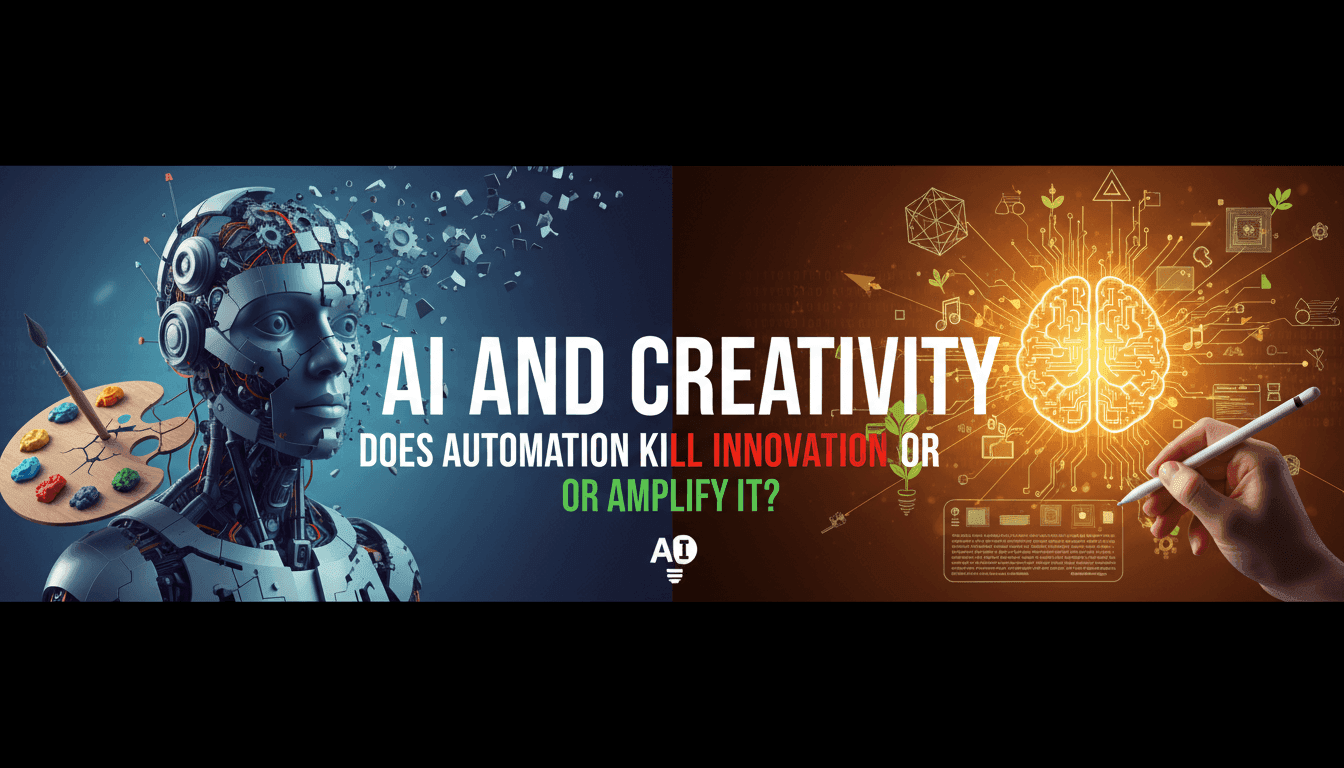
Table Of Contents
- The Great Debate: Automation vs. Human Creativity
- Understanding the AI-Creativity Paradox
- Where AI Falls Short: The Irreplaceable Human Elements
- Where AI Excels: Amplifying Creative Potential
- Real-World Examples: AI as a Creative Partner
- The Framework: How to Use AI Without Losing Your Creative Edge
- The Future of Work: Redefining Creative Roles
- Making AI Work for Your Organization
The fear is palpable in boardrooms and creative studios alike. As artificial intelligence tools become more sophisticated, generating everything from marketing copy to product designs in seconds, a critical question emerges: Are we automating ourselves into creative obsolescence?
This anxiety isn't unfounded. We've watched AI systems compose music, write articles, design logos, and even create award-winning artwork. For business leaders evaluating AI investments, the concern cuts deeper than job displacement. It touches on something fundamental: whether the pursuit of efficiency through automation might inadvertently strip away the very innovation that drives competitive advantage.
Yet the reality is far more nuanced than the doomsday predictions suggest. The relationship between AI and creativity isn't a simple replacement story. It's a transformation narrative that requires us to reconsider what creativity means in a world where machines can generate novel outputs. This article explores whether automation truly kills innovation or whether we're asking the wrong question entirely.
AI + Creativity: The Real Story
The Verdict
AI doesn't kill innovation—it transforms where human creativity gets applied. The future belongs to organizations that combine both thoughtfully.
Where AI Excels
- Rapid ideation & iteration
- Routine creative tasks
- Pattern recognition
- Personalization at scale
Where Humans Lead
- Cultural nuance
- Strategic problem-finding
- Emotional resonance
- Judgment & taste
5-Step Framework for AI Integration
Audit Your Creative Workflows
Map where creative work happens and identify routine vs. strategic tasks
Define Human-AI Collaboration Models
Design clear handoff points between AI generation and human refinement
Establish Quality Guardrails
Implement review processes to catch AI's characteristic weaknesses
Invest in Creative AI Literacy
Train teams on AI capabilities, limitations, and effective prompting
Preserve Space for Human Creativity
Protect time for strategic thinking and breakthrough innovation
AI ≠ Creative Replacement
Creative Work Shifts Higher
Humans + Machines Win
Ready to Transform AI Talk into Results?
Join Singapore's ecosystem for practical AI business implementation
The Great Debate: Automation vs. Human Creativity
The tension between automation and creativity has historical roots that predate our current AI revolution. When photography emerged in the 19th century, painters feared obsolescence. When synthesizers arrived, musicians worried about the death of authentic music. Each technological leap sparked similar anxieties, and each time, creative fields adapted rather than disappeared.
Today's debate centers on whether AI represents a fundamentally different threat. Unlike previous tools that enhanced human capabilities, modern AI systems can generate outputs independently. A generative AI model doesn't just help a writer—it writes. It doesn't assist a designer—it designs. This autonomy makes the current moment feel distinctly different from previous technological disruptions.
However, this framing reveals a critical misunderstanding about what creativity actually involves. The common assumption equates creativity with output generation, but organizational creativity encompasses much more. It includes problem identification, context understanding, strategic thinking, taste, judgment, and the ability to connect disparate ideas in meaningful ways. When we expand our definition beyond mere production, the AI threat becomes less existential and more operational.
For businesses, this distinction matters enormously. Companies that view AI as a replacement for creative thinking will likely struggle. Those that understand it as a tool that shifts where humans apply their creative energy will find significant competitive advantages. The question isn't whether to adopt AI, but how to integrate it without diminishing the human elements that drive genuine innovation.
Understanding the AI-Creativity Paradox
Artificial intelligence exhibits a fascinating paradox: it can produce novel combinations while lacking the capacity for true originality. This contradiction lies at the heart of the automation-creativity debate and deserves careful examination.
AI systems, particularly large language models and generative tools, work by identifying patterns in vast datasets and recombining elements in ways that appear fresh. A design AI trained on millions of logos can create new variations that look professional and unique. A writing AI can produce articles on topics it has never explicitly studied by synthesizing information from its training data. These outputs are genuinely novel in the sense that they didn't exist before.
Yet this novelty differs fundamentally from human creativity in several ways. AI lacks intentionality—it doesn't create with purpose or meaning beyond the prompt it receives. It has no lived experience to draw upon, no emotional resonance with the work it produces, and no stake in the outcome. When an AI generates a marketing campaign, it doesn't understand the brand's values, the market's cultural moment, or the emotional journey you want customers to experience.
This paradox explains why some AI-generated content feels impressively polished yet somehow hollow. It can mimic the surface characteristics of creativity without possessing the deeper understanding that makes creative work resonate. For businesses, this means AI can handle certain creative tasks exceptionally well while failing spectacularly at others.
The key insight is recognizing that creativity exists on a spectrum. At one end are routine creative tasks that follow established patterns—generating product descriptions, creating standard social media graphics, or drafting routine email copy. At the other end are breakthrough innovations that challenge assumptions, reframe problems, or introduce entirely new paradigms. AI currently excels at the former and struggles with the latter.
Where AI Falls Short: The Irreplaceable Human Elements
Despite rapid advances, artificial intelligence has clear limitations when it comes to the higher-order creative functions that drive business innovation. Understanding these boundaries helps organizations deploy AI strategically rather than indiscriminately.
Contextual Understanding and Cultural Nuance
AI systems lack the cultural awareness and contextual sensitivity that human creatives bring to their work. When Starbucks wanted to expand into China, success required understanding tea culture, local gathering habits, and the social meaning of coffee shops in Chinese society. No AI could have navigated these cultural subtleties or crafted the localization strategy that made Starbucks a phenomenon in Chinese markets. This contextual intelligence—understanding the unwritten rules, the historical moment, the cultural undercurrents—remains distinctly human.
Strategic Problem Identification
Perhaps AI's greatest limitation is its inability to identify which problems deserve solving. Creativity in business often means recognizing opportunities others have missed or reframing challenges in ways that reveal new solutions. AI can optimize answers to questions you ask, but it cannot decide which questions matter most to your business. This strategic insight requires experience, intuition, and a deep understanding of your competitive landscape.
Emotional Resonance and Storytelling
While AI can generate stories, it cannot understand why certain narratives move people. It doesn't comprehend loss, triumph, belonging, or aspiration except as patterns in text. When Airbnb shifted from listing features to telling stories of belonging, that strategic creative decision required empathy and emotional intelligence that AI simply doesn't possess. The campaigns that build lasting brand connections tap into human truths that machines can recognize but not genuinely understand.
Judgment and Taste
Every creative professional knows that generating options is easier than choosing the right one. AI can produce dozens of logo variations, but selecting which one captures your brand essence while differentiating from competitors requires judgment developed through experience. This curatorial function—knowing what works and why—remains a distinctly human capability.
Where AI Excels: Amplifying Creative Potential
While acknowledging AI's limitations, ignoring its genuine creative contributions would be equally shortsighted. When deployed strategically, AI amplifies human creativity in ways that expand what's possible.
Accelerating Ideation and Exploration
AI excels at rapid iteration and exploration. Design teams at companies like Autodesk use generative design AI to explore thousands of product variations based on specified constraints. What once took weeks of manual modeling now happens in hours, allowing human designers to evaluate far more options and focus their expertise on refinement rather than initial generation. This acceleration doesn't replace creativity—it shifts creative effort toward higher-level decisions.
Handling Routine Creative Work
Every creative professional spends time on routine tasks that don't require their full capabilities. AI can handle these efficiently, freeing humans for work that genuinely needs their unique talents. A marketing team might use AI to draft initial social media posts or email variations, then apply their expertise to selecting, refining, and personalizing the best options. This division of labor makes creative teams more productive without diminishing their role.
Uncovering Non-Obvious Patterns
AI's ability to process vast amounts of information can surface patterns and connections humans might miss. Netflix's recommendation algorithms don't just match viewers to existing categories—they identify viewing patterns that inform content creation decisions. Understanding that audiences who enjoyed certain combinations of shows might appreciate specific new content types provides creative teams with insights that spark innovation.
Enabling Personalization at Scale
Previously, personalized creative work was limited by human capacity. AI enables customization that would be impossible manually. Spotify's personalized playlists, dynamically generated product recommendations, and individualized email campaigns all represent creative applications that scale beyond human capacity while maintaining relevance.
Real-World Examples: AI as a Creative Partner
The theoretical debate becomes clearer when examining how organizations actually integrate AI into creative workflows.
Coca-Cola's AI-Augmented Marketing
Coca-Cola partnered with OpenAI to integrate AI into their creative process, but not as a replacement for human marketers. Instead, they use AI to generate initial concept variations, test messaging approaches, and personalize content for different markets. Human strategists still define brand positioning, select final directions, and ensure cultural appropriateness. The result is faster campaign development without sacrificing the brand understanding that makes Coca-Cola's marketing effective.
Architecture Firms Redefining Design Processes
Architectural firms like Zaha Hadid Architects use AI-powered generative design to explore structural possibilities that human designers might not consider. The AI generates options based on environmental constraints, material properties, and aesthetic parameters. Architects then apply their expertise to select and refine the most promising directions, often discovering innovative solutions that neither human nor AI would have reached independently.
Content Teams Scaling Production
Associated Press automated routine earnings reports, freeing journalists to focus on investigative stories and analysis. The AI handles straightforward quarterly earnings announcements, while human reporters tackle the stories that require investigation, source cultivation, and narrative judgment. This partnership enabled AP to expand coverage while elevating the nature of human journalist work.
Singapore Businesses Navigating Bilingual Markets
Local companies are using AI translation and localization tools to navigate Singapore's multilingual market more efficiently. However, successful implementations pair AI translation with human cultural consultants who ensure messaging resonates appropriately across Chinese, Malay, Tamil, and English-speaking audiences. The AI handles linguistic translation; humans ensure cultural translation.
These examples share a common pattern: AI handles specific, well-defined creative tasks while humans provide strategic direction, contextual judgment, and final creative decisions.
The Framework: How to Use AI Without Losing Your Creative Edge
For organizations seeking to leverage AI while preserving innovation capacity, a structured approach helps navigate the integration process effectively.
1. Audit Your Creative Workflows
Begin by mapping where creative work happens in your organization. Identify which tasks require uniquely human judgment and which follow repeatable patterns. Marketing teams might discover that social media scheduling, initial draft creation, and image resizing are routine, while brand positioning, campaign strategy, and final content selection require human expertise. This audit reveals where AI can add value without compromising quality.
2. Define Human-AI Collaboration Models
Rather than asking whether AI or humans should handle creative work, design collaboration models that leverage both. Establish clear handoff points where AI generation gives way to human refinement. For instance, a content team might have AI generate first drafts or outline options, then have writers restructure, add insights, and refine tone. The key is maintaining human creative control over strategic decisions.
3. Establish Quality Guardrails
AI outputs require human oversight, especially for customer-facing creative work. Implement review processes that catch AI's characteristic weaknesses—generic phrasing, cultural insensitivity, factual errors, or brand misalignment. These guardrails ensure that efficiency gains don't come at the expense of quality or appropriateness.
4. Invest in Creative AI Literacy
Your creative teams need to understand AI's capabilities and limitations. This doesn't mean everyone needs technical training, but they should understand what AI can realistically do, how to write effective prompts, and how to evaluate AI-generated options critically. Organizations that invest in this literacy get better results from AI tools while avoiding over-reliance or misapplication.
5. Preserve Space for Human Creativity
Paradoxically, successfully integrating AI requires protecting time for purely human creative thinking. If AI handles routine tasks but you immediately fill that freed time with more routine work, you've gained efficiency without enhancing innovation. Build in time for your team to think strategically, explore unconventional ideas, and develop the insights that drive breakthrough innovation.
Companies participating in Business+AI workshops often discover that successful AI integration requires as much organizational change as technological implementation. The tools are available; the challenge is redesigning workflows to leverage them effectively.
The Future of Work: Redefining Creative Roles
The integration of AI into creative work isn't just changing what we do—it's transforming what it means to be a creative professional.
Traditional creative roles combined execution skills with strategic thinking. A graphic designer needed both technical Photoshop expertise and the conceptual ability to solve visual communication problems. A copywriter required writing mechanics and the strategic insight to craft persuasive messaging. As AI handles more execution, these roles are shifting toward the strategic and curatorial.
Tomorrow's creative professionals will likely spend less time producing initial drafts and more time defining creative problems, evaluating options, adding nuance, and ensuring cultural resonance. The valuable skill becomes knowing what to ask AI to create, how to refine its outputs, and when to reject its suggestions in favor of human alternatives. This shift elevates rather than diminishes creative work, but it requires different capabilities.
For organizations, this evolution presents both opportunities and challenges. On one hand, creative teams can accomplish more with the same resources. On the other, developing talent requires focusing on judgment, strategic thinking, and contextual understanding rather than just execution skills. The training and development approaches that worked for previous generations of creative professionals may need significant revision.
The Singapore context offers interesting perspectives on this transition. As a highly educated, technology-forward market, Singapore businesses are often early adopters of creative AI tools. However, the market's cultural diversity and need for nuanced communication across communities means purely automated creative work rarely succeeds. This creates a natural laboratory for human-AI collaboration where both elements remain essential.
Making AI Work for Your Organization
Translating these insights into action requires moving beyond theoretical understanding to practical implementation. Organizations succeed with creative AI when they approach integration strategically rather than opportunistically.
Start with pilot projects in areas where the risk is manageable and the potential value is clear. Rather than attempting to transform your entire creative operation overnight, identify specific workflows where AI can add value without risking brand integrity or customer relationships. A B2B company might begin with AI-assisted draft creation for internal communications before expanding to customer-facing content.
Measure both efficiency and quality outcomes. It's easy to track time saved or volume produced, but ensure you're also monitoring creative quality, brand consistency, and audience response. Some organizations discover that AI speeds up production but requires more revision time, resulting in minimal net efficiency gains. Others find that AI handles routine work well but struggles with their specific brand voice, requiring extensive human editing.
Create feedback loops between creative teams and AI tools. As teams work with AI, they develop insights about what works well and what doesn't. Capture this knowledge and use it to refine your approach. Perhaps certain types of prompts yield better results, or specific AI tools match your needs better than others. This iterative refinement transforms AI from a generic tool into a customized capability.
Most importantly, maintain focus on business outcomes rather than technological novelty. AI is valuable when it helps you serve customers better, reach markets more effectively, or innovate faster—not simply because it's cutting-edge. Keep the conversation centered on business impact rather than technological capabilities.
For organizations seeking structured guidance on this journey, exploring resources designed specifically for business AI implementation can accelerate progress. The Business+AI masterclass program helps executive teams develop frameworks for AI integration that preserve competitive advantages while capturing efficiency gains.
The Verdict: Transformation, Not Termination
So does automation kill innovation? The evidence suggests a more complex answer: it transforms innovation by changing where human creativity gets applied.
AI doesn't eliminate the need for creative thinking—it shifts creative effort toward higher-order functions like strategy, judgment, and contextual understanding. Organizations that view AI as a replacement for human creativity will likely struggle, losing the strategic insight and cultural sensitivity that drive genuine innovation. Those that integrate AI as a tool that handles routine creative work while preserving space for human judgment and strategic thinking can achieve both efficiency and enhanced innovation.
The future belongs neither to pure human creativity nor to fully automated creation. It belongs to organizations that thoughtfully combine both, leveraging AI's speed and pattern recognition while preserving the contextual understanding, emotional intelligence, and strategic vision that only humans provide.
This isn't a story about humans versus machines. It's about humans with machines versus humans without them. The companies that will thrive in an AI-augmented creative landscape are those that invest in understanding both AI's capabilities and its limitations, that redesign workflows to leverage both human and machine strengths, and that maintain focus on the business outcomes that matter rather than the technological means of achieving them.
The creative apocalypse isn't coming. But creative work is changing profoundly, and the organizations that navigate this transition thoughtfully will find themselves with significant competitive advantages over those that either resist AI entirely or embrace it uncritically.
The relationship between AI and creativity will continue evolving as these technologies advance. What won't change is the fundamental need for human judgment, strategic thinking, and contextual understanding in business innovation. The question isn't whether to use AI in creative work, but how to integrate it in ways that amplify rather than diminish your organization's innovative capacity.
This requires moving beyond the binary thinking that frames AI as either savior or threat. It demands thoughtful experimentation, honest assessment of results, and willingness to redesign workflows around human-AI collaboration rather than human replacement.
For business leaders navigating this transformation, the path forward involves education, experimentation, and strategic integration. Understanding AI's capabilities and limitations, testing applications in low-risk environments, and building organizational capabilities around effective human-AI collaboration will separate the organizations that thrive from those that struggle.
The future of business creativity isn't human or machine. It's human and machine, thoughtfully combined to achieve what neither could accomplish alone.
Ready to Transform AI Talk into Business Results?
Navigating the intersection of AI and business innovation requires more than theoretical understanding. It demands practical frameworks, hands-on experience, and connection with others facing similar challenges.
Business+AI brings together executives, consultants, and solution vendors who are actively implementing AI in creative and strategic business functions. Through our ecosystem, you'll gain access to practical workshops, expert consulting, and a community of practitioners who have navigated the challenges you're facing.
Whether you're taking your first steps with creative AI tools or refining sophisticated implementations, our membership program provides the resources, connections, and expertise to accelerate your journey. Join business leaders who are turning AI potential into competitive advantage.
Explore our upcoming forums where you can learn from real implementations, ask questions to practitioners who've faced similar challenges, and discover approaches that work in Singapore's unique business environment.