
AI Agents vs Chatbots: Why the Distinction Matters for Your Business
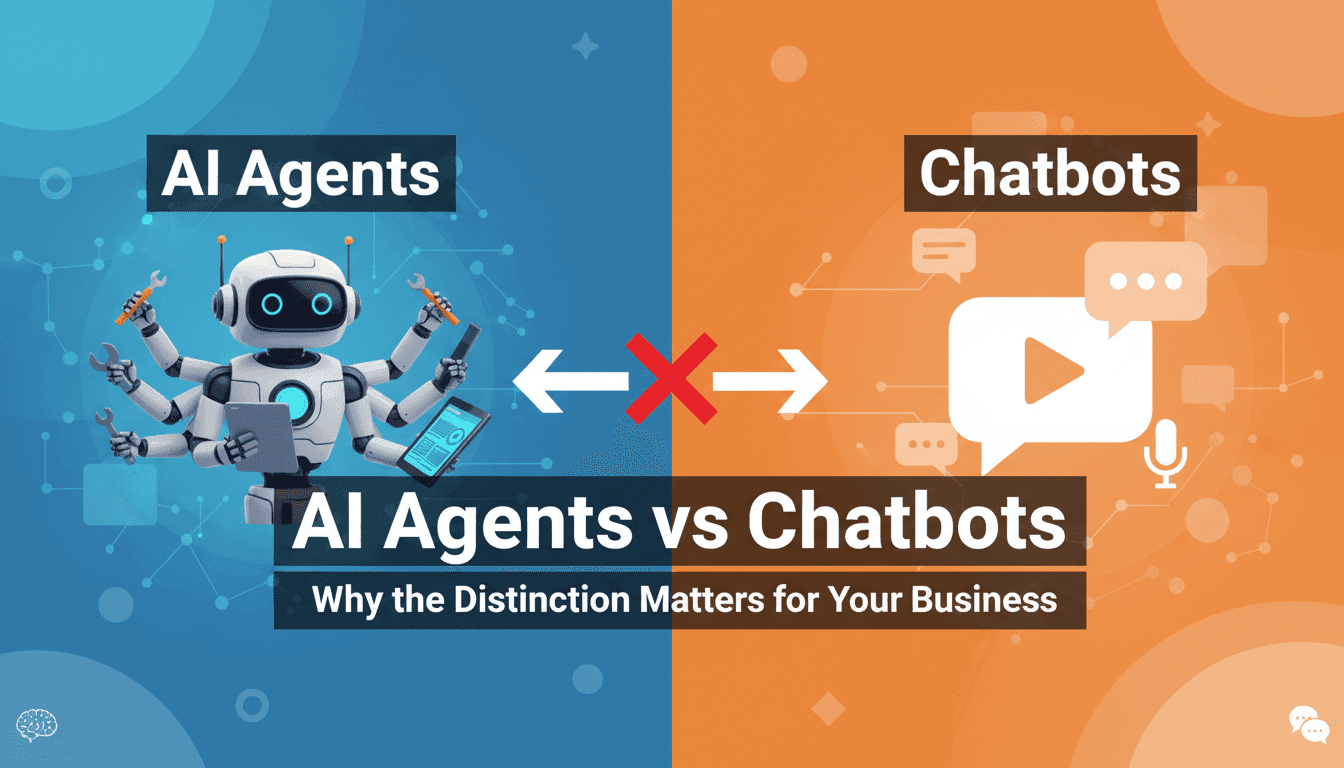
Table Of Contents
- The Confusion Is Costing Businesses Real Money
- What Is a Chatbot, Really?
- What Is an AI Agent?
- The Core Differences That Change Everything
- Why This Distinction Matters for Your Business Strategy
- Real-World Examples: Chatbot vs. Agent in Action
- The 'Gen AI Paradox' and Why Most Companies Are Stuck
- How to Decide What Your Business Actually Needs
- The Road Ahead: Where AI Agents Are Taking Business
AI Agents vs Chatbots: Why the Distinction Matters for Your Business
Walk into any boardroom in Singapore right now and you'll hear two things said with equal confidence: 'We have AI' and 'We're not seeing results from AI.' Both statements are usually true — and the gap between them often comes down to one misunderstood distinction: the difference between a chatbot and an AI agent.
These terms get used interchangeably in vendor pitches, conference talks, and technology roadmaps. But they describe fundamentally different tools with fundamentally different business implications. Deploying a chatbot when you need an AI agent is a bit like installing a speed bump when you needed a highway — it's not just insufficient, it actively shapes how the rest of your organisation thinks about what AI can do.
In this article, we break down what chatbots and AI agents actually are, where each belongs in your business, and why getting this distinction right is one of the most important strategic decisions you can make in 2025.
What Is a Chatbot, Really? {#chatbot-definition}
Chatbots have been around for decades, but the term still causes confusion because it covers a wide range of tools. At the most basic level, a chatbot is a software application designed to simulate conversation — responding to user inputs through text or voice using predefined rules, decision trees, or, in more modern versions, natural language processing (NLP).
The original chatbots were entirely rule-based: if a user typed a certain phrase, the bot would return a scripted response. Think of the automated phone menus we all navigated before smartphones made them feel obsolete. Modern chatbots are more sophisticated, using large language models (LLMs) to understand intent and generate human-like replies. But despite this evolution, the defining characteristic of a chatbot remains: it waits for you to ask it something, then it answers. It is, at its core, a reactive system.
Chatbots excel in specific, well-defined environments. They can handle high volumes of FAQs, guide users through standard processes like password resets or return policy enquiries, and provide 24/7 availability for routine support. For a customer who messages at 11pm asking about delivery times, a chatbot delivers real value — consistent, immediate, and scalable. The limitation isn't that chatbots are unsophisticated. The limitation is that they are bounded by what they were trained to respond to and the systems they have access to.
What Is an AI Agent? {#agent-definition}
An AI agent is something fundamentally different. Where a chatbot responds, an agent acts. An AI agent is a goal-driven system that can plan, reason, and take autonomous action to complete a task — without needing a human to prompt every step.
Under the hood, an AI agent combines an LLM with memory, planning capabilities, tool integrations, and orchestration logic. This allows it to interpret a high-level objective, break it into sub-tasks, query the right systems, make decisions based on real-time data, execute workflows across multiple platforms, and adapt when things change — all in a single continuous loop. The agent doesn't just retrieve an answer; it connects to your CRM, your order management system, your inventory database, and your communication tools to actually do something about the situation.
Consider a concrete example. A customer asks about a delayed order. A chatbot finds the relevant FAQ and replies, 'Your order may take 3–5 business days.' An AI agent checks the live order status, identifies that the shipment is stuck at customs, cross-references your returns policy, proactively emails the customer with an update, flags the issue to your logistics team, and logs everything in the CRM — without anyone asking it to do any of those things. That is the difference between answering and acting.
The Core Differences That Change Everything {#core-differences}
Understanding the distinction between chatbots and AI agents requires looking at several dimensions simultaneously. Here is how they compare across the capabilities that matter most for business:
Autonomy and Initiative Chatbots are reactive — they respond to user inputs. AI agents are proactive — they can initiate tasks, monitor systems, and trigger workflows without being prompted. This shift from reactive to proactive is arguably the most significant leap in practical AI capability.
Memory and Context Most chatbots handle each conversation as a standalone interaction. They lack persistent memory across sessions. AI agents maintain context over time, learning from previous interactions and using that information to personalise future responses and actions.
System Integration Chatbots typically draw from a predefined knowledge base — a help centre, a FAQ document, or a scripted flow. AI agents synthesise information across knowledge bases, CRM systems, inventory platforms, financial tools, and connected business systems. They don't just retrieve; they read and write across your entire operational stack.
Task Complexity Chatbots handle narrow, well-defined queries. AI agents manage multi-step workflows involving multiple decisions, actors, and systems. They can coordinate parallel processes, adapt to exceptions, and escalate only when genuinely necessary.
Learning and Adaptation Chatbots require manual updates to their scripts and conversation flows whenever something changes. AI agents learn and improve through feedback loops, becoming more accurate and efficient over time without requiring constant human intervention.
Why This Distinction Matters for Your Business Strategy {#business-strategy}
The reason this distinction carries strategic weight is that most organisations have made significant investments in chatbots under the impression they were investing in AI. The results have been underwhelming — and the McKinsey research is unambiguous about why: nearly 80% of companies are using generative AI in some form, but roughly the same proportion report no material impact on their bottom line.
This is what McKinsey calls the 'gen AI paradox' — and at the heart of it is an over-reliance on horizontal, chatbot-style tools that deliver diffuse, hard-to-measure productivity improvements, while higher-impact, function-specific use cases (exactly the type that AI agents unlock) remain stuck in pilot mode.
For business leaders in Singapore and across Asia Pacific, this gap presents both a risk and an opportunity. The risk is continuing to invest in tools that won't move your P&L. The opportunity is that the organisations which make the shift to agentic AI now — embedding agents into core business processes rather than bolting chatbots onto existing workflows — will build a structural competitive advantage that compounds over time.
According to PwC's 2025 survey of 300 senior executives, 88% plan to increase AI-related budgets specifically because of agentic AI. Yet the same research reveals a critical nuance: broad adoption of AI agents doesn't always equal transformation. Many businesses are using agentic features to speed up routine tasks without fundamentally rethinking how those tasks should be done.
The real value from AI agents doesn't come from inserting them into legacy workflows. It comes from redesigning those workflows around what agents make possible — parallel execution, real-time adaptation, elastic capacity, and deep personalisation at scale. That's a strategy conversation, not just a technology decision. If your team is working through this kind of transformation, Business+AI's consulting services are designed specifically to help organisations translate AI potential into business outcomes.
Real-World Examples: Chatbot vs. Agent in Action {#real-world}
Abstract distinctions only go so far. Here is how the chatbot-to-agent difference plays out in practice across common business functions:
Customer Support A chatbot answers FAQs, confirms business hours, and routes tickets to a human agent. An AI agent triages the incoming ticket, checks order history and account status, resolves common issues automatically (refunds, subscription changes, address updates), and only escalates genuinely complex cases — reducing resolution time by 60–90% in well-designed implementations.
Sales and CRM A chatbot greets a website visitor and asks qualifying questions. An AI agent monitors visitor behaviour in real time, identifies high-intent signals on a pricing page, personalises outreach automatically, logs the interaction in the CRM, and triggers the right follow-up sequence — without a sales rep initiating anything.
Finance and Operations A chatbot helps employees find expense policy documents. An AI agent monitors spend data, flags anomalies, cross-checks against budgets, generates draft reports, and routes approvals to the right people — operating continuously across the financial stack.
Supply Chain A chatbot answers supplier queries about order status. An AI agent monitors real-time demand signals, adjusts inventory allocations, reroutes shipments around disruptions, negotiates with external systems, and escalates only when strategic decisions are required.
These aren't hypothetical scenarios. Organisations deploying AI agents in production report measurable gains: teams are recovering 40–60 minutes per day from automated repetitive work, and customer-facing groups are seeing 25–35% efficiency improvements on repeatable workflows.
The 'Gen AI Paradox' and Why Most Companies Are Stuck {#paradox}
If AI agents are so clearly more powerful, why do so many businesses remain locked in chatbot-era thinking? The answer involves a combination of accessibility, risk aversion, and organisational inertia.
Chatbots and copilots are easy to deploy. Activating Microsoft Copilot, for example, can be as simple as enabling a feature within an existing Office 365 contract. There's no workflow redesign required, no deep systems integration, and no fundamental change management effort. That accessibility is exactly why they proliferated so quickly — and why they're also delivering diffuse, hard-to-measure results.
AI agents, by contrast, require genuine commitment. They need access to clean, well-governed data. They require integration with enterprise systems. They work best when they're embedded into redesigned processes rather than grafted onto old ones. And they demand cross-functional teams — business domain experts, process designers, AI engineers, and IT architects — working in concert rather than in siloes.
Gartner predicts that 40% of enterprise applications will be integrated with task-specific AI agents by end of 2026, up from less than 5% in 2025. The window to build AI agent capability before it becomes table stakes is narrowing. Organisations that treat this as an IT project rather than a business transformation are almost certain to fall behind. Understanding the technology is step one — and that's exactly the kind of grounding that Business+AI workshops and masterclasses are built to provide.
How to Decide What Your Business Actually Needs {#decision}
Not every business problem requires an AI agent. The right tool depends on the nature of the task, the complexity of the workflow, and the level of integration required. Here is a practical framework for making that call:
Choose a chatbot when:
- The use case involves answering a defined set of questions from a stable knowledge base
- The workflow is simple, linear, and rarely involves exceptions
- Speed and scalability of response are the primary goals
- The interaction doesn't require reading from or writing to multiple backend systems
- Budget and technical resources are limited and a lower-complexity solution is appropriate
Choose an AI agent when:
- The task involves multiple steps, decisions, or systems
- You want the system to take action — not just provide information
- The process currently requires significant human coordination overhead
- You need real-time adaptability based on live data
- The workflow has clear strategic value and is worth redesigning end-to-end
- You are looking at processes where even small efficiency gains compound into significant business impact
Many organisations benefit from a hybrid model — chatbots handling high-volume, simple queries at the front end, with AI agents managing the complex, multi-step workflows beneath the surface. The key is to be intentional about which tool is doing which job, and why. Mismatching the tool to the task is how organisations end up in the gen AI paradox: deployed, but not transformed.
The Road Ahead: Where AI Agents Are Taking Business {#road-ahead}
The trajectory of AI agents is clear and accelerating. The global agentic AI market is projected to grow from approximately $5.25 billion in 2024 to nearly $200 billion by 2034 — a compound annual growth rate of around 44%. More telling than the market size numbers is the direction of enterprise strategy: 43% of organisations are now directing the majority of their AI spending toward agentic capabilities, recognising that autonomous execution is where the real business value lives.
By 2028, Gartner projects that AI agent ecosystems will enable networks of specialised agents to dynamically collaborate across multiple applications and business functions, allowing users to achieve goals without interacting with each application individually. A third of user experiences are expected to shift from native applications to agentic front ends, driving entirely new business models and pricing structures.
What does this mean for business leaders making decisions today? It means the gap between chatbots and AI agents is not just a technical distinction — it is a strategic divide between organisations that are experimenting and organisations that are transforming. The technology is ready. The question is whether your operating model, your data infrastructure, and your leadership are aligned to harness it.
For executives ready to move beyond experimentation and into scaled, high-impact AI deployment, the conversation needs to happen at the strategy level — with clear outcomes defined, the right processes identified for reinvention, and a team capable of executing. That's the work Business+AI was built to support, through its forums, consulting engagements, and hands-on workshops that bring together executives, solution experts, and practitioners navigating exactly these challenges.
The Distinction Is a Decision
Chatbots and AI agents are both valuable — but they are not interchangeable, and treating them as such is one of the most common reasons AI investments fail to deliver. Chatbots are fast, accessible, and well-suited to structured, high-volume interactions. AI agents are autonomous, integrative, and capable of transforming entire business processes. Knowing which one you need, and why, is not a technology question. It is a strategy question.
The businesses that will lead their industries over the next five years are not necessarily the ones with the biggest AI budgets. They are the ones that understand what they are building, design their processes around what AI agents can actually do, and invest in the organisational capability to execute at scale. The distinction between a chatbot and an AI agent is, in that sense, the distinction between using AI and being transformed by it.
Ready to Move From AI Talk to AI Impact?
Business+AI is Singapore's ecosystem for executives, consultants, and solution vendors who are serious about turning AI potential into measurable business results. Whether you're just beginning to map your AI strategy or ready to scale agent-driven transformation across your organisation, our community, events, and expert resources are built to accelerate your journey.
Explore Business+AI Membership and join the executives who are getting ahead of the curve — not just following it.