
AI Agents on the Factory Floor: Transforming Quality, Supply Chain, and Operations
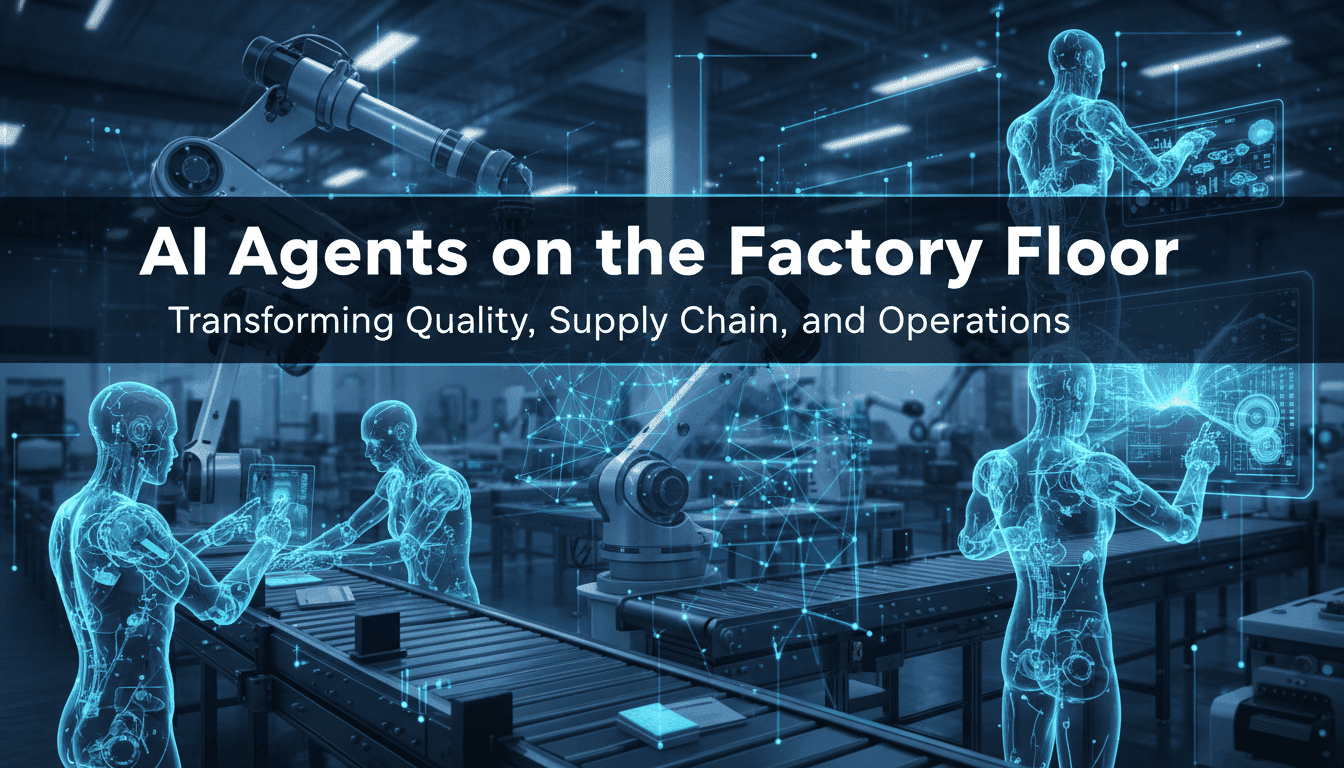
Table Of Contents
- Understanding AI Agents in Manufacturing Contexts
- AI Agents Revolutionizing Quality Control
- Supply Chain Transformation Through Autonomous AI
- Operational Excellence with AI Agent Systems
- Implementation Framework for Factory AI Agents
- Overcoming Common Challenges in Factory AI Deployment
- Measuring ROI and Performance Metrics
- The Future of AI Agents in Manufacturing
Manufacturing floors have always been environments of constant motion, where precision meets pressure and efficiency determines profitability. Today, a new workforce is emerging on these factory floors, one that never tires, continuously learns, and operates with microscopic precision. AI agents are fundamentally reshaping how manufacturers approach quality control, supply chain management, and operational efficiency.
Unlike traditional automation or even conventional AI systems that require constant human direction, AI agents operate with remarkable autonomy. They make decisions, adapt to changing conditions, and collaborate with both human workers and other AI systems to solve complex manufacturing challenges in real-time. For manufacturing leaders in Singapore and across Asia, understanding how to deploy these intelligent systems represents a critical competitive advantage.
This comprehensive guide explores how AI agents are transforming factory operations across three critical domains: quality assurance, supply chain orchestration, and operational management. You'll discover practical implementation strategies, real-world applications, and frameworks for measuring success as you navigate this industrial transformation.
AI Agents Transforming the Factory Floor
From Quality Control to Supply Chain Excellence
Three Critical Transformation Areas
Quality Control Revolution
AI agents detect nanometer-level defects, perform autonomous root cause analysis, and predict quality issues before they occur—maintaining perfect attention across every unit produced.
Supply Chain Intelligence
Autonomous agents forecast demand continuously, optimize inventory across thousands of SKUs, handle procurement decisions, and coordinate logistics networks in real-time without human intervention.
Operational Excellence
Predictive maintenance agents prevent breakdowns, production schedulers adapt to disruptions instantly, energy managers reduce costs by 15-20%, and safety systems proactively protect workers.
What Makes AI Agents Different?
Implementation Success Framework
Ready to Transform Your Factory Operations?
Join manufacturing leaders who are successfully deploying AI agents to drive measurable improvements in quality, supply chain, and operational performance.
Explore Business+AI MembershipUnderstanding AI Agents in Manufacturing Contexts
Before diving into specific applications, it's essential to distinguish AI agents from other forms of factory automation. Traditional programmable logic controllers (PLCs) follow predetermined instructions without deviation. Standard AI systems might analyze data and provide recommendations but still require human decision-making. AI agents, by contrast, perceive their environment through sensors and data streams, make autonomous decisions based on defined objectives, and take actions to achieve specific outcomes without constant human supervision.
In manufacturing settings, AI agents typically operate within carefully defined parameters. A quality control agent might autonomously flag defective products, adjust machine settings to prevent future defects, and communicate findings to production managers. The agent doesn't simply detect problems; it acts on them within its designated authority level. This autonomous capability creates unprecedented responsiveness in factory operations.
The architecture of manufacturing AI agents typically includes perception systems (cameras, sensors, IoT devices), decision-making models (often leveraging machine learning and reinforcement learning), and action mechanisms (controlling equipment, triggering alerts, or initiating workflows). Modern agent systems also incorporate learning capabilities, meaning they improve performance over time by analyzing outcomes and refining their decision-making processes.
For organizations exploring AI implementation, Business+AI workshops provide hands-on exposure to these technologies, helping leadership teams understand practical applications before committing to full-scale deployment.
AI Agents Revolutionizing Quality Control
Quality control represents one of the most mature applications of AI agents in manufacturing. Traditional quality inspection, whether manual or using basic machine vision, suffers from consistency issues, speed limitations, and inability to detect subtle defects. AI agents have transformed this landscape dramatically.
Visual inspection agents now exceed human capability in detecting surface defects, dimensional variations, and assembly errors. These systems combine high-resolution imaging with deep learning models trained on millions of product images. Unlike human inspectors who experience fatigue or inconsistency, AI agents maintain perfect attention across every single unit. At semiconductor manufacturing facilities, AI agents detect defects measured in nanometers, identifying issues that would be impossible for human eyes to perceive.
Beyond simple pass/fail decisions, quality AI agents perform root cause analysis autonomously. When defect rates increase, these agents correlate patterns across production variables like temperature, humidity, machine settings, material batches, and operator shifts. They identify likely causes and can automatically adjust upstream processes to prevent further defects. This closed-loop quality management happens in real-time rather than during periodic review cycles.
Predictive quality agents take prevention even further by forecasting potential quality issues before they occur. By continuously monitoring process parameters and comparing them against historical patterns, these agents alert operators when conditions drift toward states that previously produced defects. In pharmaceutical manufacturing, where batch failures carry enormous costs, predictive quality agents have reduced waste by up to 35% while ensuring regulatory compliance.
The integration of quality AI agents also transforms documentation and compliance processes. These systems automatically generate inspection reports, maintain complete traceability records, and ensure that quality data meets regulatory requirements without manual data entry. For industries with stringent compliance demands, this automated documentation proves invaluable.
Supply Chain Transformation Through Autonomous AI
Supply chain management involves orchestrating countless variables across suppliers, inventory levels, production schedules, logistics networks, and customer demand. The complexity overwhelms traditional planning systems, leading to either excess inventory that ties up capital or stockouts that halt production. AI agents are bringing unprecedented intelligence to these challenges.
Demand forecasting agents continuously analyze patterns across historical sales data, market trends, seasonal factors, economic indicators, and even social media sentiment to predict future demand with remarkable accuracy. Unlike traditional forecasting that produces periodic static forecasts, these agents update predictions continuously as new data arrives. When unexpected events occur (like sudden market shifts or supply disruptions), forecasting agents immediately recalculate and propagate changes throughout the planning system.
Inventory optimization agents balance the competing demands of minimizing holding costs while preventing stockouts. These agents monitor consumption rates, supplier lead times, quality metrics, and production schedules to determine optimal reorder points and quantities for thousands of SKUs simultaneously. In complex manufacturing environments with deep bills of materials, inventory agents ensure that all required components arrive precisely when needed for production, reducing working capital requirements by 20-30% in many implementations.
Perhaps most transformative are autonomous procurement agents that handle supplier selection, purchase order generation, and order tracking with minimal human intervention. These agents evaluate supplier performance across delivery reliability, quality metrics, pricing, and capacity. When production plans change or suppliers experience disruptions, procurement agents automatically identify alternatives and initiate orders. For routine purchases of standard materials, these agents operate completely autonomously, freeing procurement professionals to focus on strategic supplier relationships and contract negotiations.
Logistics coordination agents optimize transportation and warehousing decisions in real-time. These systems select carriers, determine optimal routing, consolidate shipments, and dynamically reroute deliveries when disruptions occur. By coordinating across the entire logistics network rather than optimizing individual shipments in isolation, these agents achieve cost reductions and service improvements that traditional transportation management systems cannot match.
Organizations developing supply chain AI strategies benefit from the frameworks and expertise available through Business+AI consulting services, which help manufacturers identify highest-value applications and design implementation roadmaps.
Operational Excellence with AI Agent Systems
Beyond quality and supply chain, AI agents are transforming core operational processes on the factory floor. These applications directly impact equipment effectiveness, labor productivity, energy consumption, and overall manufacturing efficiency.
Predictive maintenance agents represent one of the highest-ROI applications of AI in manufacturing. These agents continuously monitor equipment through vibration sensors, thermal imaging, acoustic analysis, and operational parameters. By detecting subtle patterns that indicate developing failures, maintenance agents schedule interventions before breakdowns occur. This shift from reactive or scheduled maintenance to truly predictive maintenance reduces unplanned downtime by 40-50% while extending equipment lifespan and reducing maintenance costs.
The sophistication of modern maintenance agents extends beyond simple anomaly detection. These systems understand equipment interdependencies, coordinate maintenance schedules to minimize production impact, automatically order required spare parts, and even schedule technician assignments based on skill requirements and availability. The agent manages the entire maintenance workflow, not just failure prediction.
Production scheduling agents optimize the complex puzzle of matching production capacity against customer orders, material availability, and equipment constraints. Traditional scheduling systems require significant manual intervention and struggle to respond when disruptions occur. AI agents continuously reoptimize schedules as conditions change, automatically adjusting production sequences, reallocating capacity, and communicating changes to relevant stakeholders. In job shop environments with high product variety, scheduling agents have improved on-time delivery rates by 25% while increasing equipment utilization.
Energy management agents reduce manufacturing's environmental footprint and utility costs by optimizing consumption patterns. These agents understand production schedules, utility rate structures, equipment energy profiles, and facility systems. They shift energy-intensive operations to lower-rate periods, optimize HVAC systems based on production needs and weather forecasts, and coordinate with on-site generation or storage systems. Manufacturers have achieved energy cost reductions of 15-20% through intelligent agent-based management without compromising production requirements.
Safety and compliance agents monitor factory operations for safety risks and regulatory compliance issues. Using computer vision and sensor networks, these agents detect unsafe worker behaviors, equipment malfunctions, environmental hazards, and compliance violations. Rather than simply recording incidents, safety agents can take immediate protective actions like stopping equipment, triggering alarms, or alerting supervisors. This proactive approach has reduced workplace accidents substantially in early deployments.
For manufacturing leaders seeking to understand which operational AI applications deliver the greatest impact for their specific circumstances, Business+AI masterclasses provide industry-specific insights and case study analysis.
Implementation Framework for Factory AI Agents
Successfully deploying AI agents requires more than technology selection. Manufacturing organizations need a structured approach that addresses technical, organizational, and operational considerations.
1. Assessment and Prioritization – Begin by identifying specific operational pain points and quantifying their business impact. Which quality issues cause the most waste? Where do supply chain disruptions create the greatest costs? Which equipment failures have the longest recovery times? Prioritize AI agent applications based on potential ROI and implementation feasibility. Start with clearly defined problems where data availability is strong and success can be measured objectively.
2. Data Infrastructure Development – AI agents require robust data foundations. Audit existing data sources including sensors, PLCs, MES systems, ERP platforms, and quality databases. Identify gaps where additional instrumentation or integration is needed. Establish data pipelines that provide agents with real-time access to relevant information. Many organizations discover that data preparation represents 60-70% of initial implementation effort, but this foundation enables multiple AI applications once established.
3. Pilot Implementation – Deploy your first AI agent in a controlled environment where failure carries limited consequences. A single production line, specific product family, or isolated process provides an ideal testing ground. This pilot phase validates technical performance, identifies integration challenges, and demonstrates value to stakeholders. Successful pilots build organizational confidence and provide templates for broader deployment.
4. Human-AI Collaboration Design – Define clear boundaries for agent autonomy. Which decisions can agents make independently? When should they alert human operators? How do humans override agent actions when necessary? Effective human-AI collaboration requires thoughtful interface design, clear communication protocols, and trust-building through transparency. Operators need to understand why agents make specific decisions, not just what actions they take.
5. Change Management and Training – AI agents transform job roles and workflows. Production supervisors shift from reactive problem-solving to strategic oversight. Quality inspectors evolve from manual checking to exception handling and continuous improvement. Maintenance technicians transition from scheduled tasks to predictive interventions. Successful implementations invest heavily in helping employees understand new responsibilities and develop required skills. Resistance typically stems from uncertainty rather than opposition, making clear communication essential.
6. Governance and Continuous Improvement – Establish governance structures that monitor agent performance, manage updates, and coordinate improvements. AI agents require ongoing refinement as production conditions evolve, new products are introduced, and learning surfaces optimization opportunities. Create feedback mechanisms where operators can report agent issues or suggest enhancements. Regular performance reviews ensure agents continue delivering expected value.
Overcoming Common Challenges in Factory AI Deployment
Despite significant potential, AI agent implementations encounter predictable challenges. Anticipating these obstacles enables proactive mitigation strategies.
Data quality and availability presents the most frequent stumbling block. AI agents trained on poor-quality data make poor-quality decisions. Legacy equipment may lack necessary sensors. Data formats across systems may be incompatible. Address these issues systematically through instrumentation investments, data cleaning initiatives, and integration platforms. Accept that data foundation work requires time and resources but enables all subsequent AI capabilities.
Integration with existing systems creates technical complexity. Most factories operate heterogeneous technology environments with equipment and software spanning decades. AI agents must interact with PLCs, SCADA systems, MES platforms, and ERP systems, each with different communication protocols and data structures. Successful implementations typically employ middleware platforms that handle translation between AI agents and legacy systems, avoiding disruptive replacements of functioning equipment.
Organizational resistance emerges when employees fear job displacement or loss of autonomy. Counter this through transparent communication about how AI agents augment rather than replace human capabilities. Involve operators and supervisors in pilot implementations, incorporating their expertise into agent design. Demonstrate how agents eliminate tedious tasks while expanding opportunities for meaningful work. Organizations that position AI as a tool empowering employees rather than replacing them achieve much higher adoption rates.
Scalability challenges appear when organizations attempt to expand from successful pilots to enterprise-wide deployment. What works for one production line may not transfer directly to others with different equipment, products, or conditions. Build modular, configurable agent architectures rather than point solutions. Invest in platforms that support multiple agent types and facilitate knowledge transfer across implementations.
Maintenance and model drift requires ongoing attention. AI agents degrade over time as production conditions change, new products are introduced, or equipment is modified. Establish monitoring systems that track agent performance against baseline metrics. Implement regular retraining cycles using updated data. Create clear ownership for agent maintenance to prevent gradual performance erosion.
The Business+AI ecosystem connects manufacturing leaders facing similar implementation challenges, enabling knowledge sharing and collaborative problem-solving across organizations.
Measuring ROI and Performance Metrics
Demonstrating tangible value from AI agent investments requires comprehensive measurement frameworks that capture both financial returns and operational improvements.
For quality control agents, track defect detection rates, false positive ratios, inspection throughput, scrap and rework costs, warranty claims, and customer quality complaints. Compare these metrics before and after agent deployment. Leading implementations achieve defect detection improvements of 30-50% while reducing inspection costs per unit by 20-40%.
Supply chain agents deliver value through inventory carrying cost reductions, stockout prevention, forecast accuracy improvements, procurement cycle time reductions, and logistics cost savings. Measure days of inventory on hand, perfect order rates, forecast error percentages, and cash-to-cash cycle times. Typical ROI for supply chain AI agents ranges from 300-500% within two years, driven primarily by working capital reductions and stockout prevention.
Operational agents impact equipment effectiveness (OEE), unplanned downtime hours, maintenance costs, energy consumption, and safety incident rates. Calculate OEE improvements, downtime cost avoidance, maintenance cost reductions, energy savings, and safety incident cost prevention. Predictive maintenance agents commonly generate returns exceeding 10x annual costs through downtime prevention alone.
Beyond direct financial metrics, measure operational resilience improvements like recovery time from disruptions, adaptation speed to demand changes, and variability reduction in key performance indicators. These capabilities create competitive advantages that transcend immediate cost savings.
Track adoption and utilization metrics including agent uptime, override frequency, and user satisfaction scores. High override rates or low user satisfaction indicate agent designs that don't align with operational realities, requiring refinement before value materializes.
Establish baseline measurements before agent deployment to enable valid comparisons. Many organizations discover they lack reliable baseline data, forcing them to operate in parallel modes during initial deployment to establish comparative benchmarks.
The Future of AI Agents in Manufacturing
AI agent capabilities are advancing rapidly, suggesting even more transformative applications on the horizon. Understanding emerging trends helps manufacturers prepare for the next wave of operational innovation.
Multi-agent collaboration represents the next frontier, where multiple specialized agents coordinate to manage complex operations. A production scheduling agent might negotiate with maintenance agents to time equipment servicing, consult with quality agents about process capability, and coordinate with supply chain agents regarding material availability. These agent ecosystems make collective decisions that optimize overall performance rather than individual functional objectives.
Generative AI integration is bringing natural language capabilities to factory agents. Operators will interact with AI systems through conversational interfaces, asking questions, receiving explanations, and issuing instructions in plain language rather than through specialized interfaces. This accessibility dramatically reduces training requirements and enables more intuitive human-AI collaboration.
Edge intelligence advancement enables more sophisticated agent processing directly on factory floors rather than in centralized cloud systems. This reduces latency for time-critical decisions, improves reliability when connectivity is intermittent, and addresses data sovereignty concerns. Edge-based agents respond in milliseconds rather than seconds, enabling applications like real-time process control that previously remained infeasible.
Digital twin integration creates virtual factory replicas where AI agents can test strategies, simulate outcomes, and optimize decisions before implementing them in physical operations. Agents learn faster and safer by experimenting in digital environments, then transfer validated strategies to actual production. This simulation capability accelerates agent development and reduces risks during implementation.
Autonomous factories represent the ultimate vision, where interconnected AI agents manage most operational decisions with minimal human intervention. While fully autonomous factories remain years away, progressive automation of decision-making continues advancing. Future manufacturing leadership focuses less on direct operational control and more on setting strategic objectives, defining constraints, and managing the AI systems that run daily operations.
For organizations building long-term AI strategies, participation in events like the Business+AI Forum provides exposure to emerging trends and connections with technology providers developing next-generation capabilities.
The transformation of factory operations through AI agents is not a distant possibility but a present reality. Manufacturing organizations across industries are achieving measurable improvements in quality, supply chain performance, and operational efficiency through intelligent, autonomous systems. The competitive question is no longer whether to deploy AI agents but how quickly and effectively organizations can implement these capabilities. Those who master AI agent deployment will define manufacturing excellence in the decades ahead, while those who delay risk obsolescence in an increasingly intelligent industrial landscape.
AI agents on the factory floor represent a fundamental shift in how manufacturing operates, moving beyond automation to true operational intelligence. From quality control systems that detect defects invisible to human eyes, to supply chain agents that orchestrate complex global networks, to operational systems that optimize energy, maintenance, and production in real-time, these intelligent systems are delivering measurable business value today.
The path to successful implementation requires more than technology adoption. It demands careful assessment of operational priorities, robust data foundations, thoughtful human-AI collaboration design, and commitment to ongoing refinement. Organizations that approach AI agent deployment strategically, learning from pilots before scaling broadly, achieve returns that justify investment many times over.
As AI capabilities continue advancing, the gap between leaders and laggards will widen. Manufacturing organizations that develop expertise in deploying and managing AI agents position themselves for sustained competitive advantage. The factory floor of the future is already taking shape, and AI agents are at its foundation.
Transform Your Manufacturing Operations with AI
Ready to explore how AI agents can drive measurable improvements in your quality, supply chain, and operational performance? Join the Business+AI membership community to access exclusive workshops, masterclasses, and consulting services designed specifically for manufacturing leaders navigating AI transformation. Connect with experts, solution providers, and peer organizations who are successfully implementing AI agents on their factory floors.