
AI Agents in Pharma: Transforming R&D, Regulatory Affairs, and Commercial Operations
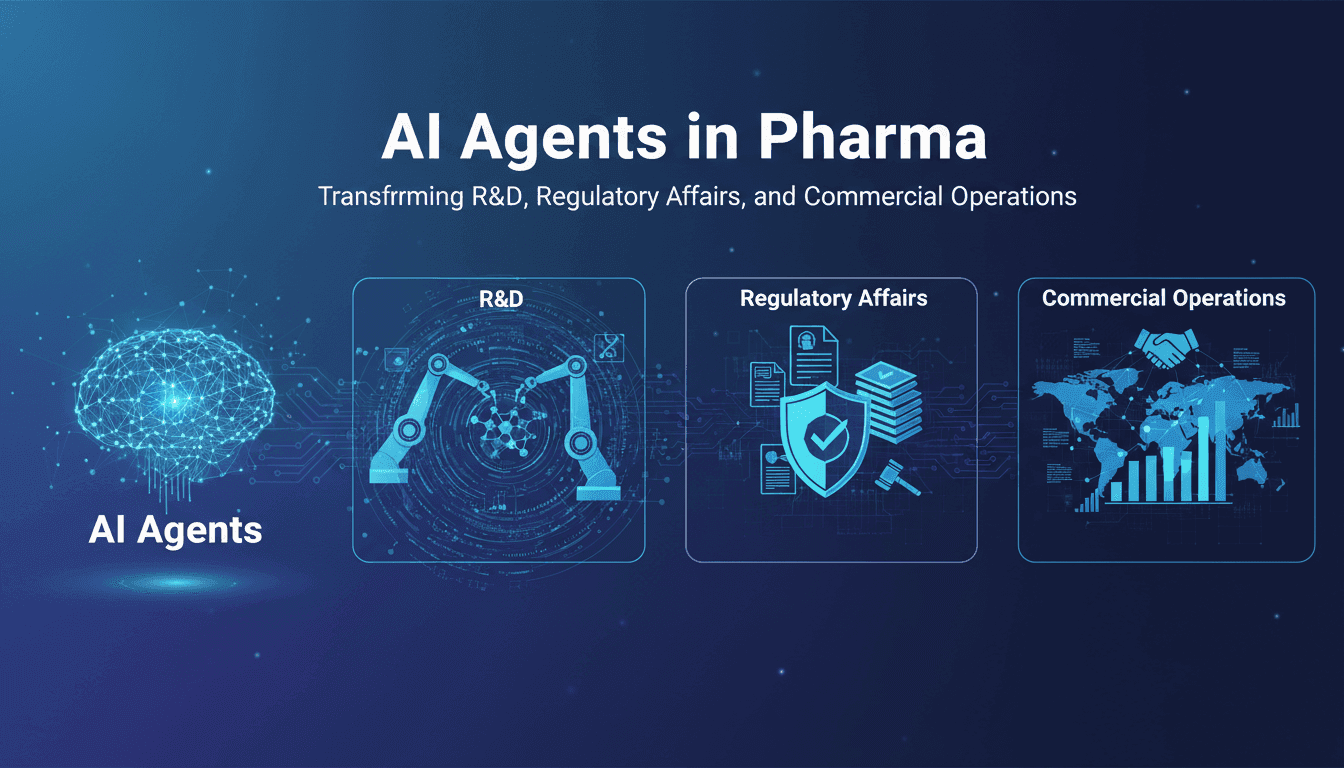
Table Of Contents
- The AI Paradox Pharma Can No Longer Afford to Ignore
- What Makes AI Agents Different from Regular AI Tools
- AI Agents in Pharma R&D: From Discovery to Clinical Trials
- AI Agents in Regulatory Affairs: From Months to Days
- AI Agents in Commercial Pharma: Smarter Engagement, Better Outcomes
- The Real Barriers to Scaling AI Agents in Pharma
- How Pharma Leaders Are Building for Agentic Scale
- From Insight to Action: What Pharma Executives Should Do Next
The AI Paradox Pharma Can No Longer Afford to Ignore {#ai-paradox}
Nearly eight in ten companies now use generative AI in some form. Yet research from McKinsey reveals that 80 percent of them report no measurable bottom-line impact. For an industry where a single drug approval can be worth billions and a trial delay costs millions per week, that gap between AI adoption and AI value is not just a technology problem — it is a strategic emergency.
Pharmaceutical companies are squeezed from every direction. R&D costs keep climbing. Patent cliffs loom. Regulatory demands grow more complex with every market. And commercially, healthcare professionals expect hyper-personalized, always-on engagement that traditional field forces simply cannot deliver at scale.
This is precisely where AI agents change the equation. Unlike standard generative AI tools that answer questions and draft text, AI agents operate autonomously across multi-step workflows — planning, executing, learning, and coordinating with other agents and humans in real time. They are not just a smarter chatbot; they are a new category of digital coworker.
In this article, we break down exactly how AI agents are being deployed across the three highest-stakes domains in pharma — R&D, regulatory affairs, and commercial operations — what real results look like, and what it takes to move from pilot to enterprise scale.
What Makes AI Agents Different from Regular AI Tools {#what-makes-agents-different}
Before exploring specific pharma applications, it is worth being precise about what an AI agent actually is — because the term is being used loosely in the industry, often as a synonym for any AI-powered feature.
An AI agent is a goal-driven system that can break down complex objectives into sub-tasks, interact with external tools and systems, remember context across interactions, and take autonomous action with minimal human intervention. Crucially, agents can be networked together so that specialist agents hand off work to one another, creating multi-agent pipelines that span entire workflows rather than just individual steps.
In a pharma context, this means an agent ecosystem might simultaneously pull data from a clinical database, synthesize literature, draft a regulatory document, flag a compliance issue, and escalate to a human reviewer — all without a single manual handoff. That is a fundamentally different capability from a gen AI tool that simply responds to prompts.
McKinsey's analysis of over 270 pharma workflows found that between 75 and 85 percent contain tasks that could be enhanced or fully automated by AI agents, with the potential to free up 25 to 40 percent of organizational capacity. The question for pharma leaders is not whether agents will matter — it is how fast and how strategically they move.
AI Agents in Pharma R&D: From Discovery to Clinical Trials {#rd-agents}
Research and development is where the stakes are highest and the bottlenecks are most expensive. A single drug takes an average of 10 to 15 years and over a billion dollars to reach market, with the majority of candidates failing somewhere along the way. AI agents are beginning to compress that timeline and sharpen those odds — not by replacing scientists, but by doing the data-intensive groundwork that currently consumes their time.
Accelerating Drug Discovery and Target Identification {#drug-discovery}
Traditional target identification requires teams of researchers to manually synthesize literature, analyze biological datasets, and assess competitive landscapes — a process that can take months. AI agents are now handling that synthesis autonomously and at a scale no human team can match.
In a multi-agent discovery setup, a literature-explorer agent continuously monitors scientific publications and patent filings, feeding insights to a data-science agent that performs multiomic analyses and in-silico modeling of candidate viability. A third agent prioritizes the resulting list of drug candidates based on predicted efficacy, safety signals, and pathway novelty. The scientist's role shifts from data gatherer to strategic reviewer — a change that dramatically accelerates the pace of early discovery.
The results from early adopters are striking. Insilico Medicine used AI agents to design a novel drug candidate for idiopathic pulmonary fibrosis that entered clinical trials in under 18 months — a timeline that would have been considered impossible through conventional methods just a few years ago. Atomwise has deployed agents to screen billions of compounds and has built partnerships with multiple major pharma companies on the back of that capability. These are not proofs-of-concept; they are commercial realities.
Generative AI applications in R&D now span scientific insight generation, mining large biological datasets to study diseases, molecule design, and clinical document drafting, with adoption accelerating rapidly across top-20 pharmaceutical companies as of mid-2025.
Transforming Clinical Trial Design and Execution {#clinical-trials}
Clinical development is one of the most workflow-intensive phases in pharma, and it is where agentic AI can deliver some of its most tangible returns. McKinsey projects a 35 to 45 percent productivity boost across clinical development functions once agents are fully embedded, with the greatest gains in biostatistics, data management, medical writing, and pharmacovigilance.
Patient recruitment alone has historically been one of the leading causes of trial delays. AI agents can analyze fragmented data sources including electronic health records and patient registries to identify eligible patients with high precision, forecast enrollment trends, and automate personalized outreach — compressing timelines that once spanned months into weeks.
During active trials, agents monitor data in real time, standardize records across multiple systems, and detect anomalies before they become protocol deviations. One illustrative workflow involves agents that can identify that a "heart attack" recorded in one system maps to a "myocardial infarction" in another, eliminating a class of reconciliation errors that routinely slow database lock. Trial monitoring agents flag potential adverse events proactively and recommend next-best actions, giving clinical operations teams a level of oversight that was simply not possible at scale before.
For trial design itself, benchmarking agents establish performance norms from historical trials, while optimizer agents use machine learning to simulate protocol variations and identify designs with the highest probability of success. Companies deploying this approach are designing trials up to 50 percent faster with significantly fewer mid-study amendments — a meaningful reduction in both cost and timeline.
One major pharmaceutical company has deployed a multi-agent trial copilot in which a supervisor agent coordinates specialized agents focused on site activation, subject enrollment, and data management, drawing on real-time data from a clinical control tower to provide actionable interventions that keep trials on track.
AI Agents in Regulatory Affairs: From Months to Days {#regulatory-agents}
Regulatory affairs may be the domain where AI agents deliver their most immediate and measurable value — not because it is glamorous, but because it is chronically under-resourced relative to the volume and complexity of work it must handle. A single NDA submission can involve tens of thousands of pages compiled from dozens of data sources. The margin for error is zero.
Automated Document Drafting and Submission Preparation {#document-drafting}
AI agents are already being deployed to autonomously draft regulatory documents — Investigator Brochures, INDs, NDAs, clinical study reports, and safety updates — by pulling structured data from internal databases and synthesizing it against predefined regulatory templates. What once required weeks of manual compilation by senior regulatory scientists can be reduced to hours of review and finalization.
The workflow logic is straightforward but powerful. A regulatory-drafting agent compiles the latest efficacy and toxicology data into a submission-ready format. A compliance-checking agent simultaneously validates the document against current FDA and EMA formatting requirements and flags inconsistencies. A human reviewer then focuses their expertise on judgment calls and strategic framing rather than data aggregation — a shift that frees regulatory professionals to take on more submissions without a proportional increase in headcount.
Genpact and GSK have collaborated on this model, using AI to automate regulatory document generation. IQVIA offers AI-driven content solutions that automate labelling and submission workflows for life sciences clients. Moderna has integrated AI agents across regulatory, legal, manufacturing, and commercial teams to synthesize complex datasets and draft documentation — with agents managing the cross-functional data integration that previously required extensive coordination effort.
In January 2025, the FDA issued its inaugural draft guidance on the use of AI in supporting regulatory decision-making for drug and biological products, proposing a structured, risk-based credibility assessment framework for AI models used in submissions. This signals that the regulatory environment is actively adapting to accommodate AI-generated data and documentation — a development that makes early investment in agent-driven regulatory workflows even more strategically important.
Real-Time Regulatory Monitoring and Compliance {#regulatory-monitoring}
Regulatory requirements are not static. Health authorities in the US, EU, and Asia-Pacific continuously update guidelines, and a labelling requirement that applies in one market may conflict with the standard in another. Staying on top of these changes across global portfolios is a constant, manual burden on regulatory teams.
AI agents are well-suited to this monitoring task. Agents can scan updates from global health authorities around the clock, assess the impact of those changes on internal documentation and workflows, and automatically flag or initiate updates to affected materials. The FDA has noted an exponential rise in AI usage across submissions — over 500 submissions with AI components since 2016 — and is actively exploring LLM-based tools to assist its own scientific reviewers in processing clinical trial information more efficiently.
For pharma companies operating in multiple markets, the compliance dimension extends to multilingual content. AI agents can handle translation and localization of regulatory and commercial content while maintaining compliance with regional guidelines — a capability that previously required significant outsourcing spend.
AI Agents in Commercial Pharma: Smarter Engagement, Better Outcomes {#commercial-agents}
The commercial side of pharma is undergoing its own transformation. Healthcare professionals are harder to reach, more time-pressured, and more selective about the interactions they find valuable. Payer environments are more complex. Brand planning cycles are compressed. And the cost of maintaining large field forces is increasingly difficult to justify without a measurable ROI.
Agentic AI is creating new possibilities across all of these pressure points — not just by automating administrative tasks, but by enabling entirely new ways of engaging customers and managing commercial operations.
Reinventing HCP Engagement and Field Force Effectiveness {#hcp-engagement}
The traditional model of HCP engagement — a field rep calling on doctors according to a static territory plan — is being fundamentally reimagined. AI agents can synthesize clinical evidence, CRM interaction history, and HCP preference data to generate personalized pre-call plans, recommend the right content for each interaction, and automate follow-up tasks after the visit.
Veeva announced its AI Agents for Vault CRM and PromoMats in December 2025, including a Pre-Call Agent, Free Text Agent, and Voice Agent. By March 2026, more than 125 customers were live on Vault CRM with these agents embedded. Bayer has been explicit about its objective: maximize customer engagement while minimizing field prep and data entry — a clean articulation of what agentic AI does for commercial teams in practice.
AstraZeneca selected Salesforce Agentforce Life Sciences for Customer Engagement in late 2025, covering next-best-action recommendations, automated multichannel campaign orchestration, and medical-commercial coordination. Novartis followed with a five-year global rollout of Agentforce 360 for Life Sciences, aiming to simplify orchestration across teams and embed compliance capabilities through AI-driven data harmonization.
Beyond field force support, agents enable what was previously described as "always-on" brand monitoring — continuously aggregating data from diverse sources to track brand health, competitive positioning, and HCP sentiment without requiring a dedicated analyst team for each brand. McKinsey estimates this kind of commercial agentification could lift pharma revenues by 4 to 8 percent while reducing commercial spending by 5 to 9 percent over five years.
Market Access and Payer Intelligence {#market-access}
Market access has traditionally been one of the most data-heavy and analytically demanding commercial functions, relying on teams of analysts to model pricing scenarios, negotiate contracts, and monitor performance across a patchwork of payer agreements. AI agents are beginning to automate the most labor-intensive parts of this workflow while also improving the quality of the underlying analysis.
Agents can simulate gross-to-net scenarios at both brand and portfolio levels, model the outcomes of different contracting strategies, and automate the generation of initial contract drafts based on fair market value benchmarks and precedent analysis. Monitoring agents track contract compliance in real time and flag discrepancies before they become financial leakage issues. Invoice auditing agents scan the long tail of transactions that human teams rarely have time to review — a category of value recovery that was largely invisible before agents made it economically viable to address at scale.
For market access leaders, the strategic implication is significant. The analytical work that once required a team of specialists — and weeks of turnaround time — can now be delivered in hours, enabling faster and better-informed decisions in a payer environment that shows no signs of becoming less complex.
The Real Barriers to Scaling AI Agents in Pharma {#barriers}
For all the momentum, most pharmaceutical companies are still running AI agents at the pilot stage rather than at enterprise scale. The reasons are structural, not technological.
Data fragmentation is the most common constraint. AI agents require high-quality, well-structured, accessible data to perform reliably. Most pharma organizations have data distributed across ELNs, LIMS, CRM systems, Veeva vaults, and legacy ERP platforms that were never designed to communicate with each other. Integrating these silos — and establishing clear data ownership and governance — is a prerequisite for effective agent deployment, not an afterthought.
Regulatory uncertainty creates hesitation, particularly in the R&D and regulatory domains. The FDA's January 2025 draft guidance provides a framework, but it is still in draft form and does not yet cover all phases of the drug development lifecycle comprehensively. The EMA has taken a broader lifecycle view, but global harmonization remains a work in progress. Pharma leaders need to build AI governance frameworks that are robust enough to satisfy regulators while flexible enough to evolve as the guidance develops.
Talent and change management may be the most underestimated challenge. When AI agents absorb 25 to 40 percent of enterprise capacity, the question of what people do with that freed-up capacity is not a technology question — it is a leadership question. Organizations that treat agent adoption as a software rollout rather than a workforce transformation tend to see minimal adoption and significant resistance. New roles such as agent orchestrators, AI governance managers, and agent supervisors will be needed, and the path to filling them runs through deliberate upskilling rather than external hiring alone.
Governance and guardrails are non-negotiable in a regulated industry. Because pharma operates under strict oversight, AI agents must consult humans before making decisions with significant clinical, regulatory, or financial consequences. Building the right escalation logic, audit trails, and accountability frameworks is not optional — it is what separates deployable agents from expensive proof-of-concepts.
How Pharma Leaders Are Building for Agentic Scale {#building-scale}
The organizations that are moving from pilot to scale share a number of common characteristics that are worth examining closely.
First, they have top-down mandate. Agentic transformation that starts in a single function and stays there rarely generates enterprise value. The pharma companies seeing the most traction have leadership teams that have made AI a strategic priority and aligned agent deployment to specific P&L outcomes — not just operational efficiency metrics.
Second, they invest in workflow reimagination rather than workflow automation. There is a meaningful difference between digitizing an existing process and rethinking what that process should look like when AI can handle tasks that humans never had the capacity to perform. The 40 percent of workflows that contain tasks too complex or uneconomical for humans to perform at scale represent the most distinctive value creation opportunity — and it requires genuine redesign, not just software deployment.
Third, they build scalable technical foundations. This means cloud-based, modular architectures that support agent-to-agent interoperability, robust data pipelines with real-time access, and governance frameworks that allow new agents to be deployed safely and monitored continuously. Strategic partnerships with technology vendors and specialized AI solution providers accelerate this foundation-building significantly.
Fourth, they treat adoption as an ongoing investment. Training, coaching, performance incentives, and integration of agents into existing business rhythms — management reviews, QBRs, sales performance evaluations — are what separate organizations where agents get used from organizations where they sit idle after launch.
An MIT Technology Review Insights survey found that 73 percent of pharma organizations are already planning, piloting, or deploying agentic AI. The gap between those organizations and the ones that extract measurable value is not technology access — it is strategic clarity and execution discipline.
From Insight to Action: What Pharma Executives Should Do Next {#next-steps}
The pharmaceutical industry is entering a period of rapid and uneven transformation. Companies that move thoughtfully and at speed will extend competitive advantages that are difficult to reverse. Those that wait for perfect conditions will find themselves playing catch-up in a landscape that rewards first movers.
For pharma executives navigating this moment, a few principles stand out.
Start with the highest-value workflows, not the lowest-hanging fruit. Automated report generation is useful, but it will not move your P&L. Prioritize the domains — clinical development, regulatory submissions, commercial operations — where agent productivity translates directly into time-to-market, revenue, or compliance risk.
Invest in the data infrastructure that makes agents reliable. The quality of your agents will never exceed the quality of your data. Governance, ontologies, and system integration are foundational, not optional.
Build the human capability to work alongside agents. This means not just technical training, but leadership development that helps managers transition from directing human workflows to orchestrating hybrid teams of humans and agents.
And critically, engage with peers and experts who are navigating the same challenges. The most effective implementation decisions in this space are rarely made in isolation — they are made in communities of practice where executives share what is working, what is not, and what the next wave of capability looks like.
The pharmaceutical industry's most important asset is its ability to develop medicines that improve and save lives. AI agents do not change that mission — they dramatically expand the capacity to pursue it.
The Agentic Opportunity Is Real — And the Window Is Now
AI agents are not a future scenario for the pharmaceutical industry. They are already deployed in drug discovery pipelines at Insilico Medicine and Atomwise, in regulatory documentation workflows at GSK and Moderna, and in commercial operations at AstraZeneca, Novartis, and Bayer. The data points are becoming harder to ignore: 75 to 85 percent of pharma workflows contain tasks that agents can enhance or automate, with the potential to grow EBITDA by 3 to 5 percentage points over the next three to five years.
But the gap between organizations that capture that value and those that do not will not be determined by access to technology. It will be determined by the quality of strategy, execution, and learning that surrounds the technology. Pharma leaders who treat agentic AI as a platform for enterprise reinvention — not just an IT project — are the ones who will look back on this moment as a turning point.
The question is not whether AI agents will reshape R&D, regulatory affairs, and commercial operations in pharma. They already are. The question is whether your organization will lead that reshaping or react to it.
Ready to Turn AI Strategy Into Pharma Results?
Business+AI brings together pharma executives, AI solution vendors, and implementation specialists to help life sciences organizations move from AI curiosity to commercial impact — faster and with less risk.
Whether you're looking to benchmark your agentic AI strategy against industry peers, get hands-on with real implementation frameworks, or connect with the solution providers building the next generation of pharma AI tools, the Business+AI ecosystem has a path for you.
- Explore the Business+AI Forum — Asia's leading executive platform for AI in business, where pharma leaders share what's actually working at scale.
- Join a Hands-On Workshop — Practical, implementation-focused sessions on deploying AI agents in regulated industries.
- Attend a Masterclass — Deep-dive programs on agentic AI strategy, governance, and commercial deployment.
- Engage Our Consulting Team — Work directly with specialists who translate AI potential into pharma-specific business outcomes.
Become a Business+AI Member and join the community of executives who are turning AI talk into tangible pharma gains.