
AI Agents for Social Media: Content Creation, Engagement, and Brand Monitoring
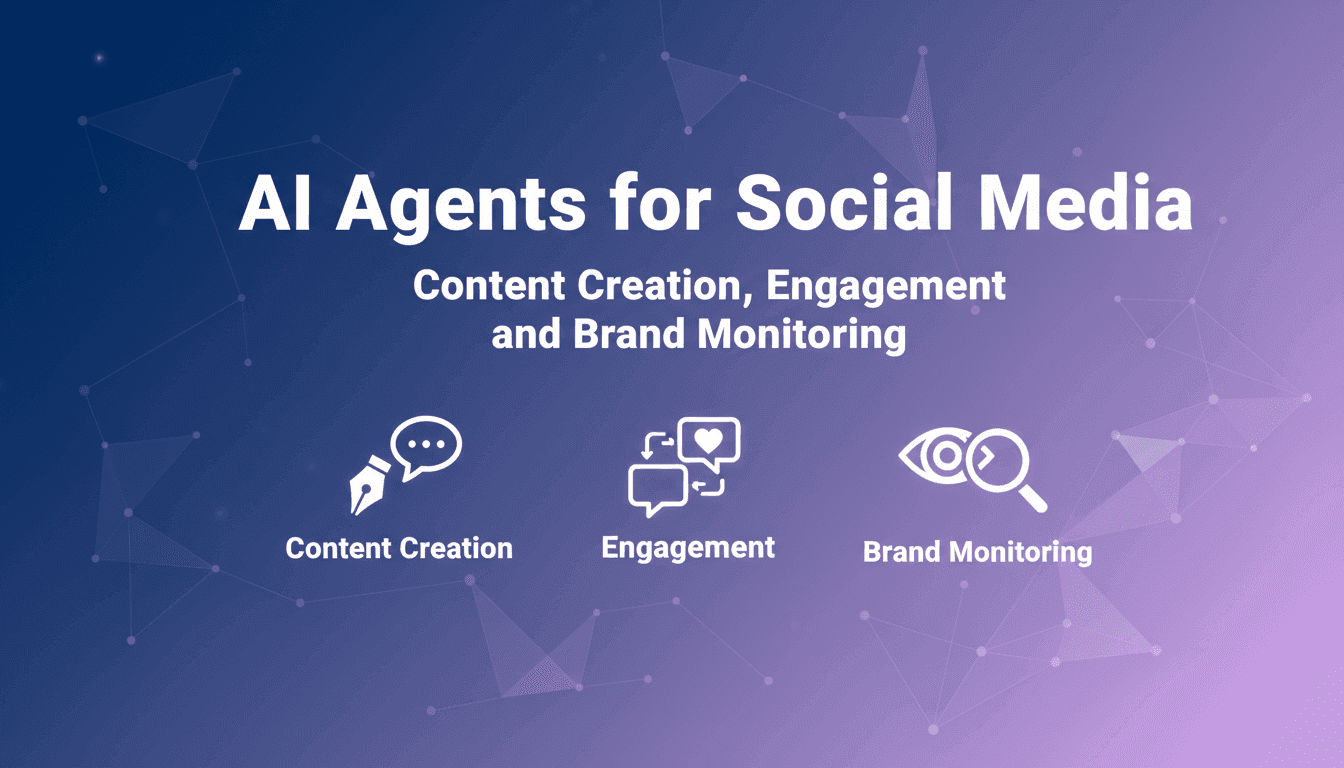
Table Of Contents
- What Makes AI Agents Different From Regular Social Media Tools
- AI Agents for Social Media Content Creation
- Automating Engagement Without Losing Authenticity
- Brand Monitoring and Sentiment Analysis at Scale
- Real Business Results: What the Data Says
- The Risks and Limits You Need to Know
- How to Get Started: A Strategic Framework
- Conclusion
Social media teams are under more pressure than ever. They are expected to publish consistently across multiple platforms, respond to comments within the hour, track brand mentions around the clock, and still find time to think strategically. For most organisations, this workload has outgrown the capacity of any human team working alone.
AI agents are changing that equation. Unlike the scheduling tools and caption generators that came before, AI agents for social media operate as autonomous, goal-driven systems capable of managing entire workflows—from content ideation and publishing to real-time engagement and brand reputation monitoring. They do not wait for instructions on every step; they observe signals, make decisions, and act within defined boundaries.
This article breaks down exactly how AI agents function across three core social media disciplines—content creation, audience engagement, and brand monitoring—along with the real-world results businesses are seeing, the genuine risks worth knowing, and a practical starting framework for leadership teams ready to move beyond experimentation.
What Makes AI Agents Different From Regular Social Media Tools {#what-makes-ai-agents-different}
The distinction matters more than most marketing technology discussions acknowledge. Standard social media tools are task-executors: they post on a schedule, send keyword alerts, and pull dashboards. AI agents are different in kind, not just degree.
AI agents are autonomous software systems that can perceive data, reason through complex scenarios, and take purposeful actions to achieve specific goals. Unlike basic automation tools that follow rigid if-then rules, AI agents use large language models and machine learning to understand context, make decisions, and adapt their behaviour based on results. In practical terms, this means an agent can receive a high-level objective—"grow our LinkedIn engagement by 20% this quarter"—and independently research, plan, create, schedule, and optimise content to pursue that goal.
Modern AI agents go further by owning workflows. In social media management, an AI agent continuously monitors activity across platforms, analyses trends and audience behaviour, generates and adapts content, and manages engagement in real time. It does not rely on constant prompts—it observes signals, prioritises what matters, and acts within clear boundaries.
The contrast with legacy systems is stark. Traditional automation triggers on keywords, while AI agents understand intent, sarcasm, urgency, and emotional tone. A comment saying "Great job breaking my order again" triggers a support workflow, not a thank-you response. That capacity for contextual interpretation is what makes agents genuinely useful for customer-facing channels where misjudged responses carry real brand risk.
AI Agents for Social Media Content Creation {#ai-agents-content-creation}
Content production is where many organisations feel the pressure first. Maintaining a consistent publishing cadence across Instagram, LinkedIn, X, TikTok, and Facebook—each with its own format norms, audience expectations, and algorithm preferences—is a serious operational challenge. AI agents address this not just by generating copy faster, but by adapting intelligently to each channel.
Agents distribute content across multiple platforms from a single input, with format, copy length, and media ratios adjusting per channel. A video created for Instagram Reels gets cropped and re-captioned for TikTok, condensed to a text summary for X, and expanded into a longer narrative for LinkedIn—all from one production cycle. For lean marketing teams managing multiple brand accounts, this is a force multiplier that previously required dedicated platform specialists.
Beyond format adaptation, agents bring strategic intelligence to content planning. The agent uses trend analysis, keyword data, and previous performance to suggest new post ideas, helping teams maintain a steady and creative content pipeline. Crucially, this is not generic ideation—agents analyse audience behaviour data to determine posting windows specific to your followers, not generic "best time to post" tables pulled from industry benchmarks.
Trend detection is perhaps the most commercially valuable content capability. Agents that monitor real-time signals across platforms can identify emerging topics relevant to your niche and draft reactive content while the trend still has momentum. One documented example: an AI agent identified a trending topic six hours before it peaked, created a brand-relevant post, published it at peak momentum, and generated 155% of that client's monthly engagement target from a single piece of content.
For businesses managing brand voice across geographies or departments, the agent learns from existing brand content and guidelines, ensuring every post matches tone, vocabulary, and brand positioning across all channels. This is particularly relevant for organisations operating across Singapore and the broader Asia-Pacific region, where platform preferences, language registers, and cultural nuances vary significantly between markets.
Automating Engagement Without Losing Authenticity {#automating-engagement}
Engagement is where automation carries the highest reputational stakes. Audiences notice when responses feel robotic, and a single poorly-timed automated reply to a sensitive comment can generate the kind of press no brand wants. This tension is real, but it is also manageable.
The business case for AI-assisted engagement starts with a simple operational reality: managing customer questions across multiple social platforms while running your business is nearly impossible. Studies show 42% of consumers expect responses within the first hour, but most businesses cannot maintain 24/7 monitoring. AI agents close that gap by operating continuously, with no drop in attentiveness during overnight hours, weekends, or peak campaign periods.
AI agents solve this by automatically handling customer messages across Instagram, Facebook, WhatsApp, and other platforms. They provide instant responses to common questions about products, services, and availability while escalating complex issues to your team with full context. That escalation layer is critical—it preserves human judgment for conversations that genuinely require it while freeing human time from repetitive, lower-stakes interactions.
Community management benefits similarly. Building an active social media community requires constant interaction. AI agents can automate community engagement while maintaining authenticity, monitoring brand mentions, automatically responding to appropriate comments, and identifying opportunities for meaningful engagement with potential customers.
The deeper performance advantage lies in what agents learn over time. Over time, the agent learns what performs well on each platform and applies those insights to future decisions. Agents adjust strategies based on live engagement data, with real-world adoption already high—40% of marketers currently use AI social media tools for performance reporting and analysis.
If your organisation is exploring how to operationalise AI for marketing and customer engagement, Business+AI workshops and masterclasses offer structured, hands-on environments to build and test these capabilities with practical guidance.
Brand Monitoring and Sentiment Analysis at Scale {#brand-monitoring-sentiment}
For executives, brand monitoring is not a marketing nicety—it is a risk management function. A product crisis, a viral customer complaint, or a competitor misstep can emerge and escalate on social media in hours. Organisations that rely on manual monitoring or weekly reports are consistently behind the curve.
AI agents bring a fundamentally different approach to this challenge. AI agents continuously monitor brand mentions and sentiment across social channels, leveraging advanced image and text recognition to interpret customer emotions in real time. This always-on surveillance capability extends well beyond simple keyword tracking.
The quality of insight has improved substantially compared to earlier sentiment tools. Traditional sentiment analysis often outputs a flat score, like "72% positive." Sentiment agents go deeper: a language interpretation agent applies LLMs trained to recognise tone, context, irony, and emotion; a summarisation agent condenses sentiment trends over a time window into human-readable insights; a topic-clustering agent groups sentiment by issue, so you can see that mentions of your CEO are trending positive while your pricing model is causing friction.
This granularity changes how leadership teams can use social data. Rather than a weekly summary to the marketing team, sentiment intelligence becomes an input to product decisions, communications strategy, and crisis preparedness. Media monitoring and social listening are essential because they link public exposure to audience perception, enabling reputation protection, campaign measurement, and competitive insight through continuous observation. Early warning systems detect abnormal mention spikes or sentiment deterioration, allowing for faster escalation and mitigation.
Competitor intelligence is an underused benefit of the same infrastructure. Social listening tools with sentiment analysis reveal how competitors are perceived, providing market context for your own brand strategy. For businesses making strategic positioning decisions in competitive markets, this real-time competitive intelligence is often more current and actionable than periodic analyst reports.
For senior leaders who want to explore how brand monitoring and AI-driven intelligence fit into a broader business strategy, the Business+AI Forum brings together executives navigating exactly these decisions across sectors.
Real Business Results: What the Data Says {#real-business-results}
Scepticism about AI ROI is healthy—and increasingly, the data gives decision-makers something concrete to evaluate. The numbers emerging from early adopters are significant enough to warrant serious attention at the executive level.
Salesforce's 2024 State of Marketing Report found that 68% of marketing leaders say generative AI is "critical to their overall social strategy." Adoption at scale is translating into measurable efficiency gains: agency account managers using AI agents handle 3x more clients with equivalent headcount.
The productivity argument extends to creative output as well. 93% of social practitioners believe AI can help alleviate creative fatigue by bearing the mental load of monitoring social environments and performing intensive data analysis. Teams that previously spent the majority of their social media hours on reactive and administrative work report reclaiming significant capacity for strategy, creative direction, and relationship-building.
For customer-facing functions specifically, the efficiency gains can be dramatic. Lyft partnered with Anthropic to automate elements of its customer support operations and reported an 87% reduction in average customer service resolution times across all channels. While this figure spans beyond social media alone, the underlying mechanism—AI handling high-volume, structured interactions—applies directly to social engagement workflows.
On the analytical side, teams using AI sentiment analysis report cutting feedback analysis time by 80–90% compared to manual review processes. What took a team of analysts a week to produce can surface in real-time dashboards.
The Risks and Limits You Need to Know {#risks-and-limits}
No serious assessment of AI agents for social media should stop at the benefits. The risks are real, and organisations that deploy these systems without adequate governance frameworks are exposed in ways that can materialise very publicly.
The most immediate operational risk is tone and context failure. AI may struggle to capture a brand's unique tone, and customers could pick up on responses that feel emotionally flat. Context and nuance gaps mean AI may also struggle to interpret grey-zone scenarios, and nuanced conversations will almost always still require human oversight.
Cultural limitations mean AI lacks the cultural awareness required to engage thoughtfully with global audiences across regions and social norms. AI-generated content also pulls from existing sources, which raises questions of plagiarism and copyright infringement that brands might not be prepared to address. For businesses operating across culturally diverse markets, this is not a minor footnote—it is a real operational consideration.
At the governance level, implementing "human-in-the-loop" oversight—enabling agents to work autonomously while human experts review decisions after they've been made—is an important safeguard. The most effective deployments treat AI agents not as replacements for human judgment, but as systems that handle volume and speed while humans retain accountability for strategy, escalations, and anything with brand reputation implications.
When paired with human oversight, AI can help teams detect emerging issues faster, prioritise responses, and automate repetitive workflows without sacrificing brand voice or customer trust. That pairing—not full automation—is the practical standard for organisations that want efficiency gains without reputational exposure.
For business leaders who want a clearer picture of where governance, strategy, and AI deployment intersect, Business+AI consulting provides advisory support to help organisations navigate these decisions with clarity.
How to Get Started: A Strategic Framework {#how-to-get-started}
The organisations that get the most from AI agents for social media typically start narrow, learn fast, and expand deliberately. Here is a practical sequence that reflects how successful deployments tend to unfold.
1. Audit your current social media workflows — Map where your team's time actually goes: content creation, scheduling, community management, reporting, monitoring. The highest-ROI automation targets are almost always the tasks that are high-volume, repetitive, and low-stakes if occasionally imperfect.
2. Prioritise one function first — Content scheduling and publishing is the lowest-risk starting point and the most mature area of AI social media tooling. Brand monitoring is the highest-urgency function for organisations with significant brand exposure. Choose based on where you feel the most operational pain.
3. Define your brand voice in writing — AI agents that learn brand guidelines produce significantly better outputs than those operating without them. Before deploying any agent for content creation or engagement, document your tone, vocabulary preferences, topics to avoid, and escalation criteria.
4. Build human oversight into every workflow — Decide in advance which types of responses require human review before publishing, which can be automated with post-hoc review, and which should never be automated. This governance layer protects brand reputation and builds organisational confidence in the technology.
5. Measure against baselines — Track response time, engagement rate, content output volume, and team hours spent on each function before and after deployment. Without baselines, ROI conversations become impressionistic rather than evidenced.
Social media automation works best when it gives you more time for work that needs judgment. A scheduler can help you publish consistently. The broader point holds across all AI agent functions: the goal is not to remove human input from social media, but to concentrate human attention where it creates the most value.
Conclusion {#conclusion}
AI agents are not a future capability for social media—they are an operational reality that a growing number of businesses are already using to scale content, improve engagement speed, and build more intelligent brand monitoring systems. The technology has matured enough that the question is no longer whether AI agents can add value, but whether your organisation has the strategy, governance, and skills to deploy them effectively.
The most important shift in mindset is treating AI agents as collaborators in a governed workflow, not as autonomous replacements for human judgement. Content creation benefits from agent-assisted drafting and trend detection. Engagement improves through always-on responsiveness with clear escalation pathways. Brand monitoring gains depth and speed through sentiment intelligence that no manual process can match at scale.
For executives and business leaders, the priority now is building the internal capability to make informed deployment decisions—knowing what to automate, where human oversight is non-negotiable, and how to measure outcomes. That capability does not develop by reading about AI; it develops through hands-on learning, peer exchange, and expert guidance from those who have navigated the same decisions.
Ready to turn AI potential into measurable business results?
Business+AI is Singapore's leading ecosystem for executives and business leaders who want to move beyond the headlines and build real AI capability. Through our workshops, masterclasses, consulting, and the flagship Business+AI Forum, we help organisations translate AI talk into tangible gains.