
AI Agents for Logistics: How Route Optimization, Warehouse Orchestration, and Last-Mile Delivery Are Being Transformed
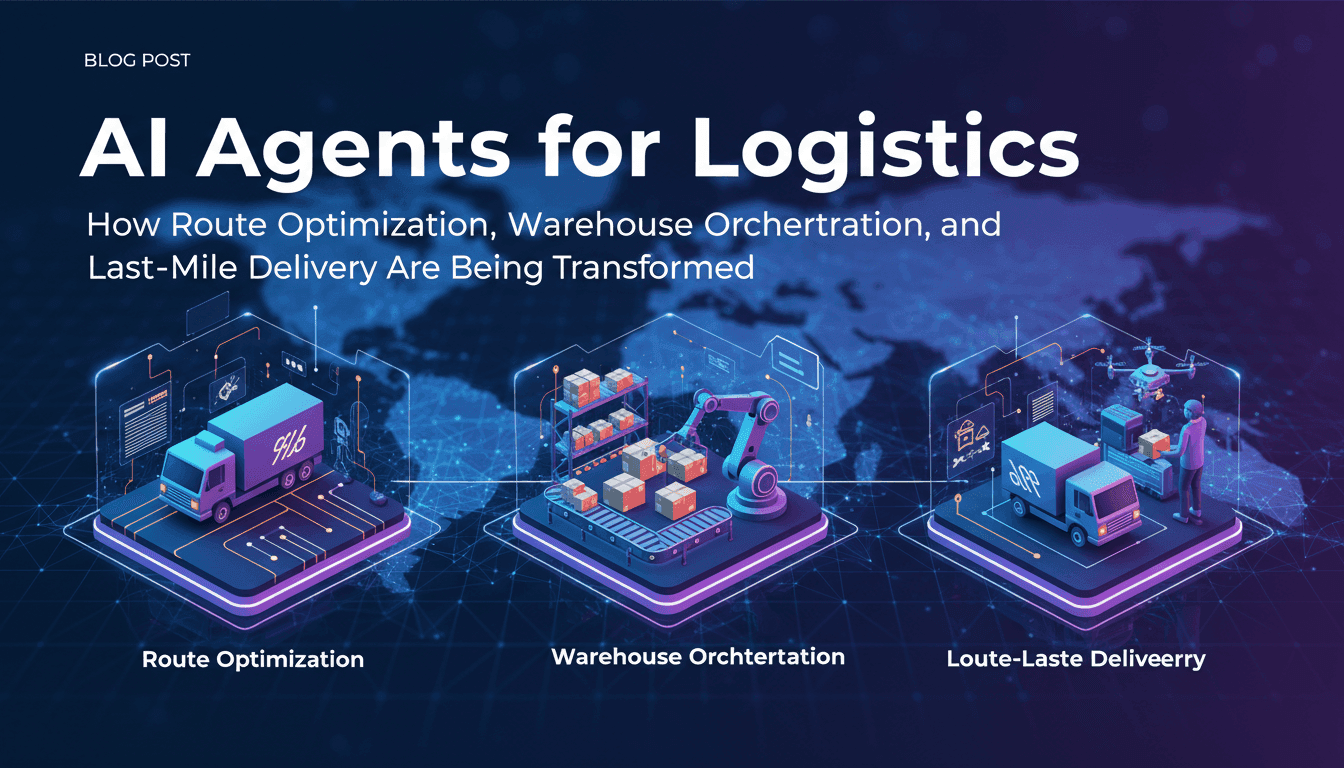
Table Of Contents
- Why Logistics Is the Proving Ground for Agentic AI
- What Makes an AI Agent Different From Traditional Automation
- Route Optimization: From Static Plans to Real-Time Intelligence
- Warehouse Orchestration: The Intelligent Fulfillment Center
- Last-Mile Delivery: Closing the Most Expensive Gap in Logistics
- Multi-Agent Systems: When the Three Pillars Work Together
- What Leaders Need to Get Right Before Deploying AI Agents
- Where to Go From Here
AI Agents for Logistics: How Route Optimization, Warehouse Orchestration, and Last-Mile Delivery Are Being Transformed
Logistics has always been a data-intensive industry. Shipment statuses, inventory positions, carrier capacity, demand signals, traffic patterns — the information has existed for years. What has changed, dramatically, is the ability to act on that data at the speed and scale modern operations demand. AI agents are not a smarter dashboard or a better forecasting model. They are an entirely different class of technology: autonomous systems that perceive conditions, reason across multiple data sources, and execute multi-step decisions — often without waiting for a human to approve each action.
For logistics leaders, this shift from AI-as-advisory to AI-as-operational is the most consequential technology transition since the introduction of the warehouse management system. The three domains where this transformation is most advanced — and where the ROI evidence is clearest — are route optimization, warehouse orchestration, and last-mile delivery. This article examines each in depth, with real-world benchmarks, a framework for thinking about multi-agent coordination, and a practical lens for leaders who are deciding where to deploy first.
Why Logistics Is the Proving Ground for Agentic AI {#why-logistics}
Logistics operations share a set of structural characteristics that make them unusually well-suited to AI agent deployment. Decisions are high-volume and time-sensitive. The cost of a wrong or slow decision compounds across every downstream step. Data from IoT sensors, telematics, warehouse management systems (WMS), and transportation management systems (TMS) is already flowing in real time. And the gap between the best-performing operators and the average is measurably large — which means there is visible, quantifiable value on the table.
The market numbers reflect this urgency. Gartner forecasts that spending on supply chain management software containing agentic AI capabilities will rise from under $2 billion in 2025 to $53 billion by 2030, with 60% adoption of agentic features among enterprises using SCM software projected within the same window. McKinsey's analysis of AI-enabled distribution improvements estimates potential reductions of 20–30% in inventory levels, 5–20% in logistics costs, and 5–15% in procurement spend across relevant use cases. These are not pilot projections. They reflect what is happening in production deployments at companies that committed early and built deliberately.
The critical distinction that leaders need to internalize before investing is that agentic AI in logistics is not replacing existing automation — it is operating across functions that automation was never designed to touch: exception handling, real-time rerouting, autonomous replenishment decisions, and cross-system coordination that spans the entire fulfillment chain.
What Makes an AI Agent Different From Traditional Automation {#what-makes-ai-agents-different}
Traditional automation in logistics — warehouse conveyor systems, rules-based TMS routing engines, scheduled inventory replenishment — operates on pre-defined logic. It executes what it was told to do in the conditions it was configured for. When conditions deviate from those configurations, the system either fails silently or escalates to a human queue that may not be actioned for hours.
An AI agent operates differently. It perceives live operational signals, reasons across multiple data sources simultaneously, and executes decisions within a bounded authority framework — without requiring human sign-off on every step. When a road closure disrupts a delivery sequence, a routing agent doesn't file an alert. It recalculates, reassigns, and updates the driver's device in seconds. When a fast-moving SKU drops below threshold in a fulfilment centre, an inventory agent doesn't generate a report. It triggers a replenishment order, confirms supplier availability, and logs its reasoning for review.
The governance model behind this autonomy matters as much as the capability itself. Production AI agents in logistics operate within pre-defined decision boundaries: below a certain threshold of complexity or financial exposure, the agent acts autonomously; above it, the agent escalates with a full recommendation and a reasoning log for human review. Every decision — executed or escalated — is fully auditable. This bounded autonomy model is what makes deployment safe at scale, not an optional governance add-on.
Route Optimization: From Static Plans to Real-Time Intelligence {#route-optimization}
Route optimization is both the oldest application of AI in logistics and the one with the deepest body of documented ROI. The evolution from static planning software to fully agentic routing systems illustrates exactly how the technology has matured — and what is now possible.
The most studied example is UPS's ORION (On-Road Integrated Optimization and Navigation) system, deployed across more than 55,000 daily delivery routes in the United States. ORION uses machine learning to generate optimized routes that minimize total distance while respecting time windows, vehicle capacity constraints, and operational preferences — including a deliberate preference for right-hand turns to reduce idle time at intersections. The documented results are substantial: ORION reduces average driver route length by 6–8 miles per day, saving UPS approximately 100 million miles annually, equivalent to 10 million gallons of fuel, 100,000 metric tons of CO₂, and an estimated $300–400 million in combined fuel and vehicle costs. ORION 2.0, deployed since 2023, adds dynamic in-day re-optimization, updating route recommendations throughout the delivery day as packages are added, removed, or rescheduled.
DHL's Greenplan dynamic routing algorithm has delivered comparable results at a different scale, with reported cost reductions of around 20% on targeted delivery corridors. Tesco's AI-powered routing setup has been documented as saving 11.2 million miles and reducing fuel use by 8% per order. These are not anomalies — they are proof points that the optimization logic is transferable across operator types and geographies.
What separates a modern routing agent from ORION's original architecture is the addition of broader contextual awareness. Current-generation routing agents do not just minimize distance. They factor in real-time weather, carrier reliability history, driver hours-of-service compliance, customer delivery window preferences, and carbon efficiency targets — simultaneously and continuously. A routing agent that responds to a road closure, weather event, or carrier failure in real time closes a decision loop that previously required a dispatcher, a manager, and a replan cycle taking several hours.
For organizations beginning to deploy in this domain, the recommended starting point is high-variability routes — urban last-mile corridors or same-day delivery networks — where the cost of suboptimal decisions is highest and the data signals are richest.
Warehouse Orchestration: The Intelligent Fulfillment Center {#warehouse-orchestration}
The warehouse is where the difference between traditional automation and agentic AI is most physically visible — and most strategically significant. Warehouses have been automating for decades: conveyor systems, barcode scanners, automated storage and retrieval systems (ASRS), and rules-based WMS platforms. What these systems share is that they optimize individual processes in isolation. Picking is optimized for picking. Putaway is optimized for putaway. The coordination layer between them, historically, has been human.
AI agents change this fundamentally. Warehouse AI agents coordinate across all functions simultaneously — adjusting labor allocation, inventory placement, pick sequencing, and shipping priorities in real time, based on live demand signals and operational constraints. AI agents running on warehouse scanners, robots, and edge sensors can make sub-second decisions on pick path optimization, bin replenishment, and quality checks, moving intelligence from the cloud to the point of action and reducing latency across the entire facility operation.
The scale of investment in this domain reflects its importance. Amazon announced the deployment of its one millionth robot across more than 300 facilities in 2025, and the documented savings from its warehouse robotics estate run to approximately $4 billion annually. DHL has reported that AI-assisted warehouse deployments reduced staff travel distance by 50% and boosted site productivity by up to 30% in comparable configurations. For mid-size distribution centers adopting AI-powered robotics in the 2025–2026 window, real-world results show payback periods of 18–36 months and efficiency gains of 25–300% depending on the starting baseline.
Beyond robotics, AI agents in the warehouse are delivering value through a second, less visible channel: intelligent inventory positioning. Rather than relying on static slotting rules updated quarterly, an inventory agent continuously monitors demand velocity, seasonal signals, and fulfillment patterns, repositioning high-turnover SKUs to minimize travel distance and adjusting safety stock thresholds in response to supplier lead time variability. Organizations deploying AI-driven inventory optimization have reported 25–35% reductions in excess inventory and 20% improvements in order fill rates within the first year of production deployment.
For warehouse leaders, the most important architectural shift is recognizing that an AI agent coordinating across warehouse functions is not a standalone system — it is a node in a broader operational network. The same agent managing warehouse operations can optimize delivery routes based on real-time fulfillment data, creating tighter integration between facility operations and the final delivery decision. That continuity between the warehouse and the vehicle is where the next generation of logistics performance gains will be found.
Businesses looking to understand how to structure these investments practically — including the data infrastructure, system integration, and organizational change requirements — can explore the topic in depth through Business+AI's hands-on workshops and AI consulting services, both designed to help leadership teams move from strategy to implementation.
Last-Mile Delivery: Closing the Most Expensive Gap in Logistics {#last-mile-delivery}
Last-mile delivery is where logistics plans meet operational reality — and operational reality rarely cooperates. Last-mile now accounts for 53% of total shipping costs, up from 41% in 2018, making it the single most expensive segment in modern supply chains. At the same time, it is the most customer-visible: a failed delivery or a missed time window can erase the goodwill built across the entire customer relationship.
The challenge is structural. Last-mile has the highest variability per stop of any logistics segment — customer unavailability, access restrictions, address errors, parking constraints — and the most customer-facing touchpoints. A 15-minute delay at stop eight can cascade into five missed time windows before noon. In last-mile, one bad stop propagates through every stop that follows.
Traditional route planning tools were not built to handle this kind of dynamic variability. AI agents are. Rather than generating a static delivery sequence at the start of the day, a last-mile AI agent continuously recalculates based on live conditions. Instead of fixed two-hour delivery windows, it generates dynamic ETAs that update as routes evolve. When a customer is unavailable, the agent doesn't flag it for dispatcher review — it autonomously re-sequences the remaining stops, communicates a revised window to the customer, and updates the driver's instructions in real time.
The ROI on last-mile AI deployment is well-documented and compelling. AI routing agents improve delivery efficiency by 10–15% on average, and documented deployments have reduced failed first-attempt delivery rates from 18% to 7% within 90 days. DHL's deployment of AI safety and routing monitoring across its Express and Supply Chain divisions resulted in drivers experiencing approximately 26% fewer accidents year over year, with accident severity costs reduced by 49%. One last-mile operator with a fleet of more than 10,000 vehicles realized $30–35 million in annual savings through the deployment of virtual dispatcher AI agents, with an initial investment of just $2 million — a return profile that is exceptional by any standard.
The customer experience dimension of last-mile AI is increasingly important alongside the operational economics. AI-powered ETA accuracy and proactive delivery communication directly reduce customer service contacts, protect repeat purchase rates, and differentiate operators in markets where consumer expectations around same-day and two-hour delivery windows are now standard rather than premium. Consumer research indicates that 80% of shoppers now treat same-day delivery as a baseline expectation, and 77% want their order within two hours — a bar that static morning route plans cannot consistently clear.
For leaders navigating the last-mile AI landscape, the most important strategic question is not whether to deploy, but which workflow to target first. The fastest ROI consistently comes from one well-defined, high-volume workflow with clean, accessible data — whether that is exception handling, customer communication automation, or dynamic re-sequencing.
Multi-Agent Systems: When the Three Pillars Work Together {#multi-agent-systems}
Route optimization, warehouse orchestration, and last-mile delivery are each powerful domains for AI agent deployment in isolation. The transformational step — and where the most forward-looking operators are investing — is in integrating these three domains into a unified multi-agent architecture.
In a multi-agent logistics system, specialized agents for demand forecasting, inventory positioning, route planning, and last-mile dispatch operate on a shared data layer and communicate with one another in near real time. When demand signals shift upstream, the inventory agent repositions stock at micro-fulfillment nodes closer to anticipated demand before the routing agent has to account for sub-optimal origin points. When a carrier fails mid-route, the routing agent's rerouting decision is immediately visible to the warehouse agent, which adjusts pick priorities and outbound staging sequences accordingly. The result is a closed-loop system that optimizes not just individual functions but the handoffs between them — which is precisely where the largest inefficiencies have historically lived.
Amazon's fulfillment network is the most documented example of this architecture at scale. Agents manage inventory placement across fulfillment centers, route orders to the nearest appropriate facility, and reroute autonomously when disruptions occur. The network operates as a system of agents on a unified data layer, not as a collection of independently optimized functions.
For mid-market operators, the path to multi-agent coordination does not require building at Amazon's scale. It requires building with the right architecture from the start — one that integrates existing ERP, TMS, and WMS platforms and establishes clear decision boundaries and audit frameworks before scaling agent authority. Industry research tracking mid-enterprise logistics agent deployments reports savings of 10–25% in fuel costs and 5–20% reductions in overall logistics costs for organizations that make the transition from route-planning software to autonomous routing agents as part of a broader agentic architecture.
For executives wanting to understand the evolving agentic AI landscape in logistics and supply chain, the Business+AI Forum brings together operators, solution vendors, and AI leaders to share what is working in production — not just what is theoretically possible. It is one of the most direct ways to benchmark your organization's position against those who are already operating at scale.
What Leaders Need to Get Right Before Deploying AI Agents {#what-leaders-need}
The gap between organizations that are generating documented returns from logistics AI agents and those that are stalling at the pilot stage is not primarily a technology gap. It is a data readiness and governance gap.
Several structural conditions consistently distinguish successful deployments from those that fail to scale:
-
Data infrastructure maturity. Successful agentic AI deployment requires real-time data pipelines and API-accessible systems across TMS, WMS, and ERP platforms. Organizations without clean, accessible data at the point of decision cannot give agents the inputs they need to act reliably. Assessing and addressing data quality gaps before selecting a deployment technology is a prerequisite, not a preliminary step.
-
Bounded autonomy design. Every AI agent in logistics should operate within pre-defined decision boundaries — a clear authority threshold below which the agent acts autonomously and above which it escalates with a full reasoning log. Organizations that skip governance design in the urgency to deploy tend to encounter trust failures that set back broader adoption.
-
Focus on one domain before expanding. Research consistently shows that organizations attempting to automate multiple workflows simultaneously achieve measurable results in none of them. The recommended approach is to identify one high-volume, high-cost workflow — exception management and inventory replenishment are the most common entry points — validate the ROI, and then expand.
-
Workforce integration, not just technology deployment. The experienced logistics professional who has managed routes or warehouse operations for decades holds institutional knowledge that no agent can replace at implementation. The most effective deployments engage operational teams in training and validating AI agents, converting implicit procedural knowledge into explicit, auditable decision logic that the system can apply consistently at scale.
-
Build for scale from the start. A gen AI application that performs well in a pilot often fails at scale due to compute cost and architectural mismatches. Building the right AI infrastructure — sometimes referred to as an AI factory — from the beginning is significantly more efficient than retrofitting it after a pilot has proven its value.
Leaders who want a structured framework for assessing their organization's readiness and prioritizing deployment decisions can access expert-led programs through Business+AI's masterclasses — purpose-built for executives navigating exactly this kind of technology transition.
Where to Go From Here {#where-to-go}
AI agents are no longer a future-state concept for logistics. The organizations generating measurable returns — UPS saving $300–400 million annually through route intelligence, Amazon running a billion-dollar autonomous warehouse estate, last-mile operators cutting accident costs by nearly half — are not running experiments. They are running production systems.
For logistics and supply chain leaders in 2026, the strategic question has shifted from whether to deploy to which workflow to target first, and whether the organizational and data foundations are in place to support it. The three domains examined in this article — route optimization, warehouse orchestration, and last-mile delivery — each offer documented entry points with clear ROI benchmarks and well-understood implementation patterns. The highest returns come when these three domains are connected through a shared agentic architecture that optimizes handoffs, not just individual functions.
The companies that build these capabilities now will compound their operational advantages quarter over quarter. Those that wait will find themselves competing against networks that are simply faster, cheaper, and more reliable at every stage of the delivery chain. The window to build a meaningful lead is open — but it will not stay open indefinitely.
Ready to Turn AI Strategy Into Operational Results?
Business+AI is Singapore's leading ecosystem for executives who are moving beyond AI talk and into tangible business gains. Whether you're mapping your first AI agent deployment, benchmarking your logistics operations against global leaders, or building the internal capability to scale, we have a program for where you are.
Join the Business+AI community and access the workshops, masterclasses, consulting support, and peer network that will help you deploy with confidence.