
AI Agents for Lead Nurturing: From Cold to Converted
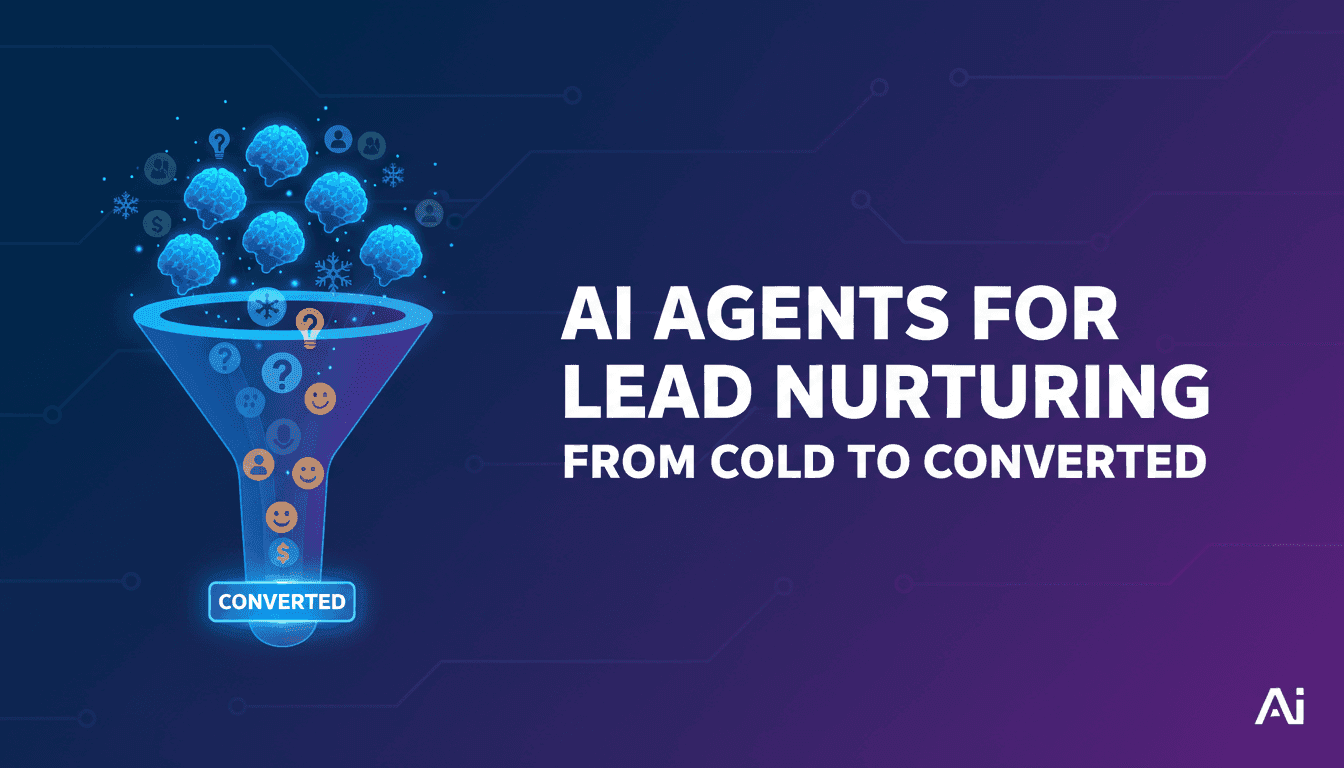
Table Of Contents
- The Evolution of Lead Nurturing in the AI Era
- What Are AI Agents and How Do They Nurture Leads?
- The Lead Nurturing Journey: Cold to Converted
- Key Capabilities of AI Agents in Lead Nurturing
- Implementation Framework: Getting Started with AI Agents
- Measuring Success: KPIs That Matter
- Common Pitfalls and How to Avoid Them
- The Future of AI-Driven Lead Nurturing
The traditional lead nurturing playbook is broken. Sales teams spend countless hours manually segmenting leads, crafting personalized emails, and timing follow-ups, only to see conversion rates stagnate at single-digit percentages. Meanwhile, promising leads slip through the cracks because human teams simply can't scale personalized attention across hundreds or thousands of prospects simultaneously.
AI agents are fundamentally changing this equation. Unlike basic marketing automation tools that follow rigid if-then rules, AI agents can understand context, learn from interactions, and adapt their approach to each individual lead's behavior and preferences. They work around the clock, processing signals that human sales teams would miss, and delivering personalized experiences at a scale previously impossible.
This comprehensive guide explores how AI agents transform lead nurturing from a labor-intensive process into an intelligent, automated system that moves prospects from cold contacts to converted customers. Whether you're a marketing executive exploring AI adoption or a sales leader seeking to accelerate pipeline velocity, you'll discover practical frameworks, implementation strategies, and measurable outcomes that demonstrate AI's impact on revenue generation.
The Evolution of Lead Nurturing in the AI Era
Lead nurturing has undergone three distinct evolutionary phases. The first generation relied on manual processes where sales representatives personally tracked every interaction in spreadsheets and sent individual emails. This approach offered maximum personalization but couldn't scale beyond small prospect lists. The second generation introduced marketing automation platforms that could trigger email sequences based on predetermined rules, enabling teams to reach larger audiences but sacrificing the nuanced responsiveness that characterizes effective relationship building.
We're now entering the third generation, where AI agents combine the scale of automation with the contextual understanding of human intelligence. These systems don't simply execute predetermined workflows; they analyze behavioral patterns, predict lead readiness, and continuously optimize their nurturing strategies based on outcomes. An AI agent might notice that a particular lead engages more with video content in the evening hours and automatically adjust delivery timing and content format without human intervention.
The business impact is substantial. Organizations implementing AI agents for lead nurturing report 30-50% increases in conversion rates and significant reductions in sales cycle length. More importantly, sales teams can redirect their time from repetitive nurturing tasks to high-value activities like closing deals and building strategic relationships. This shift represents not just efficiency gains but a fundamental reimagining of how businesses cultivate prospect relationships at scale.
What Are AI Agents and How Do They Nurture Leads?
AI agents differ fundamentally from traditional automation tools in their ability to perceive, reason, and act autonomously. While a standard marketing automation platform executes predefined rules, an AI agent observes lead behavior across multiple channels, interprets signals within context, makes decisions about appropriate next actions, and learns from outcomes to improve future performance. Think of them as digital sales development representatives that never sleep, never forget a follow-up, and continuously get better at their job.
These agents integrate with your existing technology stack—CRM systems, email platforms, website analytics, and social media channels—to create a unified view of each lead's journey. When a prospect downloads a whitepaper at 2 AM, the AI agent doesn't just send a templated thank-you email. It analyzes which specific sections the prospect spent time reading, cross-references this with their industry and company size, identifies similar leads who converted, and crafts a personalized follow-up strategy that might include targeted content recommendations, optimal outreach timing, and appropriate engagement channels.
The "agent" designation is significant because these systems exhibit goal-oriented behavior rather than simply responding to triggers. You can assign them objectives like "qualify leads for enterprise sales team" or "nurture mid-market prospects to demo request," and they'll autonomously determine the best path to achieve these goals. They operate with varying degrees of autonomy depending on your configuration—some organizations allow AI agents to send communications directly, while others use them to generate recommendations that human team members approve before execution.
The Lead Nurturing Journey: Cold to Converted
Understanding how AI agents facilitate each stage of the lead nurturing journey reveals their transformative potential for revenue generation. The path from cold contact to converted customer involves distinct phases, each requiring different engagement strategies, content types, and timing considerations.
Stage 1: Initial Contact and Qualification
The journey begins when a prospect first enters your ecosystem—perhaps through a website visit, content download, event registration, or inbound inquiry. AI agents immediately spring into action, analyzing available data points to assess lead quality and intent. They examine firmographic information like company size and industry, technographic data about current technology usage, and behavioral signals such as which pages the prospect visited and how long they engaged with specific content.
Traditional lead scoring systems assign static point values to these actions, but AI agents evaluate context dynamically. A CFO downloading a ROI calculator carries different weight than an intern accessing the same resource. The AI agent recognizes these distinctions through pattern matching against thousands of previous lead interactions and outcomes. Within minutes of initial contact, it can estimate conversion probability, recommend appropriate nurturing tracks, and flag high-potential leads for immediate sales attention.
The qualification process extends beyond binary "qualified or not" determinations. AI agents identify specific pain points, budget indicators, timeline signals, and decision-making authority clues embedded in prospect behavior. This intelligence shapes every subsequent interaction, ensuring that nurturing efforts align with where the prospect actually is in their buying journey rather than forcing them through generic sequences.
Stage 2: Engagement and Education
Once qualified, leads enter the engagement phase where the primary objective shifts to building relationship foundation and establishing your organization as a trusted resource. AI agents excel here by orchestrating multi-channel touchpoints that feel personalized rather than automated. They might send educational content that addresses the specific challenges the prospect's industry faces, share relevant case studies featuring similar companies, or invite them to webinars covering topics they've shown interest in through their browsing behavior.
The sophistication lies in continuous adaptation based on response patterns. If a prospect consistently opens emails but doesn't click through, the AI agent might test subject line variations or adjust content formats. When a lead engages heavily with technical documentation, the agent recognizes buying committee composition signals and might introduce more detailed product specifications while simultaneously nurturing potential economic buyers with business case content.
Timing optimization represents another critical advantage during this stage. Rather than sending emails on predetermined schedules, AI agents analyze when individual prospects are most likely to engage based on their historical interaction patterns and similar lead cohorts. A prospect who consistently engages with content on Tuesday mornings will receive priority communications during that window, dramatically improving open and engagement rates compared to one-size-fits-all sending schedules.
Stage 3: Consideration and Evaluation
As leads demonstrate sustained engagement and show buying signals—like visiting pricing pages, downloading comparison guides, or spending significant time on product feature pages—they transition into active consideration. AI agents detect these behavioral shifts and adjust nurturing strategies accordingly. The content mix evolves from educational to evaluative, featuring detailed product information, competitive comparisons, customer testimonials, and implementation case studies.
During this critical stage, AI agents also identify and address potential objections before they become barriers. If a prospect repeatedly visits your security documentation, the agent recognizes a concern and might proactively share security certifications, compliance information, and testimonials from security-conscious customers. This anticipatory approach prevents deals from stalling due to unaddressed concerns that prospects might not explicitly voice.
Coordination with human sales teams becomes particularly important during consideration. AI agents can identify the optimal moment for sales outreach based on engagement intensity and buying signals, then brief sales representatives with comprehensive context about the prospect's journey, content consumed, pain points indicated, and objections suggested through behavior. This intelligence transforms sales conversations from cold outreach into informed consultations that address specific prospect needs.
Stage 4: Decision and Conversion
The final stage involves supporting the prospect's decision-making process and facilitating conversion. AI agents recognize decision-stage signals like multiple stakeholders from the same company engaging with content, demo requests, pricing inquiries, or contract-related page visits. They respond by streamlining the path to purchase, providing exactly the resources decision-makers need when they need them.
This might involve automatically scheduling product demonstrations with appropriate sales team members, generating personalized ROI calculations based on the prospect's specific use case, or assembling custom proposal packages that address the unique requirements indicated through the prospect's nurturing journey. The agent ensures that momentum doesn't stall due to information gaps, scheduling delays, or misaligned follow-ups.
Post-conversion, sophisticated AI agents transition seamlessly into customer onboarding and expansion nurturing, recognizing that the relationship continues beyond the initial sale. They might trigger implementation resources, schedule check-ins at critical milestones, and identify upsell opportunities based on usage patterns and expansion signals. This continuity ensures that the intelligence gathered during nurturing informs long-term customer relationship management.
Key Capabilities of AI Agents in Lead Nurturing
The transformative impact of AI agents stems from specific capabilities that extend far beyond traditional marketing automation:
Predictive Lead Scoring: Rather than assigning static point values to actions, AI agents calculate dynamic conversion probability by analyzing hundreds of variables simultaneously. They identify patterns across historical data that human analysts would never detect, recognizing subtle behavioral combinations that indicate high purchase intent. This scoring updates in real-time as new information becomes available, ensuring that sales teams always focus on the most promising opportunities.
Natural Language Processing: AI agents can analyze the content of emails, chat conversations, and form submissions to understand sentiment, urgency, and specific needs expressed in the prospect's own words. When a lead mentions "budget approval in Q2" in a casual email exchange, the agent captures this timeline intelligence and adjusts nurturing cadence accordingly. This contextual understanding enables genuinely personalized responses rather than generic template matching.
Content Recommendation Engines: By analyzing which content types, topics, and formats drive progression for similar leads, AI agents curate personalized content journeys for each prospect. They don't simply send the next piece in a predetermined sequence; they select resources most likely to address the prospect's current questions and move them toward conversion based on their unique profile and behavior patterns.
Channel Optimization: AI agents determine the most effective communication channels for each individual prospect. Some leads prefer email communication, others respond better to social media engagement, and still others need direct phone outreach at critical moments. The agent orchestrates multi-channel strategies that meet prospects where they are rather than forcing them into channels convenient for your organization.
Conversation Intelligence: When integrated with chatbots and conversational AI systems, nurturing agents can engage prospects in natural dialogue, answer questions, qualify interest, and seamlessly transition to human representatives when appropriate. These conversations provide rich behavioral data that informs subsequent nurturing strategies while providing immediate value to prospects seeking information.
Behavioral Trigger Recognition: AI agents identify micro-behaviors that indicate changing lead status—like repeat visits to specific pages, sudden increases in engagement frequency, or patterns suggesting competitive evaluation. They respond to these triggers with appropriate interventions, ensuring that nurturing remains relevant to the prospect's current position in their decision journey.
Implementation Framework: Getting Started with AI Agents
Successfully deploying AI agents for lead nurturing requires strategic planning beyond simply purchasing technology. Organizations that achieve meaningful results follow a structured implementation approach:
1. Define Clear Objectives and Success Metrics – Begin by identifying specific business outcomes you want AI agents to drive, whether that's reducing sales cycle length by 25%, increasing marketing qualified lead to sales qualified lead conversion by 40%, or improving lead response times to under five minutes. These objectives shape system configuration, training data priorities, and evaluation criteria. Vague goals like "improve lead nurturing" don't provide sufficient direction for effective implementation.
2. Audit Your Data Foundation – AI agents require quality data to function effectively. Assess your current data completeness, accuracy, and integration across systems. Identify gaps in lead information, behavioral tracking, and conversion attribution. Many organizations discover that their CRM data quality issues that seemed manageable with human processes become critical blockers for AI implementation. Address data hygiene, establish consistent tracking across touchpoints, and ensure proper integration between your website, email platform, CRM, and other systems before deploying AI agents.
3. Start with High-Impact Use Cases – Rather than attempting to automate your entire nurturing operation immediately, identify specific high-value scenarios where AI agents can demonstrate clear impact. This might be nurturing inbound leads from a specific campaign, re-engaging dormant prospects, or qualifying leads from trade show registrations. These bounded pilots allow you to refine your approach, build organizational confidence in AI capabilities, and demonstrate ROI before expanding to additional use cases.
4. Develop Your Content and Messaging Library – AI agents work most effectively when they have access to diverse, high-quality content addressing different prospect needs, industries, use cases, and funnel stages. Audit your existing content assets and identify gaps in coverage. Create modular content pieces that agents can combine and customize based on prospect context. Establish brand voice guidelines and approval processes for AI-generated communications to ensure consistency with your organizational standards.
5. Configure Appropriate Autonomy Levels – Determine which actions AI agents should take autonomously versus which require human review. Many organizations begin with AI-generated recommendations that marketers approve before execution, then gradually increase autonomy as confidence builds. Critical decisions like pricing negotiations or contract terms typically remain human-controlled, while routine nurturing touchpoints can operate fully autonomously.
6. Train Your Team on AI Collaboration – Sales and marketing teams need to understand how to work effectively alongside AI agents. This includes interpreting AI-generated insights, knowing when to override automated recommendations, providing feedback that improves agent performance, and structuring their workflows to leverage AI-generated intelligence. Organizations often underestimate this change management component, leading to adoption resistance that undermines implementation success.
For executives exploring AI implementation, Business+AI's consulting services provide strategic guidance on technology selection, use case prioritization, and implementation roadmaps tailored to your specific business context and readiness level.
Measuring Success: KPIs That Matter
Effective measurement requires tracking metrics that reflect genuine business impact rather than vanity indicators. Focus on these key performance indicators:
Conversion Rate Improvements: Track how AI agent nurturing affects conversion rates at each funnel stage—from lead to marketing qualified lead, marketing qualified lead to sales qualified lead, and sales qualified lead to customer. Compare these rates against your baseline performance and control groups not receiving AI-powered nurturing. Meaningful implementations typically show 30-50% improvement in overall lead-to-customer conversion.
Sales Cycle Velocity: Measure the time elapsed from initial contact to closed deal for AI-nurtured leads versus traditional approaches. AI agents should accelerate progression by delivering the right information at the right time, reducing the delays that occur when prospects wait for answers or can't find relevant resources. Reductions of 20-35% in sales cycle length are common indicators of effective AI agent deployment.
Lead Response Time: Track how quickly leads receive meaningful engagement after expressing interest. AI agents can achieve response times measured in seconds rather than hours or days, significantly impacting conversion probability. Research consistently shows that leads contacted within five minutes are 21 times more likely to qualify than those contacted after 30 minutes.
Personalization Effectiveness: Monitor engagement metrics specifically for AI-personalized communications versus standard templated outreach. Look at open rates, click-through rates, response rates, and content consumption depth. Effective AI personalization should show 40-60% higher engagement than generic alternatives.
Sales Team Productivity: Measure how AI agents affect sales representative activities. Track time spent on administrative tasks versus selling activities, number of qualified conversations per representative, and deal sizes closed. The goal is demonstrating that AI agents handle routine nurturing while freeing sales teams for high-value interactions that benefit from human expertise.
Cost Per Conversion: Calculate the fully loaded cost of acquiring customers through AI-agent-assisted nurturing versus traditional approaches. Include technology costs, content development, team time, and overhead. Organizations typically see 25-40% reductions in cost per acquisition as AI agents handle increasing portions of the nurturing workload.
Common Pitfalls and How to Avoid Them
Organizations implementing AI agents for lead nurturing frequently encounter predictable challenges. Awareness of these pitfalls enables proactive mitigation:
Over-Automation Without Human Oversight: Some organizations configure AI agents with excessive autonomy before establishing appropriate guardrails, resulting in communications that miss tone, make inappropriate assumptions, or escalate edge cases poorly. Maintain human oversight for high-stakes interactions and establish clear escalation protocols for scenarios the AI agent handles with low confidence. Gradually expand autonomy as you validate performance.
Insufficient Training Data: AI agents require substantial historical data to identify effective patterns. Organizations with limited lead volume or short operational history may struggle to generate sufficient training data for sophisticated AI models. In these cases, consider starting with rule-based automation enhanced with lighter AI capabilities, or leverage industry benchmarks and similar company data to supplement your limited historical information.
Neglecting the Human-AI Handoff: Poor coordination between AI agents and human sales teams creates jarring prospect experiences. A lead nurtured through personalized AI interactions who then receives generic sales outreach that ignores their journey will question your organizational competence. Ensure seamless information flow from AI systems to sales teams, and train representatives to leverage AI-generated intelligence in their conversations.
Privacy and Compliance Oversights: AI agents processing personal information must comply with data protection regulations like GDPR, CCPA, and industry-specific requirements. Ensure your implementation includes proper consent mechanisms, data retention policies, and transparency about AI usage. Violations can result in significant penalties and reputation damage that far exceed any efficiency gains.
Measuring Activity Instead of Outcomes: It's tempting to celebrate AI agents sending thousands of emails or scoring hundreds of leads, but these activity metrics don't necessarily correlate with business results. Maintain focus on conversion rates, revenue impact, and sales cycle improvements rather than volume metrics that might mask ineffective nurturing.
The Future of AI-Driven Lead Nurturing
The trajectory of AI agent capabilities suggests profound changes ahead for how organizations nurture prospects and build customer relationships. Emerging developments include multi-modal AI agents that seamlessly integrate text, voice, video, and visual information to create richer prospect interactions. A prospect might have a voice conversation with an AI agent that references documents they previously reviewed, generates custom visualizations explaining complex concepts, and schedules appropriate follow-up across their preferred channels—all within a single interaction.
Predictive pipeline management will enable AI agents to forecast conversion probability with increasing accuracy, allowing organizations to make more confident resource allocation decisions and identify at-risk opportunities before they're lost. Real-time competitive intelligence integration will allow agents to adjust messaging and positioning based on competitive activity detected through public data sources and prospect behavior patterns indicating parallel evaluation.
The democratization of sophisticated AI capabilities means that organizations of all sizes will access agent technology previously available only to enterprises with substantial technology budgets and implementation capacity. This levels the competitive playing field, making effective lead nurturing a function of strategic implementation and creative application rather than resource advantage.
For business leaders seeking to stay ahead of these developments, Business+AI's workshops and masterclasses provide hands-on learning opportunities to understand emerging AI capabilities and develop implementation strategies appropriate for your organizational context. The annual Business+AI Forum brings together executives, solution providers, and implementation experts to share practical insights on translating AI potential into business results.
AI agents represent a fundamental shift in how organizations nurture leads from initial contact through conversion. By combining the scale of automation with contextual intelligence that rivals human understanding, these systems enable personalized prospect experiences previously impossible to deliver consistently across hundreds or thousands of leads simultaneously.
The organizations achieving meaningful results don't simply deploy technology and hope for transformation. They approach AI agent implementation strategically—defining clear objectives, ensuring data foundation quality, starting with bounded high-value use cases, and maintaining appropriate human oversight as they expand autonomy. They measure success through business outcomes like conversion rates and sales cycle velocity rather than activity metrics, and they invest in change management to ensure sales and marketing teams work effectively alongside AI capabilities.
The lead nurturing landscape will continue evolving as AI agent capabilities advance, but the fundamental principle remains constant: prospects respond to organizations that understand their specific needs, provide relevant information at appropriate times, and make the path from curiosity to purchase as frictionless as possible. AI agents simply enable you to deliver this experience at a scale and consistency that transforms revenue generation potential.
The question facing business leaders isn't whether AI agents will reshape lead nurturing—that transformation is already underway. The question is whether your organization will lead this shift or scramble to catch up as competitors leverage AI advantages to capture market share through superior prospect experiences and conversion efficiency.
Transform Your Lead Nurturing Strategy
Ready to explore how AI agents can accelerate your lead conversion and free your sales team for high-value activities? Join Business+AI's membership community to connect with executives successfully implementing AI solutions, access practical implementation frameworks, and discover solution providers with proven track records in your industry. Turn AI potential into measurable business gains.