
AI Agents for Expense Management: Transforming Receipt to Report Workflows
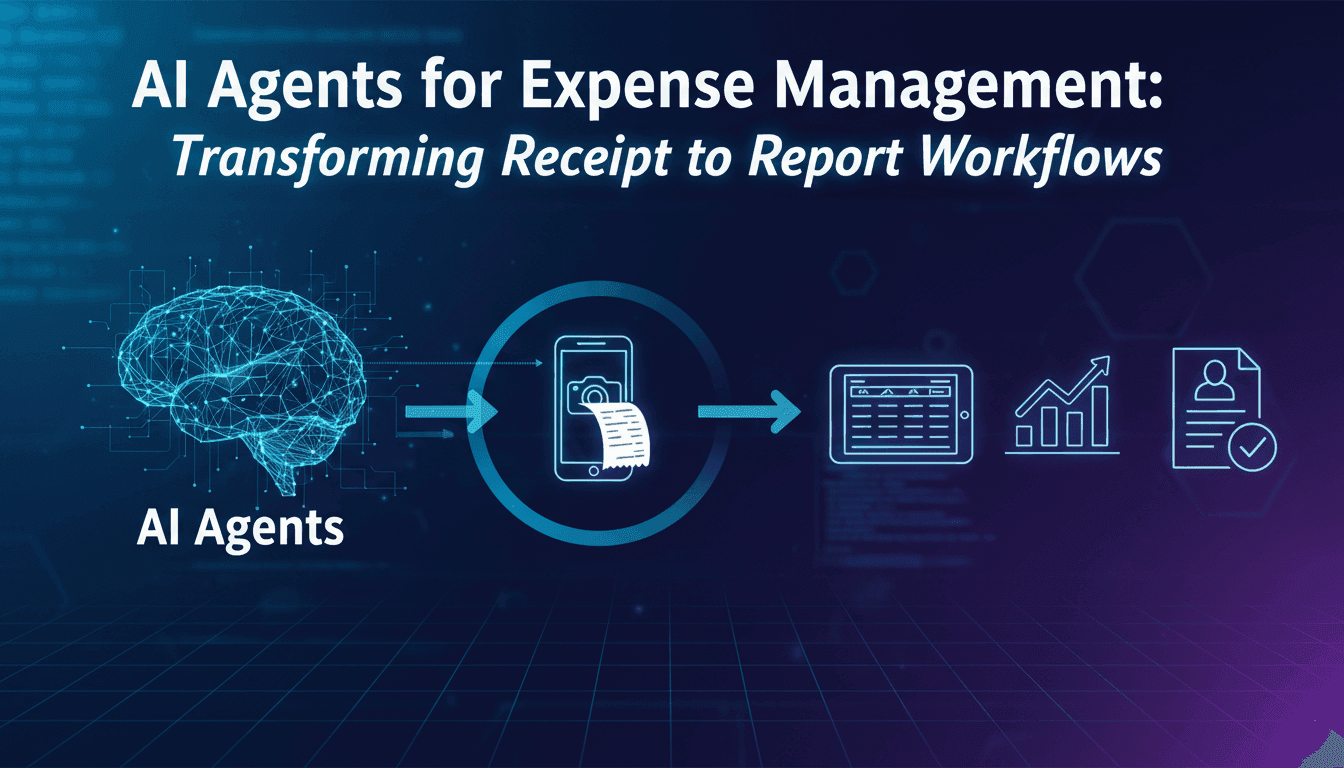
Table Of Contents
- The Evolution of Expense Management in the AI Era
- Understanding AI Agents in Finance Operations
- The Receipt to Report Journey: Where AI Agents Add Value
- Quantifying the Business Impact
- Implementation Considerations for AI Agent Deployment
- Overcoming Common Implementation Challenges
- The Future of Expense Management: Autonomous Finance
- Getting Started with AI-Powered Expense Management
Finance leaders are facing mounting pressure to deliver more with less. While traditional expense management systems have digitized basic workflows, they still require substantial human intervention at every stage—from receipt submission to final reporting. The result? Finance teams spend countless hours on manual data entry, policy checks, approval routing, and reconciliation tasks that add little strategic value.
AI agents are changing this paradigm entirely. Unlike earlier automation technologies that simply digitized paper-based processes, AI agents bring intelligence, autonomy, and continuous learning to expense management. These sophisticated systems can understand unstructured data, make contextual decisions, detect anomalies, and even predict spending patterns—all while operating with minimal human oversight.
The transformation potential is substantial. Organizations implementing AI agents in their expense management workflows report efficiency gains ranging from 40% to 70%, alongside improved compliance rates, faster reimbursement cycles, and deeper spending insights. More importantly, these technologies free finance professionals to focus on strategic activities that drive business value rather than transactional processing.
This comprehensive guide explores how AI agents are revolutionizing the entire receipt-to-report process, delivering tangible business gains that extend far beyond cost reduction. Whether you're a CFO evaluating transformation options or a finance operations leader seeking to modernize your workflows, understanding the capabilities and implementation considerations of AI agents is essential for staying competitive in the next decade of finance.
The Evolution of Expense Management in the AI Era
Expense management has undergone several transformation waves over the past two decades. The first wave brought basic digitization—replacing paper receipts with scanned images and manual spreadsheets with web-based submission portals. The second wave introduced mobile apps and optical character recognition (OCR) technology, making receipt capture more convenient but still requiring human validation at multiple touchpoints.
We're now entering the third wave, characterized by AI agents that bring true intelligence and autonomy to expense workflows. These agents differ fundamentally from their predecessors in three critical ways.
First, they possess contextual understanding. Rather than simply extracting text from receipts, AI agents comprehend the meaning and relationships within data. They understand that a dinner receipt from a client meeting location on a travel date likely represents a legitimate business meal, while similar spending at a local restaurant on a non-work day may require additional scrutiny.
Second, they demonstrate autonomous decision-making. AI agents don't just flag issues for human review—they can make routine decisions within defined parameters, escalating only exceptions that genuinely require human judgment. This autonomy dramatically accelerates processing while maintaining control.
Third, they exhibit continuous learning. As AI agents process more expense data, they become increasingly accurate at understanding company-specific patterns, policies, and preferences. An agent that initially flags 20% of expenses for review might reduce that to 5% after learning your organization's typical spending behaviors.
The convergence of natural language processing, computer vision, machine learning, and generative AI capabilities has created unprecedented opportunities for finance transformation. Organizations that deployed first-generation robotic process automation (RPA) achieved meaningful gains, but AI agents unlock an entirely new level of efficiency and insight.
Understanding AI Agents in Finance Operations
Before exploring specific applications, it's important to understand what distinguishes AI agents from simpler automation tools. AI agents possess several defining characteristics that make them particularly valuable for complex finance workflows.
AI agents operate with goal-oriented autonomy. You define the objective—such as processing expense reports while maintaining 100% policy compliance—and the agent determines the best approach to achieve it. This differs from traditional automation, where you must explicitly program every step.
They leverage multiple AI capabilities simultaneously. A single expense management agent might use computer vision to extract receipt data, natural language processing to understand policy documents, machine learning to detect fraud patterns, and generative AI to draft communications with employees about policy violations.
AI agents demonstrate contextual reasoning. They don't apply rules blindly but consider the broader context of each transaction. An agent might approve an expense that technically violates a spending limit if it recognizes the employee was traveling in an unusually expensive location during a documented business trip.
Perhaps most importantly, AI agents can interact with multiple systems and data sources. They don't simply automate a single application but orchestrate workflows across expense platforms, ERP systems, corporate card networks, travel booking tools, and accounting software—creating a seamless end-to-end process.
This sophisticated combination of capabilities enables AI agents to handle the nuanced, judgment-intensive tasks that have historically required human intervention throughout the expense management lifecycle.
The Receipt to Report Journey: Where AI Agents Add Value
The expense management process encompasses multiple stages, each with distinct challenges and opportunities for AI-driven transformation. Let's examine how AI agents enhance each phase of the receipt-to-report journey.
Intelligent Receipt Capture and Data Extraction
The expense management journey begins when an employee incurs a business expense and submits a receipt. This seemingly simple step has traditionally created significant friction and errors.
AI agents transform receipt capture through advanced computer vision that goes far beyond basic OCR. These agents can process receipts in any format—photographed, scanned, or emailed—regardless of quality, orientation, or language. They extract not just obvious fields like merchant name and total amount, but also line-item details, tax breakdowns, payment methods, and timestamps.
More impressively, AI agents understand context that humans might miss. When an employee photographs a crumpled receipt with a coffee stain obscuring part of the date, the agent can infer the likely date by cross-referencing the employee's travel itinerary, calendar entries, and corporate card transaction data. If an expense report shows a dinner receipt from Singapore on a specific date, but the employee's calendar indicates they were in Kuala Lumpur that day, the agent flags the discrepancy.
AI agents also handle receipts in multiple languages without requiring manual translation. An expense report containing receipts from Tokyo, Dubai, and São Paulo can be processed seamlessly, with all amounts converted to the home currency using the appropriate exchange rates for the transaction dates.
The efficiency gains at this stage are substantial. Organizations report that AI-powered receipt capture reduces data entry time by 80-90% while simultaneously improving accuracy rates from around 85% to over 98%.
Autonomous Policy Compliance and Fraud Detection
Policy compliance represents one of the most time-consuming aspects of traditional expense management. Finance teams must verify that every expense adheres to complex, often nuanced policies covering spending limits, eligible expense categories, receipt requirements, and approval hierarchies.
AI agents excel at this compliance verification because they can simultaneously apply hundreds of policy rules while considering contextual factors that might justify exceptions. They don't just check whether a hotel expense exceeds the maximum nightly rate—they verify whether the employee was traveling to a high-cost location during peak season, whether comparable hotels were available at lower rates, and whether the employee has a history of policy compliance.
Beyond rule-based compliance, AI agents employ sophisticated fraud detection capabilities. They identify patterns that might indicate expense manipulation, such as:
- Duplicate submissions where the same receipt appears on multiple expense reports, possibly with slight alterations
- Splitting expenses to avoid approval thresholds by dividing large purchases across multiple transactions
- Category manipulation where personal expenses are miscategorized as business expenses
- Anomalous spending patterns that deviate from an employee's typical behavior or role-based norms
- Receipt fabrication where images show signs of digital manipulation or come from known receipt generator websites
When AI agents detect potential compliance issues or fraud indicators, they don't simply reject expenses. Instead, they provide detailed explanations of the concern, suggest corrective actions, and route appropriately. Minor issues might trigger an automated request for clarification from the employee, while serious concerns escalate to finance managers with comprehensive supporting evidence.
One multinational corporation implementing AI-powered compliance detection discovered that 12% of flagged expenses weren't actually policy violations but represented gaps or ambiguities in their policy documentation. This insight prompted a comprehensive policy revision that reduced confusion and improved employee satisfaction.
Smart Approval Routing and Decision Support
Traditional expense approval workflows follow rigid hierarchies and often create bottlenecks when approvers are unavailable. Expenses sit in queues awaiting approval, delaying reimbursements and frustrating employees.
AI agents bring intelligence to approval routing by dynamically determining the appropriate approver based on multiple factors: expense type, amount, policy requirements, approver availability, and organizational context. If a manager is on vacation, the agent can route to their designated backup or, for routine expenses that clearly comply with policy, skip managerial approval entirely under delegated authority.
For approvers, AI agents provide decision support that goes beyond presenting expense details. When a manager receives an approval request, the AI agent provides context:
- Comparative analysis showing how this expense compares to similar expenses by this employee, their peers, and department averages
- Policy interpretation explaining which policies apply and whether the expense complies
- Risk assessment indicating the confidence level that this represents a legitimate business expense
- Historical patterns highlighting whether this fits the employee's normal spending behavior
- Supporting documentation automatically pulling relevant information like calendar entries, travel bookings, and project codes
This decision support enables approvers to make informed decisions in seconds rather than minutes, dramatically accelerating the approval process. Organizations report approval cycle times dropping from 5-7 days to less than 24 hours after implementing AI agent systems.
Generative AI capabilities further enhance this process by drafting communications when approvers need additional information or must decline expenses. Rather than typing rejection messages, approvers can review and send AI-drafted explanations that are professional, clear, and consistent with company communication standards.
Automated Reconciliation and Integration
After approval, expenses must be reconciled with corporate card transactions, integrated into accounting systems, and properly coded for financial reporting. This reconciliation process has traditionally required extensive manual work, particularly when discrepancies arise.
AI agents automate reconciliation by matching submitted expenses against multiple data sources. They link receipt data with corporate card transactions, travel bookings, purchase orders, and vendor invoices. When amounts don't match exactly—perhaps due to currency conversion timing differences or tips added after the initial charge—AI agents apply intelligent matching logic rather than flagging false exceptions.
The integration with enterprise resource planning (ERP) and accounting systems becomes seamless. AI agents automatically code expenses to the appropriate general ledger accounts, cost centers, projects, and dimensions based on learned patterns and rule sets. They can even interpret natural language descriptions from employees and map them to the correct accounting classifications.
When discrepancies genuinely exist, AI agents don't simply flag errors—they investigate root causes. If a corporate card shows a transaction that lacks a corresponding expense report, the agent can automatically message the employee with a reminder, including transaction details and a one-click submission option. If an expense appears on both a corporate card and a personal card reimbursement request, the agent identifies the duplication and initiates resolution.
One financial services firm found that AI-powered reconciliation reduced their month-end close cycle by three days specifically because expense-related reconciliation items were resolved in real-time rather than accumulating until period-end.
Real-Time Reporting and Predictive Analytics
The final stage of the receipt-to-report journey involves generating financial reports and extracting insights from expense data. This is where AI agents deliver strategic value that extends far beyond operational efficiency.
AI agents provide real-time visibility into spending patterns as expenses occur, not weeks later after month-end close. Finance leaders can access dashboards showing current spend against budgets, trending categories, geographic distributions, and compliance rates—all updated continuously as new expenses flow through the system.
More powerfully, AI agents apply predictive analytics to expense data, enabling proactive management rather than reactive reporting. They can forecast department spending for the remainder of the period, identify categories likely to exceed budget, and flag potential compliance issues before they become systemic problems.
Generative AI capabilities transform how finance teams interact with expense data. Rather than building complex reports using business intelligence tools, finance professionals can ask natural language questions: "Which departments are trending over budget on travel expenses?" or "What was our average daily spend in the Tokyo office last quarter compared to this quarter?" The AI agent generates the analysis and presents it in the most appropriate format—whether that's a summary paragraph, data table, or visualization.
AI agents also identify optimization opportunities within expense data. They might discover that employees frequently book hotels above the preferred vendor rates, that certain expense categories show unusual variance between offices, or that expense submission timing creates predictable cash flow patterns that could inform treasury management.
One technology company leveraged AI agent insights to renegotiate corporate travel agreements after discovering that actual booking patterns differed significantly from the usage assumptions in their contracts, resulting in annual savings exceeding $2 million.
Quantifying the Business Impact
The business case for AI agents in expense management extends across multiple value dimensions. Organizations implementing these technologies report improvements in efficiency, accuracy, compliance, employee satisfaction, and strategic insight generation.
Efficiency gains represent the most immediately measurable benefit. Finance teams processing expense reports see time reductions of 40-70% in total processing effort. One multinational reduced their dedicated expense management team from 15 full-time employees to 4, enabling the redeployed staff to focus on financial planning and analysis activities. The time savings extend beyond finance—employees spend less time preparing and submitting expenses, and managers spend less time reviewing and approving them.
Accuracy improvements manifest in multiple ways. Data extraction accuracy increases from 85-90% with traditional OCR to 98-99% with AI agents. Policy compliance checking that previously caught 70-80% of violations now identifies over 95%. Accounting coding accuracy improves similarly, reducing downstream corrections and audit findings.
Fraud and error detection delivers direct bottom-line impact. Organizations report identifying 3-7% more compliance violations and fraudulent expenses after implementing AI agents. For a company with $50 million in annual expense volume, this represents $1.5-3.5 million in prevented losses or recovered funds.
Reimbursement cycle time improvements enhance employee satisfaction and reduce administrative inquiries. Organizations report reducing average reimbursement times from 14-21 days to 3-5 days. This particularly impacts employee retention and satisfaction in markets where employees expect prompt reimbursement.
Audit readiness improves dramatically when AI agents maintain comprehensive documentation trails and enforce consistent policy application. One organization reduced their annual audit expenses by 35% because expense-related audit sampling and testing required significantly less time.
Strategic insight generation provides ongoing value that's harder to quantify but potentially more impactful. Finance teams report identifying cost reduction opportunities, negotiating better vendor contracts, and optimizing spending policies based on AI-generated insights—benefits that compound over time.
The initial investment in AI agent implementation typically generates positive returns within 12-18 months for mid-sized organizations and 6-12 months for larger enterprises with substantial expense volumes.
Implementation Considerations for AI Agent Deployment
Successfully implementing AI agents for expense management requires thoughtful planning across technology, process, and organizational dimensions. Organizations that achieve the strongest results approach implementation strategically rather than simply deploying new technology.
Data quality and integration represent the foundational requirement. AI agents require access to clean, structured data across multiple systems—expense platforms, ERP systems, corporate card networks, HR systems, and travel management tools. Organizations should conduct data quality assessments before implementation, addressing issues like inconsistent account coding, incomplete employee data, or disconnected systems. Investing in data integration upfront prevents downstream challenges and enables AI agents to deliver maximum value.
Policy documentation and rationalization become critical when AI agents will enforce policies at scale. Ambiguous or outdated policies that humans could interpret flexibly create problems when codified into agent logic. Forward-thinking organizations use AI implementation as an opportunity to review and streamline expense policies, eliminating unnecessary complexity and resolving longstanding ambiguities. Clear, well-documented policies enable more autonomous agent operation with less exception handling.
Change management and user adoption determine whether AI agents deliver theoretical or actual benefits. Employees accustomed to existing processes may resist new workflows, particularly if they don't understand how AI agents work or fear excessive scrutiny. Successful implementations include comprehensive communication about benefits, training on new processes, and transparent explanation of how agents make decisions. Organizations that position AI agents as tools that make employees' lives easier rather than surveillance mechanisms achieve much higher adoption and satisfaction.
Governance and oversight frameworks ensure AI agents operate within appropriate boundaries. While agents can make many decisions autonomously, organizations need clear policies about escalation thresholds, human review requirements, and exception handling processes. Establishing a governance committee that includes finance, IT, legal, and business representatives helps balance efficiency gains with appropriate controls.
Vendor selection and evaluation require careful consideration of multiple factors beyond basic functionality. Organizations should assess vendors' AI capabilities, integration approaches, data security practices, implementation methodologies, and ongoing support models. The expense management technology landscape includes both specialized pure-play vendors and comprehensive ERP platforms with embedded AI capabilities—each approach offers different advantages depending on organizational context.
Phased rollout strategies reduce implementation risk and enable learning. Rather than deploying AI agents across all geographies, departments, and functions simultaneously, leading organizations pilot with specific user groups, validate results, refine configurations, and then expand systematically. This approach surfaces issues when they're easier to address and builds organizational confidence in the technology.
Overcoming Common Implementation Challenges
Organizations implementing AI agents for expense management encounter predictable challenges. Understanding these obstacles and proven mitigation strategies increases implementation success probability.
Integration complexity emerges as the most common technical challenge. Expense management touches many systems, and establishing reliable data flows between them requires careful architecture. Organizations should invest in robust integration platforms or middleware rather than building point-to-point connections. Cloud-based expense management platforms often offer pre-built integrations with major ERP systems, substantially reducing integration effort.
Change resistance from employees who prefer existing processes can undermine adoption. Some employees worry that AI agents will make their work more difficult or expose minor policy violations they previously made unknowingly. Addressing this resistance requires clear communication about benefits, including faster reimbursements, reduced manual data entry, and fairer policy application. Highlighting that AI agents primarily target systematic fraud rather than minor mistakes helps reduce anxiety.
Data privacy and security concerns require careful attention, particularly for multinational organizations subject to various data protection regulations. AI agents process sensitive employee data including spending patterns and locations. Organizations must ensure compliance with GDPR, CCPA, and other privacy regulations through appropriate data handling, storage, and processing practices. Selecting vendors with robust security certifications and conducting thorough security assessments mitigates these risks.
Initial accuracy challenges can occur as AI agents learn organizational-specific patterns. Early in deployment, agents may flag legitimate expenses as exceptions or miss actual violations. Organizations should expect a learning period during which agent decisions receive more human oversight. Most implementations show accuracy improving substantially within 60-90 days as agents process more data and configurations are refined.
Policy exceptions and edge cases represent an ongoing challenge. Every organization has unique situations that don't fit neatly into policy rules—executives with different limits, project-specific exceptions, or unusual but legitimate business circumstances. Successful implementations build flexible exception handling processes rather than attempting to codify every possible scenario upfront.
Organizational politics around spending scrutiny can create resistance from senior leaders who view enhanced oversight as limiting their autonomy. Framing AI agent implementation as improving efficiency and insights rather than restricting spending helps overcome this resistance. Ensuring that policy application is consistently fair across all levels reinforces that enhanced oversight benefits the organization rather than targeting specific groups.
Organizations that anticipate these challenges and address them proactively through careful planning, stakeholder engagement, and phased implementation achieve substantially better outcomes than those treating AI agent deployment as purely a technology project.
The Future of Expense Management: Autonomous Finance
The current generation of AI agents represents just the beginning of expense management transformation. Emerging capabilities point toward increasingly autonomous finance operations that require minimal human intervention while delivering superior outcomes.
Predictive expense submission will anticipate employee needs before expenses are incurred. Imagine an AI agent that monitors an employee's calendar, notices an upcoming client dinner, suggests an appropriate restaurant based on client preferences and company policy, makes the reservation, and pre-approves the expected expense—all without the employee initiating the process.
Autonomous vendor management will enable AI agents to negotiate and manage vendor relationships for frequently purchased services. When patterns show that employees regularly book hotels in specific cities, agents could automatically negotiate corporate rates, establish preferred vendor relationships, and guide employees toward optimal choices.
Real-time budget management will shift from periodic reporting to continuous optimization. AI agents will monitor spending against budgets in real-time, automatically initiating corrective actions when trends suggest overruns—whether that's alerting managers, temporarily tightening approval thresholds, or identifying offset opportunities.
Conversational interfaces will make expense management nearly invisible. Employees will simply tell their AI agent about business expenses through natural conversation: "I just had lunch with a client and spent $127." The agent handles receipt capture, policy verification, coding, submission, and reimbursement initiation automatically.
Cross-enterprise learning will emerge as AI agents learn not just from individual company data but from anonymized patterns across multiple organizations. Agents will identify that companies in specific industries facing particular business conditions typically see certain expense patterns, enabling proactive guidance.
Integrated financial planning will connect expense management agents with broader financial planning and analysis systems. Rather than existing as a standalone process, expense data will feed directly into forecasting models, budget planning, and strategic decision-making in real-time.
These emerging capabilities suggest a future where finance professionals spend virtually no time on expense transaction processing, instead focusing entirely on strategic activities: analyzing spending patterns for business insights, optimizing policies to balance control with employee flexibility, and leveraging expense data for competitive advantage.
The organizations beginning their AI agent journey today position themselves to adopt these advanced capabilities as they mature, building on solid foundations of data quality, process optimization, and organizational change capability.
Getting Started with AI-Powered Expense Management
For organizations ready to explore AI agents in expense management, a structured approach increases the likelihood of successful outcomes. The journey begins with assessment and planning rather than technology selection.
Benchmark your current state by measuring existing expense management efficiency, accuracy, compliance rates, cycle times, and costs. This baseline enables you to quantify improvement after implementation and identify the highest-value opportunities for AI agent deployment. Organizations often discover unexpected inefficiencies during this assessment that inform implementation priorities.
Define clear objectives beyond generic goals like "improve efficiency." Specify measurable targets such as reducing average approval cycle time from seven days to two days, achieving 98% policy compliance rate, or decreasing finance team processing time by 50%. Clear objectives guide vendor selection, implementation decisions, and success measurement.
Engage stakeholders across finance, IT, HR, and business units early in the process. Understanding the pain points and requirements of employees who submit expenses, managers who approve them, and finance teams who process them ensures your implementation addresses actual needs rather than theoretical benefits. This stakeholder engagement also builds the coalition necessary for successful change management.
Assess your technology landscape including current expense management systems, ERP platforms, corporate card programs, and integration capabilities. Understanding technical constraints and opportunities shapes your implementation approach—whether that's enhancing existing systems with AI capabilities, replacing legacy platforms, or implementing complementary point solutions.
Start with a focused pilot rather than enterprise-wide deployment. Select a department or geographic unit that's large enough to generate meaningful data but small enough to manage closely. Use the pilot to validate business case assumptions, refine processes, and build organizational confidence before expanding.
Invest in capability building for the finance team members who will oversee AI agents. While agents automate many tasks, humans still need skills in areas like interpreting agent insights, handling complex exceptions, and continuously optimizing agent performance. Organizations achieving the best results treat AI implementation as a capability-building exercise rather than simply a technology deployment.
Establish feedback loops for continuous improvement. Create mechanisms to capture employee feedback on the expense submission experience, track agent decision accuracy, and identify opportunities for enhanced automation. The most successful implementations evolve continuously based on real-world usage rather than remaining static after initial deployment.
The transformation journey from traditional expense management to AI-powered autonomous processing represents a significant undertaking, but organizations that commit to it systematically achieve substantial and sustained benefits. The key is approaching AI agent implementation as a strategic finance transformation initiative rather than an isolated technology project.
For executives seeking to turn AI opportunities into tangible business results, connecting with peers who have navigated similar transformations, learning from implementation case studies, and accessing expert guidance proves invaluable. The complexity of AI agent implementation means that organizations rarely succeed in isolation—those that leverage ecosystems of expertise, whether through consulting partnerships, hands-on workshops, or executive forums that facilitate peer learning, achieve results faster and more reliably than those going it alone.
The transformation of expense management through AI agents represents one of the most compelling near-term opportunities for finance organizations to demonstrate measurable AI business value. Unlike more speculative AI applications, expense management AI delivers quantifiable efficiency gains, accuracy improvements, and cost reductions within months of implementation.
The organizations beginning this journey today gain significant competitive advantages. They free finance talent from transactional work to focus on strategic activities. They achieve superior compliance and fraud detection. They access real-time spending insights that inform better business decisions. Perhaps most importantly, they build organizational capabilities in AI implementation that translate to other finance processes and broader enterprise transformation.
The receipt-to-report process won't disappear entirely—complex exceptions, policy decisions, and strategic oversight will always benefit from human judgment. But AI agents will handle the vast majority of routine processing autonomously, elevating the finance function from a back-office operation to a strategic partner that guides the business through data-driven insights.
For finance leaders, the question isn't whether AI agents will transform expense management, but whether your organization will lead or follow this transformation. The technology has matured beyond experimental stage to proven, implementable solutions delivering tangible results. The organizations moving forward now are establishing competitive positions that will compound over time as AI capabilities continue advancing.
The journey from traditional expense management to AI-powered autonomous processing requires commitment, but the destination—a finance function operating at unprecedented levels of efficiency and strategic impact—justifies the effort. Now is the time to begin.
Ready to Transform Your Finance Operations with AI?
Turning AI possibilities into tangible business gains requires more than just technology—it demands strategic guidance, peer insights, and hands-on expertise. Business+AI brings together finance executives, AI consultants, and solution vendors to help you navigate the complexity of AI implementation.
Whether you're exploring AI agents for expense management or broader finance transformation, our ecosystem provides the resources you need:
- Connect with peers who have successfully implemented AI in finance operations at our executive forums
- Get expert guidance tailored to your specific challenges through our consulting services
- Build hands-on skills in AI implementation at our practical workshops
- Deepen your strategic understanding through our masterclass programs
Join the Business+AI membership community to access the full ecosystem of resources, connections, and expertise that help turn your AI ambitions into measurable business results.
The finance leaders who will thrive in the AI era are building their capabilities now. Join them.