
AI Agents for E-Commerce: Automating Marketing, Sales, and Customer Service
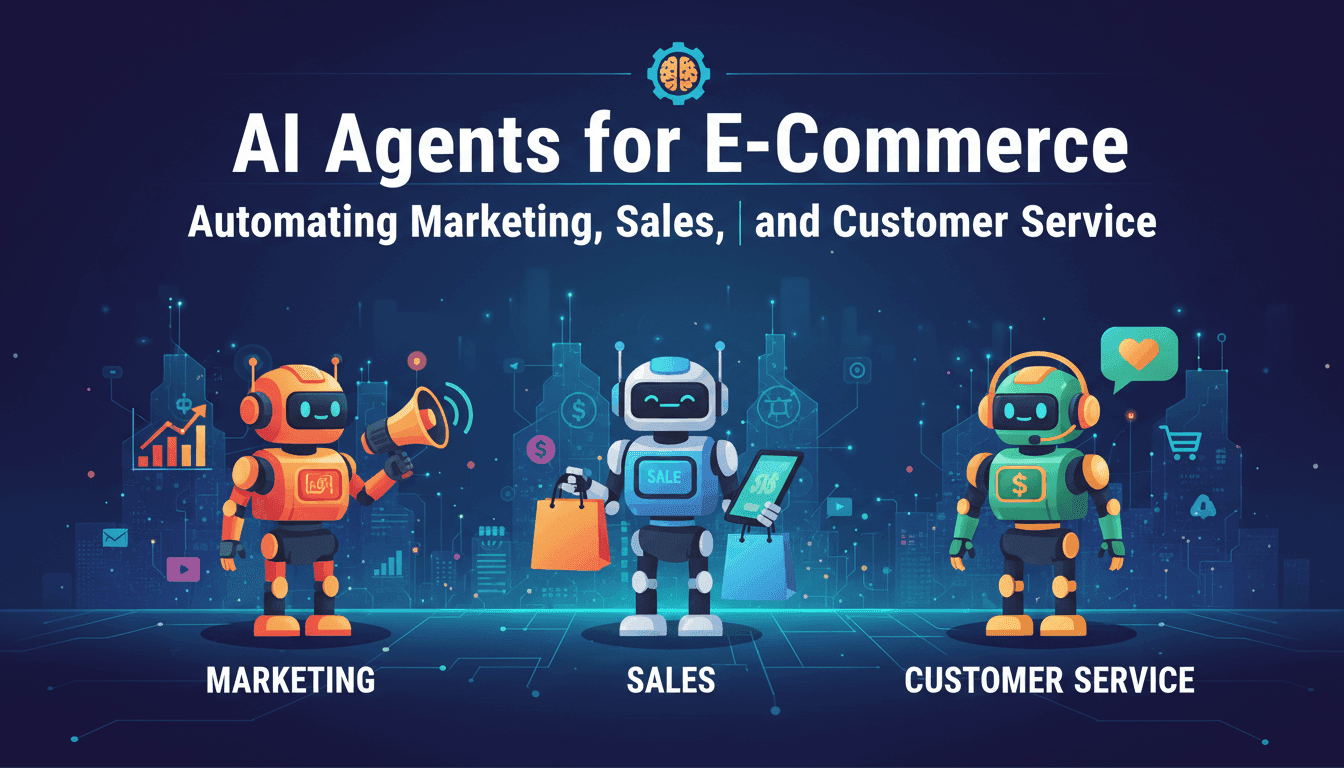
Table Of Contents
- What Are AI Agents in E-Commerce?
- AI Agents for Marketing Automation
- AI Agents for Sales: From Discovery to Conversion
- AI Agents for Customer Service
- The Business Case: ROI and Market Growth
- Key Challenges to Navigate
- How to Get Started: A Practical Framework
- The Future of Agentic Commerce
There is a meaningful difference between a business that uses AI and one that is powered by it. For e-commerce leaders, that difference is now measured in revenue points, customer satisfaction scores, and the size of the team you need to scale. AI agents—autonomous, goal-driven systems that can reason, decide, and act across multiple platforms—are no longer experimental technology. They are the operating infrastructure of the most competitive online retailers in the world today.
This article breaks down exactly how AI agents are being deployed across the three pillars of e-commerce operations: marketing, sales, and customer service. You will find the market data that makes the business case, the use cases that deliver the highest return, the challenges that trip up early adopters, and a practical framework for getting started. Whether you are evaluating your first AI deployment or looking to move from isolated tools to a fully agentic operation, this guide gives you the strategic clarity to act with confidence.
What Are AI Agents in E-Commerce? {#what-are-ai-agents}
Most organisations that think they are using AI agents are actually using automation. The distinction matters enormously. Traditional automation is trigger-based—it fires when predefined conditions are met, following a script that a human wrote in advance. AI agents are fundamentally different. They are goal-based systems that pursue an outcome, adapt to real-world context, and handle situations that scripted workflows simply cannot anticipate.
In practice, this means an AI agent can initiate a marketing campaign, monitor its performance, adjust spend allocation, recover an abandoned cart via WhatsApp, and escalate a complex complaint to a human agent—all without a single manual intervention. The shift is from reactive tools to proactive digital workers. As one way to frame it: automation follows rules, while AI agents make decisions within guardrails.
For e-commerce specifically, this evolution is happening fast. The AI-driven e-commerce market is already substantial, and the adoption curve is steep across all three operational pillars that matter most to revenue.
AI Agents for Marketing Automation {#ai-agents-marketing}
Marketing is where AI agent adoption in retail has moved the furthest and fastest. The reason is straightforward: marketing generates enormous volumes of structured data (clicks, conversions, browsing behaviour, purchase history) that AI systems can process and act on in real time.
Hyper-personalised campaigns at scale
Personalisation has long been a marketing aspiration that outpaced execution—until now. AI agents can analyse purchase histories, browsing behaviour, and account data to surface the most relevant products and offers for each individual buyer. The commercial impact is well documented. AI-powered personalisation in e-commerce can drive up to 400% ROI and cut acquisition costs by as much as 50%. Meanwhile, AI-driven marketing automation as a whole yields approximately 544% ROI, or $5.44 returned for every dollar invested over three years.
Yet there is a meaningful gap between what is possible and what is actually being done. Despite strong adoption of AI tools, 84% of marketers who have adopted AI still run generic, non-personalised campaigns. This gap represents both a risk for those who ignore it and a significant competitive advantage for those who close it.
Dynamic pricing and catalogue management
AI agents can continuously analyse competitor pricing, demand patterns, and conversion performance to adjust product pricing within safe parameters. This keeps margins intact while staying competitive—without requiring a pricing analyst to monitor dashboards around the clock. Beyond pricing, agents can keep product catalogues fresh by monitoring supplier feeds, analysing social trends, and evaluating sales data to add new products, optimise descriptions, and retire underperforming listings.
Abandoned cart recovery
Cart abandonment is one of the most consistently painful problems in e-commerce. AI agents tackle it by identifying the moment a customer leaves and instantly launching personalised re-engagement through email, SMS, or WhatsApp—sometimes offering a targeted discount or a product swap, and in some cases stepping into a live chat to address the hesitation directly. This is not a scheduled email sequence; it is a dynamic, context-aware intervention that adapts based on customer behaviour and purchase history.
Content and campaign generation
Generative AI agents can now draft product descriptions, ad copy, and email campaigns personalised to different customer segments. Organisations implementing AI in marketing report around a 32% reduction in customer acquisition costs, and 83% of marketing teams say AI helps them "do more with less"—enabling budget efficiency rather than simply adding new spend.
For executives looking to move from strategy to execution, Business+AI's workshops and masterclasses provide hands-on guidance on deploying these capabilities in a commercially grounded way.
AI Agents for Sales: From Discovery to Conversion {#ai-agents-sales}
The most forward-looking shift in e-commerce sales is the emergence of agentic commerce—where AI agents orchestrate the entire customer journey, not just a single touchpoint. Rather than a visitor browsing a website and finding their own way to checkout, multiple specialised agents collaborate to deliver a single seamless experience.
Consider how this works in practice. A discovery agent surfaces relevant products based on a customer's preferences and context (location, weather, past behaviour). A consultation agent answers questions, offers styling advice, and handles objections. A transaction agent manages checkout, applies optimal discounts, and confirms delivery. The customer experiences one coherent conversation. Behind the scenes, these agents are pulling data from your product catalogue, CRM, inventory system, and payment gateway simultaneously.
Personalised recommendation engines
AI-driven product recommendations contribute 25–35% of total e-commerce revenue, and shoppers who click on AI-generated recommendations are 4.5 times more likely to make a purchase. These are not incremental gains—they are structural shifts in how revenue is generated. The recommendation engines that drive this performance combine collaborative filtering (what similar customers bought) with LLM-based semantic understanding to surface combinations a rules-based system would never identify.
Autonomous shopping agents
A genuinely new development is the rise of AI shopping agents that act on behalf of consumers—navigating multiple marketplaces, comparing products, and in some cases completing purchases autonomously. McKinsey estimates that $750 billion of consumer spend will flow through AI-powered search by 2028, and the US B2C retail market alone could see up to $1 trillion in revenue influenced by agentic commerce by 2030. For retailers, this means their products and content must be structured not just for human browsers and traditional search engines, but for AI agents that evaluate structured data, rich product attributes, and real-time inventory.
Dynamic pricing as a sales lever
Fewer than 15% of retailers currently use AI-powered pricing, despite reported margin gains of 5–10% and payback periods within 6–12 months. This is one of the most underutilised levers in e-commerce sales. AI systems evaluate competitor prices, market demand, and inventory levels in real time—adjusting pricing by customer segment, contract terms, or order volume in ways that would be impossible to manage manually.
AI Agents for Customer Service {#ai-agents-cs}
Customer service is arguably where AI agents deliver the most immediately measurable ROI. The use case is clear, the data is abundant, and the operational cost savings are direct. AI chatbots already manage around 70% of routine e-commerce enquiries, with chatbot ROI estimated between 148% and 200%.
The more significant shift, however, is from chatbots to true AI agents. Traditional chatbots follow predefined scripts and fail the moment a customer's request deviates from an anticipated path. AI agents use machine learning and large language models to handle complex, multi-turn conversations, understand sentiment and intent, take action across connected systems, and escalate intelligently to human agents when the situation requires it.
Always-on support with genuine capability
Modern AI agents can handle order tracking, returns processing, product guidance, account enquiries, and complaint resolution—24 hours a day, seven days a week, across multiple languages. When integrated with CRM and ERP systems, they deliver context-aware responses that reflect a customer's full relationship history, not just the current conversation. The business case for this is well established: deploying AI-powered customer service agents can reduce customer service costs by 30–60%, automate up to 79% of common questions, and lift customer satisfaction scores by 27–40%.
The scale of deployment is growing rapidly. Customer service conversations handled by AI agents grew at a compound monthly rate of 2,199% between January and June 2025. Gartner projects that agentic AI will autonomously resolve approximately 80% of customer service interactions by 2029.
Intelligent escalation and sentiment detection
One of the critical differentiators between a good AI customer service deployment and a poor one is the quality of escalation logic. When an agent detects high frustration or a sentiment that signals a complex situation, it should hand off to a human agent seamlessly—providing a concise summary of the interaction history so the customer does not have to repeat themselves. This hybrid model is what separates agentic customer service from the chatbot experiences that frustrated customers a decade ago.
Proactive service
The best AI agents do not just respond—they anticipate. Proactive service means detecting a potential delivery issue before the customer notices, sending a personalised update, and offering a resolution in the same message. This approach builds loyalty while reducing inbound support volume, which compounds the cost benefit over time.
For organisations wanting to understand how to design these hybrid human-plus-AI support models effectively, Business+AI's consulting services offer direct, strategic guidance tailored to your operational context.
The Business Case: ROI and Market Growth {#business-case}
The commercial case for AI agents in e-commerce is no longer theoretical. The global AI for customer service market was valued at USD 13 billion in 2024 and is projected to reach USD 83.8 billion by 2033, growing at a compound annual growth rate of 23.2%. The retail and e-commerce segment is expected to grow the fastest within that market, at a CAGR of 26% through 2033.
At the operational level, the numbers are equally compelling:
- Marketing: AI-driven campaigns deliver 15–40% uplift in marketing ROI through better targeting, higher conversions, and cost savings.
- Sales: AI-driven product recommendations drive 25–35% of total e-commerce revenue, and AI personalization leaders report revenue gains of up to 40%.
- Customer service: Automation can cut service costs by 30–60%, with chatbot ROI between 148% and 200%.
Deloitte predicts that 25% of large businesses using generative AI will deploy AI agents in 2025, rising to 50% by 2027. Gartner estimates that 33% of enterprise software applications will include agentic AI by 2028, up from less than 1% in 2024. For e-commerce businesses considering when to move, the window for first-mover advantage is open—but it will not stay open indefinitely.
Key Challenges to Navigate {#challenges}
The opportunity is real, but so are the implementation risks. Understanding these challenges before deployment saves significant time and cost.
Data quality and integration
AI agents require large volumes of clean, connected data to function effectively. Poor or inconsistent data produces flawed outputs—and a promising AI use case becomes unworkable when the data foundation is weak. Data quality (cited by 52% of organisations) and technology integration (40%) are the two biggest barriers to marketing automation success. The foundational work is unglamorous but non-negotiable: centralise product, pricing, inventory, and customer data; standardise formats to make information structured and machine-readable.
Infrastructure and fraud detection gaps
Current e-commerce infrastructure was designed for human browsers and traditional search engines. It lacks the semantic richness that AI agents require. Additionally, existing fraud detection systems may flag legitimate AI agent traffic as bot activity—blocking transactions and creating friction that undermines the agentic commerce opportunity.
Measurement and governance
51% of organisations currently cannot measure the ROI of their AI investments. Unmeasured ROI cannot be defended in budget cycles, scaled, or optimised. The organisations that capture the strongest commercial gains from AI are not just better at building agents—they are better at measurement, and they designed their AI programs around measurable outcomes from the start. Clear governance frameworks, defined KPIs, and regular model retraining are not optional extras; they are foundational to sustained performance.
Maintaining brand voice and trust
A returns AI agent that resolves a problem efficiently but sounds robotic undermines the brand experience that years of marketing investment created. When brand voice and empathy are built into the agentic strategy, every conversation becomes an opportunity to reinforce trust. Equally, only 14% of consumers currently trust AI for autonomous purchasing—meaning transparency and clear human escalation pathways are commercially critical, not just ethically important.
How to Get Started: A Practical Framework {#get-started}
The biggest mistake organisations make is trying to do everything at once. The businesses that achieve the strongest results start with a focused, high-value use case, measure rigorously, and then scale.
A practical sequence for e-commerce leaders:
-
Start with customer support automation. Deploy an AI agent for tier-1 support enquiries. Measure resolution rates and customer satisfaction scores. This use case has the clearest ROI, the most mature tooling, and the lowest risk of brand damage if handled correctly.
-
Add product recommendations. Implement AI-powered recommendations on product pages and in search results. Track conversion lift against a control group. This is the fastest path to measurable revenue impact.
-
Launch cart abandonment recovery. Activate personalised recovery sequences across email, SMS, and messaging channels. Test different approaches—discount offers, product alternatives, urgency messaging—and measure recovery rates.
-
Fix your data foundation in parallel. Identify the data sources relevant to each use case (purchase histories, website interactions, CRM records, inventory levels) and consolidate them. This work compounds in value as you deploy more agents.
-
Build governance into every deployment. Define trigger logic, approval rules, escalation criteria, and data ownership before connecting agents to live campaigns or customer conversations. Document what the agent can and cannot do.
To accelerate this process with expert guidance, Business+AI's consulting team works directly with organisations to identify high-impact automation opportunities, design deployment blueprints, and build measurement frameworks that demonstrate commercial value. The Business+AI Forum also brings together executives, practitioners, and solution vendors who are navigating exactly these decisions in real deployments across Asia and beyond.
The Future of Agentic Commerce {#future}
The trajectory of AI agents in e-commerce points toward a world where intelligent systems do not just support the customer journey—they orchestrate it. Shopping agents that act autonomously on behalf of consumers, navigating multiple marketplaces and completing purchases based on stated preferences, are no longer science fiction. More than 60% of consumers have already used conversational AI for shopping, and 19% currently use AI agents for brand interactions—a figure expected to jump to 46% by the end of 2026.
For retailers, this shift is both an opportunity and a challenge. On one side, AI agents offer an unprecedented ability to personalise, automate, and scale operations without proportionally growing headcount. On the other, brands that fail to structure their product data, governance frameworks, and customer experience for an agentic world risk being reduced to commodities in the feed of an AI recommender that never visits their website.
The businesses that will lead in this environment are those that treat AI agents not as a technology project but as a strategic transformation—one that touches data architecture, customer experience design, brand governance, and commercial measurement simultaneously. The window to build that capability with genuine competitive advantage is now.
Conclusion
AI agents are reshaping e-commerce across every dimension that matters to revenue and customer experience. In marketing, they enable personalisation and automation at a scale that human teams cannot match. In sales, they are moving from single-touchpoint tools to orchestrators of the entire customer journey. In customer service, they are resolving the majority of enquiries autonomously while maintaining the quality and empathy that builds lasting loyalty.
The data is unambiguous: the ROI is real, the market growth is accelerating, and the competitive gap between early adopters and laggards is widening. But the organisations that capture the most value are not simply deploying more AI—they are deploying it more strategically, with cleaner data, clearer governance, and rigorous measurement.
For Singapore-based and Asia-Pacific businesses navigating this shift, turning AI potential into tangible business gains requires more than technology selection. It requires the right strategic framework, peer networks, and practical expertise to execute with confidence.
Ready to Turn AI Agents into Business Results?
Business+AI brings together executives, consultants, and solution vendors to help companies move from AI exploration to AI execution. Whether you are looking for strategic guidance, hands-on training, or access to a community of practitioners who are deploying AI agents in live commercial environments, we have the resources to accelerate your journey.
Join the Business+AI Membership to access workshops, masterclasses, consulting support, and our flagship annual Business+AI Forum—everything you need to make AI agents work for your business, not just your slide deck.