
AI Agents for Data Entry: Automating the Last Manual Process in Your Business
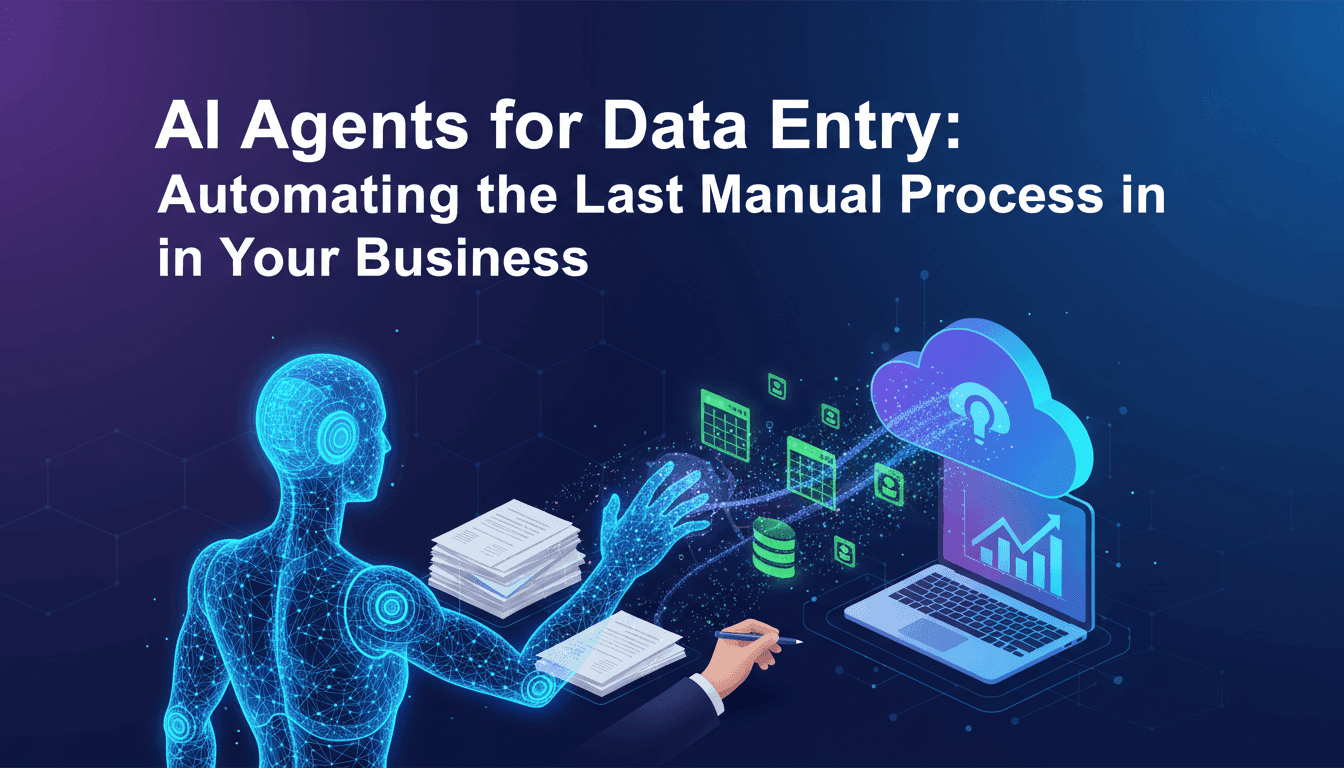
Table Of Contents
- The Hidden Cost of Manual Data Entry
- What Are AI Agents for Data Entry?
- Key Capabilities of Data Entry AI Agents
- Real-World Applications Across Industries
- Implementation: From Manual to Automated
- Measuring ROI and Business Impact
- Common Challenges and How to Overcome Them
- The Future of Intelligent Data Processing
For decades, businesses have automated everything from manufacturing lines to customer service chatbots, yet one critical process has stubbornly remained manual in many organizations: data entry. Despite accounting for thousands of labor hours and generating countless errors annually, data entry continues to consume valuable human resources that could be deployed toward strategic initiatives.
The emergence of AI agents represents a fundamental shift in how organizations approach this challenge. Unlike traditional automation tools that follow rigid rules, AI agents can learn, adapt, and handle the complexity and variability that characterize real-world data entry tasks. These intelligent systems are finally making it possible to automate what many considered the last truly manual process in business operations.
This transformation isn't just about replacing human effort with machines. It's about reimagining business processes, improving accuracy, reducing operational costs, and freeing your team to focus on high-value work that drives competitive advantage. Whether you're managing invoice processing, customer onboarding, or regulatory compliance, understanding how AI agents work and how to implement them effectively has become essential for modern business leaders.
The Hidden Cost of Manual Data Entry
Most organizations significantly underestimate the true cost of manual data entry. Beyond the obvious labor expenses, there's a cascade of hidden costs that impact your bottom line in ways that aren't immediately visible on financial statements.
Time consumption represents the most apparent cost. Studies indicate that knowledge workers spend between 10-25% of their workday on data entry tasks, translating to roughly one full day per week per employee. For a team of 50 employees, that's 250 person-days monthly devoted to repetitive data input rather than strategic work. When you calculate the opportunity cost of having skilled professionals manually transcribing information instead of analyzing data or building client relationships, the economic impact becomes staggering.
Error rates in manual data entry typically range between 1-4%, depending on data complexity and operator fatigue. While this might seem acceptable, consider that a single misplaced digit in a financial transaction or medical record can trigger costly corrections, compliance violations, or customer dissatisfaction. The downstream effects of these errors often cost 10-100 times more to fix than the original data entry task itself.
Employee morale and retention suffer when talented professionals spend hours on monotonous data entry. This repetitive work contributes to burnout, reduces job satisfaction, and increases turnover rates. Replacing an employee costs between 50-200% of their annual salary when you factor in recruitment, training, and productivity losses during the transition period.
What Are AI Agents for Data Entry?
AI agents for data entry represent a new category of intelligent automation that goes far beyond simple optical character recognition (OCR) or robotic process automation (RPA). These systems combine multiple AI technologies including computer vision, natural language processing, and machine learning to understand, extract, validate, and input data with minimal human intervention.
Unlike traditional automation tools that require explicit programming for each scenario, AI agents learn from examples and can adapt to variations in data formats, layouts, and contexts. They don't just read text from documents; they understand what the information means, where it belongs, and how it relates to other data points within your systems.
Think of an AI agent as a digital colleague who can read invoices, emails, forms, and documents just as a human would, but with several advantages. The agent works 24/7 without fatigue, processes information at speeds impossible for humans, maintains perfect consistency, and continuously improves its performance through machine learning. When it encounters something genuinely ambiguous or unusual, it can flag the item for human review rather than making a potentially costly error.
The fundamental difference between AI agents and previous automation approaches lies in their ability to handle unstructured data. While traditional systems struggled with anything that deviated from a template, AI agents can process handwritten notes, extract information from complex PDF layouts, interpret email content, and work with data in various formats and languages.
Key Capabilities of Data Entry AI Agents
Intelligent document processing forms the foundation of AI agent capabilities. These systems can automatically classify incoming documents, whether they're invoices, purchase orders, contracts, or customer applications. Once classified, the agent extracts relevant data fields using contextual understanding rather than template matching. This means the same agent can process invoices from dozens of different vendors, each with unique layouts, without requiring individual configuration for each format.
Contextual validation ensures data quality in ways that simple rule-based systems cannot. AI agents cross-reference extracted information against multiple sources, identify anomalies based on historical patterns, and apply business logic to verify that data makes sense within its context. For example, when processing an expense report, an agent recognizes whether claimed amounts are reasonable for the stated expense category, whether dates align logically, and whether supporting documentation matches the claim.
Multi-source data integration allows AI agents to gather information from various systems and formats to complete a single task. When onboarding a new customer, an agent might pull data from an email application, verify information against external databases, extract details from uploaded documents, and populate fields across multiple internal systems, all while ensuring consistency and accuracy throughout the process.
Continuous learning means that AI agents improve over time. As they process more documents and receive feedback on their performance, they refine their understanding of your specific business context, terminology, and requirements. This adaptive capability ensures that the system becomes more valuable the longer you use it, unlike static automation tools that remain fixed unless manually reprogrammed.
Exception handling and human escalation provide safety nets for complex scenarios. AI agents are designed to recognize when they're uncertain about a data point or encounter a situation outside their training. Rather than guessing or failing, they flag these items for human review with specific questions or context, creating an efficient human-AI collaboration model.
Real-World Applications Across Industries
In financial services, AI agents are revolutionizing accounts payable operations. Banks and insurance companies process thousands of invoices daily from vendors with varying formats and structures. AI agents extract vendor details, line items, amounts, and payment terms, then match invoices to purchase orders and route them through appropriate approval workflows. Organizations implementing these systems report processing time reductions of 70-80% and error rate decreases to below 0.1%.
Healthcare providers leverage AI agents to handle patient intake and medical record management. When patients submit insurance information, medical history forms, and consent documents, AI agents extract and validate this information across multiple healthcare systems. This reduces administrative burden on clinical staff, accelerates patient onboarding, and ensures that critical medical information is accurately captured in electronic health records. One hospital network reduced intake processing time from 45 minutes to under 5 minutes per patient.
Logistics and supply chain operations benefit from AI agents that process shipping documents, customs declarations, and inventory records. These agents handle the complexity of international documentation requirements, extract tracking information from carrier systems, update inventory databases, and flag discrepancies between ordered and received goods. A mid-sized logistics company reduced data entry staffing by 60% while improving shipment tracking accuracy and reducing customs clearance delays.
Professional services firms use AI agents to automate timesheet processing, expense management, and client onboarding. Rather than having consultants manually enter time entries or reconcile expense receipts, AI agents extract this information from calendars, emails, and receipt images. One consulting firm reported that consultants saved an average of 3 hours per week on administrative tasks, time that could be redirected to billable client work.
For organizations seeking guidance on identifying the right AI applications for their specific business context, Business+AI consulting services help executives develop tailored automation strategies that align with operational priorities and deliver measurable business outcomes.
Implementation: From Manual to Automated
Successfully implementing AI agents for data entry requires a structured approach that balances technical capabilities with organizational change management. The implementation journey typically follows several distinct phases.
1. Process Assessment and Prioritization – Begin by mapping your current data entry processes to identify the highest-impact opportunities. Look for processes that are high-volume, time-consuming, and follow relatively consistent patterns despite format variations. Calculate the current cost of these processes including labor hours, error correction, and opportunity costs. Prioritize implementations based on ROI potential and organizational readiness rather than attempting to automate everything simultaneously.
2. Data Preparation and System Integration – AI agents require access to relevant systems and sample data for training. Work with your IT team to establish secure API connections between the AI platform and your existing systems like ERP, CRM, or document management solutions. Gather representative samples of the documents and data you want to automate, ensuring you include edge cases and variations that the agent will encounter in production.
3. Agent Configuration and Training – Modern AI agent platforms offer low-code or no-code configuration interfaces that allow business users to set up automation without extensive programming. During this phase, you define what data fields to extract, establish validation rules, configure approval workflows, and train the agent using your sample documents. Most platforms use active learning approaches where the agent processes examples, receives feedback on its performance, and refines its models accordingly.
4. Pilot Testing with Human-in-the-Loop – Rather than immediately switching to full automation, implement a supervised deployment where the AI agent processes real work but human operators review and validate outputs before they enter production systems. This phase serves multiple purposes: it builds confidence in the technology, provides additional training data to improve accuracy, and helps identify edge cases that require additional configuration.
5. Performance Monitoring and Optimization – Once deployed, establish key performance indicators to track agent performance including processing speed, accuracy rates, exception volumes, and business impact metrics. Modern AI platforms provide dashboards that show these metrics in real-time and highlight areas for improvement. Schedule regular reviews to assess performance trends and identify opportunities to expand automation to additional processes.
Organizations new to AI implementation often benefit from hands-on workshops that provide practical experience with AI agent platforms and implementation best practices tailored to specific industry contexts.
Measuring ROI and Business Impact
Quantifying the return on investment from AI agents requires looking beyond simple labor cost savings to capture the full spectrum of business benefits.
Direct cost reduction is the most straightforward metric. Calculate the labor hours eliminated by automation, multiply by fully-loaded labor costs (including benefits and overhead), and compare this to the platform costs and implementation expenses. Most organizations achieve positive ROI within 6-12 months, with ongoing annual savings of 60-80% compared to manual processes.
Quality improvement delivers substantial but often underestimated value. When error rates drop from 2% to 0.1%, the savings from eliminated rework, reduced compliance violations, and improved customer satisfaction can exceed direct labor savings. Track metrics like correction rates, compliance audit findings, and customer complaints related to data accuracy to quantify this impact.
Capacity expansion allows your team to handle growth without proportional headcount increases. If your business volume grows 30% but your data entry capacity scales automatically through AI agents, you've avoided 30% headcount growth in those functions. This scalability advantage becomes particularly valuable during seasonal peaks or rapid business expansion.
Speed to value measures how quickly information flows through your organization. When invoice processing time drops from 5 days to 5 hours, you can accelerate payment cycles to capture early payment discounts, improve vendor relationships, and enhance cash flow visibility. Similarly, faster customer onboarding directly impacts revenue recognition and customer satisfaction.
Strategic redeployment of human talent represents perhaps the most significant but hardest to quantify benefit. When skilled employees shift from data entry to analysis, customer relationship management, or process improvement, they create value that far exceeds their data entry contributions. Track how redeployed time translates to business outcomes like increased sales, improved customer retention, or operational innovations.
Business leaders looking to develop comprehensive frameworks for measuring AI impact can explore Business+AI masterclasses that cover advanced topics in AI ROI measurement and value realization.
Common Challenges and How to Overcome Them
While AI agents offer tremendous potential, implementation isn't without challenges. Understanding these obstacles and proven mitigation strategies increases your probability of success.
Data quality and consistency issues can limit AI agent effectiveness. If your current processes involve highly inconsistent data sources or extremely poor document quality, agents may struggle initially. Address this by implementing document quality standards for submitters, using preprocessing tools to enhance image quality, and starting with higher-quality data sources before expanding to more challenging inputs.
Integration complexity with legacy systems sometimes creates technical barriers. Older systems may lack modern APIs or have security constraints that complicate automation. Work with integration specialists to develop middleware solutions, consider implementing a document management layer that bridges the AI agent and legacy systems, or use the AI implementation as a catalyst for broader system modernization efforts.
Change management and user adoption frequently determine success or failure more than technical factors. Employees may fear job loss, resist new workflows, or lack confidence in AI-generated outputs. Communicate transparently about how automation will affect roles, emphasize skill development opportunities, involve staff in the implementation process, and celebrate early wins to build momentum and confidence.
Regulatory and compliance considerations require careful attention, particularly in highly regulated industries. Ensure that your AI agent implementation maintains necessary audit trails, includes human review checkpoints for compliance-critical processes, and meets data privacy requirements. Work with compliance teams early in the planning process to address concerns proactively rather than discovering issues after deployment.
Unrealistic expectations about what AI can achieve lead to disappointment. While AI agents are powerful, they're not magic. Some processes may require significant restructuring before automation becomes viable, some edge cases will always require human judgment, and achieving high accuracy requires proper configuration and training. Set realistic timelines, start with achievable objectives, and communicate both capabilities and limitations clearly to stakeholders.
The Future of Intelligent Data Processing
The evolution of AI agents for data entry points toward a future where manual data handling becomes the exception rather than the norm. Several emerging trends will shape this transformation over the coming years.
Multimodal AI capabilities will enable agents to process information from diverse sources including voice conversations, video content, and IoT sensor streams, not just documents. Imagine an agent that extracts action items and data from recorded meetings, processes photos from field inspections, and integrates sensor readings from equipment, creating a comprehensive operational picture without manual data compilation.
Autonomous decision-making will expand as AI agents move beyond data entry to execute increasingly complex business logic. Future agents won't just extract invoice data; they'll analyze spending patterns, negotiate terms with vendors based on defined parameters, and optimize payment timing to balance cash flow with vendor relationships, all with minimal human intervention except for strategic oversight.
Collaborative intelligence models will blur the lines between human and AI work. Rather than rigid handoffs where either a human or an agent completes a task, we'll see fluid collaboration where agents handle routine elements while seamlessly involving humans for judgment calls, with the optimal division of labor determined dynamically based on the specific situation.
Industry-specific intelligence will emerge as AI agents are trained on specialized knowledge for sectors like legal, medical, or financial services. These specialized agents will understand industry terminology, regulatory requirements, and best practices, providing not just data entry but expert-level validation and insights.
The trajectory is clear: organizations that treat AI agent implementation as a strategic initiative rather than a tactical efficiency project will gain substantial competitive advantages. The question isn't whether to automate data entry, but how quickly and comprehensively you can transform this last manual process into an intelligent, automated capability that drives business value.
For executives seeking to understand how these trends apply to their specific industry context and how to position their organizations for success, the Business+AI Forum provides a platform for learning from peers and industry leaders who are successfully navigating this transformation.
AI agents represent the culmination of decades of automation evolution, finally delivering the intelligence and adaptability needed to eliminate manual data entry across virtually any business process. The technology has moved beyond experimental stages into proven, production-ready solutions that deliver measurable ROI and transformative business impact.
The competitive implications are significant. Organizations that embrace AI agents for data entry gain advantages in cost structure, operational speed, data quality, and employee satisfaction. Meanwhile, those that cling to manual processes face mounting disadvantages as the performance gap widens. In an era where digital transformation determines market leadership, automating this last major manual process has shifted from optional efficiency project to strategic imperative.
Success requires more than simply purchasing AI software. It demands thoughtful process redesign, organizational change management, and ongoing optimization. But for businesses willing to invest the effort, the payoff extends far beyond eliminated data entry costs to fundamentally improved operational capabilities and freed human potential for strategic work that truly differentiates your organization in the marketplace.
The technology is ready. The question is whether your organization is prepared to make the leap from manual to intelligent automation.
Transform Your Data Entry Processes with AI
Ready to eliminate manual data entry and unlock strategic value across your organization? Join the Business+AI membership community to access exclusive resources, connect with implementation experts, and learn from organizations successfully deploying AI agents across their operations. Transform AI possibilities into tangible business gains with the guidance and support of Singapore's premier AI business ecosystem.