
AI Agent Use Cases in Education: From Enrollment to Graduation
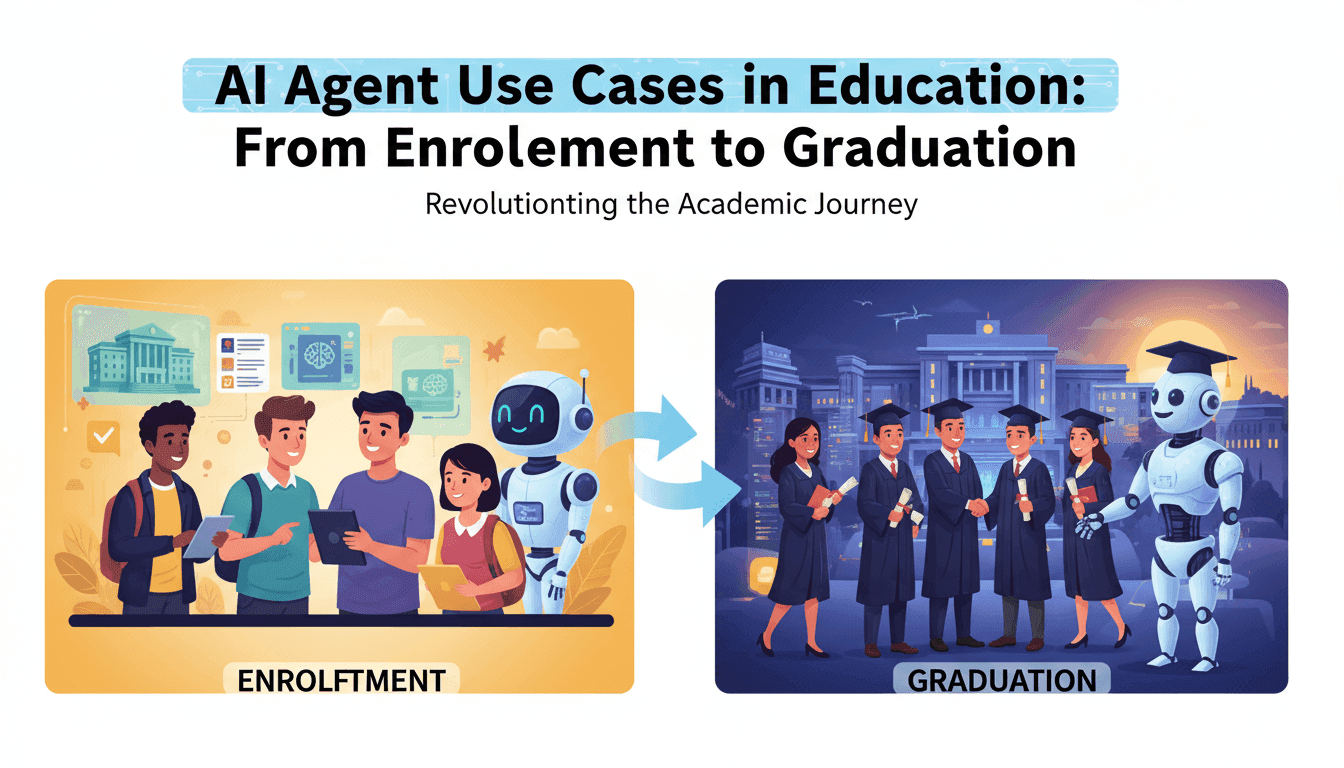
Table Of Contents
- What Are AI Agents in Education?
- AI Agents in Enrollment and Admissions
- Personalizing the Learning Experience
- Student Support and Retention
- Administrative Efficiency Across Campuses
- Assessments, Feedback, and Academic Integrity
- Career Services and Alumni Engagement
- Challenges and Considerations for Institutions
- How Business+AI Helps Education Leaders Navigate This Shift
- Conclusion
AI Agent Use Cases in Education: From Enrollment to Graduation
Education institutions are sitting on a quiet transformation. Unlike the loud disruption narratives that dominate headlines, the shift happening across universities, polytechnics, and private learning providers is more surgical: AI agents are being embedded into the student lifecycle, one touchpoint at a time. From the moment a prospective student fills out an inquiry form to the day they receive their degree, autonomous AI systems are quietly taking on tasks that once demanded significant human time and institutional resources.
For education leaders and EdTech decision-makers, this is not a distant horizon—it is an operational reality being tested and scaled right now. Understanding where AI agents create the most value across the student journey is critical for institutions that want to improve outcomes, reduce costs, and stay competitive. This article walks through the full lifecycle: enrollment, learning, student support, administration, assessment, and beyond.
What Are AI Agents in Education? {#what-are-ai-agents}
Before exploring specific use cases, it is worth clarifying what distinguishes an AI agent from a simpler AI tool. A chatbot that answers FAQs is useful, but it follows a script. An AI agent, by contrast, can perceive context, reason through a problem, take sequential actions, and adapt its behavior based on feedback or new information—often without needing a human to prompt each step.
In an education context, this means an AI agent is not just answering a student's question about deadlines; it is checking their enrollment status, cross-referencing academic calendar data, identifying if they are at risk of missing a registration window, and proactively sending a personalized reminder. The difference is between a tool that responds and a system that acts. As institutions explore AI adoption, this distinction matters enormously for setting expectations and choosing the right solutions.
AI Agents in Enrollment and Admissions {#enrollment-admissions}
Admissions teams are often the first place institutions feel the pressure of doing more with less. Application volumes grow, inquiry response times suffer, and prospective students make enrollment decisions based partly on how quickly and helpfully an institution communicates with them.
AI agents are changing this dynamic in several concrete ways:
- Lead qualification and follow-up: AI agents can assess inquiry forms, score leads based on fit criteria, and automatically follow up with personalized messages tailored to a student's program of interest, geography, or academic background.
- Application guidance: Rather than waiting days for an admissions officer to respond, applicants can interact with an AI agent that walks them through document requirements, checks submission completeness, and flags missing information in real time.
- Scheduling and interview coordination: AI agents can manage the back-and-forth of scheduling admissions interviews or campus tours, integrating directly with calendar systems and sending reminders without human intervention.
- Multilingual engagement: For international student recruitment, AI agents can conduct initial outreach and answer queries in multiple languages, removing a significant barrier for global applicants.
The cumulative effect is faster response times, higher conversion rates from inquiry to application, and admissions staff freed to focus on relationship-building with high-potential candidates.
Personalizing the Learning Experience {#personalizing-learning}
Once students are enrolled, the challenge shifts from acquisition to engagement and performance. Traditional instruction delivers the same content at the same pace to every student—a model that consistently fails those at either end of the readiness spectrum.
AI agents are enabling a fundamentally different approach. By analyzing how a student interacts with course materials, where they spend time, which concepts they revisit, and how they perform on formative assessments, AI agents can dynamically adjust the learning path. A student struggling with foundational statistics concepts in a data analytics program might be automatically directed to remedial modules, interactive exercises, or peer study groups—without waiting for a tutor to notice the gap.
Beyond remediation, AI agents can also accelerate high-performing students by unlocking advanced content, suggesting elective topics, or connecting them with research opportunities aligned to their interests. This kind of adaptive learning, at scale, is one of the most compelling arguments for AI investment in education. It moves institutions closer to the vision of personalized education without requiring a 1:1 student-to-instructor ratio.
Student Support and Retention {#student-support-retention}
Student retention is one of the most financially and reputationally significant metrics for any institution. Dropout rates carry real costs: lost tuition revenue, reduced alumni networks, and reputational damage in competitive markets. Research consistently shows that early intervention dramatically improves retention outcomes, but identifying at-risk students early enough to act has historically been difficult.
AI agents address this through continuous monitoring and proactive outreach. By integrating data from learning management systems, attendance records, financial aid status, and even library or campus facility usage, an AI agent can build a real-time picture of each student's engagement level. When patterns associated with disengagement appear—fewer logins, missed assignments, declining grades—the system can automatically initiate a check-in, route the student to a counselor, or alert a program advisor.
Beyond academic risk, AI agents are also being used to support student mental health and wellbeing. Institutions are deploying AI-powered support bots that are available 24/7 to provide initial emotional support, psychoeducation, and referrals to professional services. These systems are not replacements for qualified counselors, but they significantly reduce the gap between a student experiencing distress and getting connected to the right resource.
Administrative Efficiency Across Campuses {#administrative-efficiency}
Higher education institutions are notoriously complex organizations. A single university might operate dozens of faculties, hundreds of programs, multiple campuses, and thousands of administrative processes running simultaneously. The administrative burden on staff is immense, and much of it is repetitive and rules-based—exactly the kind of work AI agents handle well.
Key administrative use cases include:
- Course registration assistance: AI agents can help students navigate course selection, flag schedule conflicts, check prerequisite completion, and submit enrollment forms across integrated systems.
- Financial aid queries: Students frequently have urgent questions about scholarships, bursaries, and payment deadlines. AI agents can handle the majority of these queries instantly, escalating only complex cases to human advisors.
- Document processing: Transcripts, letters of enrollment, deferral requests, and graduation clearances all involve document handling that AI agents can process faster and with fewer errors than manual workflows.
- IT and facilities helpdesks: AI agents serving as first-line support for technical issues or room bookings reduce wait times and free specialist staff for higher-value tasks.
The aggregate time savings across these functions can be substantial. Institutions that have deployed AI agents in administrative roles report staff being redirected from transactional work to strategic initiatives—advising, program development, and community engagement.
Assessments, Feedback, and Academic Integrity {#assessments-feedback}
Assessment is a domain where AI is generating both significant opportunity and significant debate. On the opportunity side, AI agents can provide students with near-instant formative feedback on written work, code submissions, problem sets, and presentations. This accelerates the learning loop in ways that traditional feedback cycles—often taking days or weeks—simply cannot match.
For educators, AI agents can assist in grading rubric-based assessments, flagging submissions that deviate significantly from expected patterns, and generating detailed analytics on class-wide performance gaps that inform teaching adjustments. This does not eliminate the educator's role in assessment; it amplifies their capacity to focus on nuanced judgment calls while routine evaluation is handled at scale.
Academic integrity is the more contested territory. As generative AI makes it easier for students to produce written work with minimal effort, institutions are deploying AI detection agents as part of their assessment workflows. The arms race between AI-generated content and AI detection is ongoing, and no institution should rely solely on detection tools. The more durable response is redesigning assessments to emphasize process, oral defense, and applied demonstration—areas where AI-generated shortcuts are far less effective.
Career Services and Alumni Engagement {#career-alumni}
The student lifecycle does not end at graduation. Career outcomes are increasingly central to how prospective students evaluate institutions, and alumni engagement drives donations, mentorship programs, and industry partnerships that benefit current students.
AI agents are finding strong use cases at this stage of the journey as well. In career services, AI agents can match students with internship and job opportunities based on their skills, academic record, and stated preferences—functioning as an always-available career advisor that curates relevant openings and prepares students for applications. Resume review, interview preparation, and professional networking guidance are all areas where AI agents can provide personalized, scalable support.
For alumni relations, AI agents enable institutions to maintain engagement at a scale that human teams cannot. Personalized outreach tied to alumni milestones, relevant professional events, giving campaigns, and mentorship matching can all be orchestrated by AI agents that understand individual alumni profiles and engagement history. The result is a more consistent, relevant alumni experience that strengthens the institution's long-term community.
Challenges and Considerations for Institutions {#challenges-considerations}
Adopting AI agents in education is not without friction. Institutions considering deployment need to address several critical dimensions:
Data privacy and governance are non-negotiable starting points. Student data is sensitive, and AI systems that process it must comply with relevant regulations, including PDPA in Singapore and FERPA in the United States, among others. Institutions need clear data governance frameworks before deploying AI agents that touch student records.
Integration complexity is a practical barrier. Most institutions run legacy systems—student information systems, learning management systems, and financial platforms that were not designed to interoperate with AI agents. Successful deployment often requires significant integration work and a phased implementation strategy.
Equity and access deserve careful attention. If AI-powered personalization or support is only available to students with reliable internet access or specific devices, institutions risk widening existing inequalities rather than reducing them.
Staff capability and change management are frequently underestimated. The technical deployment of an AI agent is often easier than getting faculty and staff to trust, use, and benefit from it. Investment in training and change management is as important as investment in the technology itself.
How Business+AI Helps Education Leaders Navigate This Shift {#businessai-education}
For education executives and EdTech leaders exploring AI agent adoption, the gap between awareness and action is often filled with uncertainty: which use cases to prioritize, how to evaluate vendors, and how to build internal capability that outlasts any single implementation.
Business+AI exists precisely to close that gap. Through hands-on workshops and masterclasses designed for business leaders rather than technologists, the ecosystem helps education institutions understand AI agent capabilities in practical, applicable terms. The Business+AI Forum brings together executives, solution vendors, and consultants tackling exactly these challenges—creating a space where education leaders can learn from peers who are already navigating implementation.
For institutions that need more structured guidance, Business+AI consulting services provide expert support in assessing AI readiness, mapping use cases to institutional priorities, and building the governance frameworks necessary for responsible deployment. The goal is always the same: turning AI potential into measurable institutional outcomes.
Conclusion {#conclusion}
The student lifecycle from enrollment to graduation is a series of high-stakes interactions, many of which have historically been constrained by institutional capacity. AI agents are changing the calculus—not by replacing the human relationships that define great education, but by handling the volume, repetition, and data complexity that erode the time and attention educators and advisors have for those relationships.
Institutions that approach AI agent adoption strategically, starting with clear use cases, strong data governance, and meaningful staff enablement, are positioning themselves to deliver better student outcomes at sustainable operating cost. The window for thoughtful early adoption is open. Those who move with intention now will not just keep pace with change; they will define what excellent, AI-enabled education looks like for the next generation of learners.
Ready to move from AI curiosity to AI capability?
Join the Business+AI ecosystem and connect with education leaders, consultants, and solution providers who are already turning AI use cases into institutional results. Explore membership options at Business+AI and take the next step toward a smarter, more effective institution.