
AI Adoption Curves: What to Expect at Each Stage of the Journey
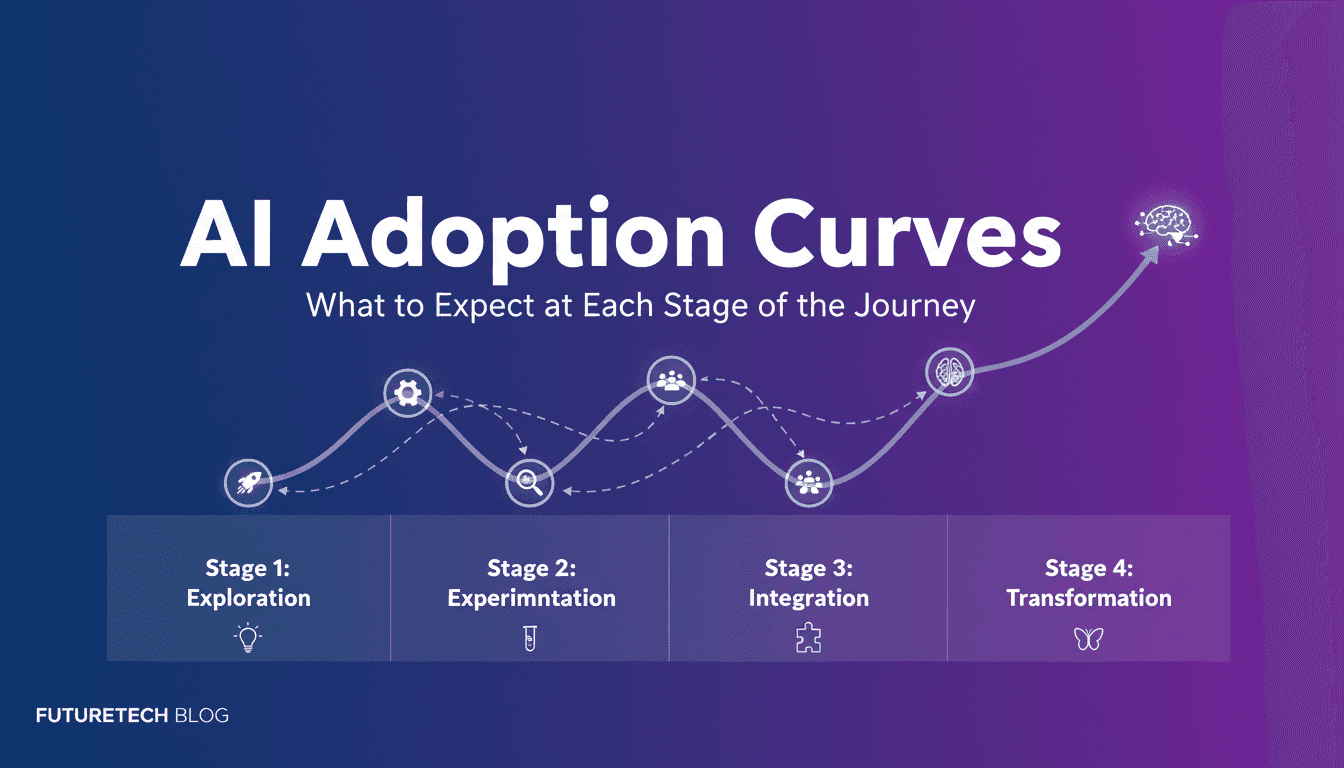
Table Of Contents
- Why the AI Adoption Curve Matters More Than the Technology Itself
- The Three Phases of the AI Adoption Curve
- Where Most Businesses Actually Get Stuck
- The Hidden Variable: Organizational Readiness
- How to Identify Which Stage Your Business Is In
- Strategic Choices at the Inflection Point
- Accelerating Your Journey Without Skipping the Fundamentals
- Conclusion
AI Adoption Curves: What to Expect at Each Stage of the Journey
Most business leaders today aren't asking whether to adopt AI. They're asking something far harder: where are we on this journey, and what should we be doing right now?
The honest answer is that AI adoption doesn't happen in a straight line. It follows a predictable curve — one that every major technology shift in history has traced before it, from the steam engine to the internet. Understanding that curve isn't just academically interesting. It tells you which challenges are normal, which mistakes are avoidable, and where the real competitive advantages are being built right now.
This article breaks down the AI adoption curve into its three core phases, explains what organizations typically experience at each stage, and gives you a practical lens for assessing where your business stands today. Whether you're just beginning to pilot your first AI tool or you're wrestling with scaling what already works, knowing your position on the curve changes how you invest, how you hire, and how you compete.
Why the AI Adoption Curve Matters More Than the Technology Itself {#why-it-matters}
There's a temptation in business to focus almost entirely on the technology when discussing AI — the tools, the models, the vendors. But the technology is rarely what separates the leaders from the laggards. What separates them is timing and organizational readiness relative to where the adoption curve currently sits.
Historically, every transformative technology follows what researchers call an S-curve: a slow initial climb as early movers figure things out, a steep acceleration as the foundations are established and adoption goes mainstream, and a flattening as the technology becomes commoditized and attention shifts to optimization. Steam power, electrification, the internet — all followed this pattern. AI is no different, except that this particular S-curve is moving faster than any before it.
Understanding this matters because the right strategy in Phase 1 is completely wrong in Phase 2. Companies that run endless pilots when they should be scaling will find themselves overtaken. Companies that rush to scale before they've built the right foundations will waste enormous resources. The curve tells you which game you're actually playing.
The Three Phases of the AI Adoption Curve {#three-phases}
Phase 1: The Learning Curve — Exploration and Experimentation {#phase-1}
The first phase of AI adoption is defined by uncertainty, and that's entirely normal. Organizations in this stage are running pilots, testing tools, and trying to figure out where AI can actually add value versus where it's just hype. Failure rates are high, timelines are long, and there's often more energy spent on internal debates about AI than on actual implementation.
At this stage, the most common mistake is treating every failed pilot as evidence that AI doesn't work for your industry. In reality, the learning curve is supposed to be messy. The front-runners who eventually dominate later phases often have a graveyard of early experiments behind them — the difference is they treated those experiments as tuition payments, not write-offs. They were learning what their data could support, which processes were genuinely automatable, and what organizational changes would be needed to make any of it stick.
What businesses in Phase 1 should prioritize:
- Data infrastructure: You cannot run AI at scale on bad data. This phase is the right time to audit your data quality, consolidate scattered systems, and start building clean, accessible data pipelines.
- Small wins that prove value: Rather than betting on one large transformation project, identify two or three contained use cases where AI can show a clear, measurable improvement within 90 days.
- Internal capability building: Start developing AI literacy across the organization, not just within the technology team. Leaders who understand AI at a conceptual level make far better decisions about where to invest.
- Vendor and partner evaluation: This is the time to assess the ecosystem — which tools, platforms, and consulting partners have genuine expertise versus marketing polish.
If your organization is at this stage, the Business+AI workshops are specifically designed to help leadership teams move from curiosity to clarity — building a shared language and prioritizing use cases that can actually deliver ROI.
Phase 2: The Doing Curve — Deployment and Scale {#phase-2}
Phase 2 is where organizations that survived the learning curve begin to accelerate — sometimes dramatically. The foundational work is largely done: data infrastructure exists, a handful of use cases have proven their value, and the organization has developed at least some internal AI capability. Now the challenge shifts from figuring out if AI works to scaling what works, fast.
This phase has a characteristic feel: it's simultaneously exciting and exhausting. Teams that cracked the code on one use case want to replicate it everywhere. Leadership starts setting ambitious targets. And then reality hits — because what works in one business unit or one market doesn't automatically transfer to another. The data environments are different, the processes are different, and the change management requirements are entirely different at scale.
Research from McKinsey's Global Lighthouse Network found that while leading manufacturers could eventually implement new AI use cases in under six months, their first five use cases took an average of ten to twenty months. The speed came after the capabilities were built. This is an important pattern for any business leader to internalize: the doing curve rewards investment in capability, not just investment in technology.
Businesses in Phase 2 face a specific set of scaling challenges:
- The copy-paste problem: A solution designed for one context often needs significant rework to function in another. Build for reusability from the start.
- Talent gaps at scale: The handful of AI champions who drove Phase 1 can't personally oversee every deployment. Organizations need to invest in training the broader workforce.
- Governance and risk management: As AI touches more decisions, the stakes of a bad model or a biased output increase. This phase demands proper AI governance frameworks.
- Measuring what matters: ROI metrics that made sense for a pilot often don't capture the full impact at scale. Businesses need more sophisticated measurement approaches.
For organizations navigating this transition, peer learning is often the fastest path forward. Hearing how other executives have solved the same scaling problems — in comparable industries and contexts — compresses the learning cycle significantly. The Business+AI Forum brings together exactly these conversations, connecting executives who are working through Phase 2 challenges in real time.
Phase 3: The Optimization Curve — Standards and Competitive Moats {#phase-3}
Phase 3 is where AI stops being a project and becomes infrastructure. Organizations at this stage have AI embedded in their core operations. The conversations are no longer about whether to use AI or how to scale it — they're about regulatory compliance, industry standards, competitive differentiation, and continuous optimization of systems that are already running at scale.
In some sectors, particularly financial services and technology, a subset of organizations are already here. For most industries in Southeast Asia and globally, Phase 3 is still on the horizon — but it's approaching faster than most leaders expect. The organizations that will define the standards of their industries are being determined right now, during Phases 1 and 2.
What's notable about Phase 3 is that the competitive moat it creates is almost impossible to overcome through technology purchases alone. By this stage, leaders have proprietary data assets built over years, deeply trained workforces, finely tuned operational processes, and AI systems that have been iterated hundreds of times. A late entrant buying the same AI tools simply cannot replicate what took years to build.
Where Most Businesses Actually Get Stuck {#where-stuck}
The most dangerous position on the adoption curve isn't Phase 1 — it's the gap between Phase 1 and Phase 2. Researchers and practitioners sometimes call this "pilot purgatory": the state where an organization has run enough experiments to know AI can work, but hasn't committed the organizational changes necessary to actually scale it.
Pilot purgatory is remarkably common. A business runs a successful chatbot pilot. Results are good. And then... nothing happens for six months while stakeholders debate budget, ownership, and integration. Meanwhile, a competitor who started three months later but committed to execution has already deployed and iterated twice.
The exit from pilot purgatory requires a deliberate decision, not better technology. It requires executive commitment to organizational change, dedicated resources for deployment (separate from exploration), and clear accountability for outcomes.
The Hidden Variable: Organizational Readiness {#organizational-readiness}
Technology is often the easiest part of AI adoption. The harder challenges are almost always human: culture, change management, internal politics, and skill gaps. Organizations that move quickly along the adoption curve share a common characteristic — they invest as heavily in people and processes as they do in technology.
This means treating AI adoption as a change management program, not a technology deployment. It means ensuring middle management is bought in, not just the C-suite. It means creating psychological safety for employees who are worried about what AI means for their roles. And it means building measurement systems that reinforce the behaviors you want, not just the outputs you can easily count.
Building this kind of organizational readiness is where many businesses benefit from expert guidance. Whether through consulting support or structured learning programs like the Business+AI Masterclass, the organizations that accelerate fastest are those that combine technical implementation with deliberate capability building at every level of the business.
How to Identify Which Stage Your Business Is In {#identify-stage}
Honest self-assessment is often the hardest part. Here are practical markers for each phase:
You're in Phase 1 if: Most of your AI activity is in pilot or proof-of-concept mode. You don't yet have standardized data infrastructure. AI decisions are being driven primarily by the technology team rather than business units. ROI from AI is still largely theoretical.
You're in Phase 2 if: At least two or three AI use cases are in production and delivering measurable business value. You're actively working to replicate those successes elsewhere in the organization but hitting unexpected friction. Talent and governance are emerging as your primary bottlenecks, not the technology itself.
You're in Phase 3 if: AI is embedded in core business processes. You're actively contributing to or monitoring industry standards and regulation. Your AI systems have significant proprietary training and iteration behind them, creating genuine differentiation that competitors can't easily replicate.
Strategic Choices at the Inflection Point {#strategic-choices}
Knowing your position on the curve enables a clearer strategic choice. Not every business needs to be a first mover in every area of AI. There are three intelligent strategic postures:
The Innovator takes calculated risks at the frontier, proving new use cases and accepting the costs and learning that comes with being first. This path builds the deepest capabilities and the strongest long-term moats, but it requires patient capital and genuine organizational commitment.
The Accelerator focuses on rapidly deploying proven approaches at scale within their industry or market, often moving faster than the innovators once the path is established. This is a high-value middle position that captures significant competitive advantage without bearing the full cost of exploration.
The Fast Follower deliberately waits until the learning curve has been navigated by others, then adopts at speed using the playbook that's been proven. This strategy works — but only if the timing is right and the follow is actually fast. Organizations that are slow followers rather than fast followers often find that the window has already closed.
What none of these strategies can accommodate is inaction. At this point in the AI adoption cycle, standing still is the only genuinely losing position.
Accelerating Your Journey Without Skipping the Fundamentals {#accelerating}
One of the most counterintuitive insights from organizations that have moved quickly along the AI adoption curve is that speed comes from doing the fundamentals well, not from cutting corners. The companies that can now implement a new AI use case in weeks rather than months are the same ones that spent years building solid data infrastructure, training their people, and developing repeatable deployment processes.
For businesses earlier on the curve, the most practical acceleration strategy is to learn from others who are further along. Peer benchmarking, executive communities, and expert-led programs that connect you with practitioners who've already navigated your current challenges can compress years of trial and error into months of structured learning.
This is precisely the model that Business+AI has built — a community where executives, AI consultants, and solution providers come together to turn strategy into action, share what's actually working, and avoid the most expensive mistakes. Whatever stage you're at on the curve, you don't have to navigate it alone.
Conclusion {#conclusion}
The AI adoption curve is not a mystery — it's a map. Every organization is somewhere on it, and understanding your position with honesty and precision is the first step to moving forward with intention. The learning curve is normal and necessary. The doing curve is where competitive positions are being established right now. And the optimization curve represents a state of genuine, durable advantage that will define industry leaders for the next decade.
The businesses that will look back on this period as the moment they pulled ahead aren't necessarily the ones with the biggest budgets or the most sophisticated technology. They're the ones that correctly diagnosed where they were, made a clear strategic choice about where they wanted to be, and built the organizational capability — not just the technology — to get there.
Your position on the curve is not fixed. What you do next is.
Ready to Accelerate Your AI Journey?
Business+AI is Singapore's ecosystem for executives who are serious about turning AI strategy into measurable business results. From hands-on workshops and masterclasses to expert consulting and the annual Business+AI Forum, we connect you with the people, insights, and frameworks to move faster and smarter along the adoption curve.
Explore Business+AI Membership and join a growing community of leaders who are navigating AI adoption — together.