
7 AI Marketing Agents That Are Replacing Traditional Roles
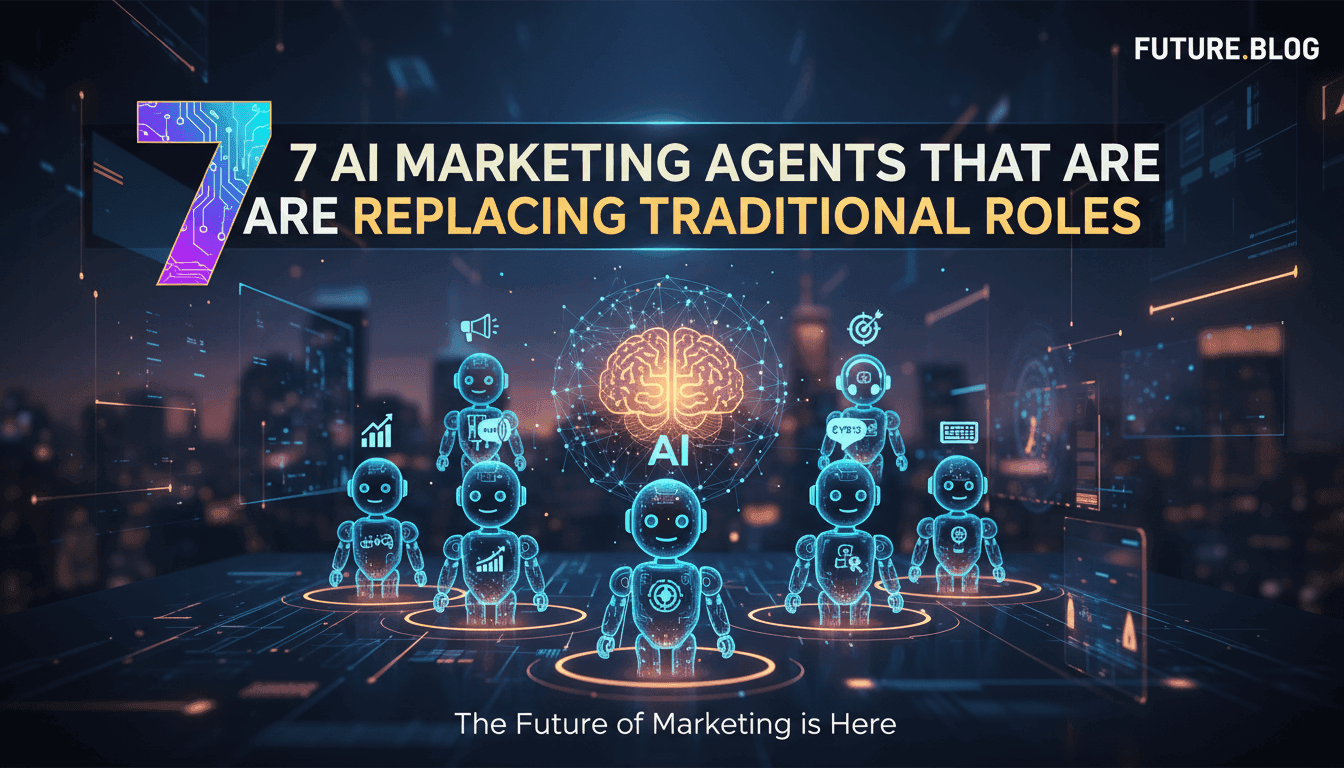
Table Of Contents
- The Shift Already Happening on Marketing Teams
- 1. AI Content Creation Agents
- 2. AI SEO and Search Optimization Agents
- 3. AI Social Media Management Agents
- 4. AI Paid Advertising Agents
- 5. AI Customer Journey and Personalization Agents
- 6. AI Analytics and Reporting Agents
- 7. AI Influencer and Outreach Agents
- What This Means for Marketing Teams and Leadership
- How to Get Ahead of the Curve
7 AI Marketing Agents That Are Replacing Traditional Roles
A mid-sized e-commerce brand recently cut its content team from twelve people to four — not through layoffs born of budget pressure, but because AI marketing agents now handle the workload the other eight once managed. This is not a distant prediction. It is a pattern playing out across industries right now, and marketing departments are sitting at the epicenter of this transformation.
AI marketing agents are purpose-built autonomous systems that don't just assist human marketers — they execute tasks end-to-end, learn from performance data, and optimize outcomes without waiting for someone to issue the next instruction. The difference between an AI tool and an AI agent is agency itself: the ability to perceive, decide, and act within a defined domain. For marketing, that domain is enormous.
This article breaks down seven specific AI marketing agents that are actively displacing or significantly transforming traditional marketing roles, what they can and cannot do, and what business leaders should be thinking about as this shift accelerates.
The Shift Already Happening on Marketing Teams {#shift}
Marketing has always been a function that blends creativity with data, and that combination made many assume it was relatively insulated from automation. That assumption is eroding quickly. The emergence of large language models, multimodal AI, and agentic frameworks has unlocked a new category of software — systems that can reason, plan, and execute marketing tasks at a scale and speed no human team can match.
What makes this moment different from earlier waves of marketing automation is the degree of cognitive work these agents can now perform. Earlier tools automated repetitive mechanical tasks like scheduling emails or resizing banner ads. Today's AI marketing agents can write a full content strategy, generate and publish assets, analyze competitor positioning, manage ad spend in real time, and report on results — all within a single workflow loop.
For executives and marketing leaders, the question is no longer whether AI will reshape their teams. The question is which roles are transforming first, and how to position your organization ahead of that curve.
1. AI Content Creation Agents {#content-creation}
The most visible displacement is happening in content. AI content creation agents — built on models like GPT-4o, Claude, and Gemini — can now produce blog articles, product descriptions, email sequences, video scripts, and social copy at a volume that would previously require entire editorial teams.
These agents go beyond simple text generation. When properly configured, they can research a topic, match a brand's tone of voice, optimize for SEO, incorporate internal linking strategies, and produce a publish-ready draft. More advanced deployments connect directly to a CMS, meaning content can move from brief to published with minimal human intervention.
Roles most affected: Content writers, copywriters, junior editors, and content strategists at the execution level. Senior strategists and brand voice custodians remain essential — at least for now — to set direction and maintain quality standards.
2. AI SEO and Search Optimization Agents {#seo}
Traditional SEO required a specialist who understood keyword research, technical audits, backlink analysis, and on-page optimization — and who could translate those insights into months-long content calendars. AI SEO agents are compressing that entire workflow.
Tools built on agentic architectures can now crawl a website, identify technical issues, map keyword gaps against competitors, generate optimized content briefs, and even draft the content itself. Some agents monitor Google Search Console data continuously and surface optimization recommendations without being prompted.
The deeper disruption here is happening in how search itself works. As AI-generated search overviews (like Google's AI Overviews) change what a click even means, AI SEO agents are being built to optimize for answer-engine visibility rather than just traditional blue-link rankings.
Roles most affected: SEO specialists, technical SEO analysts, and content strategists focused primarily on organic search execution.
3. AI Social Media Management Agents {#social-media}
Social media management has historically required a team: someone to plan the calendar, someone to write the copy, someone to design the assets, and someone to engage with comments and DMs. AI social media agents are beginning to collapse these functions into a single automated pipeline.
These agents can monitor trending topics, generate platform-native content, schedule posts across channels, and analyze engagement data to adjust future output. More sophisticated deployments include agents that respond to comments and messages using brand-aligned language, escalating only genuine customer service issues to human team members.
The risk, of course, is brand consistency and authenticity — areas where human judgment still adds significant value. Organizations that treat social AI agents as a complete replacement rather than a force multiplier tend to produce content that feels generic. Those that use agents to handle volume while humans manage voice and community relationships tend to see the best results.
Roles most affected: Social media coordinators, community managers, and social content creators at the execution level.
4. AI Paid Advertising Agents {#paid-advertising}
Paid advertising has been partially automated for years through platforms like Google Performance Max and Meta Advantage+. But the new generation of AI advertising agents goes further, operating across platforms, managing creative testing, adjusting budget allocation in real time, and generating new ad variants when performance drops.
These agents ingest performance signals — click-through rates, conversion rates, cost-per-acquisition — and make bidding and budget decisions faster than any human analyst can. Some can also write and generate new ad copy and creative assets autonomously when the system detects ad fatigue.
The net effect is that a single performance marketing manager, equipped with the right AI agent stack, can now manage campaigns at a scale that previously required a team of four to six specialists.
Roles most affected: PPC specialists, paid media buyers, and performance marketing analysts handling routine campaign management.
5. AI Customer Journey and Personalization Agents {#personalization}
Personalization at scale has been a marketing aspiration for decades. AI personalization agents are finally delivering on it. These systems analyze behavioral data, purchase history, email engagement, and browsing patterns to dynamically adjust what each user sees — whether that's the content on a landing page, the sequence of emails they receive, or the product recommendations surfaced in an app.
What makes these agents genuinely transformative is their ability to operate across the full customer journey, not just at a single touchpoint. An AI personalization agent can identify that a high-value prospect has gone cold, trigger a re-engagement sequence, adjust the offer based on the prospect's historical behavior, and hand off to a sales agent when signals indicate buying intent — all without human initiation.
This capability was previously housed in roles like marketing automation specialists, CRM managers, and lifecycle marketers. Those roles are evolving rapidly toward AI supervision and strategy rather than manual execution.
Roles most affected: Marketing automation specialists, CRM managers, and email marketing coordinators.
6. AI Analytics and Reporting Agents {#analytics}
Marketing analytics has long been a bottleneck. Data sits in multiple platforms, and translating it into actionable insights requires analysts who can query databases, build dashboards, and communicate findings to non-technical stakeholders. AI analytics agents are dismantling this bottleneck.
Modern AI analytics agents connect to data sources across the marketing stack — ad platforms, CRM, web analytics, email platforms — and generate natural language reports that answer specific business questions. Instead of waiting for a weekly report, a CMO can ask an agent "Which campaign drove the most qualified leads last quarter and why?" and receive a synthesized, data-backed answer within seconds.
Some organizations are deploying these agents to run continuous marketing mix modeling, providing ongoing visibility into which channels drive revenue rather than relying on quarterly retrospectives.
Roles most affected: Marketing analysts, data analysts embedded in marketing teams, and reporting specialists.
7. AI Influencer and Outreach Agents {#influencer}
Influencer marketing and PR outreach have traditionally been relationship-driven functions that resisted automation. That resistance is weakening. AI outreach agents can now identify relevant influencers or media contacts, assess their audience alignment with a brand's target market, draft personalized outreach messages, manage follow-up sequences, and track response rates — all within an automated workflow.
On the influencer side, some platforms use AI agents to match brands with creators, negotiate terms, brief campaigns, and analyze performance outcomes. For PR, AI agents are being used to monitor media sentiment, identify story opportunities, and draft pitches tailored to individual journalists' known interests and recent coverage.
The human relationship element still matters — particularly for high-value partnerships and strategic media relationships. But the volume work that junior PR coordinators and influencer managers once handled is increasingly agent-driven.
Roles most affected: Influencer marketing coordinators, PR assistants, and outreach specialists.
What This Means for Marketing Teams and Leadership {#implications}
The honest framing for business leaders is this: AI marketing agents are not replacing marketing as a function — they are compressing the ratio of output to headcount, and simultaneously raising the bar for what human marketers need to contribute.
The roles that will remain and grow are those centered on strategic judgment, creative direction, brand stewardship, and AI supervision. The roles being hollowed out are those defined primarily by volume execution — writing a certain number of posts, pulling a certain number of reports, managing a certain number of ad variations.
For organizations still building traditional marketing team structures, this is an urgent signal. Hiring decisions made today are being made in a context where a single AI-enabled marketer can outperform a team of five specialists from two years ago. The competitive advantage in marketing is shifting from team size to AI stack sophistication and the strategic talent to direct it.
Businesses that understand how to deploy these agents effectively — and how to integrate them into workflows that still leverage human creativity and judgment at the right points — will have a significant and compounding advantage over those still treating AI as an optional add-on.
How to Get Ahead of the Curve {#get-ahead}
Understanding that AI marketing agents exist is one thing. Knowing which ones to deploy for your specific business context, how to evaluate vendors, how to restructure your team, and how to measure ROI requires a different kind of preparation.
For marketing leaders and executives looking to move from awareness to action, the most effective path combines structured learning with peer exchange and expert guidance. Seeing how other organizations have deployed these agents — what worked, what failed, and what the transition actually looked like internally — accelerates decision-making in ways that reading articles alone cannot.
Business+AI brings together executives, consultants, and solution vendors across Singapore and the region specifically to bridge this gap, through hands-on workshops, masterclasses, and the Business+AI Forum. For organizations that want tailored guidance on building an AI marketing strategy specific to their business, consulting engagements are also available to help leadership teams move from strategy to implementation with confidence.
The Agents Are Already at Work
The seven AI marketing agents outlined here are not prototypes or experiments sitting in research labs. They are being deployed by businesses across sectors right now, reshaping team structures and redefining what marketing departments look like. The leaders who treat this as a near-future concern rather than a present reality are the ones whose organizations will find themselves playing catch-up.
The opportunity is not to resist this shift — it is to move through it deliberately, understanding which agents create real leverage for your business, and building the human capabilities around them that AI cannot replicate. That is where competitive advantage in marketing is being built today.
Ready to move from AI curiosity to AI advantage?
Join the Business+AI community to connect with peers who are navigating the same transformation, access expert-led workshops and masterclasses, and get the strategic support your team needs to lead rather than follow.