
6 AI IT Agents Running Your Technology Stack
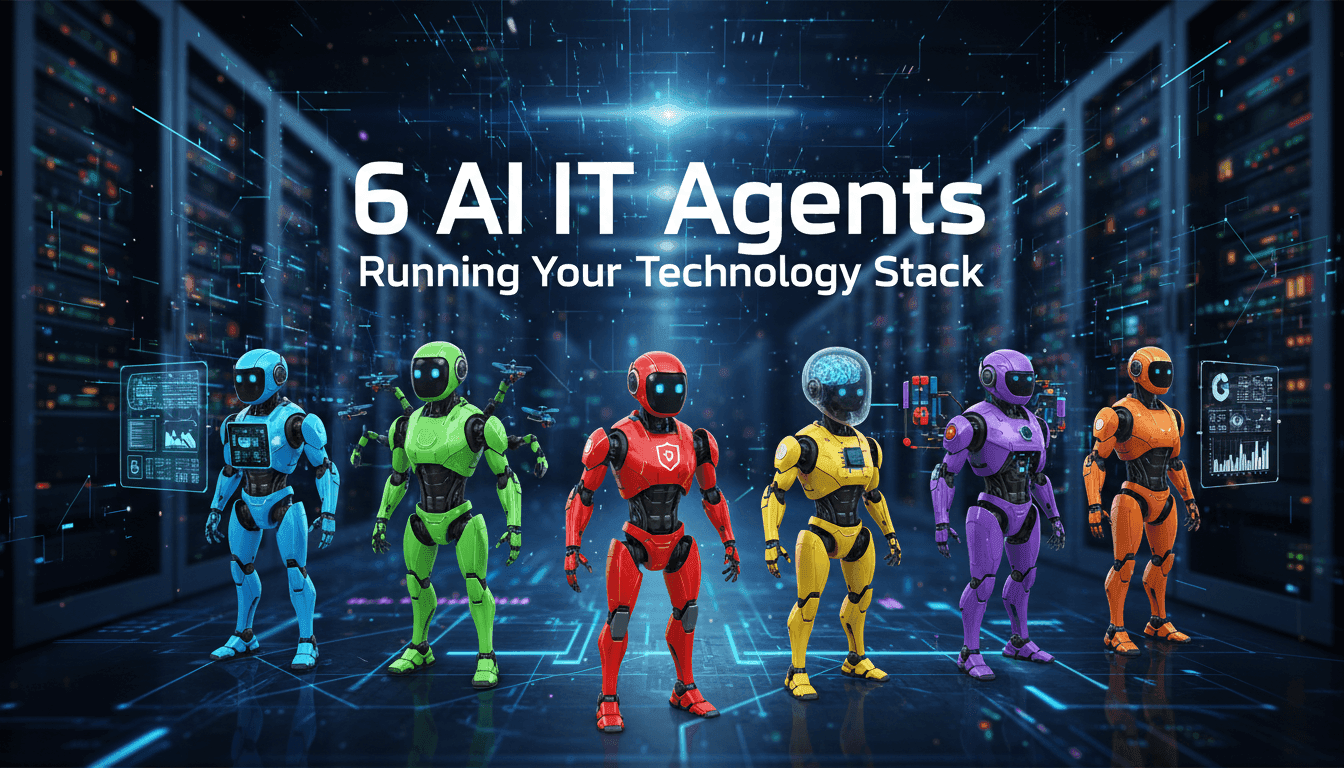
Table Of Contents
- The Shift from Automation to Agentic IT
- What Makes an IT System Truly Agentic?
- The 6 AI IT Agents Now Running Enterprise Technology Stacks
- The Real ROI Behind AI IT Agents
- What Business Leaders Must Get Right
- Turning AI IT Agents Into Competitive Advantage
Your IT department is running around the clock, but your technology stack is not. Tickets pile up overnight. Incidents escalate slowly. Developers spend hours debugging code that AI created in minutes. Security threats move faster than human analysts can respond. This is the operational tension that is quietly costing enterprise technology teams time, money, and competitive edge.
AI IT agents are changing this equation. Not incrementally — structurally. Unlike traditional automation tools that follow rigid scripts, agentic AI systems reason through problems, select actions autonomously, adapt based on feedback, and loop until a goal is achieved. They are, in practical terms, the difference between a rule-based bot and a tireless digital colleague who actually understands the system it is managing.
The numbers signal a rapid shift. According to a Google Cloud study, 52% of executives say their organisations have already deployed AI agents in production, with 74% reporting ROI within the first year. Gartner projects that by 2028, 33% of enterprise software applications will include agentic AI, enabling 15% of day-to-day work decisions to be made autonomously. The momentum is not theoretical — it is operational.
This article profiles six distinct AI IT agent types that are actively running enterprise technology stacks today. For each, we explain what it does, how it works within the broader stack, and what business leaders need to understand before deploying one.
The Shift from Automation to Agentic IT {#shift}
Enterprise IT teams have spent years building towards automation. They adopted cloud platforms, invested in DevOps pipelines, deployed AIOps monitoring dashboards, and rolled out workflow orchestration. Yet despite all of this, most organisations found that complete, multi-step automation remained elusive, with humans staying in the loop at nearly every stage.
The problem was not a lack of tooling or data. Traditional automation tools excel at executing defined, repeatable sequences. What they cannot do is reason. They cannot look at an ambiguous system state, weigh multiple possible causes, decide which diagnostic path to take, and then course-correct if the first path fails. That cognitive gap is where human engineers have remained irreplaceable — until now.
Agentic AI closes this gap by pairing large language models (LLMs) with persistent memory, tool access, and feedback loops. The result is a system that does not merely respond to input. It pursues a goal. According to CIO.com, agentic AI's reasoning and planning capabilities can handle tasks with little or no human intervention — not by following a fixed script, but by analysing a situation, deciding which action is appropriate, and then executing on it. This is why the enterprise IT landscape is shifting from automation tooling to agentic operations.
What Makes an IT System Truly Agentic? {#what-is-agentic}
The term 'agentic' has become something of a buzzword, applied liberally to everything from chatbots to workflow builders. A meaningful definition matters before your organisation invests.
An AI IT system becomes genuinely agentic when it meets four specific conditions. It operates with a goal, not just answering a question but moving toward an outcome. It chooses its own actions — selecting tools, steps, or decisions without direct prompting. It adapts based on feedback, using memory or results to change course when something does not work. And it runs in a loop, re-evaluating and re-running tasks until the goal is achieved or deliberately abandoned. As one analysis from Futuriom put it concisely: "If it just reacts to input, it's a function. If it decides what to do next, it's an agent."
This distinction matters operationally. A monitoring tool that alerts you to a CPU spike is not an agent. A system that detects the spike, correlates it against recent deployments, identifies the likely root cause, attempts a remediation action, verifies whether it worked, and escalates to a human only if it fails — that is an agent. The practical implication is significant: each of the six IT agent types below operates on this agentic principle, not simply the automation one.
If your team is still building the foundational AI literacy to evaluate these systems confidently, the Business+AI workshops and masterclasses are designed specifically to bridge that gap for business and technology leaders.
The 6 AI IT Agents Now Running Enterprise Technology Stacks {#six-agents}
1. The Incident Response Agent {#incident-response}
When a production system fails at 2 a.m., an on-call Site Reliability Engineer (SRE) faces a familiar ordeal. Information about the incident is scattered across logs, deployment pipelines, configuration histories, and multiple monitoring tools. Manually correlating telemetry from each source — while Slack fills with 'Is the site down?' messages — can take hours. Mean Time to Resolution (MTTR) climbs. Business impact compounds.
Incident response agents are purpose-built to handle exactly this scenario autonomously. AWS's DevOps Agent, for example, correlates data across monitoring tools and CI/CD systems, maps infrastructure topology, tracks recent deployments, and generates resolution recommendations when an alert fires. In a documented case, the agent worked through an API integration issue systematically — ruling out authentication as a cause, shifting investigation focus to container deployments, and tracing the root cause to a code regression in a new version that failed to handle an unrecognised database value — all without pulling engineers from an ongoing company hackathon.
The agent's value is not just speed. It is contextual depth. Traditional monitoring tells you what is happening. An incident response agent connects what happened to why it happened and what to do next — reducing MTTR from hours to minutes and freeing senior engineers for higher-value architectural work.
Key platforms: AWS DevOps Agent, PagerDuty, Datadog Bits AI SRE Agent, Dynatrace.
2. The IT Service Desk Agent {#service-desk}
The IT service desk is one of the highest-volume, most repetitive functions in any enterprise. Password resets, software installation requests, access provisioning, hardware troubleshooting — most of these interactions follow predictable patterns, yet they consume a disproportionate share of skilled IT staff time.
Service desk AI agents intercept these requests at the point of need, resolving them directly inside the tools employees already use — Slack, Microsoft Teams, and service portals — without requiring a traditional ticket to be raised at all. A McKinsey case study illustrates the scale of impact available: a multinational enterprise embedded agents across its IT service desk support model, aiming to reduce resolution times for approximately 450,000 tickets annually. The transformation resulted in up to 80% of requests being automated, 50% of service agent capacity being redeployed to higher-value activities, and a customer satisfaction score of 4.8 out of 5.
For business leaders, the service desk agent represents one of the fastest paths to measurable AI ROI, because the volume of interactions is high, the tasks are well-defined, and the agent operates entirely within existing communication infrastructure. The skill requirement for deployment is also lower than in infrastructure-heavy agent types, making it an ideal starting point for organisations building their agentic capabilities.
Key platforms: Moveworks (acquired by ServiceNow), Freshservice Freddy AI, Siit.
3. The DevOps & Deployment Agent {#devops}
Modern software delivery relies on CI/CD pipelines, containerised environments, automated testing, and infrastructure-as-code — an interconnected chain where a failure at any link can halt deployment entirely. DevOps and deployment agents sit inside this chain and act as autonomous SRE squad members: running builds, analysing failures, suggesting fixes, and executing safe auto-remediation.
These agents bring reasoning to tasks that previously required senior DevOps expertise to handle. MITRE, for example, developed internal AI agents for code repository management. According to CTO Charles Clancy, "the agent will download it, try to build it, and if it doesn't run, it'll fix the build scripts and code if necessary, check the code back into the repository, and flag it was done by an AI agent." This kind of closed-loop, documented autonomy is what distinguishes a deployment agent from a simple CI/CD script.
However, business leaders should note an important caution here. IBM research found that developers can spend significantly more time debugging AI-generated code — with one study showing nearly 20% longer resolution times when developers use AI tools on code issues. The most effective deployment agents are therefore not those with maximum autonomy, but those with the right governance controls: clear human escalation paths, AI gateway layers that enforce policy, and observability tools that track agent behaviour through every step of the pipeline.
Key platforms: DuploCloud, GitHub Copilot, AWS Kiro, LangGraph-based custom pipelines.
4. The Cloud Cost Optimisation Agent {#cloud-cost}
Cloud spending continues to climb as organisations scale AI workloads. For many enterprises, the gap between what they pay for cloud infrastructure and what they actually utilise represents a significant and largely invisible cost. Cloud cost optimisation agents operate as always-on financial analysts for your infrastructure, continuously monitoring usage patterns, identifying waste, right-sizing resources, and recommending — or in some configurations, autonomously executing — changes to reduce spend.
These agents analyse workload telemetry in real time, querying metrics and logs with natural-language reasoning rather than requiring engineers to navigate dashboards manually. Platforms like Datadog and Dynatrace now integrate LLMs directly into their monitoring layers, enabling teams to ask questions like 'Which queries are consuming the most database time?' or 'Which services are affected by the new release?' and receive contextual answers tied to actionable recommendations. This transforms cloud cost management from a periodic finance review exercise into a continuous, agent-driven operational discipline.
For IT and finance leaders, the business case is particularly clear. Cloud cost optimisation agents operate on infrastructure that already generates the telemetry they need. There is no significant new data infrastructure requirement, and the agent can begin identifying savings opportunities almost immediately after deployment, making it a strong candidate for early-stage agentic AI investment.
Key platforms: Datadog, Dynatrace, Spot.io, AWS Cost Explorer with AI integrations.
5. The Cybersecurity Agent {#cybersecurity}
Cybersecurity is perhaps the domain where the case for agentic AI is most self-evident — and most urgent. Threat actors operate continuously. They exploit vulnerabilities faster than any human security team can manually triage, investigate, and respond. The attack surface for modern enterprises has also expanded dramatically, with cloud-native architectures, distributed workforces, and the introduction of AI agent endpoints themselves creating new vectors.
Cybersecurity agents can autonomously detect, react to, and mitigate security threats in near real-time, reducing response times to potential attacks and enhancing overall security posture. Early adopters in Google Cloud's 2025 ROI of AI study were significantly more likely to report ROI from security operations specifically — 40% versus a 30% average across all organisations. Deutsche Telekom's RAN Guardian agent offers a real-world infrastructure example: operating across mobile network environments, agents actively monitor performance, assist in troubleshooting, and optimise solutions in response to network events and exceptional situations.
For business leaders, the critical governance question in cybersecurity is not whether to deploy AI agents, but how to ensure they remain auditable. AI agent security startups are seeing rapid momentum growth precisely because agents create new attack surfaces alongside the ones they defend. Governance frameworks, role-based access controls, and policy-enforced escalation chains are not optional add-ons — they are the foundational requirements for responsible deployment in this domain.
Key platforms: CrowdStrike Falcon, Microsoft Sentinel AI, Palo Alto XSIAM, Snyk (code security).
6. The Identity & Access Management Agent {#iam}
Managing user access across enterprise systems is one of the most time-consuming and error-prone functions in IT operations. Every new employee, role change, contractor onboarding, or application rollout generates a cascade of provisioning requests that require coordination across identity providers, HR systems, and individual application administrators. Done manually, this process is slow, inconsistently applied, and creates compliance risk.
Identity and access management (IAM) agents automate this complexity end to end. When an employee requests access to a system like Salesforce, the agent gathers the required details, validates the employee's eligibility, creates the necessary records, and closes the ticket — without human intervention at each step. Software installation requests are handled with the same logic: a request to install Zoom is interpreted, validated against policy, executed, and confirmed. The agent does not just route the request faster; it completes the entire workflow.
This agent type has particular value in regulated industries where access controls are both critical and heavily audited. By integrating with IAM platforms and enforcing role-based access controls from the outset, these agents reduce both the administrative overhead and the compliance risk that comes with manual, inconsistently applied provisioning processes.
Key platforms: Okta AI, Microsoft Entra, ServiceNow IAM, Moveworks.
The Real ROI Behind AI IT Agents {#roi}
Beyond the operational capabilities, business leaders evaluating AI IT agent investments will want to see financial validation. The evidence is accumulating.
According to a survey-based analysis, organisations project an average ROI of 171% from agentic AI deployments, with 62% of organisations anticipating exceeding 100% ROI on their investments. Among current adopters, 66% of companies report measurable value through increased productivity. These are not projections built on theoretical efficiency models — they are reported outcomes from organisations that have moved past pilot phase.
Enterprise-focused agentic AI is growing from $2.58 billion in 2024 to a projected $24.50 billion by 2030, representing a 46.2% compound annual growth rate. And according to Deloitte's 2026 State of AI in the Enterprise report, worker access to AI rose by 50% in 2025, with twice as many leaders as the previous year reporting transformative impact. The competitive gap between organisations deploying agents and those still deliberating is widening — not gradually, but sharply.
The most common failure mode, however, is not in deployment but in expectation-setting. A BCG 2025 study found that only 5% of companies have achieved AI value at scale, while 60% report no material returns despite substantial investment. The difference between the 5% and the 60% is rarely about technology choice. It comes down to data quality, governance frameworks, workflow redesign, and the organisational capability to manage autonomous systems responsibly. Deploying an agent without reimagining the workflow it operates within produces incremental gains at best.
For a deeper strategic discussion of how AI IT investments translate to enterprise business value, the Business+AI consulting team works directly with technology and business leaders on exactly this challenge.
What Business Leaders Must Get Right {#get-right}
Deploying AI IT agents is a strategic infrastructure decision, not a software procurement exercise. Several principles separate organisations that capture value from those that don't.
Start with one high-value, well-defined use case. The organisations achieving the strongest ROI from agentic AI are not deploying the most agents — they are taking one operational workflow to production first, proving the governance model, then scaling. The IT service desk is often the right starting point: high volume, measurable outcomes, and relatively contained risk.
Treat governance as a design requirement, not an afterthought. Only one in five companies currently has a mature governance model for autonomous AI agents, according to Deloitte. Agents that fail, hallucinate, or behave unpredictably create immediate business risk. Human escalation paths, audit trails, role-based access controls, and policy enforcement layers must be built into the deployment architecture from day one.
Measure what matters before you expand. Set clear success metrics — cycle time, error rate, escalations avoided, MTTR reduction — before expanding to additional use cases. These metrics create the evidence base for broader investment and help identify where agents need refinement before they operate at greater autonomy.
Invest in organisational capability alongside technology. The AI skills gap is identified as the biggest barrier to AI integration in enterprise, according to Deloitte's 2026 report. The most successful organisations invest 70% of their AI resources in people and processes, not just technology. This is why community-led learning environments matter — the Business+AI Forum brings together executives, consultants, and solution vendors to share exactly this kind of implementation knowledge.
Turning AI IT Agents Into Competitive Advantage {#competitive-advantage}
The six AI IT agents profiled above — incident response, service desk, DevOps and deployment, cloud cost optimisation, cybersecurity, and identity and access management — are not emerging concepts. They are in production at enterprises globally, delivering measurable reductions in MTTR, operating cost, and compliance risk. The question for business and technology leaders is no longer whether agentic AI will run enterprise technology stacks. It is how quickly your organisation will be among those running it well.
The organisations capturing the strongest returns share a common pattern: they commit to one use case, build governance into the foundation, invest in organisational capability, and scale from a position of proven results rather than untested ambition. The agentic era is not a future state to prepare for. For the 52% of enterprises that have already deployed AI agents in production, it is the operational reality they are working from today.
Building a sound strategy around AI IT agents requires more than technology selection. It requires business-level clarity on where autonomous systems create value, where human oversight remains essential, and how to govern the intersection of both. That is the work — and it is where the real competitive advantage is made.
Ready to turn AI IT agent strategy into business results?
Business+AI connects executives, consultants, and technology leaders across Southeast Asia who are navigating exactly this transition. Whether you are building your AI literacy, evaluating deployment strategies, or looking to learn from peers who have already done it, the Business+AI ecosystem offers the community, expertise, and structured learning to accelerate your journey.