
6 AI HR Agents Reshaping the Entire Employee Lifecycle: From Recruitment to Exit
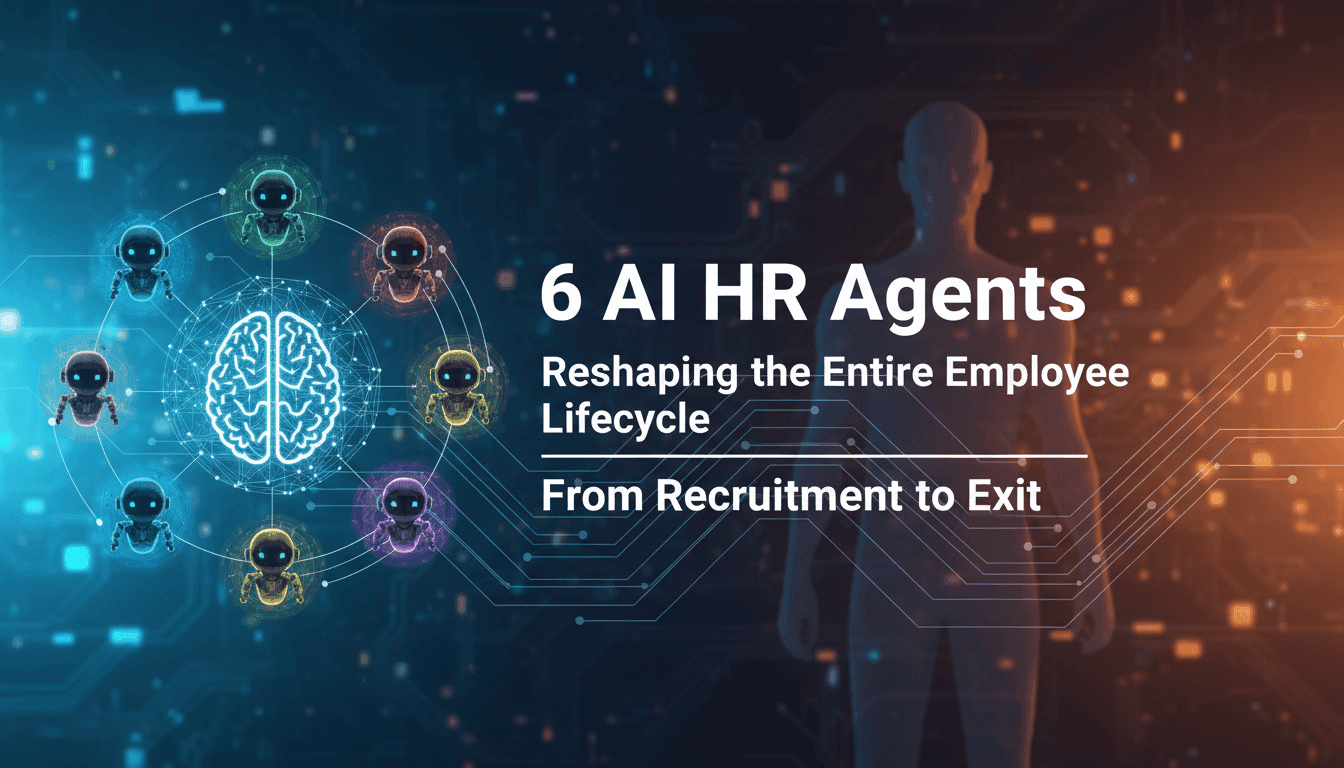
Table Of Contents
- Understanding AI HR Agents: Beyond Chatbots and Automation
- Recruitment Agent: Intelligent Talent Acquisition
- Onboarding Agent: Seamless New Hire Integration
- Learning & Development Agent: Personalized Employee Growth
- Performance Management Agent: Continuous Feedback and Improvement
- Employee Experience Agent: Proactive Engagement and Support
- Offboarding Agent: Strategic Exit Management
- Implementation Roadmap: Turning AI Talk Into Tangible HR Gains
Human resources departments stand at a pivotal crossroads. As organizations grapple with talent shortages, rising employee expectations, and the demand for data-driven decision-making, traditional HR approaches are showing their limitations. Enter AI HR agents—intelligent systems that don't just automate tasks but fundamentally reshape how organizations manage their most valuable asset: people.
Unlike conventional HR software that requires constant human intervention, AI agents operate with a degree of autonomy, learning from interactions, anticipating needs, and taking proactive actions across the employee lifecycle. They're transforming recruitment from a reactive screening process into predictive talent matching. They're evolving onboarding from paperwork management into personalized integration experiences. And they're converting performance reviews from annual rituals into continuous development conversations.
For executives and HR leaders navigating the intersection of artificial intelligence and people management, understanding these six AI HR agents isn't just about keeping pace with technology trends. It's about gaining competitive advantage in attracting, developing, and retaining talent in an increasingly complex business environment. This article examines how each agent addresses specific pain points across the employee journey, the business value they deliver, and practical considerations for implementation in your organization.
Understanding AI HR Agents: Beyond Chatbots and Automation {#understanding-ai-hr-agents}
Before examining specific applications, it's essential to understand what distinguishes AI HR agents from traditional HR technology. An AI agent isn't simply a chatbot that answers frequently asked questions or an automated workflow that routes approvals. It's an intelligent system that can perceive its environment, make decisions based on data and context, learn from outcomes, and take actions with minimal human supervision.
AI HR agents combine several technologies: natural language processing for understanding employee communications, machine learning for pattern recognition and prediction, and decision engines that apply organizational policies and best practices. What makes them transformative is their ability to operate across the entire employee lifecycle, creating connections between recruitment data, performance metrics, learning patterns, and engagement signals that would be impossible for HR teams to synthesize manually.
The business case for these agents extends beyond efficiency gains. Organizations implementing AI HR agents report improvements in time-to-hire, employee retention rates, learning completion percentages, and overall employee satisfaction scores. More importantly, they free HR professionals from administrative burdens, allowing them to focus on strategic initiatives and human-centered activities that truly require emotional intelligence and judgment.
For companies seeking to move from AI experimentation to measurable business outcomes, Business+AI's consulting services provide guidance on identifying which HR processes offer the highest ROI for AI augmentation.
Recruitment Agent: Intelligent Talent Acquisition {#recruitment-agent}
The recruitment agent represents perhaps the most mature application of AI in HR, yet its capabilities continue to evolve beyond basic resume screening. Modern recruitment agents analyze job requirements against candidate profiles with nuanced understanding of skills transferability, cultural fit indicators, and future potential rather than just keyword matching.
Advanced recruitment agents perform several critical functions: They source candidates from multiple channels including passive talent pools, analyzing not just stated qualifications but project contributions, peer recommendations, and learning trajectories. They conduct initial screening conversations that feel natural and conversational while systematically gathering information about candidate motivations, expectations, and circumstances that might affect job fit.
What distinguishes intelligent recruitment agents from earlier ATS (Applicant Tracking System) automation is their ability to reduce bias while improving match quality. By focusing on demonstrated capabilities and potential rather than pedigree signals like university names or previous employer brands, these agents surface candidates that traditional processes might overlook. They can identify patterns in your highest-performing employees and find candidates with similar success indicators.
The business impact is substantial. Organizations using AI recruitment agents typically see 40-60% reductions in time-to-hire, 30-50% decreases in cost-per-hire, and improvements in new hire performance ratings. Perhaps most significantly, they enable smaller HR teams to compete for talent at scale previously achievable only by large enterprises with extensive recruiting departments.
Implementation considerations include ensuring your job descriptions and success criteria are clearly defined, establishing feedback loops so the agent learns from hiring outcomes, and maintaining human oversight for final decisions. The agent's role is augmenting recruiter judgment, not replacing the human assessment of cultural fit and interpersonal dynamics.
Onboarding Agent: Seamless New Hire Integration {#onboarding-agent}
The critical first 90 days of employment often determine whether new hires become productive contributors or early departures. Onboarding agents transform this period from a checklist-driven administrative process into a personalized integration journey that adapts to each employee's role, learning pace, and needs.
An effective onboarding agent orchestrates multiple dimensions: It manages the administrative necessities like documentation, system access, and equipment provisioning, but goes far beyond logistics. It introduces new hires to relevant colleagues based on their role and projects, schedules informal coffee chats with team members who share interests or backgrounds, and surfaces relevant organizational knowledge at precisely the moments when context makes it meaningful.
The personalization capability matters enormously. A software engineer joining a development team receives different content, connections, and learning pathways than a sales representative joining a regional office. The onboarding agent recognizes these distinctions and adjusts accordingly, while also identifying when individuals need additional support or are progressing faster than typical timelines.
Proactive support represents another differentiator. Rather than waiting for new hires to get stuck or confused, onboarding agents anticipate questions based on timing and role patterns. When a new employee should be receiving their equipment or expecting access to certain systems, the agent checks status and alerts appropriate parties if things aren't on track. This proactive approach significantly reduces the frustration and disconnection that causes early turnover.
Organizations with AI-powered onboarding report 50% reductions in time-to-productivity, higher 90-day retention rates, and improved early engagement scores. New hires consistently cite feeling more supported and connected, despite much of the guidance coming from an intelligent agent rather than constant HR hand-holding.
For HR leaders looking to implement sophisticated onboarding experiences, Business+AI's workshops offer hands-on guidance in designing employee journeys that effectively blend AI automation with human touchpoints.
Learning & Development Agent: Personalized Employee Growth {#learning-development-agent}
Traditional learning management systems offer catalogs of courses that employees rarely complete and often find irrelevant to their actual development needs. Learning and development agents flip this paradigm by creating personalized learning journeys that adapt in real-time based on employee goals, performance gaps, career aspirations, and learning preferences.
These agents analyze multiple data sources to understand development needs: performance review feedback, project outcomes, skills assessments, career goals stated during development conversations, and even patterns in the work employees are doing daily. They identify skills gaps before they become performance issues and surface learning opportunities that align with both individual aspirations and organizational needs.
The delivery approach matters as much as content selection. Learning agents don't just assign courses; they curate diverse learning experiences including relevant articles, video content, peer mentoring connections, stretch project opportunities, and formal training. They space learning over time using evidence-based approaches that improve retention, send timely reminders that increase completion without becoming annoying, and adjust difficulty based on comprehension signals.
Career pathing integration elevates learning agents from training administrators to development partners. When an employee expresses interest in moving from individual contributor to management roles, the agent maps the skills gap, suggests relevant development activities, connects them with mentors who made similar transitions, and tracks progress toward readiness. This systemic approach to development was previously available only to high-potential employees with dedicated HR support.
The business outcomes include measurably improved skills acquisition, higher learning completion rates (often 3-4x traditional LMS completion), better internal mobility rates, and stronger retention of high performers who see clear development pathways. Organizations also report improved ability to close skills gaps through internal development rather than expensive external hiring.
Performance Management Agent: Continuous Feedback and Improvement {#performance-management-agent}
Annual performance reviews have long been recognized as inadequate for driving employee development and business performance, yet many organizations struggle to implement truly continuous performance management. Performance management agents make continuous feedback practical by reducing the administrative burden while improving the quality and timeliness of performance conversations.
These agents facilitate ongoing feedback loops by prompting managers and peers to provide input after project completions, significant interactions, or skill demonstrations rather than waiting months for formal review cycles. They synthesize feedback from multiple sources into coherent patterns that help employees understand their strengths and development areas without managers spending hours compiling input.
Goal tracking and alignment represents another critical function. Performance agents help employees set objectives that connect to team and organizational priorities, track progress automatically by integrating with project management and work systems, and alert both employees and managers when goals appear off-track or need adjustment based on changing business priorities.
Data-driven insights enhance management effectiveness. The agent identifies performance patterns across teams, flags potential issues like declining engagement or productivity before they become serious, and suggests interventions based on what's worked in similar situations. It might recommend additional training, workload adjustments, or specific conversations managers should have.
Crucially, performance agents address the consistency problem that plagues traditional reviews. By providing prompts and frameworks, they help reduce recency bias, ensure similar standards across different managers, and create documentation that supports fair compensation and promotion decisions. This consistency particularly matters for organizations concerned about equity and compliance.
Implementing performance management agents requires cultural readiness for continuous feedback and manager training on having more frequent performance conversations. Business+AI's masterclass programs help organizations develop both the technical implementation and change management strategies for successful adoption.
Employee Experience Agent: Proactive Engagement and Support {#employee-experience-agent}
Employee experience agents serve as always-available resources that support employees across diverse needs, from answering policy questions to facilitating workplace requests to identifying and addressing engagement risks. They represent the connective tissue that holds together various HR systems and processes from the employee perspective.
The breadth of employee experience agent capabilities includes immediate answers to HR policy questions without requiring employees to search knowledge bases or wait for HR responses, facilitating common requests like time-off approvals, schedule changes, or benefit updates through conversational interfaces, and routing complex issues to appropriate human HR specialists with full context so employees don't repeat their situations.
Beyond reactive support, these agents proactively monitor engagement signals including communication patterns, collaboration metrics, sentiment in feedback, and changes in work behavior that might indicate declining engagement or personal challenges. When patterns suggest an employee might be struggling or disengaging, the agent can alert managers or HR to intervene before the situation leads to performance issues or turnover.
Personalized communication improves the employee experience significantly. Rather than generic HR announcements, employee experience agents tailor communications based on relevance to specific individuals. A message about parental leave policies goes to employees likely to need that information soon. Benefit enrollment reminders include personalized recommendations based on individual circumstances. This targeting reduces information overload while ensuring employees receive guidance when it's actually useful.
The agent also facilitates peer connections and community building by identifying employees with shared interests or complementary skills, suggesting networking opportunities, and even organizing informal gatherings or employee resource group activities. This social dimension addresses the isolation that particularly affects remote and hybrid employees.
Organizations implementing employee experience agents report improved HR service delivery metrics, higher employee satisfaction scores, and earlier identification of retention risks. The 24/7 availability particularly benefits global organizations and shift workers who previously had limited access to HR support.
Offboarding Agent: Strategic Exit Management {#offboarding-agent}
Offboarding receives less attention than other lifecycle stages, yet how organizations manage departures significantly impacts employer brand, knowledge retention, legal compliance, and alumni relationships. Offboarding agents ensure consistent, professional exits while capturing valuable institutional knowledge and maintaining positive relationships.
Comprehensive offboarding orchestration includes managing the logistics of departure such as equipment return, system access revocation, and final compensation processing, but extends to knowledge transfer facilitation by scheduling handoff meetings, guiding documentation of responsibilities and relationships, and capturing expertise before it walks out the door.
Exit interviews conducted by AI agents often yield more candid feedback than conversations with HR staff, particularly when employees are leaving due to management or cultural issues. The agent asks consistent questions across all departures, identifies patterns in exit reasons that might indicate systemic problems, and provides aggregate insights without compromising individual confidentiality. This intelligence helps organizations address retention issues they might otherwise miss.
Alumni relationship management turns former employees into potential future assets. The offboarding agent maintains connections with departed employees, shares relevant updates about the organization, identifies opportunities for re-engagement as contractors or future boomerang employees, and even facilitates customer or partnership connections when appropriate. Leading companies recognize that former employees become brand ambassadors, talent sources, and business network connections.
Compliance protection represents a critical but less visible benefit. Offboarding agents ensure consistent process adherence that reduces legal risks, document necessary information for potential unemployment or discrimination claims, and ensure intellectual property and confidentiality obligations are clearly communicated and acknowledged.
The business value includes reduced legal and security risks from improper offboarding, preserved institutional knowledge that otherwise disappears with departing employees, actionable retention insights from exit interview patterns, and expanded talent networks through positive alumni relationships. Organizations investing in offboarding agents view departures not as endings but as relationship transitions.
Implementation Roadmap: Turning AI Talk Into Tangible HR Gains {#implementation-roadmap}
Understanding AI HR agents' capabilities matters little without practical implementation guidance. Organizations that successfully deploy these agents follow systematic approaches that address both technical integration and organizational change dimensions.
Start with strategic prioritization rather than attempting to implement all six agents simultaneously. Assess which employee lifecycle stages present the greatest pain points or opportunities in your organization. High-volume recruiting needs might prioritize recruitment agents. Retention challenges might emphasize employee experience or performance management agents. Quick wins build momentum and organizational confidence for broader implementation.
Data readiness often determines implementation success or failure. AI agents require quality data to deliver value, including consistent job descriptions and requirements data, historical hiring and performance information, up-to-date organizational structure and relationships, and integrated HR systems that allow data flow. Organizations should audit their data quality and integration before selecting specific agent solutions.
Vendor selection requires careful evaluation. The AI HR agent market includes established HR technology vendors adding AI capabilities, specialized AI startups with deep technical expertise but limited HR domain knowledge, and professional services firms offering custom development. Consider factors like integration capabilities with existing HR systems, customization flexibility for your specific processes, transparent AI logic that allows understanding of agent decisions, and vendor stability and implementation support.
Change management determines whether sophisticated technology delivers business value. Employees and managers need clear communication about agent roles and capabilities, training on how to interact with and leverage agents effectively, reassurance that agents augment rather than replace human HR support, and channels for feedback to continuously improve agent performance.
Measurement frameworks should be established before implementation, including baseline metrics on current process performance, specific targets for improvement (time-to-hire, retention rates, learning completion, etc.), user satisfaction and adoption metrics, and ROI calculations that consider both cost savings and value creation.
For organizations seeking structured guidance through AI implementation complexity, Business+AI's membership program provides access to implementation frameworks, vendor insights, and a community of executives navigating similar transformations. The Business+AI Forum also offers opportunities to learn from organizations further along their AI HR journeys.
Continuous improvement should be built into your approach. AI agents improve through learning from interactions and outcomes, so establish feedback mechanisms that capture what's working and what's not. Regular reviews with stakeholders help identify refinement opportunities. The goal isn't perfect implementation at launch but rather creating systems that become more effective over time.
Finally, maintain realistic expectations about timelines and impact. Most organizations see meaningful results from AI HR agents within 6-12 months of implementation, but reaching full potential typically requires 18-24 months as the agents learn from your specific organizational context and users develop proficiency in leveraging their capabilities. This timeline mirrors the broader reality that AI transformation is a journey requiring sustained commitment rather than a quick fix.
AI HR agents represent more than incremental improvements to existing HR processes. They fundamentally reshape how organizations attract, develop, engage, and transition talent throughout the employee lifecycle. From recruitment agents that identify hidden talent pools to offboarding agents that turn departures into strategic relationships, these intelligent systems address longstanding HR challenges while creating capabilities that weren't previously feasible.
The competitive implications extend beyond HR efficiency. Organizations that effectively implement AI HR agents gain advantages in talent acquisition, faster employee productivity, more effective development of internal capabilities, stronger retention of key talent, and data-driven people decisions that improve business outcomes. In talent-constrained markets, these advantages compound into significant competitive differentiation.
Yet realizing these benefits requires more than technology acquisition. It demands strategic thinking about which lifecycle stages offer the highest impact opportunities, data and integration readiness that allows agents to access necessary information, change management that brings employees and managers along the journey, and commitment to continuous improvement as agents learn and evolve.
For executives and HR leaders, the question isn't whether AI will transform people management but rather how quickly your organization will capture the advantages these technologies offer. The organizations moving decisively today will set new standards for talent management that laggards will struggle to match.
Ready to Transform Your HR Function with AI?
Moving from understanding AI HR agents to implementing them successfully requires expertise, frameworks, and peer insights. Join Business+AI's membership program to access implementation playbooks, connect with executives who've navigated similar transformations, and gain the practical guidance that turns AI possibilities into business results. Don't let your competition gain the talent advantage while your organization is still talking about AI potential.